
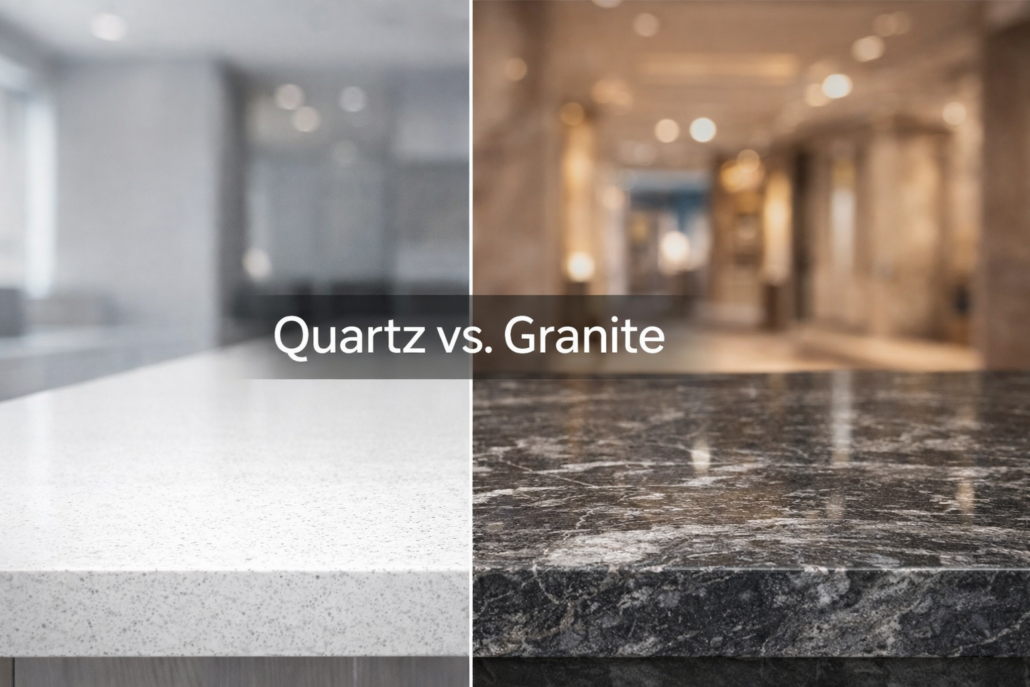
Quartz vs. Granite: Which is Best for Commercial Construction?
Quartz vs. Granite: Which is Best for Commercial Construction?
An experience-based comparison built specifically for commercial construction teams
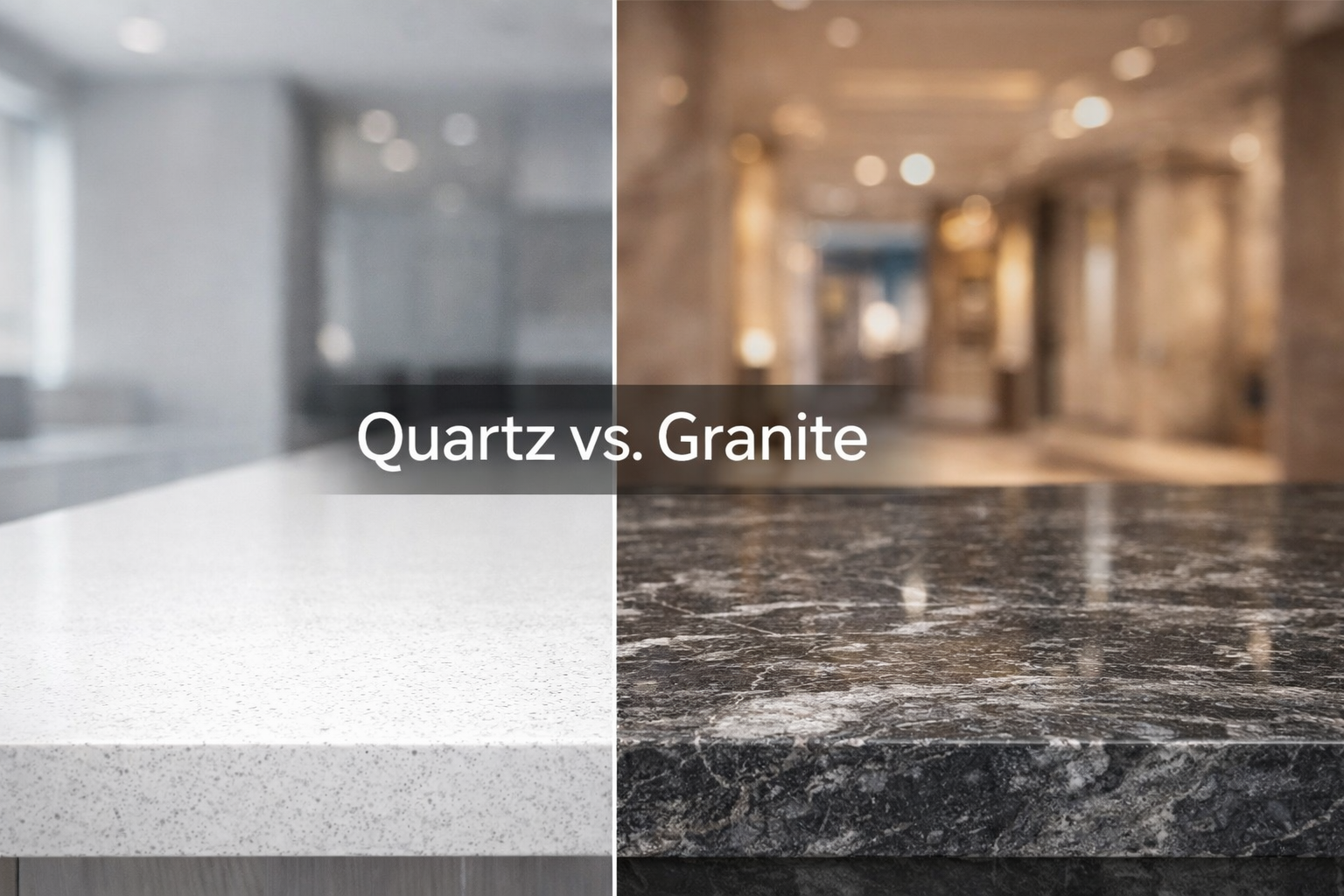
| Quartz vs. Granite — Executive Snapshot
• Quartz: Non-porous, zero sealing required, lower lifecycle maintenance cost • Granite: Natural prestige, heat-resistant, outdoor-ready • Quartz often delivers lower 10-year TCO in high-traffic commercial interiors • Granite performs strongly in low-traffic prestige and outdoor applications • Hybrid strategies — quartz back-of-house, granite front-of-house — increasingly common in U.S. commercial builds |
Here is a scenario that plays out on U.S. commercial projects every week.
A team picks granite. It fits the budget. It looks premium. Everyone signs off.
Twelve months later — the facilities manager is chasing a sealing contractor. The kitchen passed its health inspection by the skin of its teeth. And someone is now modeling what happens if they skip the next sealing cycle.
None of that is inevitable.
It is the result of a material decision made without a full picture of what each material demands over its lifecycle.
This guide gives you that picture — without the marketing spin and without the oversimplified verdict that one material is always better. Because it is not.
The right answer depends on where the material is going, how it will be maintained, and what your 10-year cost model looks like.
The Core Difference Nobody Explains Clearly
Granite is natural rock. Quarried from the earth. No two slabs are the same.
That uniqueness is part of its value in high-end commercial design. It signals permanence. Investment-grade construction.
It is also porous.
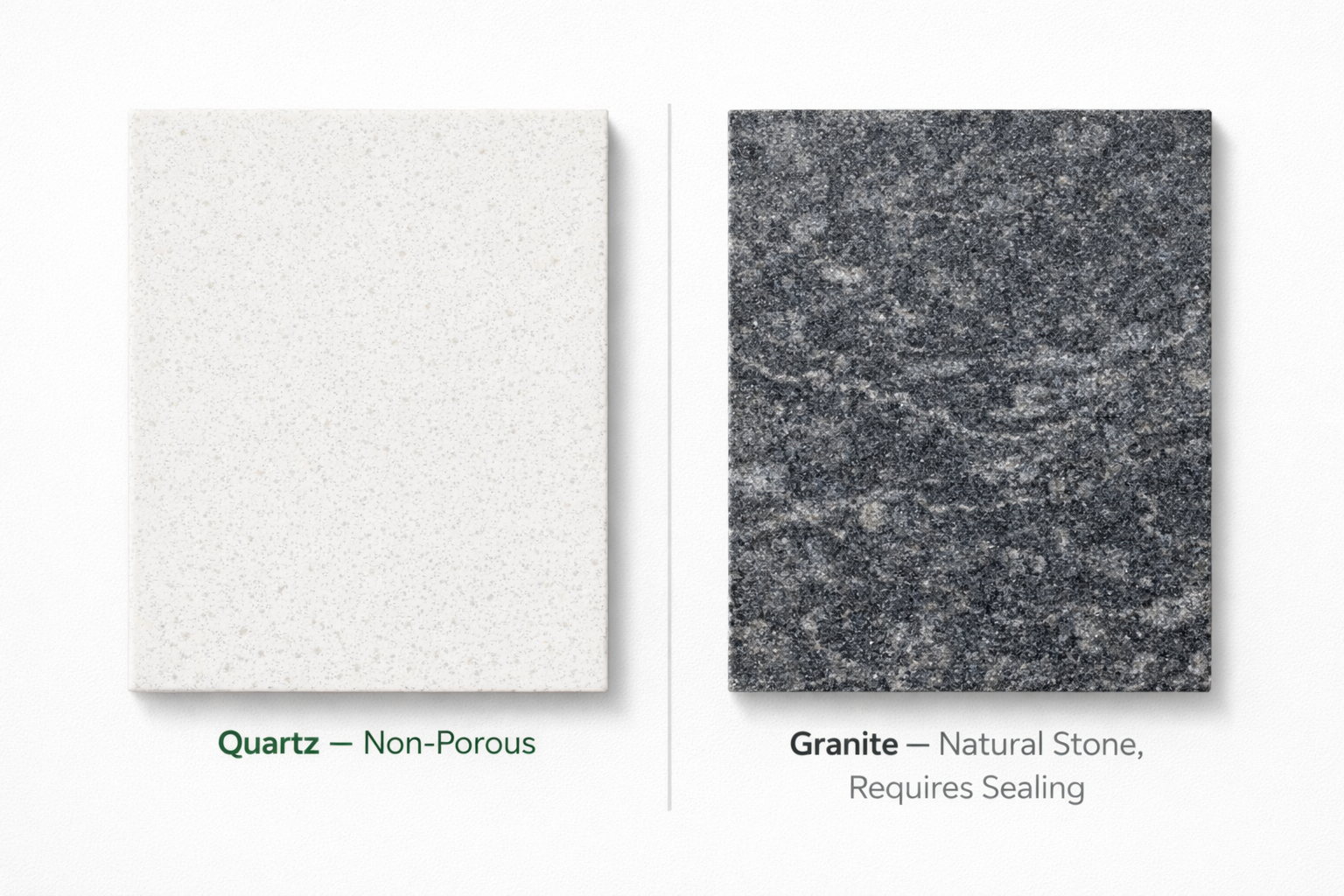
Without regular professional sealing, granite absorbs liquids, oils, and over time — bacteria. In a hotel lobby, that is a maintenance issue. In a commercial kitchen or healthcare facility, it is a compliance risk.
Quartz is engineered. 90 to 95 percent crushed natural quartz crystals, bound with polymer resin.
That process makes quartz non-porous, dimensionally consistent, and available in a much wider color range than natural stone.
What you give up: the organic uniqueness of granite.
What you gain: predictability. In supply, in appearance, and in maintenance.
Both materials rate 6 to 7 on the Mohs hardness scale. Scratch resistance is comparable in daily commercial use.
The real difference is not hardness.
It is porosity, maintenance dependency, and supply consistency at scale.
Quartz vs Granite Durability in Commercial Construction
Durability in commercial construction is not just about hardness ratings.
It is about how a surface holds up under daily commercial use — chemical cleaning, moisture, heat, and heavy contact — over 10 years.
For granite sealing in commercial buildings, the risk compounds over time. Miss one sealing cycle in a high-traffic environment and the surface absorbs contaminants that no amount of cleaning reverses.
Quartz holds its surface integrity without any sealing protocol. That makes it the lower-risk specification for natural stone procurement USA-based projects with strict facilities management constraints.
Granite wins on heat resistance and outdoor durability — no debate there. But in commercial surface specification for interiors, quartz durability is easier to guarantee over the asset lifecycle.
Where Each Material Actually Performs Best
The mistake most commercial buyers make: treating this as a binary choice.
Pick one. Apply it everywhere.
In practice, the specification decision should be made environment by environment.
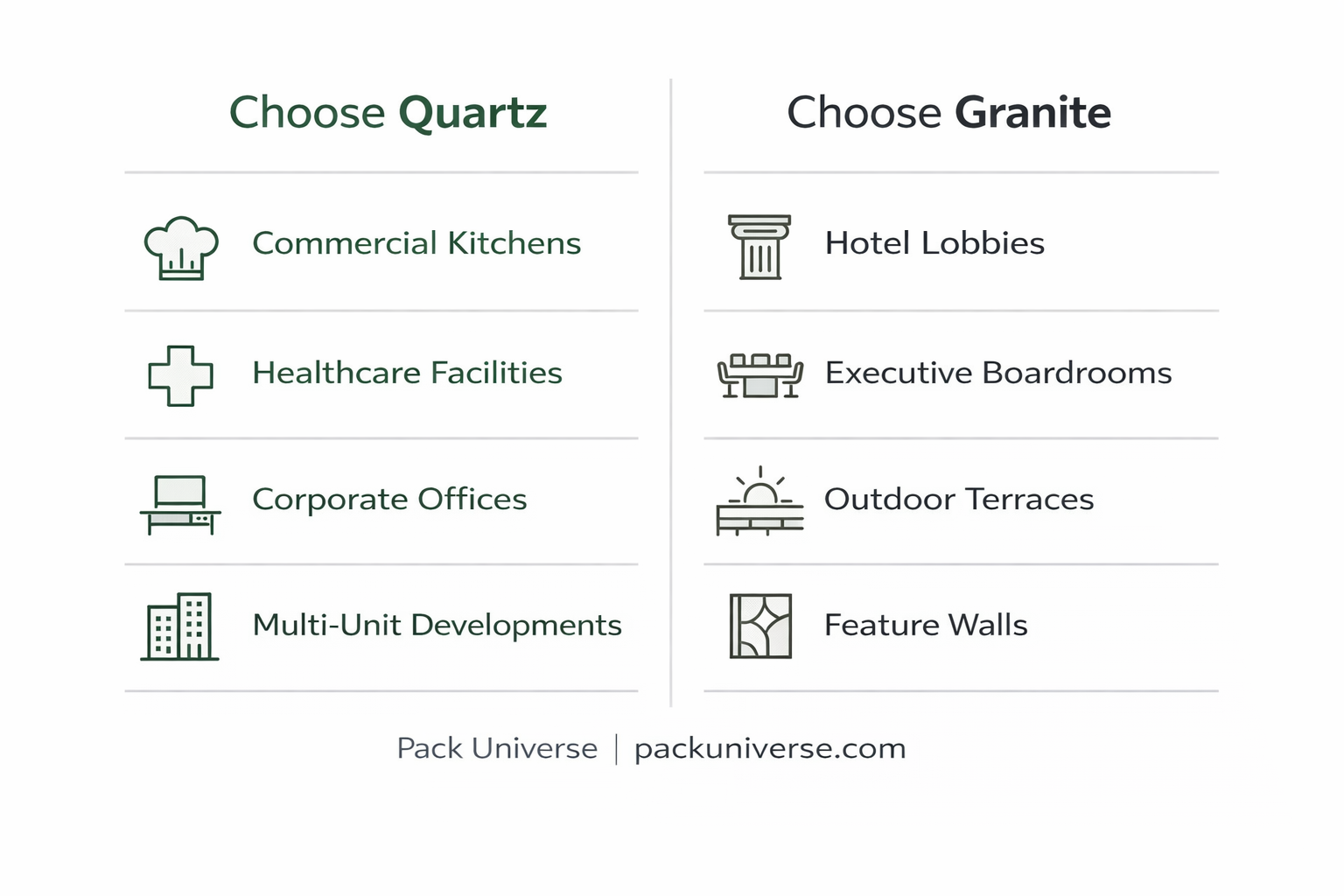
Quartz belongs in any environment where hygiene compliance, low maintenance, and commercial surface specification drive the decision.
Quartz for healthcare facilities, commercial kitchen countertop material, corporate offices, and multi-unit residential bathrooms — these are quartz environments.
The non-porous surface significantly reduces bacterial absorption. It eliminates sealing costs entirely. It can be matched consistently across hundreds of units without batch variation risk.
Granite belongs where design prestige, heat resistance, and natural material credentials drive the specification.
Hotel lobbies. Executive boardrooms. Outdoor terraces. High-end restaurant feature walls.
No engineered product fully replicates how natural stone signals quality to a guest or client walking in for the first time.
| Quartz | Granite | |
| Porosity | Non-porous | Porous — needs sealing |
| Sealing Required | Never | Every 12–24 months |
| Heat Resistance | Moderate | Excellent |
| UV / Outdoor Use | Not recommended | Yes |
| Batch Consistency | Excellent | Varies by slab |
| Aesthetic Quality | Consistent, wide range | Unique, natural variation |
| Best Application | BOH, healthcare, offices | Lobbies, outdoor, prestige |
Source: Natural Stone Institute | NAHB Research Center 2025
The Cost Comparison Most Guides Get Wrong
Most online comparisons quote material price per square foot and stop there.
For a homeowner, that is enough.
For a commercial buyer specifying 10,000 square feet — or modeling quartz vs granite cost USA across a multi-building development — it misses the most important number: total cost of ownership over the full asset lifecycle.
Real numbers. Conservative estimates.
Granite — 10,000 sq ft, mid-grade, installed at $80/sq ft:
- Installed cost: $800,000
- Sealing at $3/sq ft, every 2 years — 5 cycles over 10 years
- Sealing total: $150,000
- 10-year granite total: $950,000
Quartz — same project, mid-grade, installed at $90/sq ft:
- Installed cost: $900,000
- Sealing cost: $0 — not required
- 10-year quartz total: $900,000
| Conservative finding:
Quartz delivers approximately $50,000 in lifecycle savings on this project scale — assuming sealing every two years. That gap grows proportionally on larger developments. These are illustrative estimates. Always model your specific project costs before finalizing specification. |
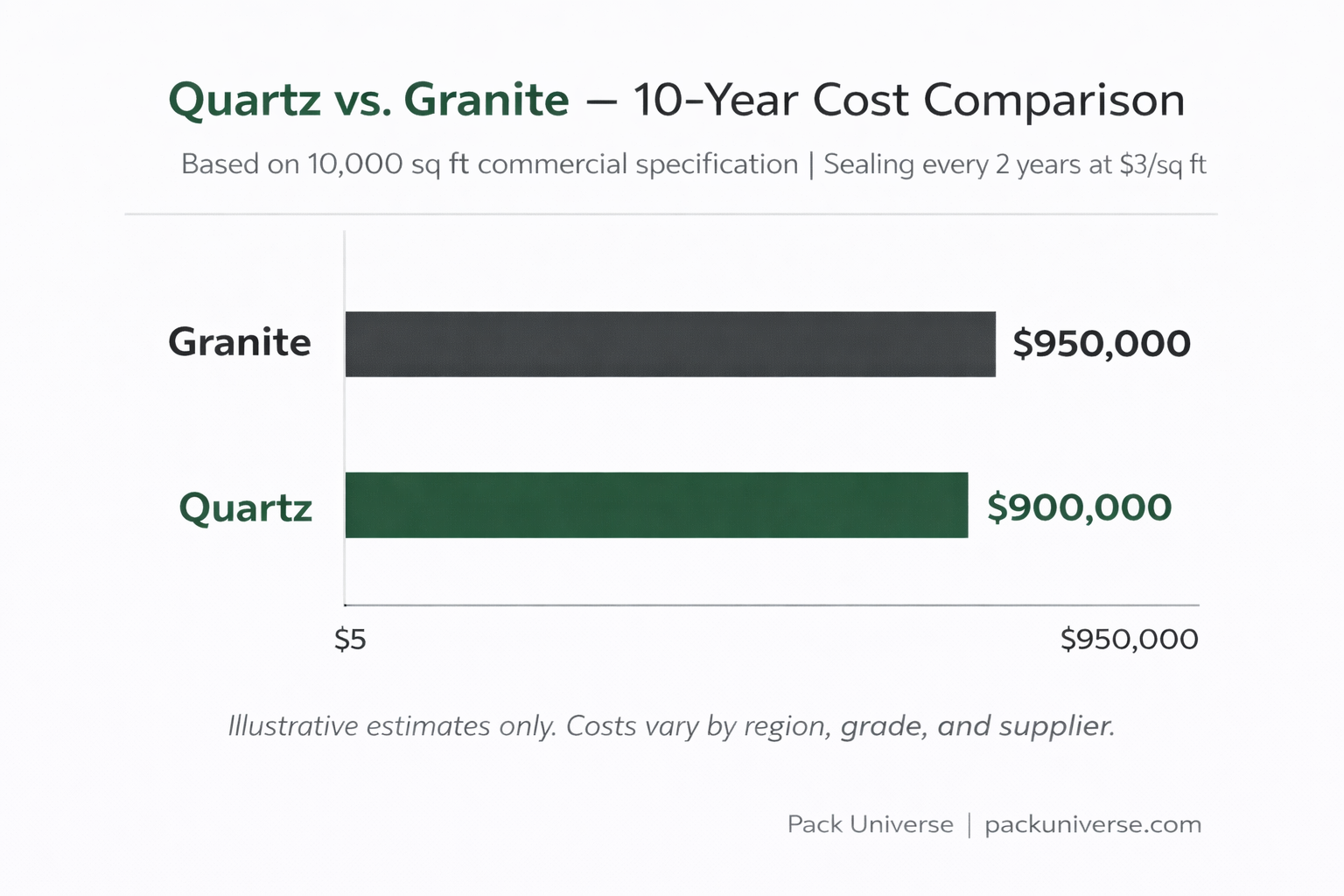
The upfront price difference — $10 per square foot — disappears within the first two sealing cycles.
On a large multi-unit development, that math compounds fast.
Factor in the labor cost and compliance risk of maintaining a sealing schedule across 200 units, and the TCO advantage of quartz becomes difficult to ignore.
That said, granite competes effectively on TCO in lower-traffic applications.
When sealing frequency drops — and the design premium granite commands increases lease rates or room rates — the return model can shift significantly.
The Strategy Most Buyers Miss: Use Both
Some of the most effective commercial specifications we have seen do not choose between quartz and granite.
They assign each material to the environment where it performs best — within the same project.
Quartz goes back-of-house.
Commercial kitchens, staff bathrooms, service corridors, utility areas.
Zero sealing cost. Hygienic surface. Easy to clean with standard commercial products.
Granite goes front-of-house.
Lobby reception desks, feature walls, executive dining surfaces, outdoor terraces.
Full design impact where guests and clients see it — with a formal maintenance protocol built into the facilities plan.
This hybrid approach optimizes both lifecycle cost and design quality.
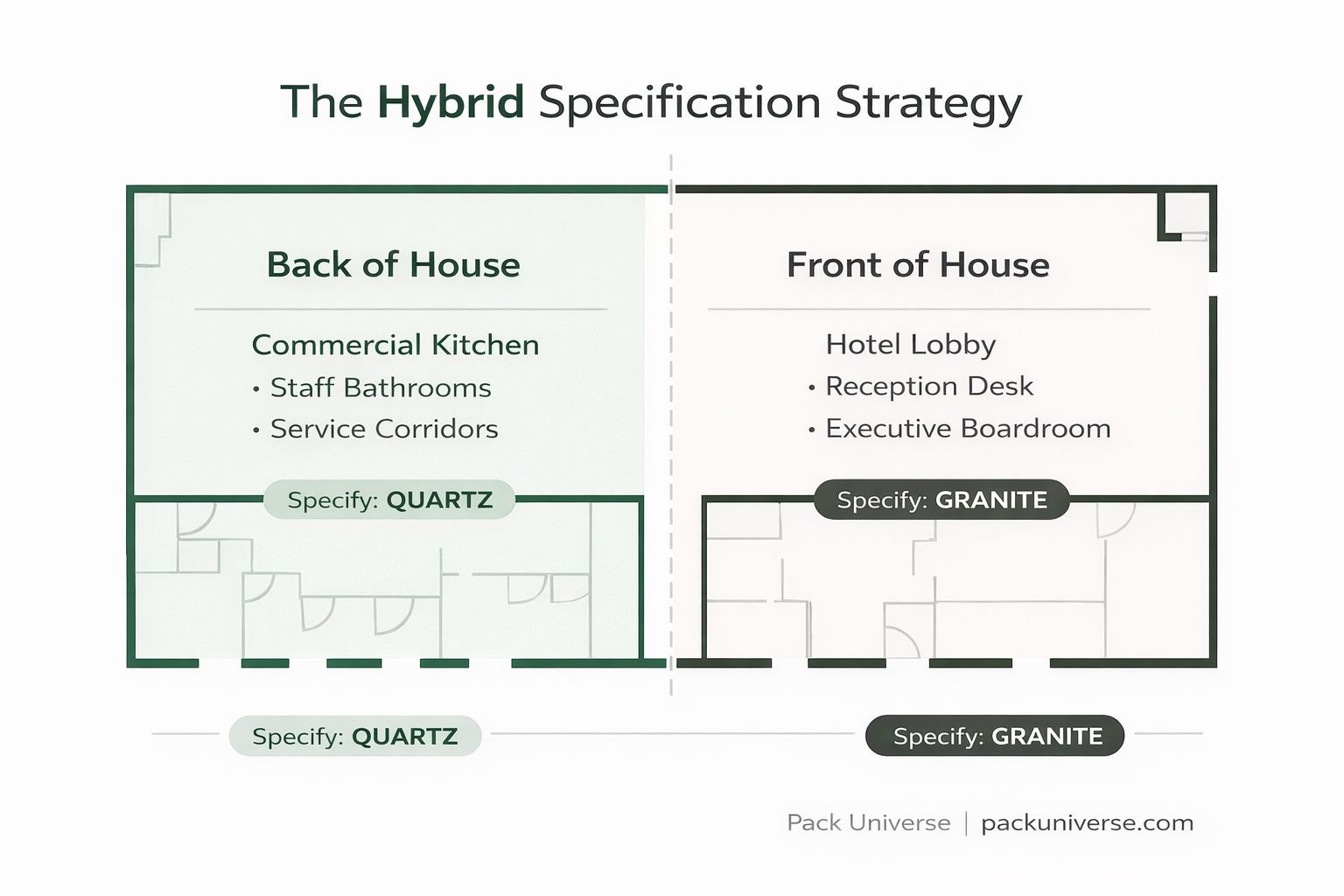
Without forcing a compromise across the full project.
It is worth modeling before defaulting to a single-material specification.
Before You Commit: Four Things to Verify With Any Supplier
Material choice is only half the decision.
The reliability of your supply chain — and the documentation your supplier provides — will affect your project timeline, your green building certification eligibility, and your warranty position if something goes wrong.
Before committing to any bulk surface material order, verify these four things:
- Grade specification in writing. Confirm the material grade matches your project requirements — not just what looks good in a showroom.
- Batch consistency guarantee. For granite especially, confirm your supplier can deliver matching material for your full project volume. A mismatch across 200 bathroom vanities mid-installation is an expensive problem.
- Environmental Product Declaration (EPD). Required for LEED v4 and WELL certification credit eligibility. Your supplier must provide a verified, ISO 14025-compliant EPD for the specific product being specified.
- NSF/ANSI 51 certification. Required for any surface material going into food-service or healthcare applications. Do not skip this step.
The Honest Verdict
Quartz vs. granite is not a contest.
It is a context decision.
Choose quartz when hygiene compliance, low maintenance, and 10-year TCO are the priority.
Choose granite when design prestige, heat resistance, and outdoor durability lead the specification.
Consider a hybrid approach when your project includes both maintenance-intensive and high-visibility prestige surfaces.
What always matters — regardless of material — is an honest 10-year cost model, a documented granite sealing commercial buildings protocol if granite is specified, and a natural stone procurement USA supply chain you can fully verify before contract execution.
| Work with Pack Universe:
Pack Universe serves commercial construction projects across the United States, supplying bulk quartz and granite to contractors, developers, and specification teams. We provide full documentation support including EPDs, grade specifications, and NSF certifications. Visit our wholesale quartz supply page, browse our commercial granite inventory, or request a bulk quote to discuss your project. |
Sources
Natural Stone Institute | USGBC LEED v4 Reference Guide | NSF International | NAHB Research Center 2025 | SCAQMD Rule 1168
About the Author
The Pack Universe editorial team brings over a decade of hands-on experience specifying quartz and granite for commercial construction, hospitality, healthcare, and multi-unit residential projects across the United States.
Pack Universe serves commercial and residential construction projects nationwide — supplying bulk quartz and granite to contractors, developers, and specification teams.
Disclaimer: Cost figures are illustrative estimates based on current U.S. commercial market data (2025) and should not be used as project-specific budgets. Actual costs vary by region, supplier, material grade, and project scale. Consult a qualified specification professional before finalizing material decisions.

