Is Quartz Better Than Granite for Commercial Construction? [2026]
Is quartz better than granite for building things for businesses? [Guide for Contractors in 2026]
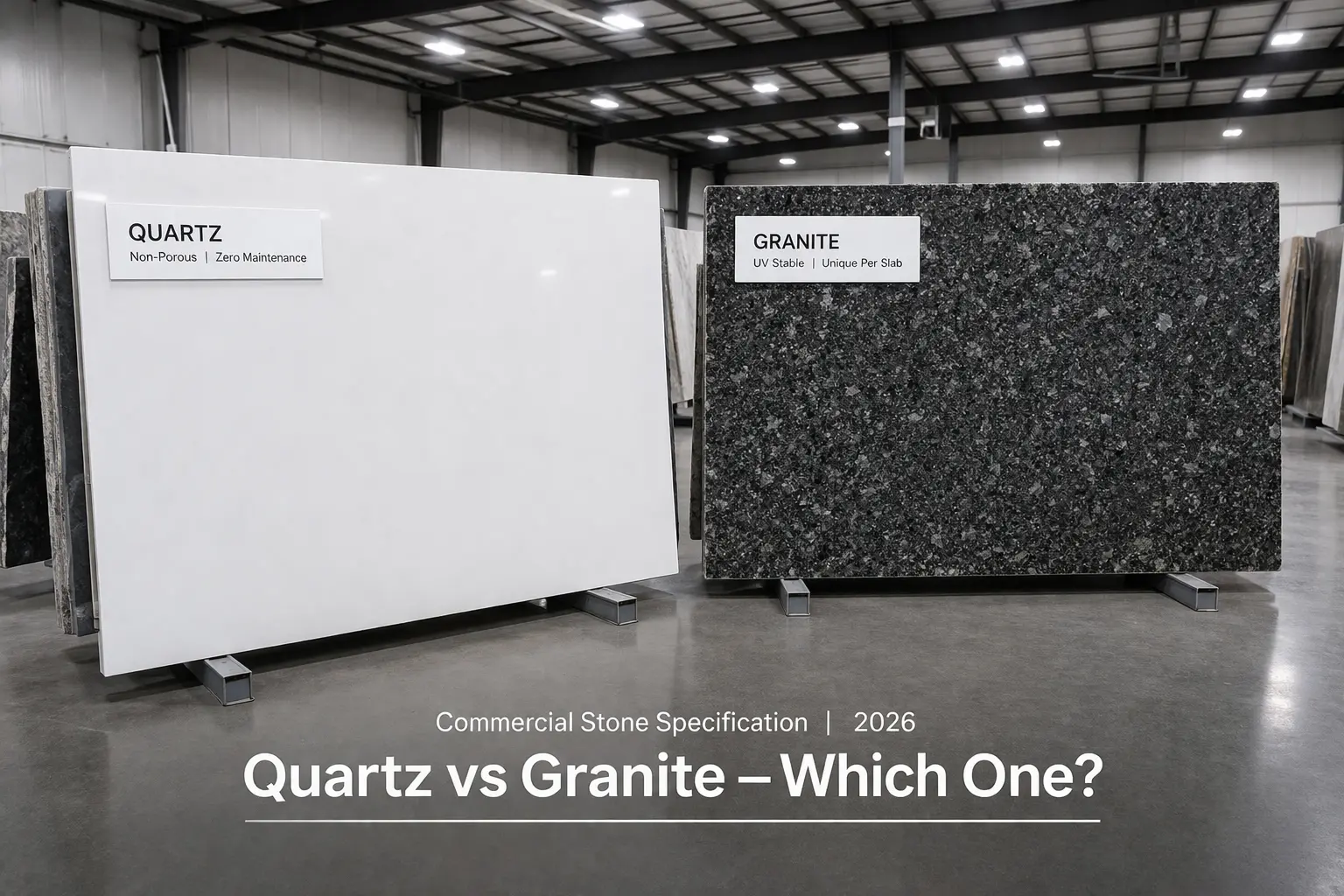
A direct comparison of quartz and granite for commercial construction projects in 2026, including porosity, maintenance, compliance with hygiene standards, color consistency, UV performance, and a full 12-application specification table. Information from NKBA, NSI, and ASHRAE. For builders, contractors, and commercial specifiers who want to buy a lot of stone at once.
| Is quartz better than granite for building things for businesses?
It depends on what you’re using it for, but for most indoor commercial surfaces, quartz is the better choice. Quartz is not porous, doesn’t need to be sealed, and has a consistent color across large orders. This is very important for commercial projects with multiple units. Granite is better than quartz in two situations: when you need to use it outside and when you need it to be heat-resistant. Here is the short version by type of application: • Commercial kitchens and food service: Quartz has a non-porous surface that meets food safety standards without needing to be sealed every year. • Hotel rooms and other areas where guests stay: Quartz—same color in every room, no upkeep needed by housekeeping. • Quartz for corporate offices and reception desks: the color is the same throughout the entire fit-out, and it lasts a long time with daily use. • Outdoor commercial kitchens and pool areas: only granite, because quartz resin breaks down when exposed to UV light outside. • Luxury lobbies and architectural feature surfaces: Level 3 granite or exotic granite. Engineered stone can’t copy the unique natural pattern. Pack Universe Supply has all grades of both stones in stock. They offer wholesale contractor prices and don’t require a minimum first order. Call +1 704-951-7822 or go to packuniversesupply.com/request-a-quote. |
More often than you might think, contractors get this question wrong, which costs them money on commercial projects.
The mistake is usually not picking the wrong stone right away. It means picking the same stone for every type of surface in a business project without checking to see if it’s the right material for each use. Quartz used outside in a kitchen. Granite in a hotel with 40 rooms where every countertop has to match. These are real mistakes in the specifications that show up during installation or, even worse, when the building owner first reviews the facility.
This guide answers the question of whether to use quartz or granite in commercial construction. It does not compare the two stones in general, but rather gives practical advice on which stone to use based on the type of project. The answer is different for each project, and knowing why it is different is what makes a contractor who quotes confidently different from one who has to go back to the architect three times.
External data from NKBA 2025, the Natural Stone Institute’s commercial specification guidelines, and ASHRAE’s building material performance data.
- What Makes Quartz Different from Granite in a Business Setting?
The most important difference between quartz and granite in commercial construction is not their hardness or appearance. It’s how porous they are and what that means for cleaning, upkeep, and the total cost of the building’s life.
Granite is very brittle, with a Mohs rating of 6 to 7, and quartz is very hard, with a Mohs rating of 7. Under normal commercial use, neither will scratch. Both need a polished finish, and you can get them in a wide range of colors and grades. If only durability were the issue, the answer would be a tie.
The main difference between them is how the surface changes over time and what the owner must do to maintain it.
What It Means That Quartz Is Not Porous
About 93% of quartz is made up of ground quartz crystals that are held together by polymer resin. This makes the surface completely non-porous, so bacteria, moisture, and staining agents can’t get through it. There is never a need to seal. A facility manager wipes it down, and that’s all there is to the maintenance program.
In a commercial building, like a hotel with 80 rooms, a restaurant chain with 12 locations, or a healthcare facility with strict hygiene standards, the fact that it doesn’t need any maintenance is a real operational and financial benefit that is taken into account when calculating the total cost of ownership. According to NKBA 2025 commercial specification research, facilities that used quartz countertops spent 23% less on annual stone surface maintenance than those that used natural stone.
If you’ve ever used granite in a rental or hospitality project that gets a lot of traffic, you know where this is going.
What it means that granite is porous in real life
Granite is porous, which means that it can soak up water, stains, and bacteria if it isn’t sealed properly. To keep the surface clean and stop it from getting stained, it needs to be resealed every year. This is doable in a home kitchen where the owner takes care of their own repairs. When the facility management team is in charge of 40, 80, or 200 stone surfaces in a commercial building, it becomes a line item in the maintenance program.
The Natural Stone Institute says that granite countertops in businesses should be resealed at least once a year, and every six months in food service and healthcare settings where hygiene is important. Every time the surface is resealed, it has to be taken out of use, treated, and then let cure. This adds up on a commercial scale.
| Quick answer:
You never have to seal quartz. Granite in a business setting needs to be sealed every 6 to 12 months, depending on the weather. That difference is big over the course of a building’s 10-year life. |
| Data from the industry:
The NKBA 2025 commercial specification research found that quartz countertops in businesses cost 23% less to maintain each year than natural granite countertops over a 5-year period. The Natural Stone Institute says that granite should be resealed every six months in places like restaurants and hospitals. In most business offices, the suggestion is once a year. Sources: NKBA Commercial Specification Survey 2025 (nkba.org) and Natural Stone Institute Commercial Guidelines (naturalstoneinstitute.org) |
| Keep this in mind:
If a facility team is in charge of maintenance costs and making sure the building is clean, quartz is almost always the cheaper option. |
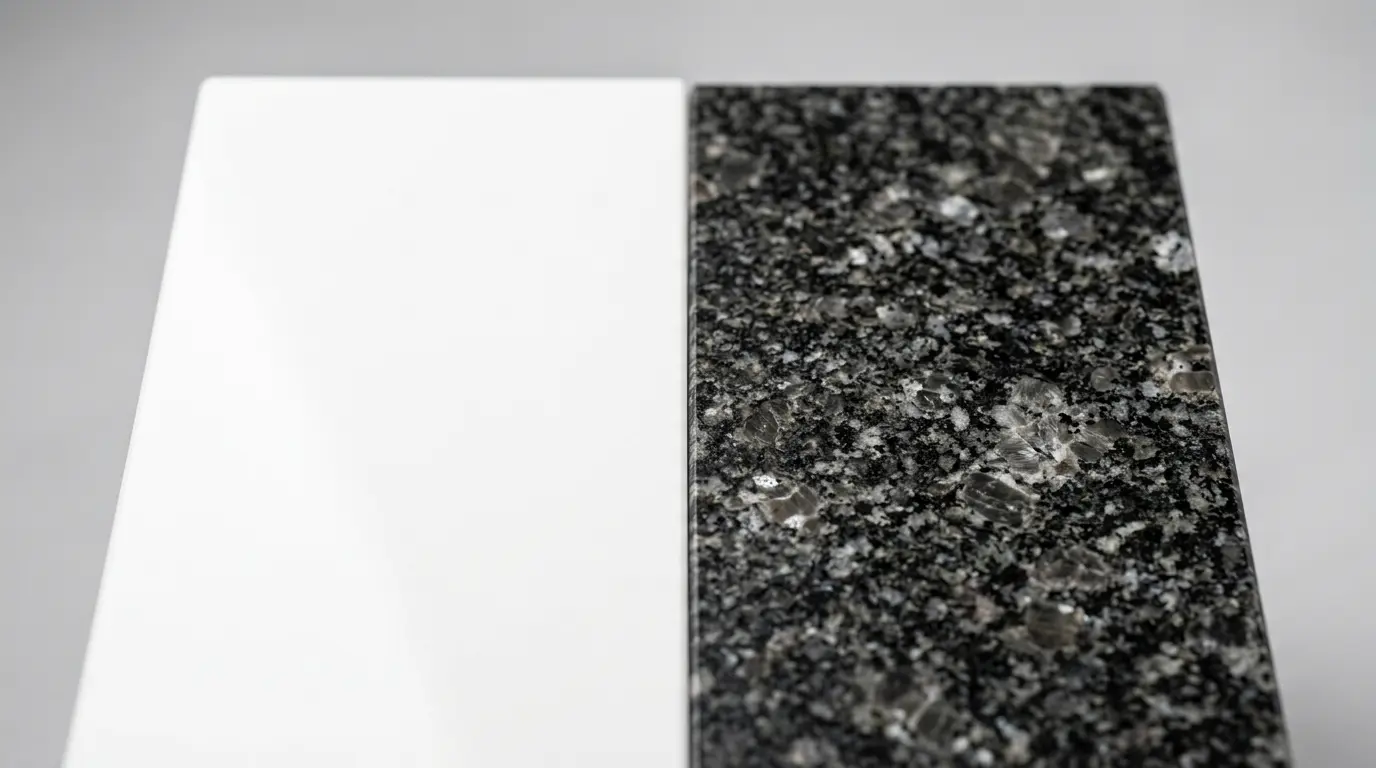
The table below compares all the important factors for commercial stone specification. You can scroll down or look at the picture above to see how the surfaces compare.
- Full Comparison of Quartz and Granite for Commercial Construction
We directly compare every crucial aspect of commercial stone specifications across 12 distinct areas.
Before you choose either material for a commercial project, look at the table below. The last column gives practical advice for how to use it in business, not a theoretical answer.
The table below lists all the important specifications for commercial construction, including porosity, hygiene, outdoor UV performance, and lot matching at scale.
| Factor | Quartz | Granite | Commercial Specification Guidance |
| Surface porosity | Non-porous — no sealing ever | Porous — annual sealing required | Quartz preferred for food service, healthcare, high-turnover rental |
| Hardness (Mohs) | 7 — very hard | 6–7 — very hard | Equal for all practical commercial applications |
| Heat resistance | Good — avoid prolonged direct heat | Excellent — direct heat safe | Granite for cooking environments. Quartz for all other commercial use. |
| UV / outdoor use | ❌ Not suitable outdoors | ✅ Full UV stability | Granite is the only choice for any outdoor commercial surface |
| Colour consistency | Consistent across batches | Varies — each slab unique | Quartz for multi-unit where all rooms must match. Granite for feature surfaces. |
| Maintenance requirement | Zero — wipe clean, no sealing | Annual sealing required | Quartz significantly reduces long-term facility maintenance cost |
| Hygiene compliance | Non-porous — meets food standards | Requires sealing for compliance | Quartz preferred in all regulated food and healthcare environments |
| Visual uniqueness | Consistent — engineered | Unique — no two slabs identical | Granite for luxury lobbies. Quartz for standardised commercial fit-outs. |
| Lot matching (bulk) | Reliable — same production batch | Difficult at Level 3 | Quartz for large multi-unit. Granite Level 1–2 manageable. Level 3 plan carefully. |
| Scratch resistance | Excellent — Mohs 7 | Excellent — Mohs 6–7 | Equal for commercial countertop and floor use |
| Edge profile options | Full range — 3cm recommended | Full range — all thicknesses | Both: specify 3cm for commercial countertops — thicker edge is the commercial standard |
| Long-term cost | Lower — no sealing maintenance | Moderate — sealing adds lifecycle cost | Quartz delivers lower total lifecycle cost on commercial projects over 10+ years |
The Natural Stone Institute’s commercial specification guidelines for 2025 are the source. Data from the NKBA contractor survey for 2025. ASHRAE data on how well building materials work.
| The short answer is:
Quartz is the best choice for a large commercial fit-out that needs to look the same color all the time. Engineered stone is made to a set color standard, but granite is not. |
| Do you need a bulk quote for your business project?
Let us know what kind of commercial project you have, how big it is, and where it is located. We’ll suggest the best stone and grade and give you a confirmed wholesale quote within two business hours. +1 704-951-7822 or packuniversesupply.com/request-a-quote |
- Where Granite Is the Right Commercial Specification
In three specific business situations, granite is better than quartz, and in these situations, choosing quartz is a real mistake.
This is something that needs to be clear. The comparison in Section 2 doesn’t mean that granite is the wrong stone; it just means that it’s not the right stone for some uses. Granite is not only acceptable for the three commercial uses listed below. That is the only right specification.
Outdoor Commercial Applications — The Non-Negotiable
You can’t use quartz outside. That’s it. When exposed to UV light, the polymer resin binder in engineered quartz breaks down, changing color, losing structural integrity, and developing a chalky surface in direct outdoor conditions within 1 to 3 years. There is no warranty from the manufacturer for outdoor quartz installation.
Granite is the only stone that works well for outdoor commercial uses like hotel pool surrounds, rooftop bar countertops, restaurant terrace surfaces, and corporate campus outdoor kitchens. Granite is a mineral that comes from the earth and is completely stable in UV light at all outdoor temperatures.
Most contractors are aware of this. But it still happens, usually because a client or architect asks for quartz to match the inside and no one fights back hard enough.
| ⚠ Real Risk — Real Result:
The risk is that quartz is specified for any outdoor commercial surface, even those that are covered or screened and only get indirect UV light. The result is that the surface will change color, the resin will break down, and the warranty will be voided in 1 to 3 years. If the client didn’t know about the specification, the contractor will have to pay for a full surface replacement. |
| Answer quickly:
Granite must be used for any commercial surface outside, whether it is covered or not. No exceptions. Quartz resin breaks down when exposed to UV light, whether directly or indirectly. |
Luxury Lobbies and Surfaces for Architectural Features
Quartz can’t give you true visual uniqueness, which is the one thing it can’t do. The fact that every quartz slab in a production run is made to match is what makes it a good business. But for a hotel lobby, a corporate headquarters reception desk, or the amenity floor of a high-end apartment building, the goal is often the opposite: a surface that is clearly one-of-a-kind.
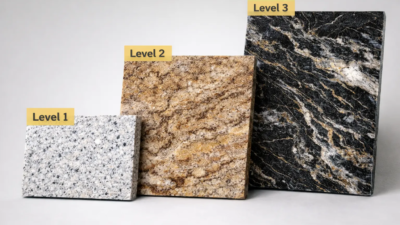
Level 3 exotic granite, like Blue Bahia, Cosmic Black, Juparana Fantasy, and Van Gogh, does this. Each slab is a one-of-a-kind geological event. No other hotel, office building, or development in the world has the same pattern. That level of detail is valuable to both the building owner and the people who stay there or rent it.
Environments with Direct Heat
Granite’s higher heat tolerance is a real benefit in commercial kitchens where surfaces are exposed to direct heat for long periods of time, such as when pans are placed directly on the surface or hot equipment comes into contact with the stone regularly. Quartz can handle moderate heat well, but the polymer resin part doesn’t handle heat as well as pure natural stone. For heavy-duty commercial kitchens where direct, long-term contact with heat is unavoidable, granite is the better choice.
| The one thing you need to remember
Is Surface outside? Only granite. Lobby with architectural features? Level 3 of granite. Direct heat that lasts? Granite. What else is inside? Quartz almost always wins when it comes to cleanliness, upkeep, and consistency. |
- Where Quartz Is the Right Commercial Specification
Most indoor commercial surfaces, like hospitality rooms, food service, healthcare, corporate offices, and rental developments, are best with quartz because it costs less over time and is easier to work with.
The answer goes back to the porosity question in Section 1 and how it affects maintenance, hygiene compliance, and the building owner’s experience with the surfaces they install.
The Consistency Argument for Multi-Room Hospitality Projects
At check-in, year one, and year five, all 80 bathroom vanities and 80 kitchenette countertops in a hotel with 80 rooms must look the same. This is what quartz does. The same color, the same production lot, and the same surface that doesn’t need any maintenance in every room.
Managing granite in 80 rooms is hard to do consistently, creates natural differences between rooms that some guests will notice, and needs an annual resealing program for all 160 stone surfaces. That isn’t just a theoretical problem; it’s a real cost of doing business that the building owner will take into account when deciding on the specifications.
It sounds like a little. Until you get a call from the hotel FM team asking why room 47 looks different from room 12.
Food Service and Healthcare: The Hygiene Argument
In commercial kitchens and hospitals, there are rules about the cleanliness of surfaces. Most US codes for food service and healthcare facilities say that a non-porous surface is either required or highly recommended. Quartz’s non-porous structure meets these standards without requiring the sealing maintenance that granite needs to maintain its hygiene performance.
ASHRAE and NSI say that porous materials need documented resealing schedules to stay in line with the rules for commercial food preparation surfaces. This is an ongoing compliance management burden for a restaurant or healthcare facility with a lot of turnover. A quartz specification eliminates it completely.
| Answer quickly:
Because quartz is not porous, it doesn’t need to be resealed as often as granite does in food service and healthcare settings, according to ASHRAE and NSI commercial guidelines. |
The Turnover Argument for Build-to-Rent and Co-Living
Rental surfaces can take a lot of damage. Tenants don’t care about keeping a surface clean because they don’t own it, cleaning is inconsistent, and when tenants move out, the surface gets cleaned with whatever product the cleaning team uses. Quartz can handle all of this without the risk of staining or sealing damage that granite has in a high-turnover environment.
For developers who build to rent or co-live and order stone for 50, 100, or 200 units, quartz Level 1 or Level 2 is the best choice because it lasts for 10 years without needing to be resealed or refinished like granite does.
| Answer quickly:
For buildings that are built to rent or for co-living, quartz Level 1 or 2 lasts for 10 years without needing to be sealed. In the same environment, granite needs to be resealed every 12 months and costs more to refinish over the life of the building. |
The table below lists 12 types of commercial projects and the stone that is best for each one, along with an explanation of why it is best.
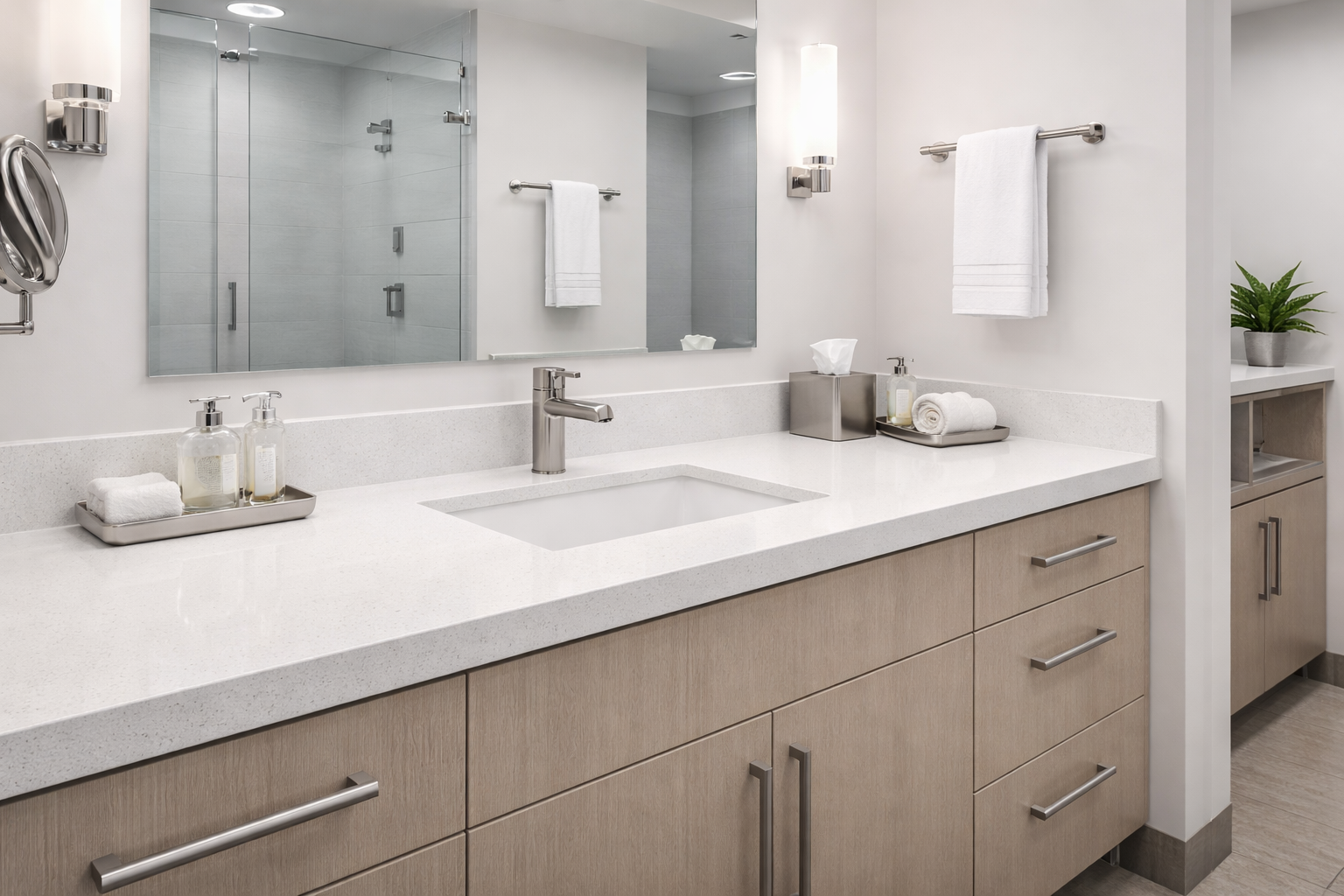
- Commercial Application Specification Guide: Use Quartz or Granite for Any Type of Project
The right stone for each type of major commercial use, along with the reasons for each recommendation and the grade and specification that go with it.
Before you place your next bulk order for commercial stone, use this table. The grade column shows the recommended wholesale grade. This is not the most expensive option, but the one that is best for the job.
| Commercial Application | Recommended Stone | Reason | Grade |
| Hotel rooms — standard countertops | Quartz | Consistent colour across all rooms. Zero maintenance for housekeeping. Non-porous in high-turnover use. | Level 2 |
| Hotel rooms — luxury / boutique | Quartz or Granite | Quartz Level 3 for zero maintenance. Granite Level 3 for unique visual impact in premium rooms. | Level 3 |
| Hotel lobby feature wall / floor | Granite | Natural uniqueness is the design intent. Every slab different — this is what makes luxury lobbies memorable. | Level 3 |
| Restaurant / café countertops | Quartz | Non-porous surface meets food hygiene standards. Heat-safe for service areas away from direct flame. | Level 1–2 |
| Commercial kitchen — food service | Quartz | Non-porous mandatory for food hygiene compliance. White or light grey for contamination visibility. | Level 1 |
| Healthcare facility surfaces | Quartz | Non-porous is a regulatory requirement in most healthcare environments. Zero harbour for bacteria. | Level 1 |
| Corporate office — reception desk | Quartz | Colour uniformity across the full fit-out. Professional neutral grey or white. Zero maintenance. | Level 2 |
| Corporate office — feature reception | Granite Level 3 | Dramatic exotic granite on a reception desk or wall makes a statement that quartz cannot replicate. | Level 3 |
| Retail interior — countertops | Quartz | Consistent colour across multiple locations in a retail rollout. Identical stone in every store. | Level 1–2 |
| Co-living / build-to-rent kitchens | Quartz | High turnover, minimal maintenance between tenants. Non-porous resists staining under daily rental use. | Level 1 |
| Outdoor commercial kitchen — pool/patio | Granite only | Quartz cannot be used outdoors. UV degrades resin. Granite is the only commercial outdoor stone. | Level 2 |
| Gym / fitness centre surfaces | Quartz | Non-porous resists cleaning chemicals. Consistent colour across multiple surfaces. | Level 1 |
Specifications based on NKBA commercial standards 2025, NSI installation guidelines, and Pack Universe Supply commercial contractor order data March 2026.
A lot of the confusion in commercial stone specification comes from using residential logic to solve commercial problems. They’re different briefs. The table above shows them in a different way.
| Answer quickly:
Using residential stone selection logic on a commercial project is the most common mistake people make when specifying stone for a business. Commercial specification is not just about how things look; it’s also about how much it costs to keep them clean, how well they meet hygiene standards, and how consistent the colors are across a large area. |
Pack Universe Supply takes care of this
Pack Universe Supply has all grades of quartz and granite in bulk for businesses. We ship from our warehouse in Charleston, SC.
For commercial projects that need lot-matched quartz in 20, 50, or 200 units, we check the production lot numbers before your order ships as a matter of course.
We also have granite levels 1 through 3 for commercial outdoor kitchens, fancy lobbies, and other surfaces that need to stand out.
If you’re not sure which specification is best for your business project, call +1 704-951-7822 before you order.
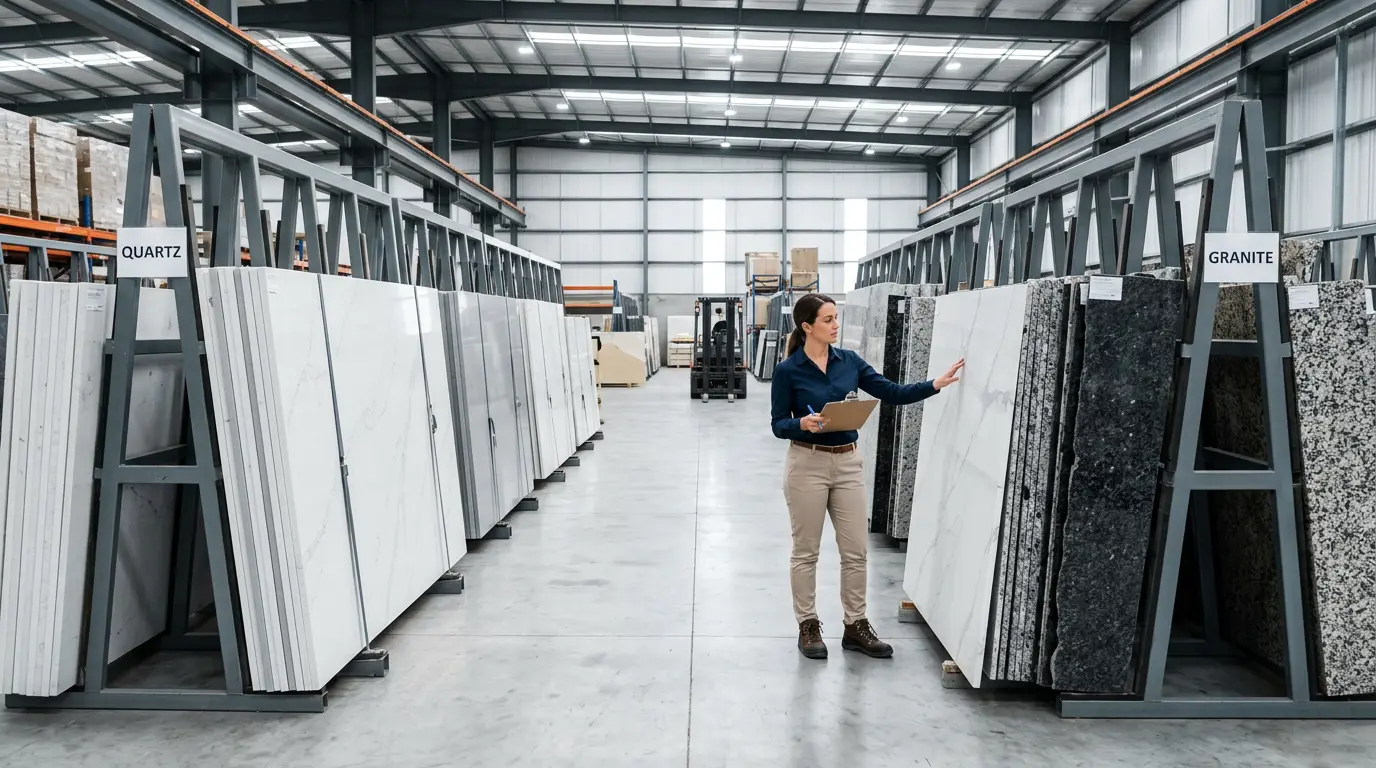
| Order Quartz or Granite in Bulk for Your Business Project:
All levels. All colors. Bulk orders that match lots. No minimum order for the first time. Charleston, SC (USA) | Burlington, ON (Canada) | Delivery across the country. → Get a Quote: packuniversesupply.com/request-a-quote → Call: +1 704-951-7822 (Monday through Friday, 8 am to 5 pm EST) → Canada: +1 (647) 362-1907 | WhatsApp: button at packuniversesupply.com |
| Verdict: Should you use quartz or granite for commercial construction?
The decision is: For most indoor business uses, quartz is the better choice because it is non-porous, requires no maintenance, stays the same color across large orders, and costs less over its lifetime. Granite is the right choice for three specific situations: any outdoor commercial surface (UV stability), luxury lobbies and architectural features where the goal is to be unique, and places where heat is direct and long-lasting. The error is treating this as a question of either/or for the whole project. Most commercial buildings need both quartz for the floors and walls of all the rooms and units, and granite for the feature surfaces where the extra maintenance is worth it because of the natural uniqueness. Don’t say what you want; say what you need. That is the difference between a commercial stone specification that the building owner likes in year one and one they are unsure about in year three. |
| Other Guides:
→ What kind of granite or quartz is best for my project? LINK: /blog/guide-for-granite-contractors-at-level-1-level-2-and-level-3 → What do contractors need to know about granite, quartz, and marble? LINK: /blog/granite-vs-quartz-vs-marble-contractors → What colors of quartz work best for countertops in commercial kitchens? LINK: /blog/best-wholesale-quartz-slab-colors-kitchen-countertops-2026 → What is the best way to find a trustworthy wholesale stone supplier in the US? LINK: /blog/how-to-find-reliable-wholesale-stone-supplier-usa → See all of our wholesale stone products at packuniversesupply.com/products |
About the Writer
Sam Micheale has 5 years of direct experience providing stone to commercial contractors, hospitality developers, and multi-unit residential builders in the Southeast USA and Canada. Pack Universe Supply has wholesale warehouses in Charleston, South Carolina, USA, and