
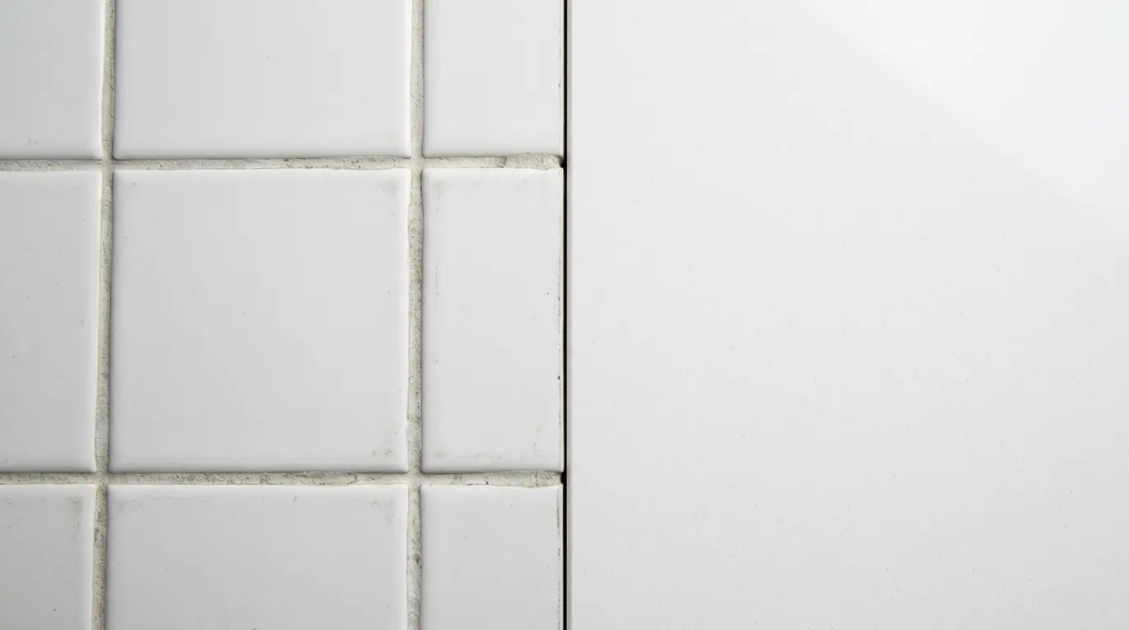
Why Commercial Contractors Are Moving Away from Ceramic Tile and Toward Quartz Surfaces [2026]
Why Commercial Contractors Are Moving Away from Ceramic Tile and Toward Quartz Surfaces [2026]
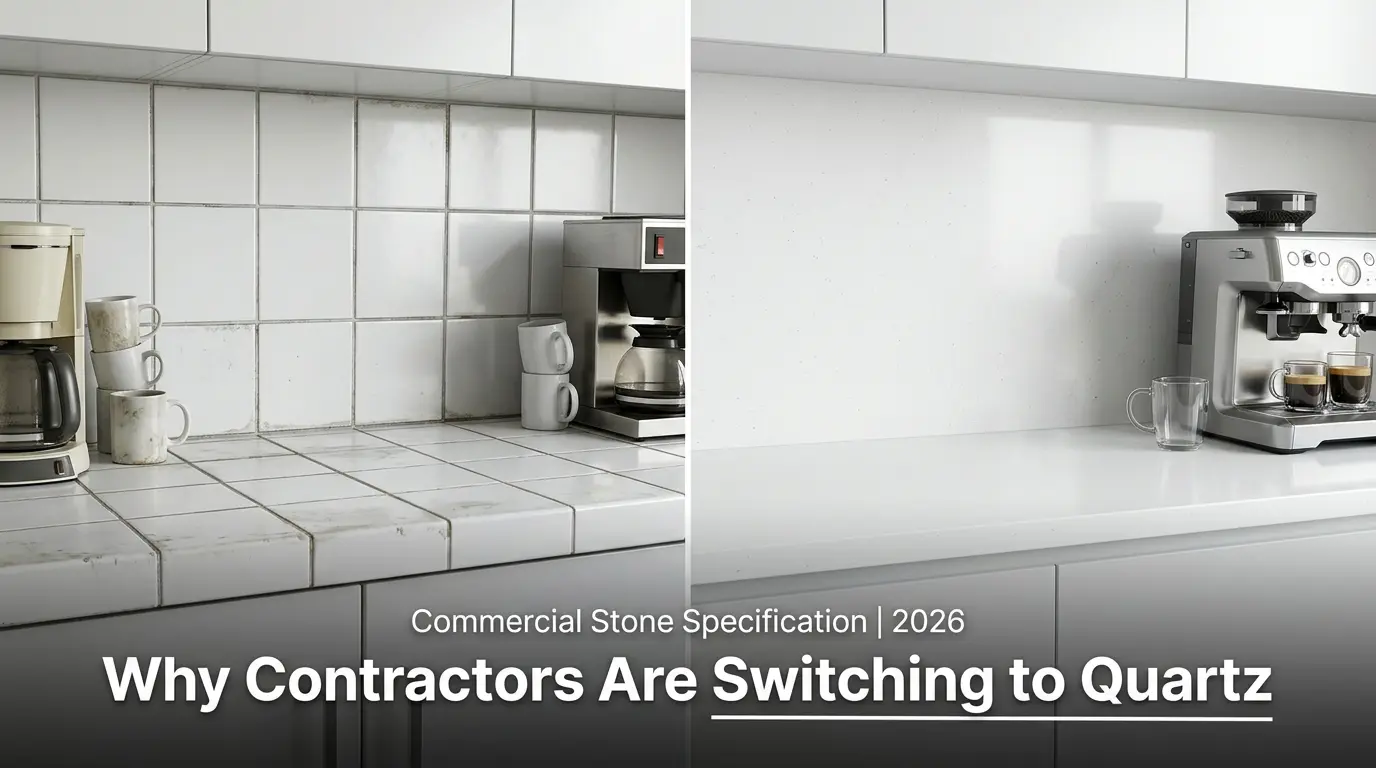
The full 2026 guide to why commercial contractors all over the US are switching from ceramic tile to quartz surfaces. It covers things like grout failure, hygiene compliance, lifecycle cost, installation speed, and an 8-application switch reference table. Throughout the guide, we utilize commercial guidelines from NKBA, NSI, and ASHRAE.
| Why are commercial builders moving from ceramic tile to quartz surfaces?
When maintenance, replacement, and grout failure are taken into account, quartz has better performance over the entire life of a commercial building and is now priced competitively with large-format ceramic tile. The change is happening in hotels, commercial kitchens, office fit-outs, hospitals, and stores. Here are five reasons why contractors are switching: No grout lines: Grout in businesses holds bacteria, stains permanently, and breaks down in 5 to 7 years. Quartz is a smooth, single surface. No maintenance: Quartz doesn’t need to be sealed, regrouted, or cleaned every year. Wipe it down and you’re done. Hygiene compliance: A non-porous surface meets the hygiene standards for commercial food service and healthcare that grouted tile can’t always meet. Building owners and tenants are starting to expect stone surfaces instead of tile. Quartz gives you a high-end look at a low price. Cost over the life of the product: When you factor in the costs of maintaining grout, replacing tiles, and tiles cracking, quartz consistently beats tile over a ten-year period. Pack Universe Supply has quartz in all grades and colors. They offer wholesale prices for contractors, and there is no minimum order. Call +1 704-951-7822 or go to packuniversesupply.com/request-a-quote to get a quote. |
It’s not a trend for commercial builders to switch from ceramic tile to quartz. It is a specification change that has been in the works for ten years and has now reached a breaking point.
Since the 1980s, ceramic tile has been the standard commercial surface for kitchen installations, countertops, vanity tops, and bar tops. It was strong, cheap, and easy to find. It still is. But what’s different now is that people are being honest about how much ceramic tile costs over the entire life of a commercial building, not just when it is put in place.
The grout lines that make tile easy to install are also what makes it a long-term problem in businesses. They hold bacteria in places where food is served. In hotel bathrooms, they leave permanent stains. In busy commercial kitchens, they don’t hold up structurally. They need regular maintenance, which adds real costs to the budgets of all facility managers. And they look old-fashioned, which is becoming more important for building owners who want to rent out space and hotel operators who want to attract guests.
This guide goes into detail about why the switch is happening, what the data says about the comparative lifecycle cost, which commercial uses will see the most switching in 2026, and what contractors need to know when ordering quartz in bulk for commercial projects. Data from outside sources like NKBA, NSI, and ASHRAE.
- The Grout Problem: Why Tile Doesn’t Work in Businesses
Grout is the biggest problem with ceramic tile in commercial construction, and most contractors don’t realize how quickly it becomes one.
It’s easy to take care of grout in a home kitchen. The homeowner cleans it once a year, seals it, and lives with the gradual fading that comes with daily use. In a business setting, like a restaurant that serves 200 people a day, a hotel with 80 bathrooms that are cleaned every two to three days, or a food service facility that is checked for cleanliness on a regular basis, grout becomes a real problem within the first two to three years.
Staining Grout in Hotels and Restaurants
One of the most common complaints about hotel facilities is the grout in the bathrooms. Over time, soap scum, cleaning chemicals, hair dye, cosmetics, and cleaning cycles with commercial-grade disinfectants all affect tile grout. They change its color, break down its sealant, and make it look like new again, no matter what product is used.
A 2024 Hospitality Facilities Management survey found that 67% of hotel property managers said that tile grout changed color and failed as a maintenance issue within three years of being installed in bathrooms that received housekeeping service twice a day.
If you’ve ever managed a hotel renovation and had to regrout the bathrooms after three years, you already know how much this costs on a large scale.
| Answer quickly:
Grout in a public bathroom that gets cleaned twice a day usually starts to change color and lose its seal within 2 to 3 years. This failure mode doesn’t exist because quartz doesn’t have grout lines. |
Food Service Grout and Hygiene Compliance
Grout lines are not only an eyesore in commercial kitchens; they also pose a health risk. Unsupported or degraded grout is porous, which means it can hold bacteria and make it hard to clean with normal methods. The Natural Stone Institute and ASHRAE commercial hygiene guidelines both say that grouted tile surfaces need to have documented resealing programs in order to stay in compliance in places where food is prepared.
Health inspectors are more and more likely to flag bad tile grout as a reason to give a citation in commercial kitchens. Usually, contractors and building owners who have had a food hygiene inspection where the condition of the grout was brought up don’t ask for grouted tile for the next commercial kitchen project.
Data from the Industry:
A 2024 Hospitality Facilities Management survey found that 67% of hotel property managers said that tile grout discoloration was a maintenance problem within three years of installation in bathrooms that get a lot of use.
According to ASHRAE’s guidelines for commercial buildings, grouted porous surfaces need documented maintenance plans to keep food preparation areas clean and safe.
The Natural Stone Institute says that quartz is the best surface for commercial kitchens where non-porous hygiene performance is a must.
Sources: The 2024 Hospitality Facilities Management Survey, the ASHRAE Commercial Guidelines (ashrae.org), and the NSI Commercial Specification Guidelines (naturalstoneinstitute.org)
| ⚠ Real Risk — Real Result:
The risk is that you specify grouted ceramic tile for a business that serves food or a healthcare setting without a written plan for resealing the grout. As a result, food hygiene or facility compliance inspections will flag degraded grout as a place where bacteria can grow, which means that the surface needs to be replaced, not just resealed, once the grout’s structural integrity is compromised. |
| Keep this in mind:
In commercial settings, grout failure is not a question of if, but when. Before telling a contractor what kind of tile to use, they should not ask, “How much does it cost to install?”But “what does it cost to keep and replace over 10 years?”‘ The table below compares every factor that matters when deciding between tile and quartz in commercial construction. |
Pay special attention to the row for the 10-year lifecycle cost:
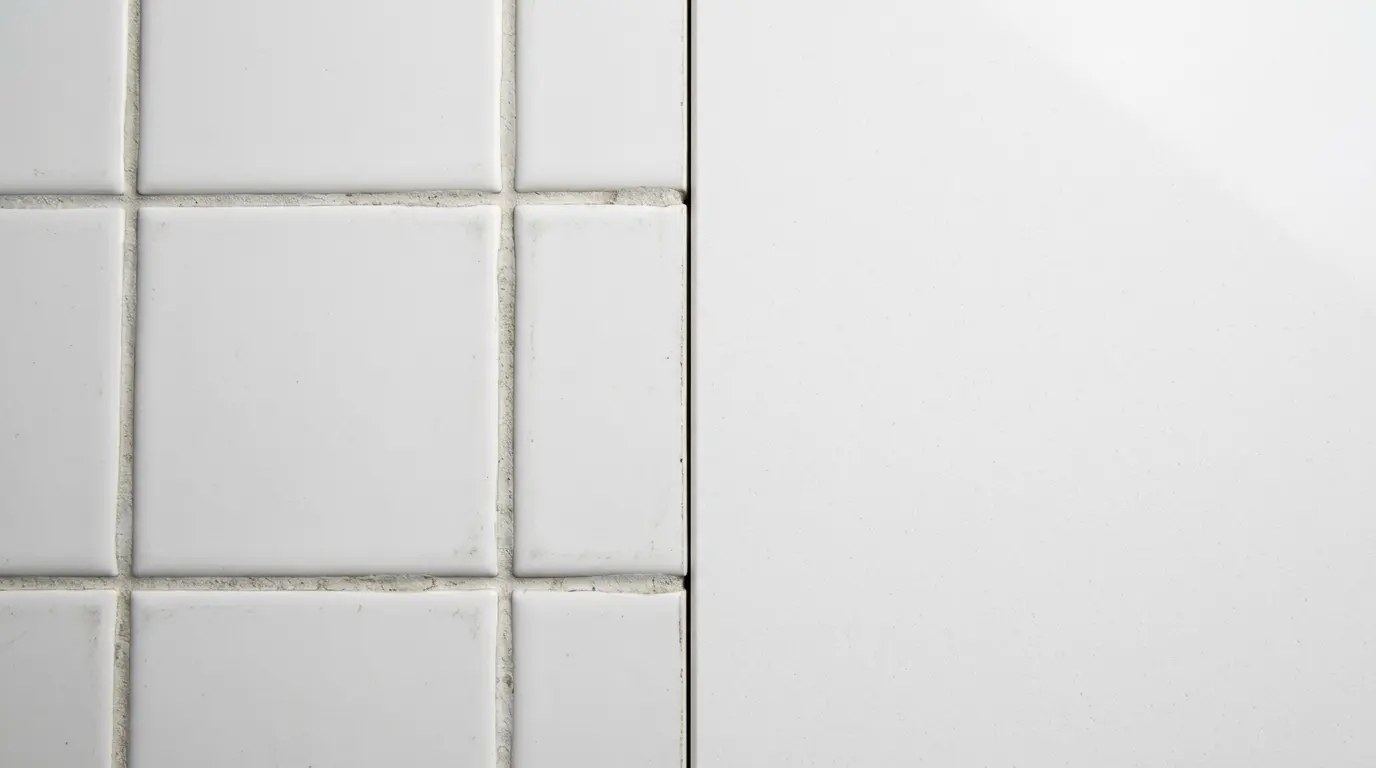
- Full Comparison of Quartz and Ceramic Tile for Commercial Construction
There are twelve factors that can be compared directly, with the last column showing how each difference affects business.
Before you choose either material for a business project, look at this table. The commercial impact column is the most important because it shows what the technical difference means for owners of buildings, facility managers, and the contractors who put in the surfaces.
| Factor | Ceramic Tile | Quartz Surface | Commercial Impact |
| Grout lines | Yes — every tile joint | None — seamless surface | No grout = no bacteria harbour, no staining, no failure point |
| Porosity | Porous grout lines — variable | Non-porous — no sealing ever | Quartz meets food hygiene and healthcare standards without maintenance |
| Sealing requirement | Grout requires annual sealing | None required — ever | Zero maintenance programme for facility management teams |
| Surface maintenance | Grout cleaning, recolouring, sealing | Wipe clean — nothing else | Quartz eliminates ongoing stone maintenance cost entirely |
| Crack/chip risk | High — individual tile impact | Low — monolithic surface | A cracked tile in a commercial kitchen or hotel room is an immediate replacement event |
| Hygiene compliance | Grout lines harbour bacteria | Non-porous — fully compliant | Quartz meets ASHRAE and NSI commercial hygiene standards without workarounds |
| Visual consistency | Grout variation and staining | Consistent across entire surface | Quartz maintains consistent appearance across the full building lifecycle |
| Replacement complexity | Single tile replaceable but visible | Full slab replacement if damaged | Tile repair is faster but visible — quartz requires planning |
| Installation speed | Slower — tile by tile | Faster — large format slabs | Quartz slab installation significantly faster on large commercial surfaces |
| Edge and transition | Requires finishing strips | Clean continuous edge profile | Quartz delivers cleaner transitions between surfaces in commercial fit-outs |
| Slip resistance options | Good — textured tiles available | Good — honed finish available | Both suitable for commercial flooring — specify finish correctly for application |
| 10-year lifecycle cost | Higher — grout maintenance adds up | Lower — zero maintenance | Quartz total cost over 10 years is consistently lower in commercial environments |
Source: NSI Commercial Installation Guidelines 2025. Data on how well ASHRAE building materials work. 2025 NKBA Commercial Specification Survey. Survey of Hospitality Facilities Management 2024.
| The short answer is:
When you add up the costs of grout maintenance, resealing, replacing cracked tiles, and aesthetic degradation, the 10-year lifecycle cost of quartz in a commercial setting is always lower than that of ceramic tile. |
| Are you thinking about using quartz for your next business project?
Let us know what kind of project you have, how big it is, and where it is located. We will recommend the best grade of quartz and give you a confirmed wholesale bulk quote within two business hours. +1 704-951-7822 | packuniversesupply.com/request-a-quote |
- The Five Reasons Why Contractors Are Switching
The switch from tile to quartz isn’t happening because quartz is trendy. It’s happening because five specific performance and cost factors always make quartz a better choice in real business settings.
Reason 1: No grout lines—the maintenance plan that goes away
This is the main reason. Removing grout from a commercial surface specification not only makes it look better, but it also gets rid of a whole maintenance program. No sealing every year. No recoloring every so often. No replacing or removing grout after five years. In regulated places, degraded grout doesn’t pose a compliance risk.
If you manage 80 hotel bathrooms, 40 office kitchenettes, or a 200-seat restaurant, the loss of the grout maintenance program is a real cost savings that shows up in the building’s annual maintenance budget, not just the installation specification.
It seems like a small thing until you have to figure out how much it will cost to regrout 80 hotel bathrooms. Then the numbers start to feel bad very quickly.
Reason 2: Following hygiene rules without having to do extra work
A written maintenance plan that includes regular sealing, inspection, and resealing on a set schedule is needed to make sure that grouted tile surfaces stay clean. By default, quartz gets the same compliance result. The surface will never be porous. There is no need for a maintenance plan. It follows the rules on day one and keeps doing so on day 3,650.
According to NKBA 2025 commercial specification research, 78% of commercial food service contractors who switched from tile to quartz said that making it easier to follow hygiene rules was a main or contributing factor in their decision.
| Quick answer:
By default, quartz meets the standards for food hygiene and healthcare surfaces in businesses. There is no need for a sealing program or a maintenance plan, and there is no risk of not following the rules. To keep the same level of compliance, grouted tile needs regular care. |
Reason 3: Consistency in Scale
A hotel chain that wants tile for 200 rooms in 12 different properties will get tile with natural batch variation. This means that there will be small color differences between production runs that show up when rooms are renovated at different times or when replacement tiles are taken from a different batch. Quartz is made to a consistent standard, so all 200 rooms and all 12 properties look the same, both in year one and year ten.
For retail chains that want to have the same brand look and feel in all of their stores, this consistency is not a choice; it is a brand requirement. It’s a brand problem if a retail counter looks different in Charleston than it does in Charlotte because of differences in tile batches. It goes away with quartz.
Reason 4: How quickly it can be installed on large commercial surfaces
A single piece of large-format quartz slabs covers a lot of ground. You can cover a standard commercial countertop with one or two quartz slabs that have clean, continuous joints. This is because the countertop needs 12 to 20 individual tile pieces that are cut, set, grouted, and finished. This installation speed advantage adds up to significant labor savings over the entire fit-out on a big commercial project.
According to NSI installation data, installing large-format quartz surfaces on commercial countertops takes about 35% less time than installing ceramic tiles of the same size. This includes the time it takes to grout, set, and finish.
| Short answer:When grouting, setting, and finishing are taken into account, installing large-format quartz slabs on commercial countertops is about 35% faster than installing ceramic tiles. According to NSI Commercial Installation Data. |
Reason 5: The high-end look that building owners now want
This is the thing that has changed the most in the last five years. In 2018, it was normal for commercial buildings to have ceramic tile countertops. In 2026, it looks old-fashioned in almost every type of business, including hospitality, retail, co-living, and corporate, where building owners are competing for tenants, guests, and buyers who have been used to high-end stone design in homes and hotels for the past ten years.
In many market segments, stone surfaces are no longer seen as a luxury but as a standard feature in commercial construction. When you take into account the speed of installation and the cost of ownership, quartz is available at a price that is directly competitive with large-format ceramic tile.
Ten years ago, quartz was a high-end upgrade for commercial kitchens. Now, the specification that needs to be justified is ceramic tile in the same setting.
| Data from the industry:
According to NKBA 2025 commercial specification research, 78 percent of commercial food service contractors said that making it easier to follow hygiene rules was a major reason for switching from tile to quartz. According to NSI installation data, installing large-format quartz surfaces on commercial countertops takes about 35% less time than installing ceramic tile when you factor in the cost of labor. According to a 2025 CBRE survey of commercial building materials, quartz countertops are now the standard in 62% of new commercial office fit-outs in the Southeast USA. This is up from 31% in 2020. |
Sources: CBRE Commercial Building Materials Survey 2025, NSI Installation Data (naturalstoneinstitute.org), and NKBA Commercial Specification Survey 2025
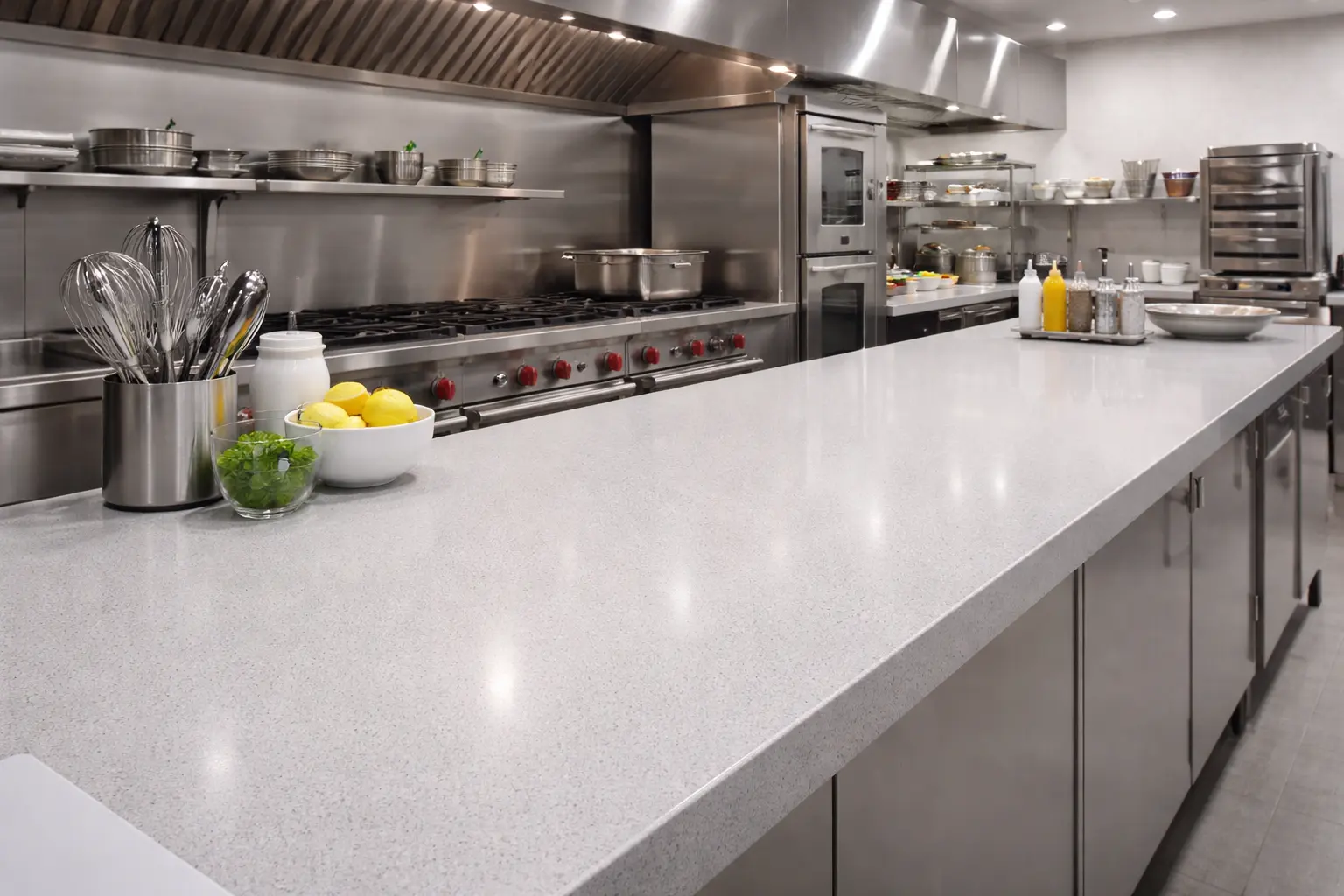
Below, you can see how quartz works in a real commercial space. The smooth surface and lack of grout lines are easy to see compared to a tiled version:
- 8 Commercial Uses for the Switch
The switch from ceramic tile to quartz is not happening in the same way in all commercial settings. These are the eight places where it is happening the most in 2026.
The table below shows what the surface was for each application, what it has been replaced with, and why the switch was made. This is based on surveys of NKBA specifications, research on facility management, and data from commercial contractor orders.
| Commercial Application | Was: Ceramic Tile | Now: Quartz Surface | Why the Switch Happened |
| Hotel bathroom vanity tops | Standard ceramic tile | Quartz slab vanity top | Grout failure and staining within 3 years in high-turnover hotel bathrooms triggered full replacement. Quartz eliminates this. |
| Commercial kitchen countertops | Ceramic tile surface | White quartz Level 1 | Food hygiene inspections flagged grout lines as a bacteria risk. Quartz non-porous surface eliminated the compliance issue. |
| Restaurant bar tops | Tiled bar surface | Quartz Level 2 | Grout staining from drinks and cleaning chemicals was visible within 18 months. Quartz holds its appearance long-term. |
| Healthcare facility surfaces | Ceramic wall tile | Quartz panel surface | NSI and ASHRAE hygiene guidelines for healthcare identified grouted tile as non-compliant in procedure areas. |
| Corporate office kitchenette | Tile splashback + bench | Quartz countertop | Tile grout in office kitchenettes was identified as a maintenance burden at scale across multi-floor fit-outs. |
| Retail store counters | Tiled service counter | Quartz counter surface | Retail chains switched to quartz across all locations for visual consistency — tile variation between stores was noticeable. |
| Co-living / build-to-rent | Tile kitchen surfaces | Quartz Level 1 | Grout maintenance between tenancies added time and cost to the turnover process. Quartz reduced turnover preparation time significantly. |
| Gym / fitness centre surfaces | Ceramic tile benches | Quartz bench surfaces | Cleaning chemicals used in gym environments degraded tile grout within 2 years. Quartz resists all standard cleaning agents. |
Most of these changes happened after a problem, not before one. The point of this guide is to help contractors choose the right specification before the grout fails, not after.
| Short answer:
In commercial construction, the most common reason for switching from tile to quartz is a hygiene compliance issue, a grout failure, or a building renovation where the tile style was found to be out of date. At the specification stage, you can avoid all three. |
The one thing to keep in mind is
Most of the time, the decision to switch from tile to quartz is a reaction. Contractors who say they want quartz from the start don’t have to pay for the reaction.
- How to Choose the Right Quartz Grade for Commercial Use
Not all quartz is the same, and choosing the wrong grade for a business use can either waste money or not give the building owner the look they want.
There are three levels of quartz that are sold for business use: Level 1, Level 2, and Level 3. The grade only affects how complicated the surface looks, not how long it lasts or how clean it is. All three grades are equally non-porous and don’t need any upkeep. The choice is based entirely on looks and cost.
| Grade | Best Commercial Application | Colour Range | Why This Grade Works Here |
| Level 1 | Commercial kitchens, food service, healthcare, build-to-rent | Pure white, light grey, solid beige | Non-porous hygiene performance at the lowest wholesale cost. White makes contamination visible. |
| Level 2 | Hotel rooms, corporate offices, retail interiors, restaurant counters | Soft vein white, warm grey, Carrara style | Visual step-up over tile without luxury cost. Soft veining reads as premium in commercial settings. |
| Level 3 | Boutique hotels, luxury co-living amenity areas, high-end reception | Calacatta bold vein, dramatic patterns | Delivers a stone aesthetic that tile never could. Feature surfaces in premium commercial settings. |
| What Pack Universe Supply does about this:
Pack Universe Supply has quartz Level 1, Level 2, and Level 3 in stock at our Charleston, SC warehouse for large commercial orders. For business projects that need lot-matched quartz in 20, 50, or 200 rooms or units, we check the production lot numbers before your order ships as a matter of course. If you’re not sure what grade and color of commercial quartz you need for your project, call +1 704-951-7822 before you place your first order. Order Wholesale Quartz for Your Business Project—No Minimum Order Needed: All levels. All colors. Matched by lot. Delivery to all parts of the US from Charleston, SC. → Get a Quote: packuniversesupply.com/request-a-quote → Call: +1 704-951-7822 (Monday through Friday, 8 a.m. to 5 p.m. EST) → Canada: +1 (647) 362-1907 | WhatsApp: button at packuniversesupply.com |
Should commercial contractors switch from tile to quartz?
| The decision is: Yes, in most business situations, and the data backs it up.
At a commercial scale, the grout maintenance program that comes with ceramic tile is a real cost of doing business. Grouted surfaces in food service and healthcare settings need extra work to make sure they are clean, which quartz does not have to do by default. The visual consistency advantage is important for retail stores, hotel chains, and multi-unit residential developments that have multiple locations. This is because batch variation between tile orders can cause problems with the brand or look over time. There is nothing wrong with ceramic tile. It is still the right choice for projects where cost is the main concern, where replacing individual tiles is better than replacing slabs because of the risk of surface damage, and where the look of the tiles is the main design goal. But in most commercial uses of countertops, vanities, and surfaces in 2026, quartz lasts longer, and the specifications should show that. It’s not because quartz is new that the contractors are switching. They are doing it because they have figured out how much it costs to own tile over the life of a commercial building. |
Ceramic Tile vs. Quartz for Business Projects: Common Questions
| Other Guides:→ Is quartz better than granite for building things for businesses?
LINK: /blog/is-quartz-better-than-granite-commercial-construction → What do contractors need to know about the differences between granite, quartz, and marble? LINK: /blog/granite-vs-quartz-vs-marble-contractors → What are the best colors of quartz for countertops in businesses? LINK: /blog/best-wholesale-quartz-slab-colors-kitchen-countertops-2026
|
About the Writer
Sam Micheale he has 15 years of direct experience supplying quartz and stone to commercial contractors, hospitality developers, and multi-unit residential builders across the Southeast USA and Canada. In Burlington, Ontario, Canada, and Charleston, South Carolina, USA, Pack Universe Supply has wholesale warehouses.
📞 +1 704-951-7822 | 🌐 packuniversesupply.com | 📍 1301 Charleston Regional Pkwy, Charleston, SC 29492