What Is Stone Fabrication and Why It Matters for Wholesale Slab Orders [2026]
What Is Stone Fabrication — And Why It Matters for Bulk Wholesale Slab Orders [2026]
| What is stone fabrication, and why is it important for big wholesale slab orders?
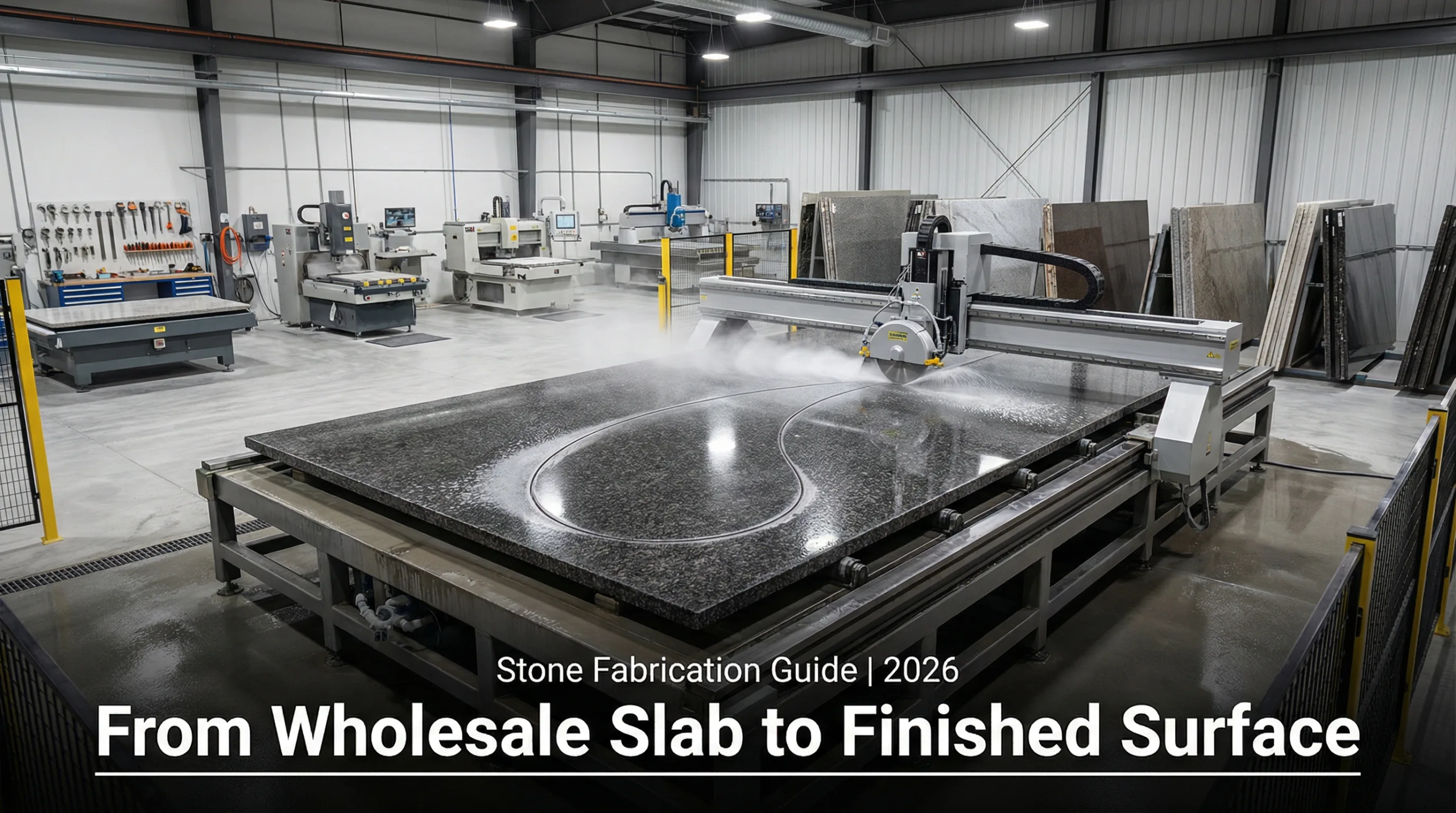
This guide provides a comprehensive overview of stone fabrication for both contractors and wholesale buyers, encompassing the year 2026. It covers what fabrication is, the seven steps from slab to installation, how slab specifications at the wholesale order stage affect the results of fabrication, different types of finishes, edge profiles, and what fabricators need from a wholesale slab to do their best work. Data from NSI, NKBA, and MIA+BSI is available all the time. What is stone fabrication, and why is it important for big orders of slabs? Stone fabrication is the process of cutting, shaping, finishing, and getting raw stone slabs ready for installation. It turns a wholesale slab into a fitted countertop, vanity top, or surface that is ready for site. When you order a lot of slabs at once, knowing how they are made is important because the quality of the slabs you order directly affects what can go wrong and what can go right during the fabrication stage. Why fabrication is important for the wholesale slab order: The thickness of the slab affects the options for making it: 3cm slabs can have unsupported overhangs and waterfall edges. 2cm slabs need a substrate and limit the choices for edge profiles. The size of the slab affects the amount of waste and where the seams go. For example, larger slabs make seams less visible on long countertop runs. Ordering slab size without checking what the fabricator needs will cost you more. Lot consistency has an effect on the finished installation: slabs from different production lots that are cut and installed next to each other will show a visible difference at the seam. The hardness of the stone affects the cost of making it: For example, cutting and finishing quartzite costs more than cutting and finishing granite or quartz. This affects the fabricator’s quote. Before you place your order, you need to say what kind of finish you want. Polished, honed, leathered, and brushed finishes are all done during fabrication, not at the warehouse. Tell us what you want before you order. Pack Universe Supply has wholesale slabs of all grades, thicknesses, and types of stone in stock and ready to be made. There is no minimum for the first order. Call +1 704-951-7822 or go to packuniversesupply.com/request-a-quote. |
Most people who buy stone in bulk think the order is over when the slabs get to the job site. Fabricators know that it starts there.
Stone fabrication is the process of turning a raw wholesale slab into the countertop, vanity top, or other surface that the customer agreed on. The quality, specification, and consistency of the slab that comes from the supplier determine everything that happens between the wholesale order and the finished installation. If you order the wrong thickness, the fabricator won’t be able to make the waterfall edge that the architect wanted. If you order from two different lots, the seam between them will show up on the finished surface. If you don’t specify the finish when you order, the fabricator will make a default choice that may not match what the client was shown in the brief.
This guide goes over the whole process of making stone, from getting a wholesale slab to putting it in place. It explains what each step involves, how the wholesale order affects each step, and what contractors and developers who order stone in bulk need to know about fabrication to get the results they are paying for. All of the information comes from NSI, NKBA, and MIA+BSI.
- What Stone Fabrication Really Is
Stone fabrication is the whole process of turning a raw wholesale slab into a finished, perfectly sized surface that is ready to be installed. This includes templating, cutting, profiling, finishing, and installation.
A wholesale stone slab from a supplier is a big, flat piece of raw stone that is usually 55 to 65 inches wide and 100 to 130 inches long, with a thickness of 2 cm or 3 cm. It has been polished on one side at the quarry or factory, but it is not yet related to the specific countertop, vanity, or surface it will become. The series of precise manufacturing steps that make that connection is stone fabrication. It turns the raw slab into a finished piece that is the right size and shape for installation in a specific building at a specific location.
Who Makes the Fabrication
Stone fabricators are companies that have CNC cutting machines, edge profiling equipment, polishing and finishing tools, and skilled workers who know how to use them. Fabricators get the raw materials they need from wholesale slab suppliers and the project briefs they need from contractors, developers, or designers who tell them what size, edge profile, cutouts, and finish they need.
The connection between the wholesale supplier and the fabricator is what makes every stone installation work. A wholesale supplier who sends consistent lot-matched slabs of the right thickness and stone type gives the fabricator the raw materials they need to do their best work. A supplier who sends inconsistent lots, the wrong thickness, or doesn’t tell you about grade changes causes problems with fabrication that show up as visible flaws in the finished installation.
| Short answer:
Stone fabrication turns a wholesale slab into a surface that is ready to be used. The quality of the wholesale slab sets the highest quality level for the finished product. A fabricator can work with good stone, but they can’t fix problems with the slab that come with the delivery. |
| Data from the Industry:
The Marble Institute of America and the Building Stone Institute say that the most common cause of edge profile defects and countertop installation failures in residential and commercial stone projects is inconsistent slab thickness. NSI quality guidelines say that lot consistency is the most important single factor in how well multi-unit stone installations turn out. This is because slabs from different production lots of the same named color show visible seam variation in about 1 in 3 multi-unit installations. According to NKBA 2025, 68% of complaints from stone installation clients come from decisions made about specifications at the wholesale order stage, not from mistakes made during fabrication. |
One thing to keep in mind:
68% of complaints from stone installation clients come from decisions made about specifications at the time of the wholesale order. Fabrication can’t fix a mistake in the specifications; it can only work with the slab it gets.
The table below shows all the steps in the fabrication process, from getting the slabs in bulk to putting them in place. It also tells contractors what they need to know at each step.
- The Seven Steps of Stone Fabrication: From Buying a Slab to Putting It Up
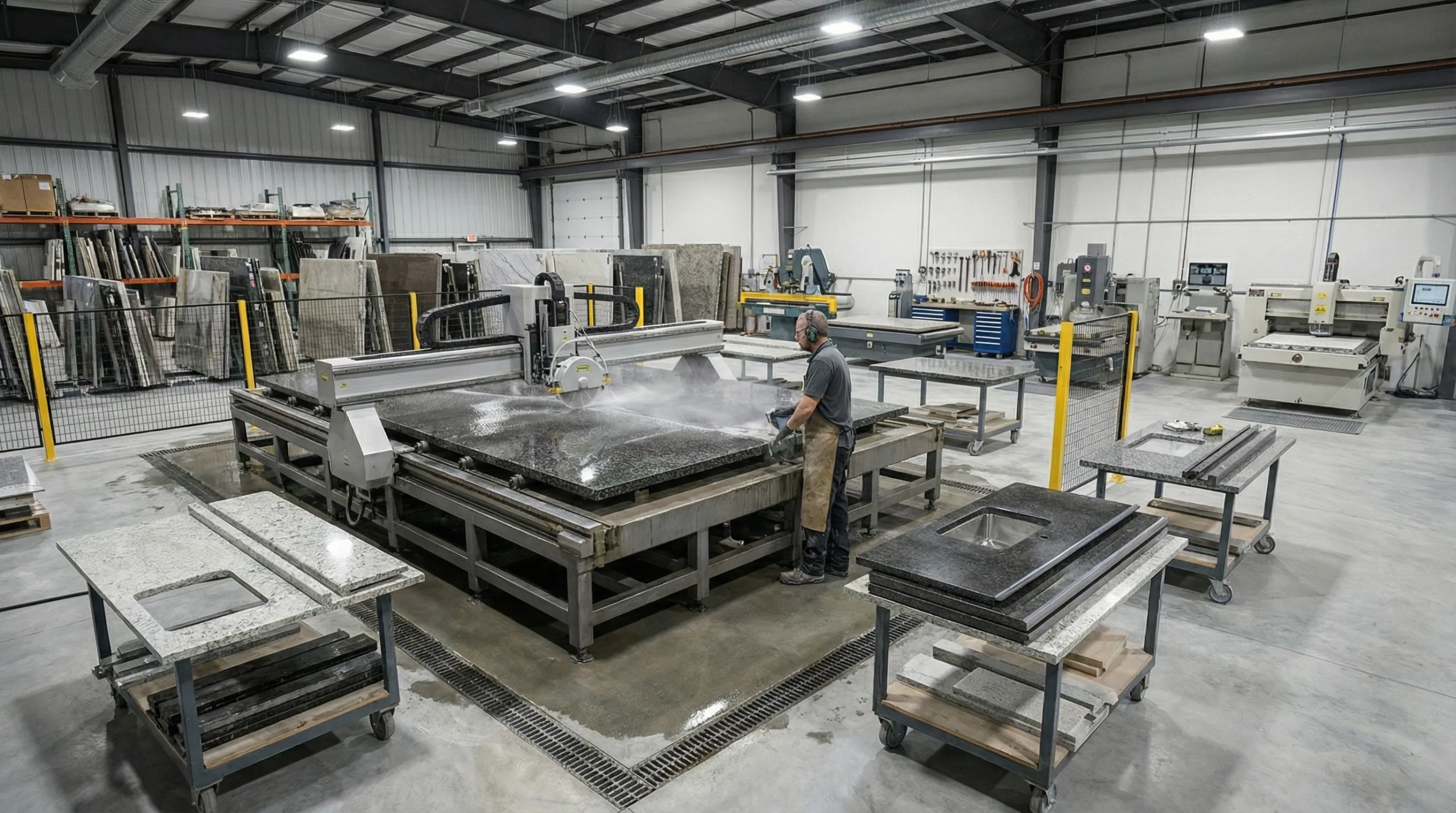
There are seven steps that every stone countertop or surface goes through between the time you order the slab and the time it is installed. Contractors can make better choices about specifications when they order if they know what each stage is.
The table below shows every step of the fabrication process, including what happens, how long it takes, and what contractors need to do or know at each step to avoid problems later on.
| Fabrication Stage | What Happens | Time Required | What Contractors Need to Know |
| Templating | Fabricator measures the exact countertop area on site — cabinets, walls, appliances — and creates a precise template. | 1–3 hours on site | Cabinets must be installed and level before templating. Changes after templating add cost and delay. |
| Slab selection | Fabricator or contractor selects the specific slabs from the wholesale supplier’s inventory — matching colour, veining, and lot. | Variable | Always involve the client or fabricator in slab selection for Level 2 and Level 3 stone. Never select on their behalf from a catalogue photo. |
| CNC cutting | Computer-controlled cutting machines cut the slab to the template dimensions — including sink and appliance cutouts. | 2–4 hours per slab | Complex layouts with multiple cutouts take longer and generate more waste. Factor into quantity calculations. |
| Edge profiling | The exposed edges of the countertop are cut and shaped to the specified profile — straight, bevelled, ogee, waterfall, mitre. | 30 mins–2 hours | 3cm slabs support all edge profiles. 2cm slabs have limited edge profile options without laminating. |
| Surface finishing | The surface is polished, honed, leathered, or brushed to the specified finish — a process that changes the appearance and feel significantly. | 1–3 hours per slab | Finish type must be specified at the wholesale order stage — not assumed. Polished is standard. Honed, leathered, and brushed are specified finishes. |
| Quality inspection | The fabricated piece is inspected for dimensional accuracy, edge quality, surface finish consistency, and any damage from cutting. | 30–60 minutes | Fabricators should inspect and photograph finished pieces before delivery to the site. Ask for a photo record. |
| Delivery and installation | The fabricated pieces are delivered to site and installed — set in place, sealed at seams, and anchored to the substrate. | Half day to full day | Stone is heavy and fragile in fabricated form. Professional installation is required — DIY installation voids most fabricator warranties. |
The most common problem with fabrication timelines is when a contractor orders stone late and then expects the fabricator to speed up every step to meet the installation date. You can’t rush stone fabrication without hurting the quality. The only sure way to keep the installation on schedule is to order the wholesale slab early and make sure the specifications are correct before the order ships.
| Quick answer:
The physics of cutting and finishing stone set the timeline for making things. The contractor can only control when the wholesale slab gets to the fabricator and how complete the specification is when it gets there. |
How the wholesale slab specification affects each step in the fabrication process
Every choice made when placing a wholesale order affects the fabrication process. Contractors who know how these things are connected make fewer expensive mistakes during the project.
Thickness: 3 cm is self-supporting and can hold up all edge profiles. 2cm needs a full substrate and limits the choices for edges. At the wholesale order stage, the thickness must be confirmed. It can’t be changed after delivery.
Larger slabs mean fewer seams on long countertop runs. Before you finish the layout plan with the fabricator, make sure you know the biggest slab size your supplier can provide.
Lot consistency: When slabs from different production lots are cut and put together at a seam, you can see differences in color, shade, or veining. The only way to stop this from happening is to confirm the lot before the wholesale order ships.
Stone hardness: Some exotic granites and quartzite are much harder than regular granite or quartz. Cutting and edge profiling take longer and cost more. Don’t be surprised if this is included in the fabrication quote.
The default finish is polished. Before the slab leaves the wholesale supplier, and in some cases even before it is cut, the honed, leathered, and brushed finishes must be chosen. Please specify at the time of order.
- What Stone Finish Types Are and How to Choose Them
The finish on a stone slab is not just for looks; it also affects how easy it is to clean, how hygienic it is, and how it looks when it’s installed. It needs to be said before the order is made.
Most contractors who buy stone in bulk think that the finish is polished unless they say otherwise. In most cases, this is true. But if the client brief or architectural drawings say that the finish should be honed, leathered, or brushed, the finish must be confirmed at the wholesale order stage. It is possible to put a different finish on a slab after it has been cut, but it costs more and takes more time. If you find a difference in the finish after installation, you can’t fix it without replacing the whole surface.
The table below shows the five main types of stone surface finishes, along with their looks, how to care for them, and the best uses for each one in business.
| Finish Type | Appearance | Maintenance | Best Commercial Application |
| Polished | High gloss — reflective, smooth, deep colour | Easiest to clean — smooth surface resists staining | Most specified finish for commercial countertops — hotel vanities, kitchen surfaces, office fit-outs |
| Honed | Matte — soft, flat, no shine | Slightly more porous surface — may require more frequent sealing on natural stone | Commercial environments where glare is undesirable — bathrooms, spa surfaces, understated corporate interiors |
| Leathered | Textured matte — natural texture of the stone is visible | Easier to maintain than honed — texture hides fingerprints and minor marks | Premium residential and boutique hospitality — the texture adds tactile interest to Level 3 exotic stones |
| Brushed | Soft sheen — between polished and honed, slightly textured | Good maintenance profile — texture hides daily marks better than polished | Modern commercial interiors — corporate and hospitality where a softer stone aesthetic is specified |
| Flamed / Sandblasted | Rough textured — non-slip surface | More porous surface — requires sealing more frequently | Outdoor commercial surfaces — flooring, pool surrounds, exterior steps (granite only) |
A client who was shown a leathered finish sample in a design brief and then got a polished finish on installation day is not happy. No contractor wants to have a conversation about who said what and when. The order confirmation should include the finish specification. That’s the solution.
| Answer quickly:
At the wholesale order stage, not the fabrication stage, you should say what kind of surface finish you want. Polished is the default setting. The order must clearly state any other finish. If the finish that was specified does not match the finish that was delivered, that is a specification error, not a fabrication error. |
| ⚠ Real Risk — Real Result:
The risk is that you order stone slabs in bulk without saying what kind of finish you want, and then you find out that the fabricator polished the surface when the client asked for honed or leathered. The result is that the finish difference can’t be fixed on site. The fabricated piece must go back to the fabricator for refinishing, which adds days to the project timeline and costs more to fabricate. |
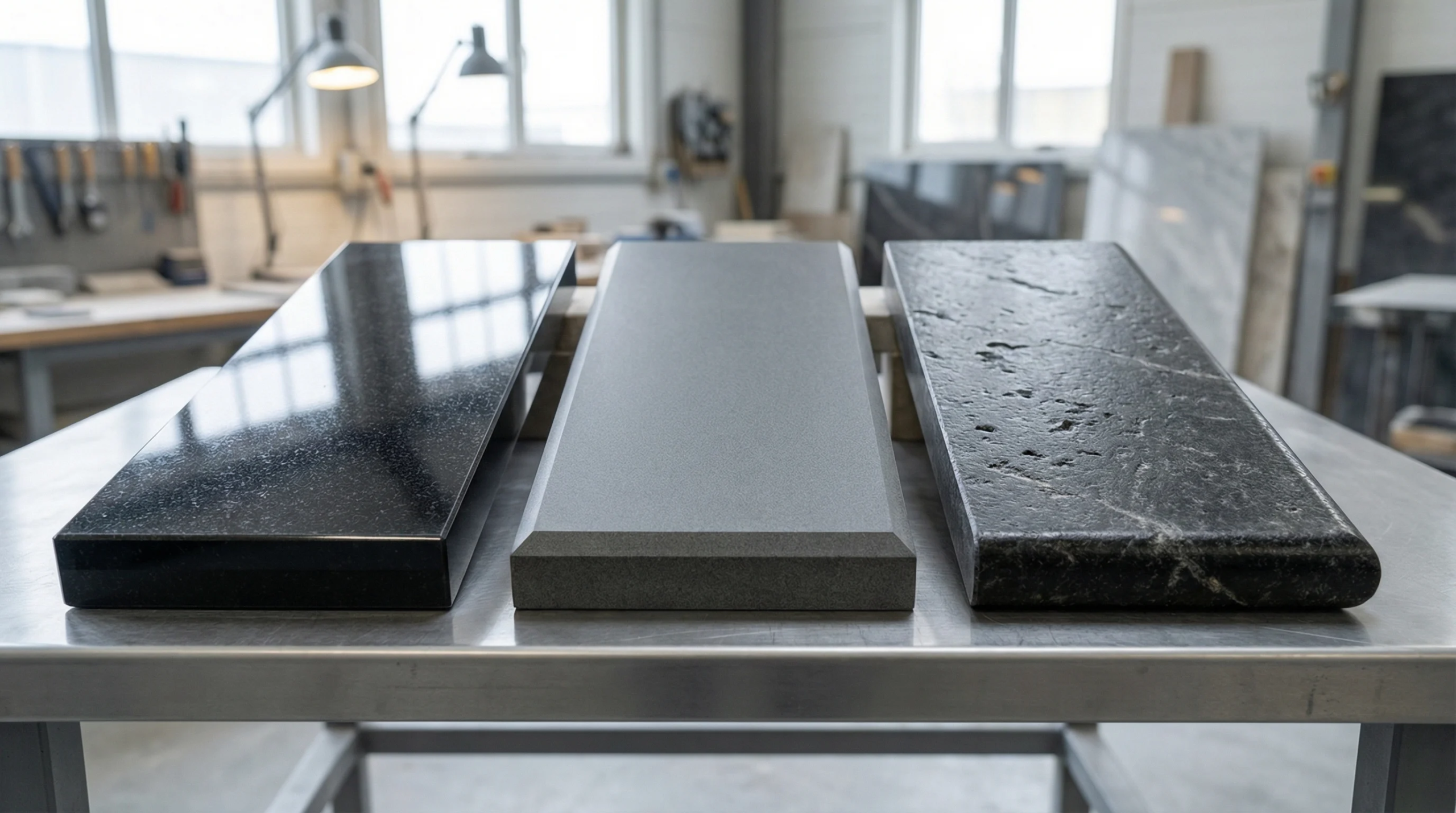
The table below shows the seven most common edge profiles, along with their thickness requirements and the best use for each one:
- Edge Profiles: What Each One Is and How Thick It Needs to Be
The edge profile is the most important detail that gives a stone countertop its unique look. It is limited by the thickness of the slab ordered at the wholesale stage.
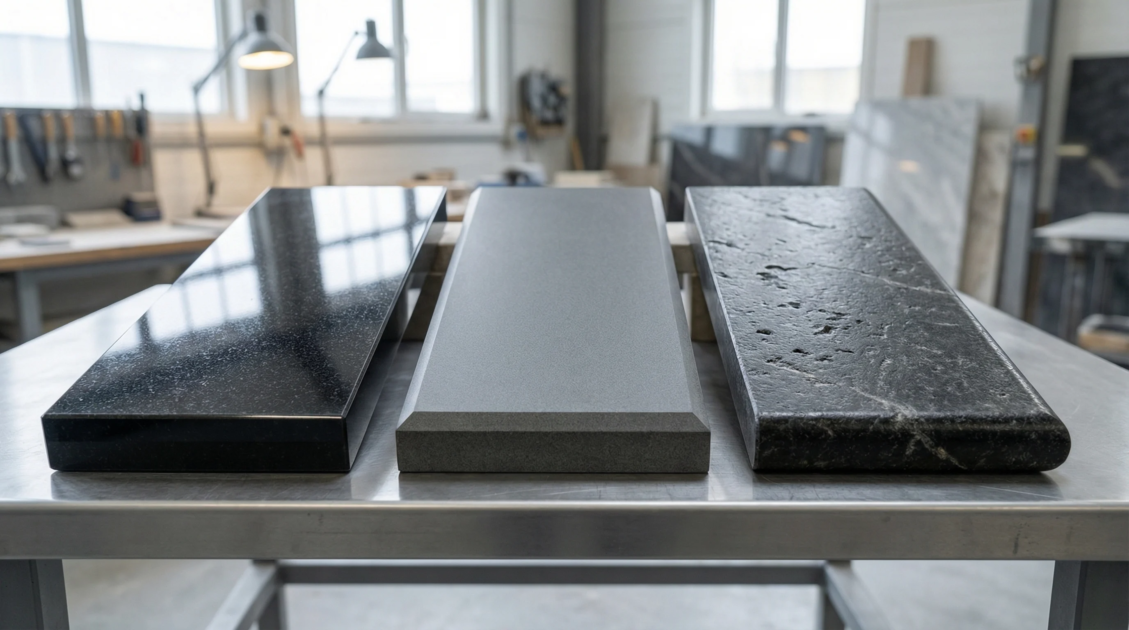
You can get a straight or eased edge in 2cm or 3cm, and it works for almost any project. A waterfall edge, which is when the stone goes straight down the side of a kitchen island, needs 3 cm and can’t be delivered in 2 cm. To make a mitre edge that looks very thin, you need two 3cm slabs cut at 45 degrees and then joined together. When the project brief says to order 2cm slabs, it’s not a fixable problem. It is a new order and a new timeline for making things.
| Edge Profile | Description | Thickness Required | Best For |
| Straight / Eased | Clean 90-degree edge with a very slight chamfer on the top corner | 2cm or 3cm | Commercial standard — hotel bathrooms, corporate kitchenettes, any project where clean and simple is the brief |
| Bevelled | Angled cut on the top edge — typically 45 degrees | 2cm or 3cm | Mid-range residential and hospitality — adds visual detail without complexity |
| Ogee | Decorative S-curve profile — traditional, ornate appearance | 3cm recommended | Traditional residential and heritage hospitality — not suited to modern commercial interiors |
| Bullnose | Fully rounded edge — smooth and soft to touch | 3cm recommended | Family homes and residential bathrooms — reduced injury risk on exposed corners |
| Waterfall | Slab continues vertically down the island side — dramatic statement | 3cm required | Luxury residential kitchen islands and boutique hospitality feature surfaces — the premium statement edge |
| Mitre | Two pieces joined at a 45-degree angle — creates an ultra-thin appearance | 3cm required (two pieces) | Luxury and architectural — used to make a 3cm slab appear thinner while maintaining structural integrity |
| Double waterfall | Slab continues down both sides of the island | 3cm required | Luxury residential only — maximum visual impact, maximum fabrication cost |
In 2026, the waterfall edge on a luxury kitchen island is one of the most requested and photographed design features in high-end homes. The edge profile is also the most common cause of problems on a project when the wholesale slab comes in 2cm instead of 3cm. Before confirming the edge profile with the client, make sure to check the thickness.
| Answer quickly:
The wholesale slab must be 3 cm thick if the project brief says it should have a waterfall edge, a mitre edge, or a full bullnose profile. It is not possible to make these edge profiles out of 2cm slabs. Before confirming the edge specification with the client or architect, make sure the slab is the right thickness. Do you need wholesale stone slabs that are ready to be made? Please let us know what kind of stone you need, how thick it should be, how it should be finished, what the edge profile should be, and how many square feet you need. We will check our stock and give you a wholesale quote within two business hours. +1 704-951-7822 | packuniversesupply.com/request-a-quote |
- How bulk wholesale orders change the way large commercial projects are built
When it comes to large commercial stone orders, like a 50-room hotel, a 100-unit apartment complex, or a multi-location retail rollout, there are fabrication issues that don’t come up with single-unit residential projects.
When you work on big commercial fabrication projects, the problems get bigger. For example, you have to deal with a lot more stone volume, so you have to make sure that the slabs are in the right order and that the phases are delivered on time. At the wholesale ordering stage, each of these is easy to handle. However, if they aren’t fixed before the first delivery gets to the fabricator, they can cause big problems.
Keeping Lots Consistent at a Commercial Scale
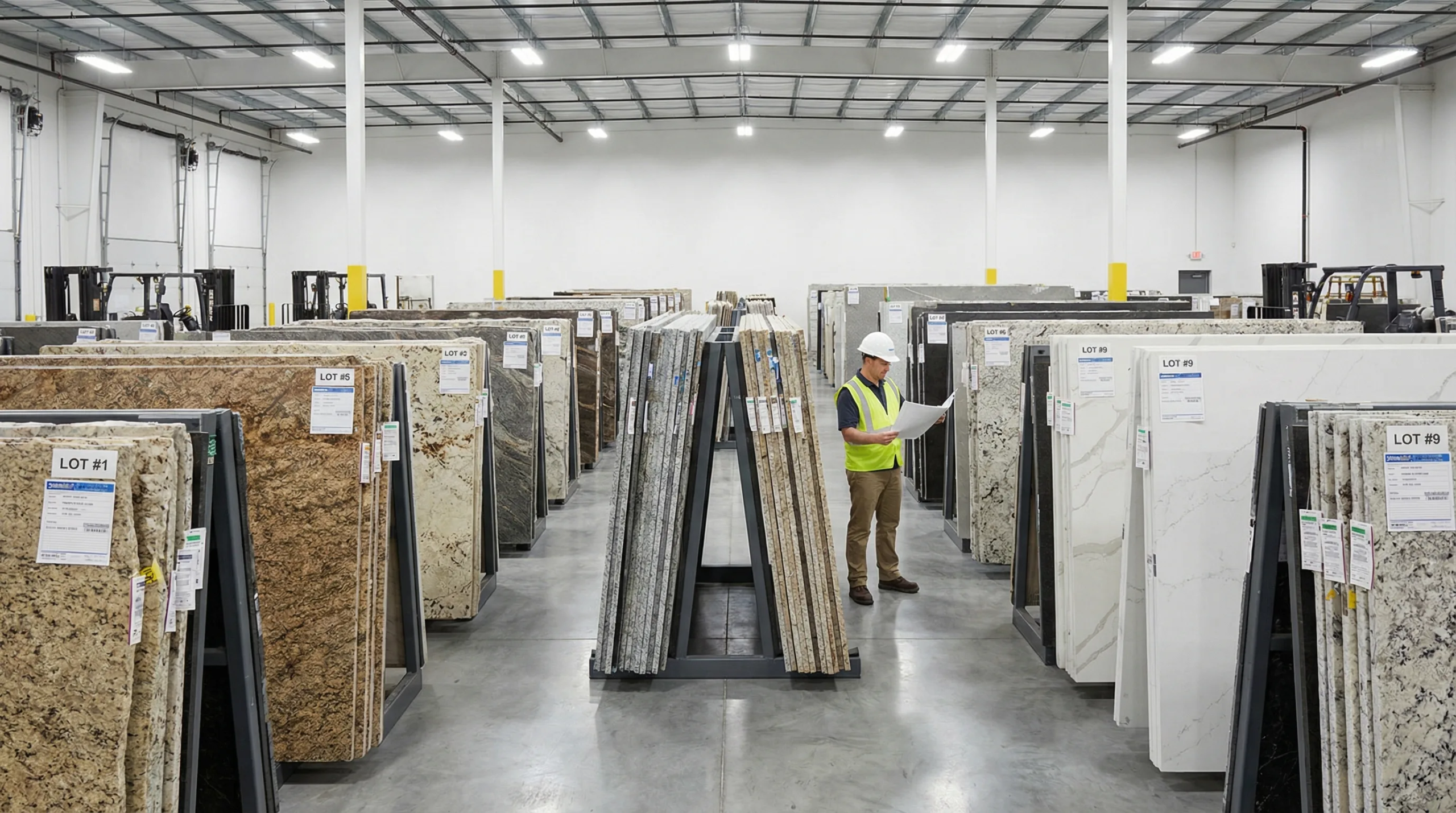
All 100 kitchens and 100 bathrooms in a 100-unit residential development use the same stone. If slabs of the same color are delivered from two different production lots across the project, it is because the first lot ran out and a second lot was found to finish the order. This causes visible color differences between units. At the cutting stage, the fabricator can’t deal with lot variation. Before any deliveries can start, the wholesale supplier must confirm and set aside a single lot for the whole project.
Delivery in phases and slab sequencing
Phases are used to build big commercial projects. The fabricator needs stone slabs delivered to their workshop before each phase of installation starts, but not all at once and not too late. A wholesale supplier who can deliver items in phases from reserved, lot-matched inventory that fits with the construction schedule is a real asset on a big commercial project. If a supplier delivers all the slabs at once, or worse, can’t say when the next delivery will arrive, it causes problems with the scheduling of fabrication that affect the whole project timeline.
Managing Waste and Overage
The waste from cutouts, offcuts, and breakage on a 100-unit project can be 15% to 25% of the total volume of stone ordered. At a commercial scale, this waste costs a lot of money in materials. Ordering the right percentage of overage—after checking with the fabricator—means that you won’t have to rush to order more matching-lot stone in the middle of the project. The NSI fabrication guidelines say that you should add at least 15% to the net installed area for all standard layouts and 20 to 25% for complex layouts that need a lot of cutouts.
| How Pack Universe Supply helps fabricators:
From our Charleston, SC warehouse, Pack Universe Supply takes care of all three commercial fabrication problems: confirming the lot on every bulk order before it is sent out, scheduling phased delivery to fit your construction schedule, and helping with overage calculations on any project over 500 square feet. We also offer project-specific lot reservations for commercial projects over 1,000 square feet. This means that you can secure matched inventory before your fabrication schedule starts. Before you place your next big order, please call our wholesale team at +1 704-951-7822 to talk about your commercial fabrication needs. Order wholesale stone slabs that are ready to be made into something else. There is no minimum order for the first time. Granite, quartz, and marble in all thicknesses and finishes, with bulk orders that match the lot. Charleston, South Carolina (USA) Burlington, Ontario (Canada) Delivery all over the country. → Get a Quote: packuniversesupply.com/request-a-quote → Call: +1 704-951-7822 (Monday through Friday, 8 a.m. to 5 p.m. EST) → Canada: +1 (647) 362-1907 | WhatsApp: button at packuniversesupply.com |
Verdict: Why it’s important to understand fabrication at the wholesale order stage
Decision:
Fabrication is when the wholesale order turns into a finished surface. Every choice made at the ordering stage either helps the fabricator do their best work or limits them before they even start.
The thickness of the slab affects the options for the edge profile. The look of the seams between units depends on the lot consistency. The finish specification decides what kind of surface the client gets. Waste overage decides if you need to reorder from a different lot in the middle of the project. At the wholesale order stage, not the fabrication stage, all of these outcomes are set.
It’s not always the case that the contractors who work with the best fabricators get the best results. They are the ones who order the right slabs, making sure they are the right thickness, lot, finish, and quantity. They also give the fabricator everything they need to turn raw stone into the surface the client saw.
| More Guides:→ What mistakes do contractors make when they buy stone countertops?
LINK: /blog/7-mistakes-contractors-make-buying-countertops → What do I need to know before I order stones in bulk? LINK: /blog/10-questions-before-placing-wholesale-stone-order → How thick is a 2cm and a 3cm quartz slab? LINK: /blog/2cm-vs-3cm-quartz-slab-thickness-wholesale → What are the differences between Level 1, Level 2, and Level 3 granite? LINK: /blog/level-1-vs-level-2-vs-level-3-granite-contractor-guide → What is the best way to find a trustworthy wholesale stone supplier in the US? LINK: /blog/how-to-find-reliable-wholesale-stone-supplier-usa |
About the Writer
Sam Michele 15 years of direct experience selling wholesale stone slabs to builders and contractors in the US and Canada. Pack Universe Supply has wholesale warehouses in Burlington, Ontario, Canada, and Charleston, South Carolina, USA.