Stone Countertops in a Commercial Renovation — Remove, Reuse, or Replace?
Stone Countertops in a Commercial Renovation — Remove, Reuse, or Replace? [2026 Guide]
The 10-condition decision table, stone inspection checklist, cost comparison, phased renovation protocol, and 8 FAQs — the complete contractor guide to stone decisions in commercial renovations.
| Quick answer:
Reuse if the stone is structurally sound with no cracks, the correct thickness for the new layout, and the same material suits the new application. Professional refinishing and re-sealing costs $3 to $8 per sqft — a fraction of replacement. Replace if the stone has structural cracks, is the wrong thickness for the new layout, or the application is changing (e.g. adding a kitchen where quartz existed before). Remove and dispose only when full replacement is confirmed — stone removal without a reuse plan adds cost and waste with no benefit. The decision is not about aesthetics. It is about structural condition, thickness, and application compatibility. This guide gives you a checklist for each. |
1. The Remove, Reuse, or Replace Decision — 10 Conditions Covered
The right decision for each renovation depends on the condition of the existing stone, the new layout, and what the surface needs to do after the renovation. This table covers every scenario.
The most common and most costly renovation mistake is defaulting to full replacement without assessing whether the existing stone is structurally sound. Professional refinishing on sound granite costs under $250 for a standard counter. Full replacement of the same counter costs $800 to $2,000. The assessment takes 30 minutes on site.
| Condition of Existing Stone | Remove | Reuse | Replace | Decision Driver |
| Structurally sound, no cracks, correct thickness | — | Yes | — | Material is performing. Reuse — refinish and re-seal only. |
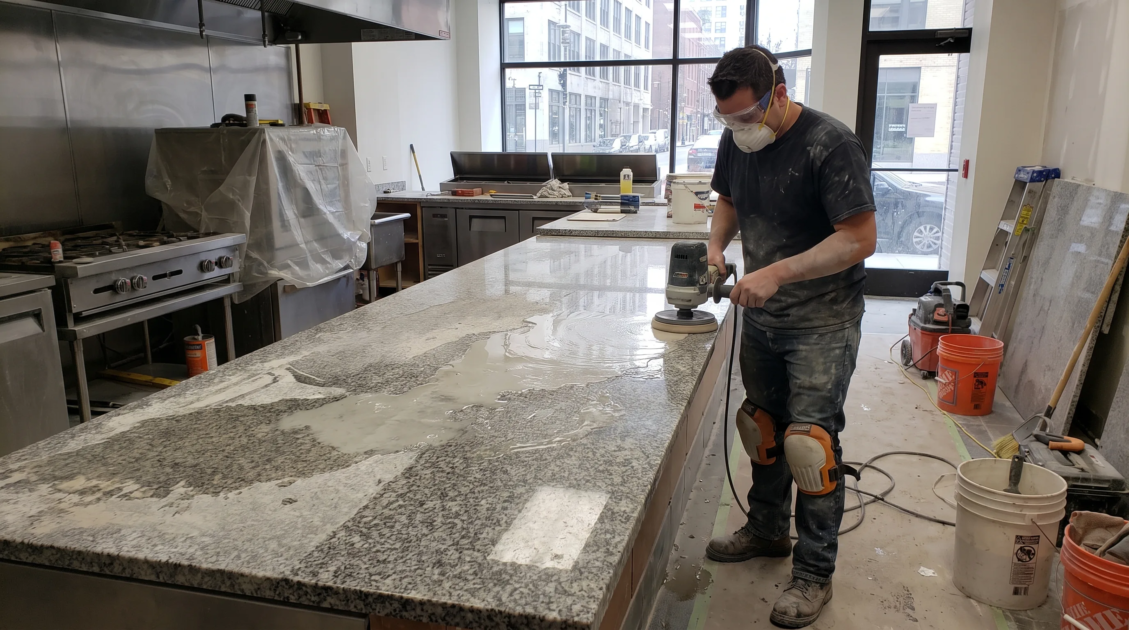
| Surface dulling, no physical damage | — | Yes | — | Professional diamond polish restores surface. Cost: $3-8 per sqft. Far cheaper than replacement. |
| Minor edge chips, no cracks | — | Conditional | — | Eased or bevelled edge rework by fabricator. Acceptable if chips are cosmetic only. |
| Staining from unsealed pores | — | Yes | — | Professional poultice treatment removes most staining. Re-seal immediately after. |
| Cracked slab — crack across full span | Remove | — | Yes | Structural failure. Full removal and replacement required. Cannot be repaired in place. |
| Wrong thickness for new layout — 2cm in 3cm application | Remove | — | Yes | Structural risk. Specification change requires new material at correct thickness. |
| Wrong material for new use — e.g. quartz planned for kitchen | Remove | — | Yes | Application conditions changed. Wrong material for new brief. |
| Lot exhausted — partial renovation needing matching stone | — | Yes | Partial | Reuse what can be saved. New stone will not match existing lot. Plan carefully. |
| Full renovation — all surfaces being replaced | Remove | — | Yes | Full scope. New lot confirmation across all surfaces. Clean break is cleanest. |
| Phased renovation — live building, partial replacement | Selective | — | Partial | The hardest scenario. See Section 4 — phased renovation protocol. |
Decision criteria based on NSI installation standards, fabricator assessment guidelines, and Pack Universe Supply commercial renovation order data June 2026.
| Data:
NSI 2025 — professional stone refinishing (diamond polish and re-seal) restores commercial granite surfaces to near-original appearance in 85% of cases where the stone has no structural cracks. Average refinishing cost is $4-6 per sqft versus $25-40 per sqft for full removal and new installation. |
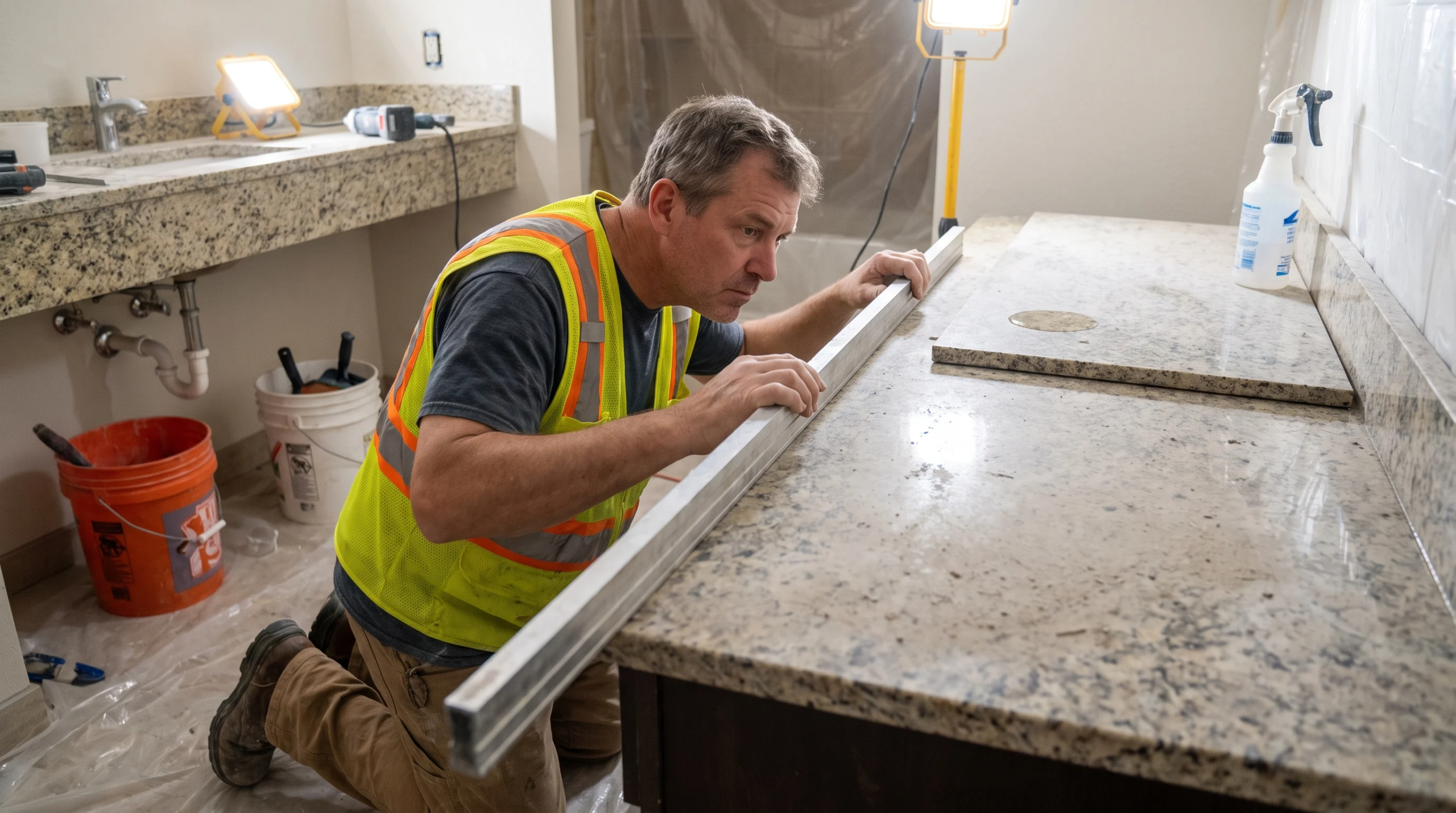
2. The On-Site Inspection — What to Check Before Making the Decision
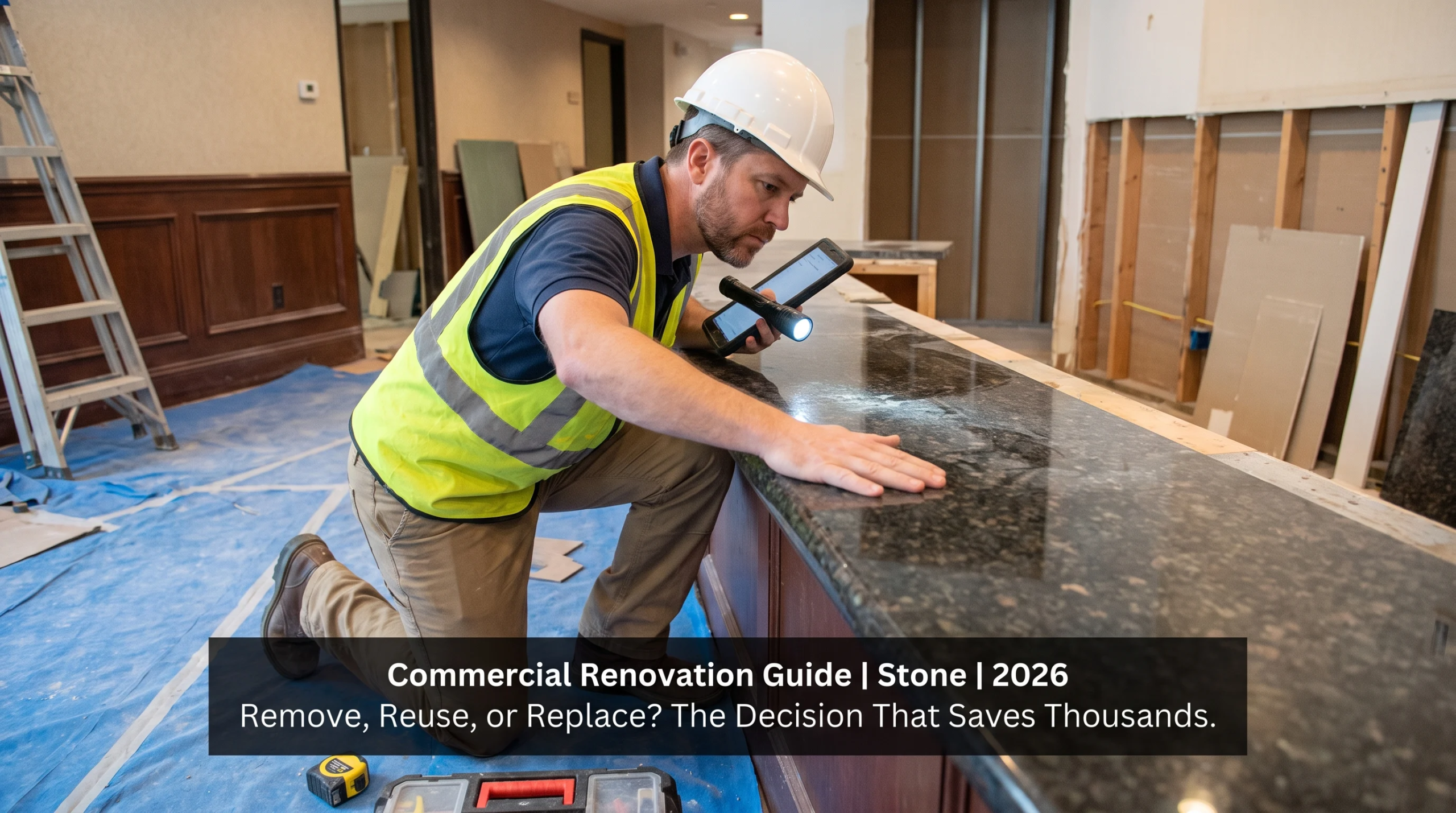
Every remove, reuse, or replace decision should start with a 30-minute on-site inspection. These 8 checks give you a complete picture of the existing stone’s viability.
The two checks that determine the decision fastest: structural integrity (cracks) and thickness. A cracked slab is replaced regardless of surface condition. A 2cm slab that will have an overhang in the new layout is replaced regardless of structural condition. Everything else is refinishable, treatable, or correctable.
| What to Check | Tool / Method | What You Are Looking For |
| Structural integrity — cracks | Visual + metal straight edge | Any crack crossing more than 20% of the slab width. Hairline surface cracks may be cosmetic — through-cracks are structural. |
| Thickness | Tape measure at exposed edge or drill hole | 2cm vs 3cm. If the new layout has overhangs or unsupported spans, 2cm must be replaced with 3cm regardless of condition. |
| Surface condition — polish | Visual in raking light | Widespread dull patches = professional refinish required. Localised dulling = targeted treatment. Mirror test: reflection clarity. |
| Staining depth | Water and paper towel test | Surface staining lifts with damp cloth. Deep staining (colour change persists when dry) requires poultice treatment or replacement. |
| Seal integrity | Water bead test | Drop water on surface. Beads within 4 minutes = sealed. Absorbs and darkens = unsealed. Must be re-sealed before any continued commercial use. |
| Edge condition | Visual — all edges | Chips over 5mm deep are structural weaknesses on overhangs. Cosmetic chips under 5mm on supported edges can be eased by fabricator. |
| Lot number — slab label or documentation | Check supplier records or slab edge markings | If partial replacement is needed, lot number must be confirmed before ordering. Slabs from a different lot will not match. |
| Layout compatibility — new vs existing | Measure existing and compare to new plan | If new layout adds an overhang or unsupported span not in the original installation, thickness assessment required before reuse decision. |
Inspection protocol based on NSI stone assessment guidelines and fabricator field standards. Pack Universe Supply renovation order data June 2026.
| Key point:
The water bead test takes 30 seconds and tells you the sealing status of any stone surface instantly. Drop water on the surface. Beads within 4 minutes: sealed, proceed. Absorbs and darkens the stone: unsealed, will require re-sealing before any continued use regardless of the renovation decision. Run this on every stone surface in the renovation scope before deciding. |
3. Cost Comparison — Refinish vs Repair vs Replace
The cost difference between refinishing and replacing sound stone is significant. The numbers make the decision straightforward when the stone passes the structural inspection.
The reason most contractors default to replacement without assessing refinishing is that replacement is the simpler procurement conversation — order new stone, install, done. Refinishing requires a specialist stone restoration contractor and a slightly more complex site programme. The cost difference makes that complexity worthwhile in almost every case where the stone is structurally sound.
| Option | Cost Range | Timeline | Best for |
| Professional refinish — polish and re-seal | $3–$8 per sqft | 1–2 days per area | Sound stone with surface dulling, minor staining, or etch marks from previous use |
| Edge repair by fabricator | $80–$200 per linear metre | Half day per section | Cosmetic edge chips on structurally sound counters — hotel bars, reception desks |
| Partial replacement — damaged slabs only | Material + install at full rate | 3–5 days per area | Cracked or fractured slabs within an otherwise sound installation |
| Full removal and replacement | $800–$2,000 per standard counter (30 sqft) all-in | 1–2 weeks per area | Structural failure, wrong specification for new brief, full renovation scope |
| Reuse with lot-matched supplement | Material for new areas only | Dependent on availability | Partial renovation where existing stone is sound and lot can be matched or supplemented |
Cost data based on US market stone refinishing and installation rates 2025-2026. Indicative — varies by market, surface area, and contractor. Pack Universe Supply wholesale material costs for replacement reference.
| Common mistake:
Common mistake: specifying full removal and replacement of granite counters in a hotel bathroom renovation without inspecting the stone first — discovering after removal that the existing stone was structurally sound and could have been refinished for $180 per vanity instead of $1,400. The inspection costs 30 minutes. The decision it enables saves thousands on a multi-room hotel renovation scope. |
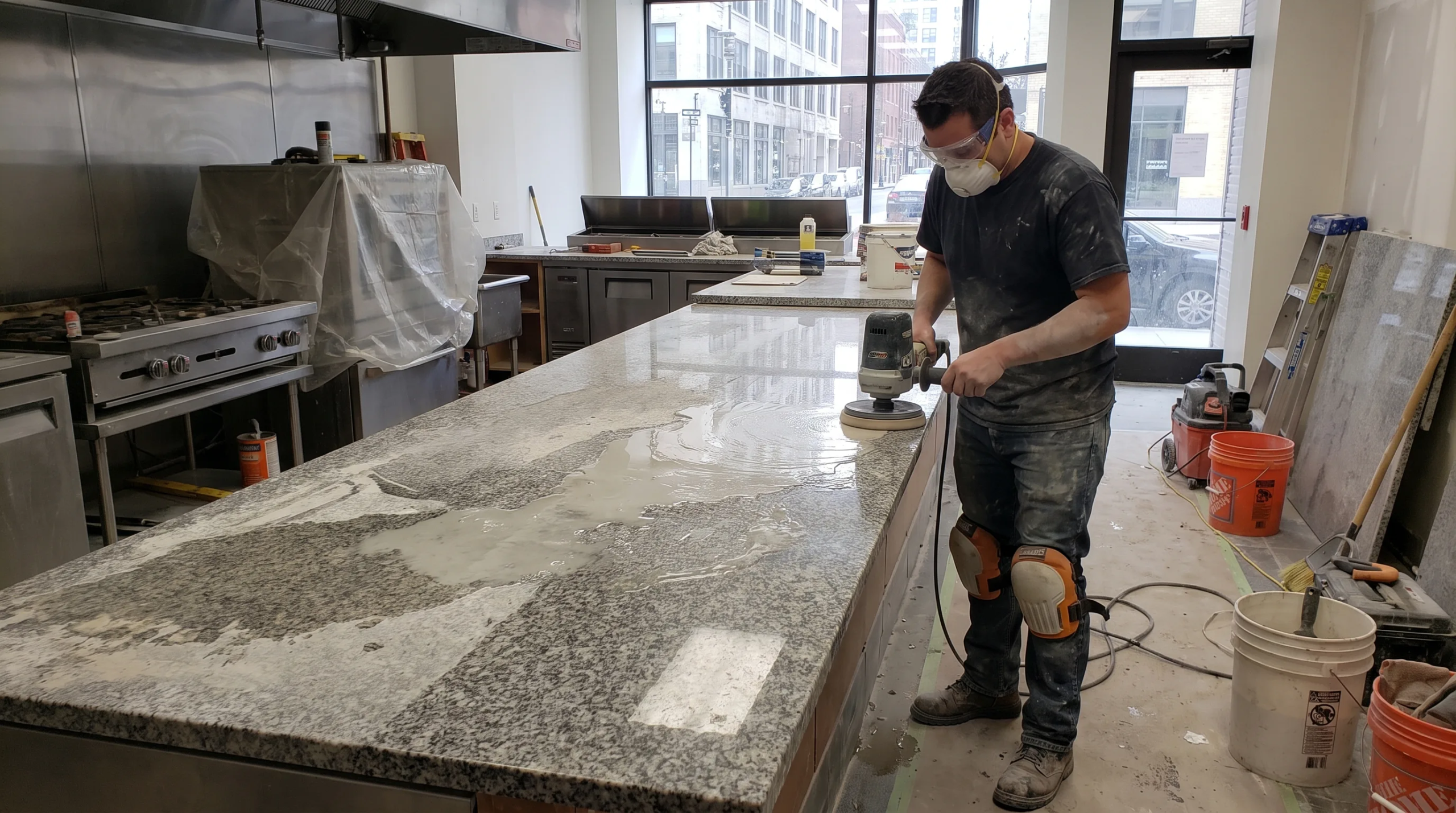
4. Phased Renovations in Live Buildings — The Hardest Scenario
Phased renovations — where the building continues to operate while renovation happens in sections — create the most complex stone decisions. The protocol below prevents the most common problems.
The core challenge: stone from Phase 1 and stone from Phase 3 may not match if replacement is needed, because the original lot may be exhausted between phases. And in a live building, the renovation window for each section is limited — decisions about remove, reuse, or replace must be made faster and with less access time than in a full shutdown renovation.
Before Phase 1 Starts
- Inspect all renovation zones Complete the 8-point inspection in Section 2 on every stone surface across all phases — not just the first phase.
- Confirm lot number If any replacement stone is needed in any phase, confirm the production lot from the original supplier and reserve the full replacement quantity across all phases before Phase 1 begins.
- Decide remove/reuse/replace for every zone Make the decision for every phase at the start. Mid-renovation decisions under time pressure with limited access produce worse outcomes than decisions made with full access and no deadline.
During Each Phase
- Protect stone not in current scope Stone in adjacent areas that is not being touched in the current phase needs protection from renovation dust, adhesive, and impact. Hard board over counters. Tape on edges.
- Stage removal carefully If stone is being removed for reuse elsewhere — in a different part of the building or in storage for a later phase — handle with suction cups, not pry bars. A reusable slab damaged in removal is a replaced slab.
- Confirm lot match before ordering replacement For any Phase 2 or later replacement order, confirm the lot against a physical sample from Phase 1 installation before the order is placed. Do not rely on memory or photography.
The Lot Exhaustion Problem in Phased Renovations
The most common phased renovation stone problem: Phase 1 completes with new stone from Lot A. Phase 3 begins 6 months later. Lot A is exhausted. New slabs from the same named material come from Lot B. Lot B has a slightly different background tone. The renovation has visible inconsistency between early and late phases.
Prevention: reserve the full estimated replacement quantity across all phases at Phase 1 order stage. Pack Universe Supply holds reserved stock from a confirmed lot until each phase delivery is required — at no additional cost on commercial renovation orders.
| Planning a commercial renovation with stone countertops?
Pack Universe Supply confirms lot availability, reserves full renovation quantity, and supplies phase-by-phase to match your renovation programme. -> Call: +1 704-951-7822 (Mon–Fri 8am–5pm EST) -> Request a Quote: packuniversesupply.com/request-a-quote -> Canada: +1 (647) 362-1907 |
8 Questions Contractors Ask About Stone in Commercial Renovations
[ WordPress: Use FAQ Block with FAQPage schema markup for each Q&A. ]
| Question | Answer |
| Can you reuse stone countertops in a commercial renovation? | Yes — if the stone is structurally sound, the correct thickness for the new layout, and the same material is appropriate for the new application. Structurally sound stone with surface dulling, minor staining, or cosmetic edge chips can be professionally refinished, treated, and re-sealed at significantly lower cost than full replacement. The inspection checklist in Section 2 confirms reuse viability before the renovation begins. |
| How much does it cost to refinish granite instead of replacing it? | Professional granite refinishing — diamond polishing to restore surface gloss followed by professional sealing — costs approximately $3 to $8 per square foot. A standard 30 sqft commercial kitchen counter costs $90 to $240 to refinish versus $800 to $2,000 for full removal and replacement. Refinishing is viable where the stone is structurally sound with no cracks and the surface damage is limited to dulling, minor staining, or etch marks. |
| What if the stone lot number is no longer available for a partial replacement? | If the original lot is exhausted, new slabs from a different lot of the same named material will show tonal differences from the existing installation. Options: (1) replace only the structurally failed slabs and accept the tonal difference in less visible areas, (2) replace all surfaces in the renovation scope with a new confirmed lot for visual consistency, or (3) re-specify to a different material or colour that works visually alongside the retained stone. Pack Universe Supply confirms lot availability before any partial replacement order. |
| How do you remove stone countertops without damaging cabinets? | Stone removal requires: scoring the silicone seal between stone and cabinet with a utility knife, gentle upward pressure with suction cups and a flat pry bar at the silicone joint (not the stone edge), and support from underneath as the slab lifts. Commercial stone slabs are heavy — 3cm granite at 30 sqft weighs approximately 90kg. Two-person minimum for any slab removal. Professional removal recommended for any slab with value to be retained for reuse elsewhere. |
| Can quartz countertops be refinished like granite? | Quartz surface damage is different from granite. The resin binder in quartz cannot be diamond-polished back to its original finish the way granite can — the resin and aggregate respond differently to mechanical abrasion. Minor surface scratches in quartz can sometimes be polished with a quartz-specific repair kit. Scorch marks, deep scratches, or resin discolouration typically require full slab replacement. This is one reason quartz has a lower maintenance cost than granite during service — but a higher replacement cost when physical damage does occur. |
| How long does a full commercial stone countertop replacement take? | A standard commercial counter replacement — removal of existing stone, installation of new slabs, sealing, and grouting — takes 3 to 5 days for a standard kitchen or bathroom scope. Hotel renovation schedules typically allow 5 to 7 days per room for a full stone countertop replacement including removal and curing time. Phased renovations in live buildings should plan for longer due to access restrictions and operational constraints around the renovation area. |
| When should you replace rather than reuse stone in a renovation? | Replace when: the stone has structural cracks crossing more than 20% of the slab width, the existing thickness (2cm) is insufficient for the new layout which includes overhangs or unsupported spans requiring 3cm, the material is wrong for the new application (e.g. quartz planned for a new kitchen area with commercial cooking), or the renovation is a full scope where lot-matched consistency across all new surfaces is required by the design brief. |
| Where can contractors order replacement stone for a commercial renovation? | Pack Universe Supply stocks commercial granite and quartz from our Charleston, SC warehouse (USA) and Burlington, ON (Canada). For renovation orders: we confirm lot availability for partial replacements, confirm the correct thickness for the new layout, and provide nationwide delivery. No minimum on first orders. Call +1 704-951-7822 or visit packuniversesupply.com/request-a-quote. |
| Verdict:
The default in commercial stone renovation should be assess first, replace only if necessary. Structurally sound stone with surface wear is a refinishing job — not a replacement job. The cost difference is significant across a multi-room renovation scope. The three conditions that require replacement, not refinishing: structural cracks crossing more than 20% of the slab, wrong thickness for the new layout, wrong material for the changed application. For phased renovations: confirm lot, reserve full quantity across all phases, decide remove/reuse/replace for every zone before Phase 1 starts. Mid-renovation decisions under time pressure cost more and produce worse outcomes. |
Sources & References
NSI — Natural Stone Institute: naturalstoneinstitute.org | NAHB — National Association of Home Builders 2025: nahb.org | Pack Universe Supply commercial renovation order data, June 2026.