Engineered Stone vs Natural Stone: Complete Contractor Buying Guide 2026
The Complete Contractor Buying Guide 2026: Engineered Stone vs. Natural Stone
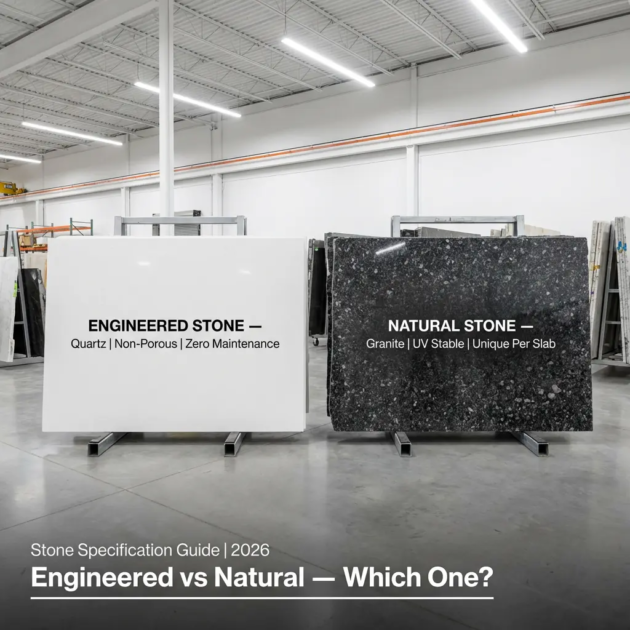
The 2026 contractor’s guide to engineered stone vs. natural stone has everything you need to know about each type of stone, including how they differ in terms of porosity, maintenance, UV performance, color consistency, and lifecycle cost. It also has a full 12-row comparison, a 6-stone natural stone reference table, and a 12-application decision guide. Data from the British Geological Survey, NKBA, NSI, and ASHRAE all the time.
What is the difference between natural stone and engineered stone? Which one should contractors buy?
Engineered stone, which is mostly quartz, is made by mixing crushed minerals and resin. This makes a smooth, non-porous surface that doesn’t need any upkeep. Each slab is different, has different levels of porosity, and needs to be sealed every now and then. Neither one is better than the other. What you should choose depends on the application, the context of maintenance, and the budget.
The short version of what matters most is:
| If keeping costs down is the most important thing: Engineered stone (quartz) needs no sealing or maintenance and has a lower 10-year lifecycle cost in commercial buildings.
If you want something that looks different, natural stone (granite Level 3, marble, quartzite) is the way to go. No two slabs are the same, which is something that engineered stone can’t do. If it’s important that the color is the same on many units, engineered stone is made to a consistent standard, so it looks the same on 10 or 200 units. If you need to use it outside, only natural stone (granite) will do. Engineered stone resin breaks down when exposed to UV light. No exceptions. If following hygiene rules is a must: Engineered stone is permanently non-porous and meets food service and healthcare standards without needing a sealing program. Pack Universe Supply has all grades of both engineered and natural stone in stock. They offer wholesale prices to contractors and don’t require a minimum first order. Call +1 704-951-7822 or go to packuniversesupply.com/request-a-quote. |
This question pulls contractors in two different directions: clients who want the high-end look of natural stone, building owners who want the low-maintenance practicality of engineered stone, and architects who want both on the same project.
The truth is that in most commercial and residential projects, engineered stone and natural stone don’t compete with each other; they work well together. The right specification uses engineered stone where it makes sense to do so and is cost-effective, and natural stone where it adds uniqueness and visual drama that makes the extra maintenance worth it. The mistake is using one type of surface for the whole project without first looking at what each type needs.
This guide has everything a contractor needs to make that decision correctly in 2026, from the most basic differences between materials to a full 12-application decision table. External data from the British Geological Survey, NKBA, NSI, and ASHRAE are used throughout.
- What Engineered Stone and Natural Stone Really Are
Engineered stone and natural stone are two very different types of stone: one is made, and the other is mined. Knowing the difference between the two at the material level is the first step in making the right specification decision.
This difference is not just for school. The way each material is made affects how porous it is, how well it holds its color, how well it blocks UV rays, how much care it needs, and how well it works for different commercial and residential uses. Contractors who know the difference between different types of stone can answer questions from clients and architects about stone selection in a way that builds trust in the specifications.
What Engineered Stone is:
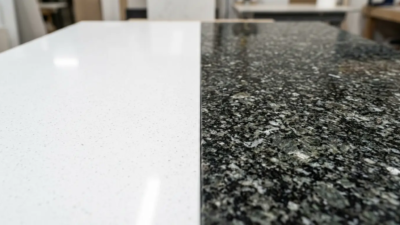
Engineered stone is a man-made material. The most common type is quartz surfacing, which is made by mixing about 93% ground quartz crystal with 7% polymer resin, pigments, and binding agents. The mixture is compressed with vacuum and vibration, and then heated to cure it. This makes a thick, non-porous slab that has the same color and pattern all the way through.
The most valuable thing about engineered stone for business is that it is always the same. This is because of how it is made. Every slab in a production batch is made to the same color standard. There is no porosity in any square inch of a slab. There is no maintenance needed on any of the surfaces of any of the slabs. For business projects where cleanliness, consistency, and no-maintenance performance are important, these are not small benefits.
| The short answer is
Quartz is about 93% ground quartz crystal and 7% polymer resin. The resin is what keeps it from being porous, and it’s also what makes it not good for outdoor use, where UV rays break it down in 1 to 3 years. |
What is natural stone?
Granite, marble, quartzite, travertine, limestone, sandstone, and slate are some of the most important types of natural stone that are quarried directly from geological formations in the earth. The mineral makeup, hardness, porosity, and visual character of each type of stone are all different. This is because they formed under different geological conditions, which can take millions of years.
The geological origin of natural stone is also what makes it so unique, which is its most appealing feature for businesses. No two slabs taken from the same formation are the same, and no two formations in the world make exactly the same stone. A Level 3 exotic granite slab put in a hotel lobby today is, by definition, a surface that has never existed before and will never exist again in that exact way. That is what makes it worth the extra work for some uses.
It’s important to explain the difference to clients in a clear way. Engineered stone is made to be consistent. Natural stone is one of a kind. Neither is better. They are just different tools for different tasks.
| Data from the industry:
According to research by NKBA 2025, engineered quartz now makes up 62% of all commercial countertop specifications for new construction in the Southeast USA. This is up from 31% in 2020. According to the British Geological Survey, natural stone quarries around the world produce about 150 million tonnes of dimension stone each year. Most of this stone is granite and marble, which are used in buildings. According to NSI data, natural stone is still the most popular choice for high-end residential feature surfaces and architectural lobby installations, where a unique look is worth more in design. |
The one thing you should remember is:
Engineered stone: every slab is the same color, has the same porosity, and needs the same amount of care. Natural stone is unique because of its geology. No two slabs are the same, and the porosity of each type of stone changes, so the frequency of maintenance also changes.
The table below compares all the factors that are important to the decision to buy engineered or natural stone, such as the properties of the materials and the cost of the entire lifecycle:
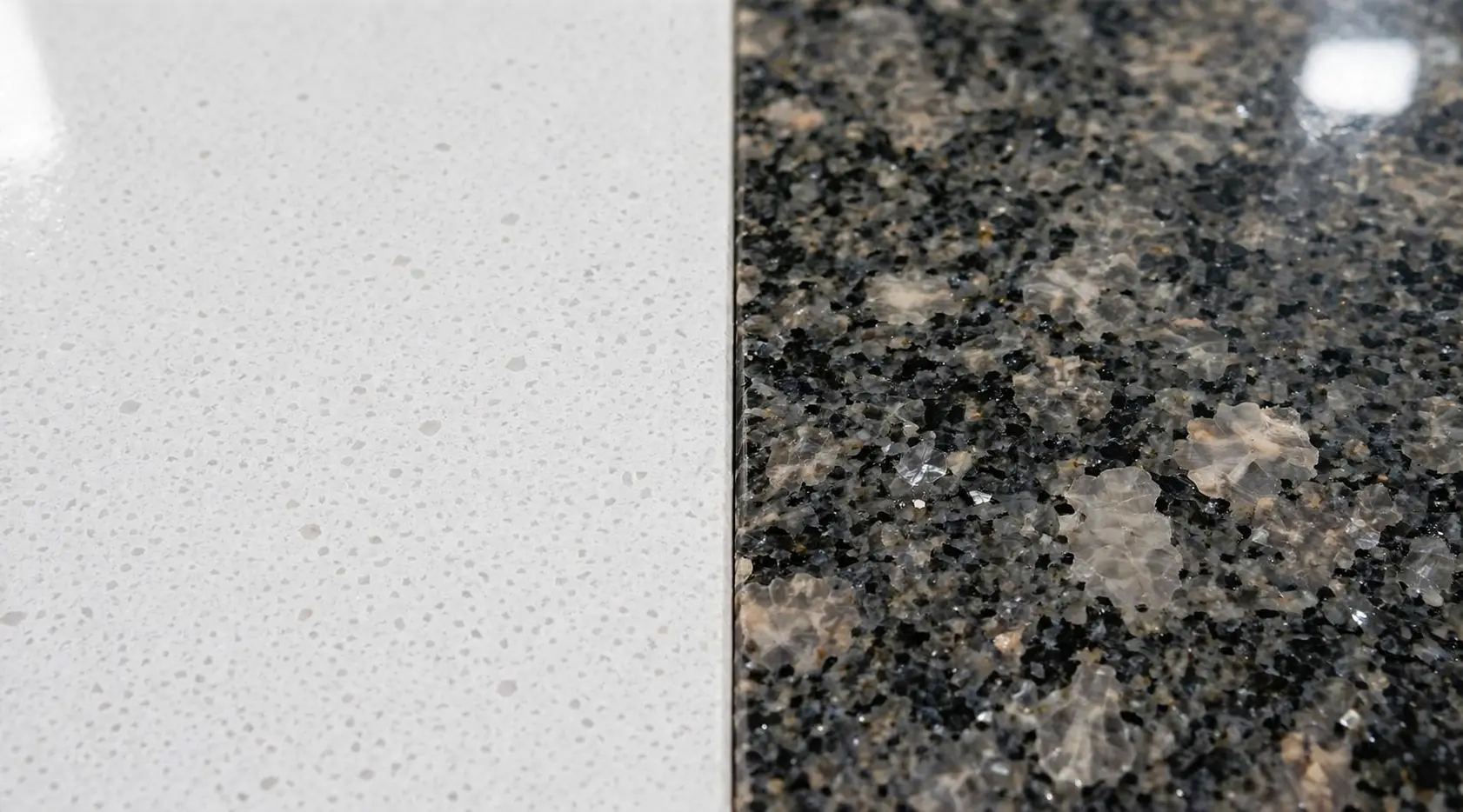
- A complete comparison of engineered stone and natural stone
Every important factor that goes into making a contractor specification decision, looked at directly across 12 dimensions, with real-world effects on both residential and commercial projects.
This table is meant to be used during the specification stage. The right column explains what each technical difference means for the contractor, the building owner, and the facility management team that is in charge of the building’s surfaces over its lifetime.
| Factor | Engineered Stone (Quartz) | Natural Stone (Granite / Marble) | What It Means for Contractors |
| Composition | 93% quartz crystal + 7% polymer resin | 100% natural mineral — quarried | Engineered: consistent properties. Natural: properties vary by stone type and grade. |
| Porosity | Non-porous — permanently | Varies: granite porous, marble very porous | Engineered: zero sealing ever. Natural: annual sealing required (granite) to frequent (marble). |
| Maintenance | Zero — wipe clean, nothing more | Annual sealing at minimum | Over 10 years in a commercial building, the maintenance cost gap accumulates significantly. |
| Colour consistency | Consistent across production batches | Every slab unique — natural variation | Engineered: multi-unit projects can match perfectly. Natural: each slab has individual character. |
| UV outdoor use | Not suitable — resin degrades | Granite: fully UV-stable. Marble: not recommended outdoors. | Any outdoor surface: granite only. No engineered stone outdoors under any condition. |
| Visual uniqueness | Engineered — consistent pattern | Every slab a unique geological event | Natural stone Level 3 for feature surfaces. Engineered for standardised commercial fit-outs. |
| Hardness | Mohs 7 — very hard | Granite: 6–7. Marble: 3–4. Quartzite: 7. | Granite and quartz: equal commercial durability. Marble: softer, scratches more easily. |
| Heat resistance | Good — avoid sustained direct heat | Granite: excellent. Marble: good. | Granite for heavy cooking environments. Quartz and marble for most other commercial use. |
| Hygiene compliance | Non-porous — meets standards by default | Requires sealing to maintain compliance | Engineered: food service and healthcare standard by default. Natural: maintenance programme needed. |
| Lot matching at scale | Reliable — batch-confirmed production | Level 1–2 manageable. Level 3 difficult. | Multi-unit developments: engineered stone is the reliable specification for consistent colour. |
| 10-year lifecycle cost | Lower — zero maintenance | Higher — sealing adds recurring cost | Engineered delivers lower total ownership cost in most commercial applications over 10 years. |
| Price range (wholesale) | Level 1: entry. Level 3: premium. | Level 1: entry. Level 3 / exotic: premium. | Both available across full grade range — match specification to project tier and application. |
| Short answer:
Porosity is the most important difference between engineered and natural stone when it comes to business. It’s not hardness, appearance, or price. Engineered: no porosity and no need for maintenance. Natural: has holes that let things through to different degrees and needs to be sealed at different times. Are you trying to decide between engineered stone and natural stone for your next project? Let us know what kind of project you have, how big it is, and how you plan to use it. We’ll recommend the best stone type and grade and give you a confirmed wholesale quote within two business days. +1 704-951-7822 | packuniversesupply.com/request-a-quote |
- What Each Type of Natural Stone Is and When to Use It
“Natural stone” isn’t just one type of stone; it’s a group of six different types of stone that are very different in terms of hardness, porosity, maintenance needs, and best commercial uses.
A lot of specification mistakes begin here. If a contractor says “natural stone” without saying whether it’s granite or marble, or quartzite or travertine, they’re letting the person who supplies the material decide how to use it. The table below lists the six most important types of natural stone for business in 2026.
| Natural Stone | Hardness (Mohs) | Porosity | Sealing Frequency | Best Commercial Application |
| Granite | 6–7 | Moderate porous | Every 12 months (standard). Every 6 months (food service/healthcare) | Outdoor countertops, luxury lobbies, feature surfaces, architectural applications |
| Marble | 3–4 | Very porous | Every 3–6 months | Luxury bathroom vanities, hospitality feature walls, high-end residential feature surfaces |
| Quartzite | 7 | Low-moderate porous | Every 12 months | Mid-to-luxury residential countertops, outdoor surfaces (UV-stable, unlike engineered stone) |
| Travertine | 3–4 | Very porous (natural voids) | Every 3–6 months | Feature walls, flooring (filled and sealed), luxury residential and hospitality interiors |
| Limestone | 3 | Very porous | Every 3–6 months | Interior feature walls, heritage and period architecture, luxury hospitality lobbies |
| Sandstone | 6–7 | High porosity | Every 6–12 months | Exterior cladding, landscape features, outdoor applications (UV-stable natural material) |
The Marble Talk That All Contractors Should Have
Marble is the most commonly misused natural stone in commercial construction. This is usually because the client or architect asked for it based on how it looks without fully understanding how to care for it. Mohs rates marble between 3 and 4, which makes it much softer than granite or quartz. Because it is so porous, it needs to be sealed every three to six months in business use. When it comes into contact with acidic things like wine, citrus, or cleaning products, it etches the surface and leaves dull marks that can’t be wiped away.
Marble is a beautiful choice for a luxury residential bathroom vanity top or a boutique hotel feature wall where the surface is professionally cleaned and the client knows what they’re getting into. Marble is a maintenance problem in a commercial kitchen, a busy restaurant bar top, or a healthcare facility because it will show signs of wear and tear within 12 to 18 months of regular cleaning.
One of the most important talks to have early on is about marble. Some clients who love how marble looks in a showroom have trouble with how it looks in a commercial kitchen after 18 months. Setting the right expectations at the specification stage protects the relationship with the client.
| ⚠ Real Risk, Real Consequence:
The danger is choosing marble for a busy commercial surface, like a kitchen counter, restaurant bar, or café counter, based on how the client wants it to look without making it clear what the maintenance needs are. The result is visible etching, staining, and surface damage within 12 to 18 months of commercial use. After that, a client blames the contractor for not giving them enough information during the specification stage. |
| In a hurry:
Marble rates Mohs 3 to 4, which is a lot softer than granite (6–7) or quartz (7). It etches when it comes into contact with acids, and in commercial settings, it needs to be sealed every 3 to 6 months. Great for the right use. Incorrect specification for commercial surfaces with a lot of traffic. |
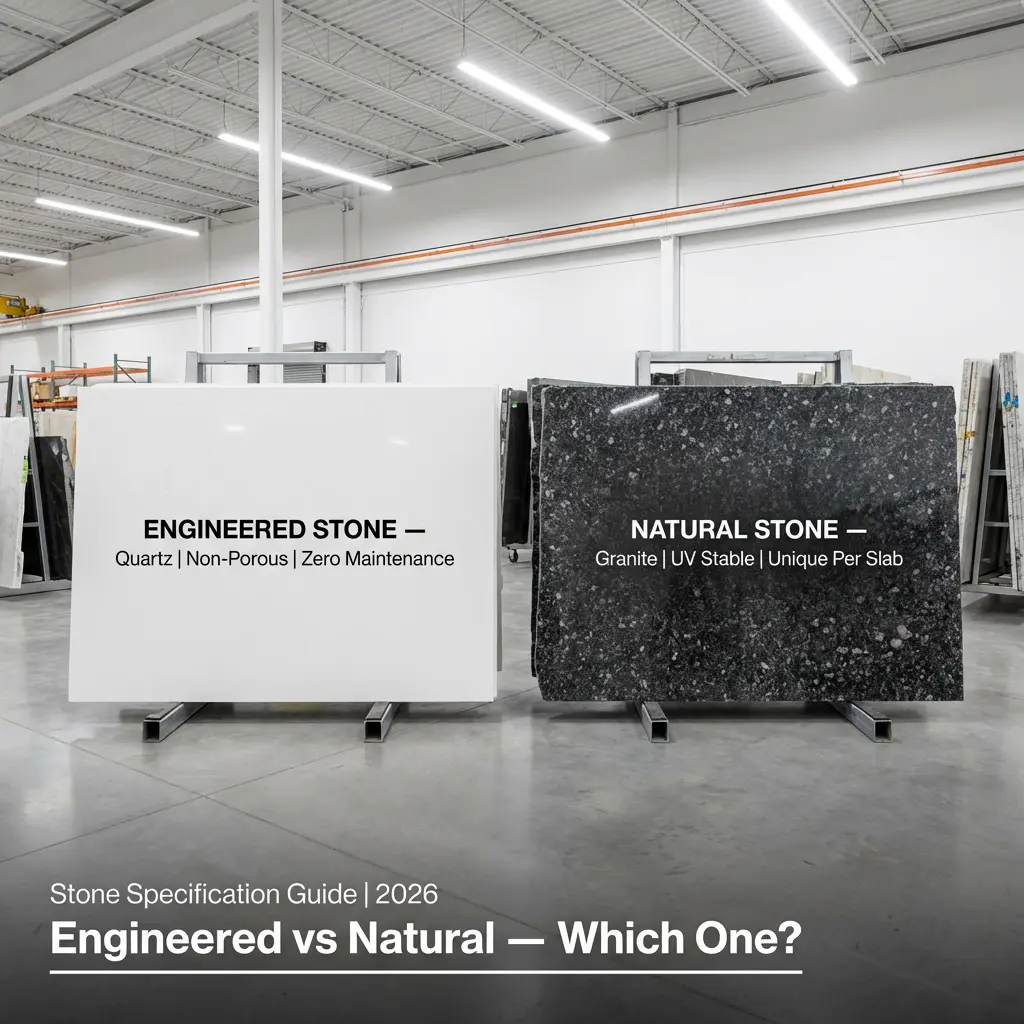
Engineered or Natural Stone: The Best Choice for Any Project
The application decision table below lists 12 types of commercial and residential projects, along with the recommended type of stone, the grade, and the reason for each recommendation.
Before you order a lot of stones, use this table. The “Choose” column shows what the specification choice is. The “Why” column tells you why, which is what you need to tell a client, architect, or building owner who asks about the decision.
| Application | Choose | Why |
| Multi-unit residential kitchens (20+ units) | Engineered (Quartz) | Colour consistency across all units. Lot-matched production. Zero maintenance for buyers and tenants. |
| Hotel room bathroom vanities | Engineered (Quartz) | Consistent across all rooms. No maintenance programme for housekeeping. Non-porous in high-turnover use. |
| Commercial food service countertops | Engineered (Quartz) | Non-porous meets hygiene compliance by default. No sealing documentation required. |
| Healthcare facility surfaces | Engineered (Quartz) | Non-porous mandatory for most healthcare regulatory environments. Zero bacteria harbour. |
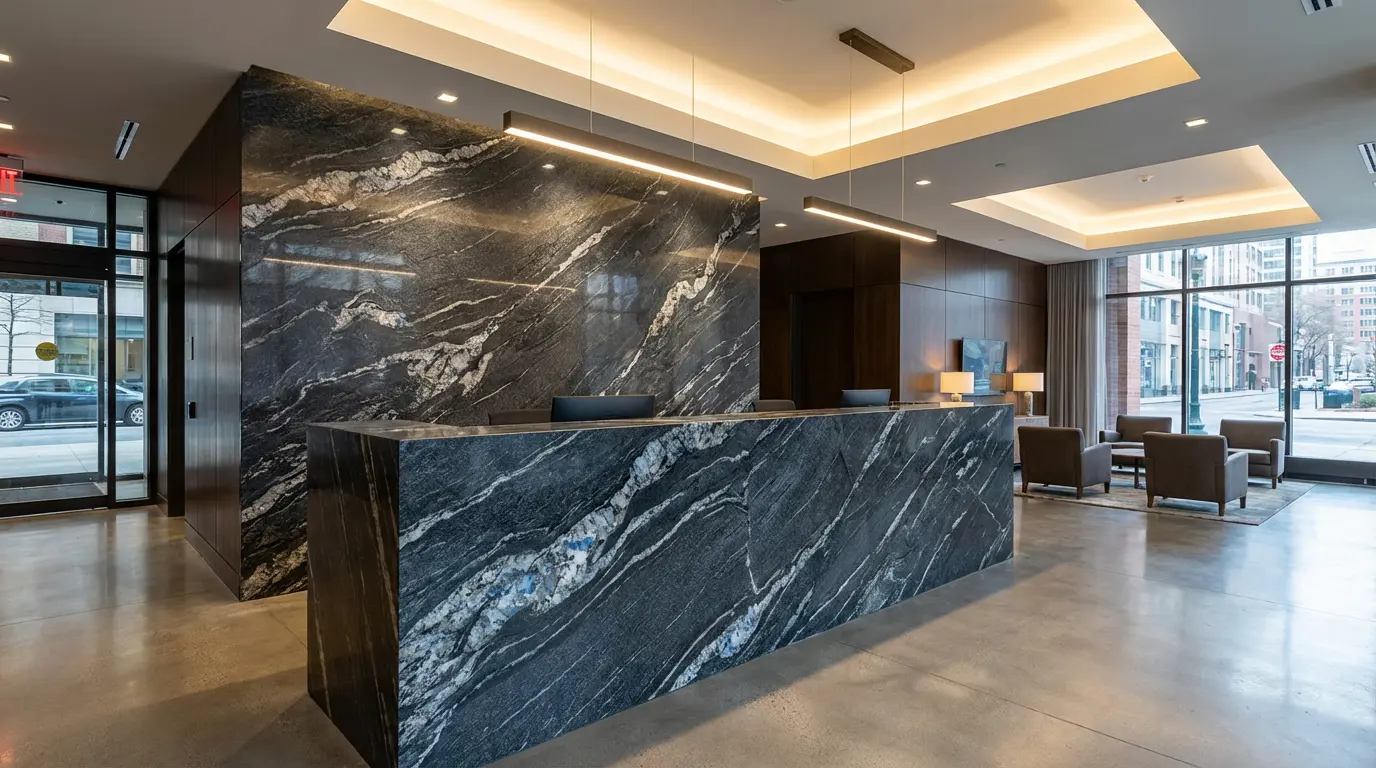
| Hotel lobby feature counter | Natural (Granite Level 3) | Uniqueness is the design intent. No engineered surface can replicate one-of-a-kind exotic granite. |
| Luxury residential kitchen island | Natural (Granite L3) or Engineered (Quartz L3) | Both are correct — brief determines. Granite: uniqueness. Quartz: zero maintenance. Client decides. |
| Outdoor commercial kitchen or pool surround | Natural (Granite only) | UV degrades engineered stone resin. Quartzite also suitable. No quartz or marble outdoors. |
| Corporate office fit-out — general | Engineered (Quartz) | Consistent across all floors. Professional neutral aesthetic. Zero maintenance programme. |
| Luxury bathroom vanity — residential | Natural (Marble) or Engineered (Quartz) | Marble: premium visual. Quartz: zero maintenance. Budget and client brief determine the choice. |
| Retail chain rollout — multiple locations | Engineered (Quartz) | Identical appearance across all locations. Batch variation in natural stone visible at retail scale. |
| Architectural feature wall — commercial | Natural (Granite L3 or Marble) | The visual drama of natural stone is the specification intent. Engineered cannot deliver this. |
| Build-to-rent kitchen — high turnover | Engineered (Quartz Level 1) | Non-porous resists staining under rental use. No maintenance between tenancies. Low lifecycle cost. |
Having this table in front of a client is helpful because it changes the topic from personal preference to application logic. Most clients who want a certain material at first will agree to a better specification if the reasons are clear and the framing is professional.
| Answer quickly:
The most common mistake when it comes to engineered vs. natural stone is making the same choice for every surface in a project based on one preference. The right way to do it is to use engineered stone on operational surfaces and natural stone on feature surfaces. |
| The most important thing to remember is
Most projects need both engineered and natural stone. Engineered stone is used for operational surfaces where consistency and no maintenance are important, while natural stone is used for feature surfaces where uniqueness and visual drama make the maintenance worth it. The mistake is to only use one across the whole project. |
- The Contractor Buying Guide: Things to Know Before You Buy Either Type of Stone
Making the specification choice is only half the work. Before ordering a lot of either engineered or natural stone, every contractor needs to check with their supplier on five things.
- Check that the supplier owns the stock, not just the listing.
The first thing to find out when buying a lot of engineered or natural stone is whether the supplier actually owns and stores the slabs they are selling. A supplier who is brokering, or getting things from a third party to sell, can’t confirm lot numbers, can’t promise when things will be delivered, and can’t replace damaged slabs from the same production batch. Before placing a bulk order that poses a significant project risk, make sure to confirm a specific warehouse address.
- Check the Production Lot Number Before the Order Leaves
For engineered stone used in multiple-unit projects, lot confirmation makes sure that all the slabs come from the same production batch, so that all the units have the same color and pattern. Lot confirmation makes sure that the slab character of the first delivery matches the slab character of any later deliveries for natural stone Level 2 and Level 3. NSI quality standards say that lot confirmation before shipping is the best way to keep colors from being inconsistent in large-scale stone installation.
- For Level 2 and up, ask for a sample or slab photo.
Ordering engineered or natural stone at Level 2 or higher without a sample or slab photo from the current lot inventory is a risk to the specifications. The veining pattern of engineered stone Level 2 and 3 can change from one production run of the same color to the next. By definition, the quality of natural stone Level 2 and 3 changes from slab to slab. As a standard service, a trustworthy wholesale supplier will send you pictures of the current lot before you place a large order.
- Know the Suitability for Outdoor Use Before Specifying
Engineered stone can’t be used outside because the polymer resin breaks down in 1 to 3 years, no matter how much coverage or indirect exposure it gets. Granite and quartzite are the only types of natural stone that are completely UV-stable and can be used outside. Depending on the climate, exposure, and use, marble, limestone, travertine, and sandstone are all good for outdoor use to different degrees. Before you choose any natural stone for an outdoor commercial or residential installation, check with your supplier.
- Figure out the total cost of the lifecycle, not just the cost of installation.
It’s not too hard to compare the installation costs of engineered stone and natural stone. The total lifecycle cost comparison is where the real value of the specification shows up. Engineered stone: no cost for sealing, no cost for maintenance, and no downtime for the building’s surface. Natural stone: a yearly sealing program that costs money for labor, chemicals, and time when the surface is not being used. Over 10 years, this cost difference adds up a lot in a commercial building with a lot of stone surfaces.
How Pack Universe Supply takes care of this:
| Our Charleston, SC warehouse has all grades of engineered quartz and natural stone (granite, marble) in stock.
For any bulk order of engineered or natural stone, we check the lot numbers before shipping, send slab pictures on request for Level 2 and above, and give a confirmed wholesale quote within two business days. We can also tell you if a certain stone in our current inventory is good for outdoor use before you tell a client about it. If you’re not sure, call +1 704-951-7822 before your first order. Get wholesale engineered or natural stone for your next project: All grades and colors of quartz (engineered), granite, and marble, all lot-matched. Charleston, South Carolina (USA) | Burlington, Ontario (Canada) | Delivery across the country. No minimum order for the first time. |
| → Get a Quote: packuniversesupply.com/request-a-quote
→ Call: +1 704-951-7822 (Monday through Friday, 8 a.m. to 5 p.m. EST) → Canada: +1 (647) 362-1907 | WhatsApp: button on packuniversesupply.com |
Decision: Engineered Stone or Natural Stone?
The decision is:
The answer is almost always both, but it depends on the surface you are talking about.
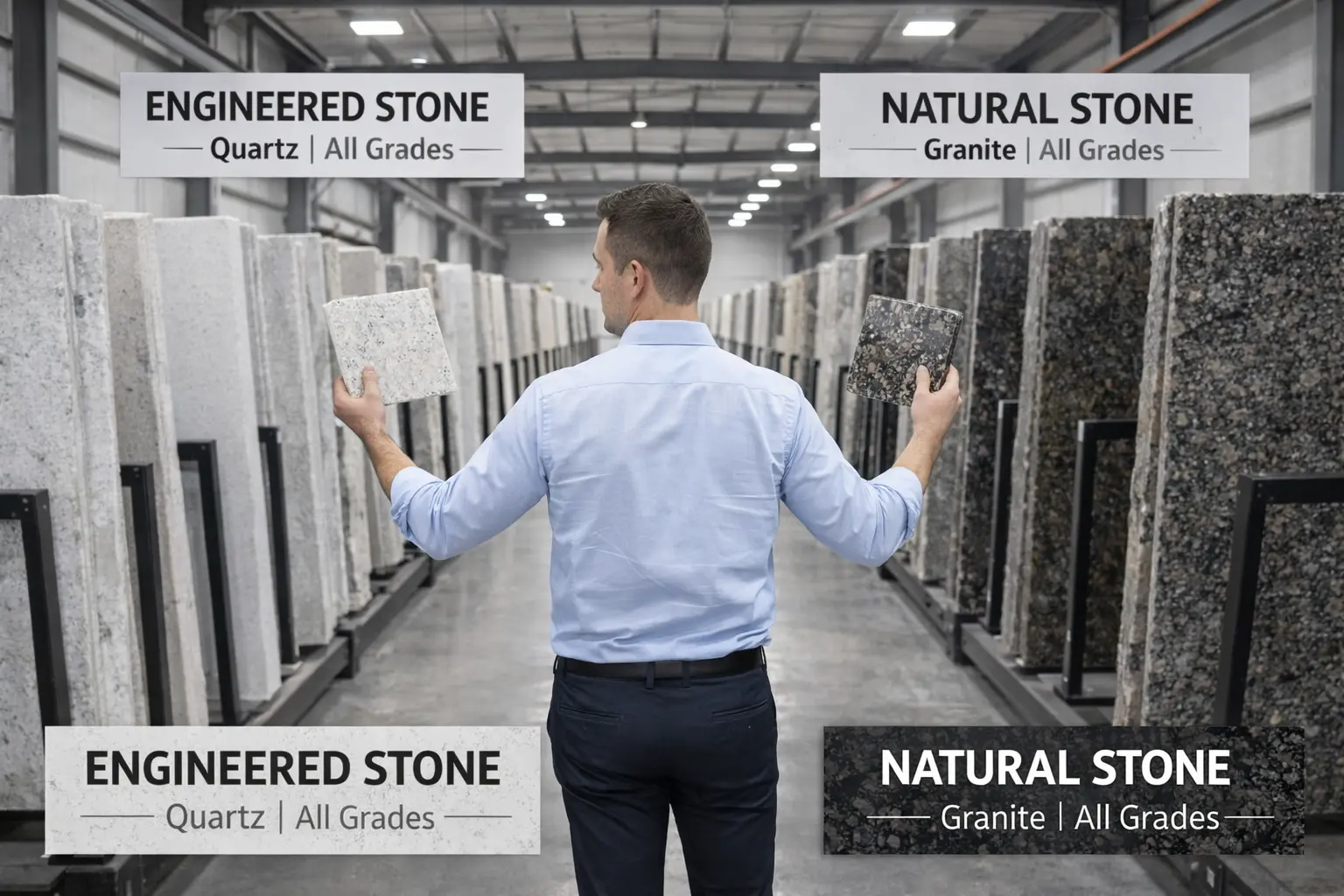
Engineered stone (quartz) is the best choice for operational surfaces where hygiene, consistency, and no maintenance costs are important. This includes hotel rooms, commercial kitchens, healthcare facilities, multi-unit residential developments, corporate office fit-outs, and build-to-rent kitchens. In 2026, this specification will be the best for these uses because it is consistently made, never porous, and doesn’t need any maintenance.
Natural stone is the best choice for feature surfaces where the goal is to create something unique, visually dramatic, and true to the character of a one-of-a-kind geological material. Examples include hotel lobby counters, luxury residential feature islands, architectural feature walls, and corporate reception statement surfaces. The same quality that makes natural stone harder to work with also makes it impossible to find a replacement for these uses.
When you need operational reliability, choose engineered stone. Use natural stone when you want to make an impression that nothing else can. Both are needed for most important business projects.
| Other Guides:
→ Is quartz or granite better for countertops in businesses? LINK: /blog/which-is-better-commercial-countertops-granite-or-quartz → Is quartz better than granite for building things in general? LINK: /blog/is-quartz-better-than-granite-commercial-construction → What sets Level 1, Level 2, and Level 3 granite apart from each other? LINK: /blog/level-1-vs-level-2-vs-level-3-granite-contractor-guide → Why are business contractors moving from ceramic tiles to quartz? LINK: /blog/why-contractors-switching-ceramic-tile-to-quartz-commercial → What is the best way to find a trustworthy wholesale stone supplier in the US? LINK: /blog/how-to-find-reliable-wholesale-stone-supplier-usa |