How to Match Countertops with Flooring in Large Developments
How to Match Countertops with Flooring in Large Developments [2026 Developer Guide]
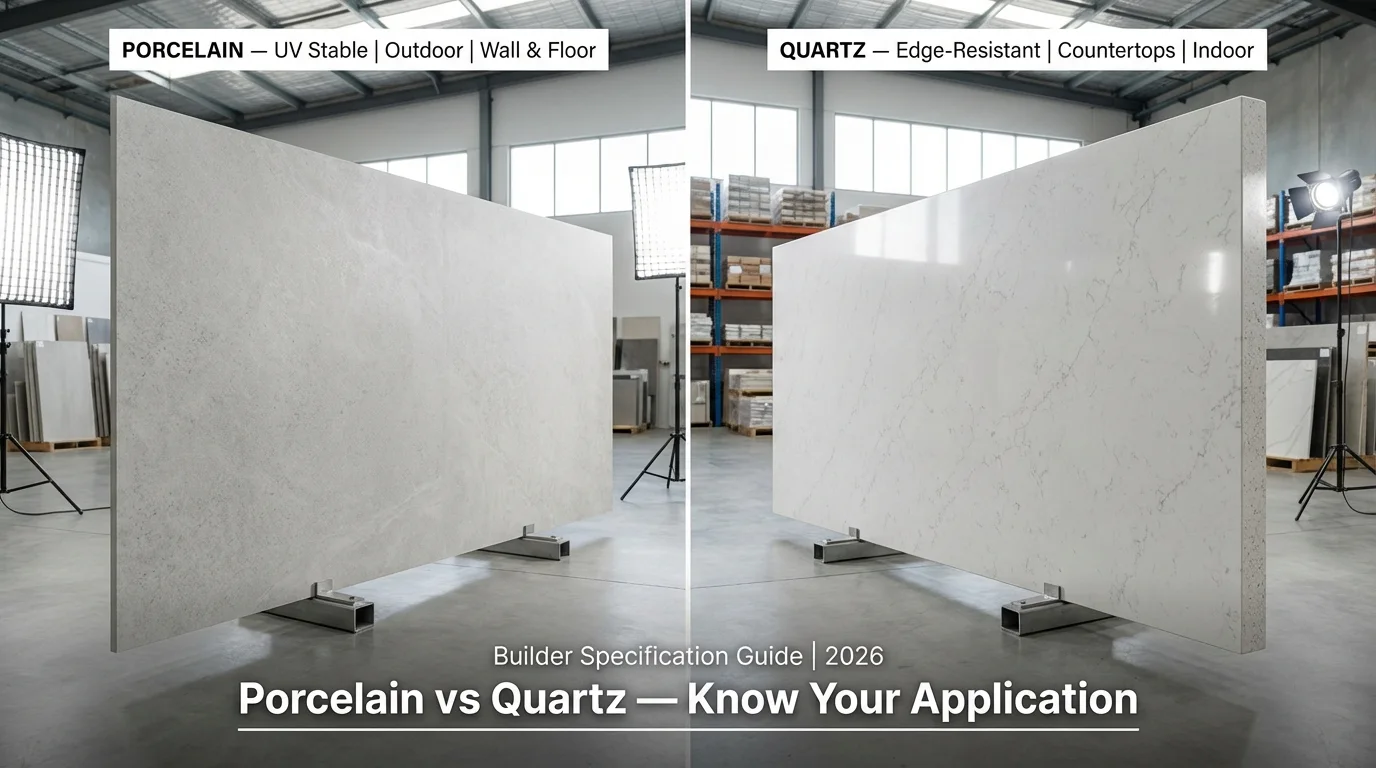
A practical 2026 guide for developers, builders, and project managers on coordinating countertop and flooring specifications across large residential and commercial developments — covering tonal palette rules, material sequencing, lot confirmation across both surfaces, a 7-combination tonal reference table, and an 8-tier development specification guide.
| How do you match countertops with flooring across a large residential or commercial development?
Consistent material matching across a large development is achieved through three coordinated decisions: a single confirmed lot for all countertop stone, a complementary flooring specification confirmed before countertop orders ship, and a tonal palette rule that prevents clashing at the junction between floor and counter. Getting the sequence right matters as much as the materials chosen. The five rules that govern countertop-to-floor matching at development scale: Confirm the flooring specification first: The floor is the larger visual surface. It anchors the palette. The countertop should respond to the floor — not the other way around.Match tone, not pattern: Countertop and floor do not need to be the same stone or colour. They need to be in the same tonal range — warm to warm, cool to cool. Avoid same-material countertop and floor: Quartz countertop on a quartz floor, or granite on granite, looks flat. Contrast within the same tonal range reads as intentional and high quality. Confirm lot numbers on both materials before any delivery: Visible variation between units on either surface destroys the consistency that a coordinated specification is designed to create.Scale the specification to the market tier: Level 1 countertop with entry porcelain flooring for build-to-rent. Level 3 countertop with premium large-format stone flooring for luxury. Both countertop stone and flooring stocked at Pack Universe Supply — wholesale contractor pricing, no minimum first order.Call +1 704-951-7822 | packuniversesupply.com/request-a-quote |
The countertop and floor are the two surfaces that every buyer, tenant, and guest sees simultaneously when they walk into a unit.
Getting the pairing wrong across 100 units is not a design oversight — it is a valuation problem.In a single residential project, a countertop and floor combination that does not work is inconvenient. In a 100-unit apartment development, a 60-room hotel, or a multi-location retail rollout, a mismatched or inconsistent surface pairing is visible in every unit, every room, and every location simultaneously. The developer who delivered them all carries the conversation with the building owner, the tenants, and the buyers at handover.Matching countertops with flooring at development scale is not primarily a design decision — it is a procurement decision. The materials need to be specified in the right sequence, ordered from confirmed production lots, and coordinated for tonal compatibility before a single slab or tile is cut. This guide covers how to do all of that correctly.
Data from NKBA specification research, NSI installation guidelines, and NAHB developer purchasing surveys throughout.
- The Sequencing Problem — Why Order of Specification Matters
The most common countertop-floor mismatch in large developments is not a poor aesthetic choice — it is a sequencing error. The countertop was confirmed before the flooring was decided, and the two materials were never evaluated together before orders were placed.At development scale, material specifications are often confirmed by different people at different stages of the procurement process. The kitchen countertop may be locked by the architect in the early design stage. The flooring may be confirmed by the fitout contractor three months later from a different supplier. Neither party evaluated the two materials together. The developer discovers the tonal mismatch on the first show apartment walkthrough.
According to NAHB 2025 developer purchasing research, surface material inconsistency — visible tonal mismatch or variation between countertop and floor across units — was cited as a handover issue by building owners on 1 in 5 large residential developments. In almost all cases, the mismatch was traceable to materials being specified and ordered without a coordinated palette review before either order was placed.The show apartment walkthrough with a building owner is not the moment to discover that the countertop reads warm and the floor reads cool. That conversation should have happened at the sample board stage, before either material was ordered.
| Quick answer:
Always confirm both the countertop and flooring specification together — from physical samples or confirmed swatch references — before either order is placed. Tonal mismatches between two materials that looked acceptable in separate specification documents are only visible when placed next to each other. |
The Correct Specification Sequence for Large Developments
- Confirm the flooring specification and obtain confirmed samples or reference swatches.
Select countertop options that are tonally compatible with the confirmed flooring — evaluate from physical samples placed together, not from separate specification documents.
- Confirm the countertop specification with lot number availability verified from the wholesale supplier before client or architect sign-off.
Place both orders with confirmed lot numbers locked — countertop stone and flooring material from the same or compatible production batches.Request sample deliveries from the confirmed lots before full volume is shipped — particularly for Level 2 and Level 3 stone and premium flooring where lot variation is more visible.
- Confirm the pairing on the show apartment before rolling out across all units.Industry Data:
NAHB 2025 developer purchasing research: surface material inconsistency — visible tonal mismatch between countertop and floor across units — was cited as a handover issue on 1 in 5 large residential developments. Traceable in almost all cases to materials ordered without a coordinated palette review.NKBA 2025 specification research: developers who confirmed countertop and flooring specifications together from physical samples reported 74 percent fewer surface material handover complaints than those who specified materials separately.
- NSI installation guidelines: lot confirmation for both countertop stone and flooring stone on the same development is recommended as standard practice for any project requiring visual consistency across more than 5 units.
| The one thing to remember:
The floor is the larger visual surface in any interior space. Confirm it first. The countertop specification should respond to the floor — not lead it. Reversing this sequence is the most common origin of large development surface mismatches. |
The tonal pairing reference table below covers seven of the most common countertop specifications in large developments — with complementary flooring, what to avoid, and the reason each pairing works:
- The Tonal Rules — How Countertop and Floor Should Relate
Countertop and floor do not need to match — they need to relate. The difference between a pairing that reads as coordinated and one that reads as accidental is almost always tonal alignment, not material similarity.
The principle that governs successful countertop-floor coordination at any scale is simple: match the warmth or coolness of both materials. A cool-toned countertop — white or grey quartz, cool-grey granite — reads well with a cool-toned or neutral floor. A warm-toned countertop — cream, taupe, warm beige stone — reads well with a warm-toned floor. Placing a cool countertop next to a warm floor, or vice versa, creates a tonal tension that reads as unintentional even when neither material is objectively wrong.
Rule 1 — Match Tone, Not Material
The countertop and floor do not need to be the same stone type, the same material, or the same colour. They need to be in the same tonal range. A white quartz countertop with a warm greige porcelain floor works. A white quartz countertop with a cool light grey porcelain floor also works. A white quartz countertop with a warm amber terracotta tile does not — the tonal gap between the cool engineered stone and the warm fired clay is too wide for the pairing to read as intentional.
| Quick answer:
Tonal range is the governing rule for countertop-floor coordination. Cool with cool. Warm with warm. Neutral with either. The materials can be completely different — what matters is that their warmth or coolness is in the same register. |
Rule 2 — Use Contrast Within the Same Tonal Range
The pairing that reads most professionally in a residential or commercial development interior is not a perfect match — it is a deliberate contrast within the same tonal range. A dark countertop with a light floor. A textured floor with a smooth counter. A natural stone counter with a clean engineered floor. The contrast creates visual interest and reads as a considered design decision. The same material on both surfaces — quartz countertop and quartz floor in the same colour — reads flat and lacking in depth.The specification that reads best in a show apartment is almost never the one where the countertop and floor are too similar. It is the one where they are clearly different — but obviously belong together.
Rule 3 — Scale the Flooring Format to the Development Tier
Floor tile format — the size of individual tiles or planks — signals quality as clearly as the material itself. A 300x300mm tile in a premium residential development reads as budget regardless of the material it is made from. Large-format flooring — 600x600mm minimum at mid-range, 800x800mm or above at premium — reads as a considered specification choice. At luxury tier, full-slab porcelain panels or large natural stone slabs on the floor create the impression of quality that small-format tiles of equivalent material cannot achieve.The floor format and the countertop specification need to be in the same quality register. A Level 3 granite countertop with a small-format tile floor creates a quality mismatch that buyers and tenants notice immediately, even if they cannot articulate why. Coordinate the format scale of the flooring with the grade level of the countertop.Quick answer:
Floor tile format is a quality signal as clear as the material itself. At mid-range residential tier, 600x600mm minimum. At premium tier, 800x800mm or above. At luxury tier, large-format stone slab or full-panel porcelain. Match the flooring format scale to the countertop grade level.
- Countertop-to-Floor Tonal Pairing Reference
Seven countertop specifications paired with complementary flooring choices — including what to avoid and the reason each pairing works at development scale.
Use this table when reviewing countertop and flooring options together before confirming either order. The ‘Avoid’ column is as important as the recommendation — it flags the pairings that look acceptable on separate specification sheets but create visible tonal tension when installed together.
| Countertop Specification | Complementary Floor | Avoid | Why It Works |
| White quartz Level 1–2 | Light grey or warm white large-format porcelain | Dark charcoal tile — too much contrast for a standard unit | Tonal alignment creates visual continuity without being identical. Clean, professional, easy to maintain. |
| Light grey quartz Level 2 | Warm greige or light beige porcelain | Bright white tile — cold and clinical | The slight warmth in the floor softens the grey counter and reads as considered rather than default. |
| Calacatta-style quartz Level 3 | White or light grey honed marble-look porcelain | Busy pattern tile — competes with the counter veining | Clean floor lets the bold counter veining read as the design feature, not one of many competing elements. |
| Black or dark grey quartz Level 2–3 | Light grey or cream large-format porcelain | Dark grey tile — both surfaces compete for attention | High contrast reads premium. Dark counter, light floor. The contrast is the design decision. |
| Granite Level 2 — speckled | Mid-tone neutral porcelain or stone tile | Busy pattern tile — double natural variation is visually noisy | Neutral floor lets the natural stone character of the granite read clearly without visual competition. |
| Granite Level 3 — exotic | Light neutral large-format stone or porcelain | Another dramatic natural stone floor | One dramatic material per room. The exotic granite counter is the feature — the floor supports it. |
| Marble vanity top (residential) | Large-format white or warm stone-look tile | Same marble pattern on floor — overdone | A marble countertop with a complementary but different floor reads as sophisticated, not repetitive. |
A marble countertop with a complementary but different floor reads as sophisticated, not repetitive.Pairing guidance based on NKBA specification research 2025, NSI visual consistency standards, and Pack Universe Supply developer coordination data March 2026.The ‘Avoid’ column in this table is the one that saves the most difficult handover conversations. Almost all of the combinations in the Avoid column would have been caught at the sample board review — if the sample board review had been done before either material was ordered.
| Quick answer:
The most reliable test for any countertop-floor pairing in a large development: place physical samples of both materials side by side under the lighting conditions of the actual installation space. What works in daylight may not work under LED downlights. What works on a specification sheet almost never reliably predicts what works installed.Ordering countertops and flooring for a large development? Tell us your development type, unit count, market tier, and countertop preference — we will recommend a coordinated countertop and flooring specification and give you a confirmed wholesale quote for both within 2 business hours.+1 704-951-7822 | packuniversesupply.com/request-a-quote |
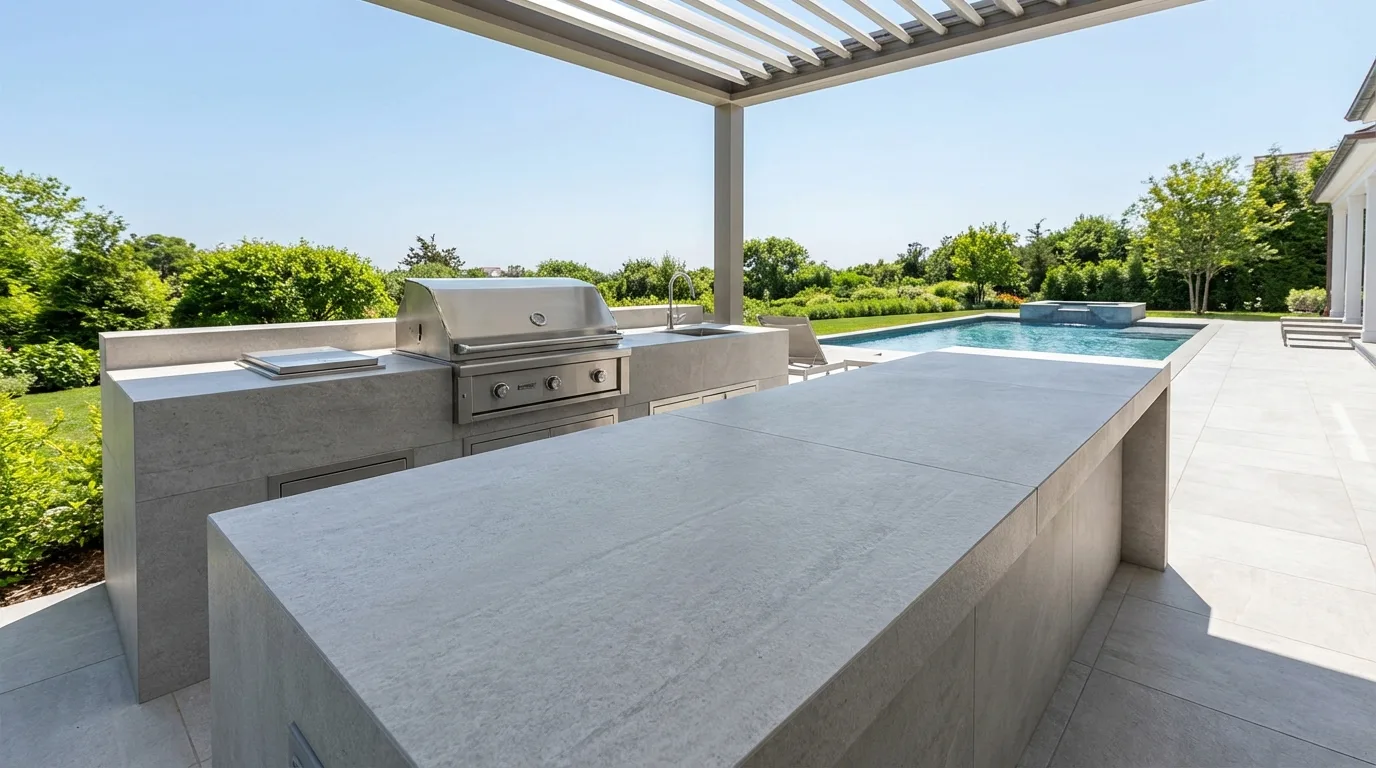
The development tier specification table below gives the right countertop and flooring pairing for every major development type — from build-to-rent to luxury residential:
- Specification by Development Tier — Countertop and Flooring Matched
The right countertop and flooring specification for every major development type — matched to the market tier and the buyer or tenant expectation at each level.Use this table at the specification stage for any large development. The coordination notes column gives the key decision point for each tier — the specific thing that distinguishes a well-executed specification at that level from one that misses the mark.
| Development Tier | Countertop Specification | Flooring Specification | Coordination Notes |
| Build-to-rent / budget | Quartz Level 1 — white or light grey | Plank-format LVT or entry porcelain — neutral tones | Keep both materials simple and consistent. Avoid visual complexity that adds cost without return. |
| Mid-range residential | Quartz Level 2 or Granite Level 2 | Mid-format porcelain in warm greige or grey | A small tonal step between counter and floor reads as considered. Avoid identical colours. |
| Premium residential | Quartz Level 3 or Granite Level 3 | Large-format porcelain or natural stone | Scale up format. 600x600mm minimum floor tile at this tier. Confirm lot numbers on both materials. |
| Luxury residential | Level 3 quartz or natural stone | Large-format stone — limestone, travertine, or premium porcelain | One statement material per space. Bold countertop: neutral floor. Neutral countertop: textured floor. |
| Hotel standard rooms | Quartz Level 2 white or grey | Plank porcelain or large-format light grey tile | Consistent across all rooms. Lot confirmation on both materials essential. Zero visual variation. |
| Hotel luxury / boutique | Quartz Level 3 or natural stone | Premium large-format stone or honed porcelain | Unique per suite is acceptable at boutique tier. Confirm material availability before client sign-off. |
| Corporate office fit-out | Quartz Level 2 | Polished or honed large-format porcelain — neutral grey | Consistent across all floors. Professional palette. No drama — the work is the visual focus. |
| Hospitality / restaurant | Quartz Level 2 front of house | Durable anti-slip porcelain — mid-tone, pattern optional | Front of house: visual. Back of house: functional. Specify both correctly for their zone. |
Tier specifications based on NKBA 2025, NAHB developer research, NSI guidelines, and Pack Universe Supply large development order data March 2026.
The difference between the build-to-rent and premium residential rows is not just the material — it is the format scale, the lot confirmation discipline, and the number of visual decisions made deliberately rather than defaulted.
Premium developments read as premium because decisions were made, not avoided.
| Quick answer:
At every development tier, the principle is the same: the countertop and floor should be in the same quality register, the same tonal range, and confirmed from the same or compatible production lots before any orders are placed. The tier determines the materials. The principles do not change. |
- Lot Confirmation Across Both Surfaces — The Step Most Developers Skip
Lot confirmation matters as much for coordinated surface specifications as it does for individual material orders — and it is the step that most large development procurement processes do not include.On a 100-unit residential development, the countertop stone must all come from the same production lot to ensure visual consistency across all 100 kitchens. This is understood by most contractors who have worked on multi-unit projects. What is less commonly understood is that the same principle applies to flooring — particularly stone or large-format porcelain flooring where production batches can show tonal variation.
A development where the countertop stone is lot-confirmed but the flooring varies between phases will still produce visible tonal inconsistency between units when both surfaces are seen together.
- For countertop stone: Ask the wholesale supplier to confirm and reserve a single production lot for the full unit count plus waste allowance before any delivery ships.
- For stone flooring: Apply the same lot confirmation requirement to any natural stone floor specification. Ask for confirmation that all tiles or slabs come from the same quarry batch.
- For porcelain flooring: Most porcelain manufacturers publish a shade variation classification (V1–V4). Specify V1 or V2 (minimal variation) for developments requiring consistency across units. Avoid V3 and V4 for multi-unit projects.
- For both surfaces together: Request sample pieces from the confirmed lots and review them together under the installation lighting before full volume is released for delivery.
|
⚠ Real Risk — Real Consequence:
The risk: confirming countertop stone lot numbers but not applying the same discipline to flooring in a large development.The consequence: units across the development show tonal consistency in the countertop but visible batch variation in the floor — creating a quality impression that undermines the coordinated specification the rest of the development delivers. |
| How Pack Universe Supply handles large development orders:
Pack Universe Supply coordinates both countertop and flooring material orders for large developments from our Charleston, SC warehouse.For developments over 20 units: we confirm production lot numbers on countertop stone before dispatch and can advise on porcelain flooring shade variation classifications for coordinated ordering.We can provide sample pieces from confirmed production lots for both surfaces simultaneously — for review under installation lighting before volume orders are released. Call before placing any large development countertop or flooring order: +1 704-951-7822.Order Coordinated Countertop and Flooring for Your Development — No Minimum First Order: Granite, quartz, marble, and flooring — all from one wholesale account. Lot-matched. Nationwide delivery.Charleston SC (USA) | Burlington ON (Canada) → Request a Quote: packuniversesupply.com/request-a-quote → Call: +1 704-951-7822 (Mon–Fri, 8am–5pm EST) → Canada: +1 (647) 362-1907 | WhatsApp: button at packuniversesupply.com |
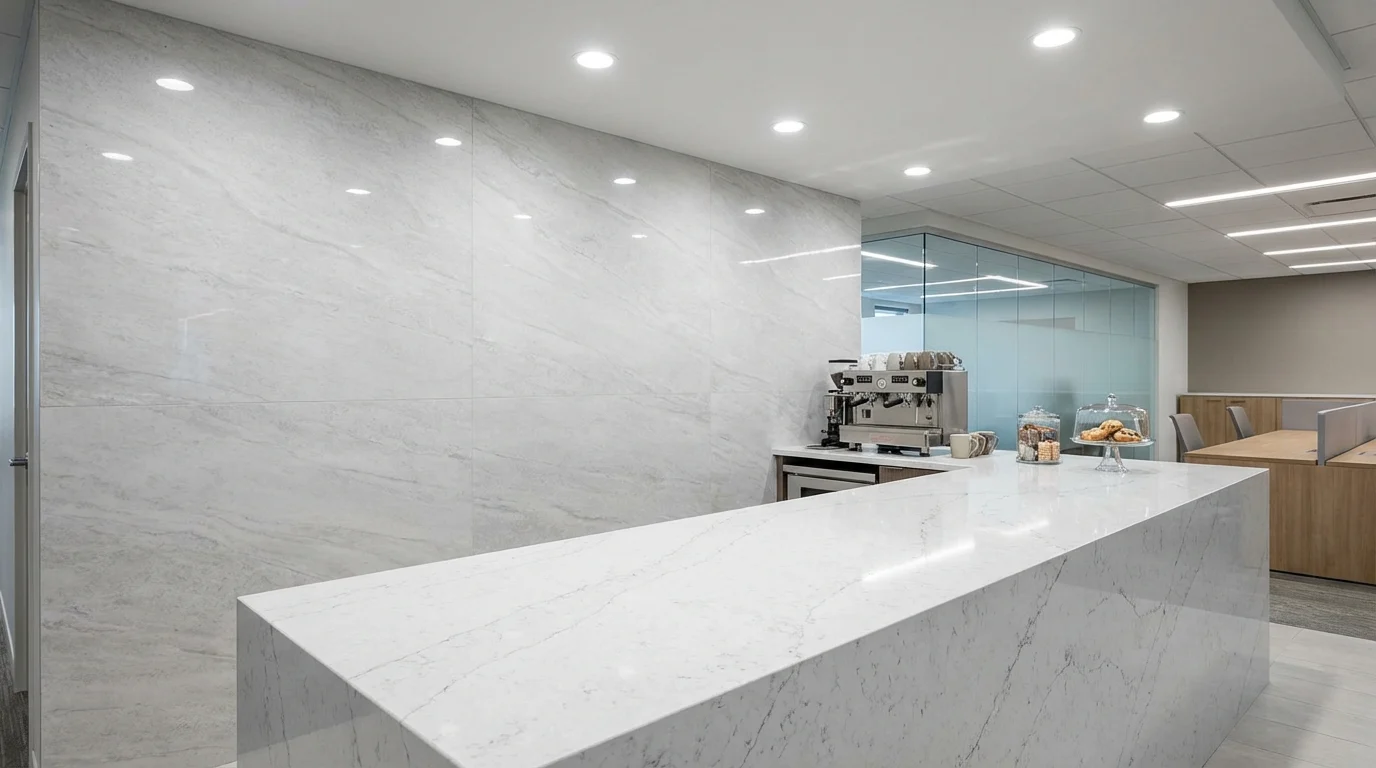
Verdict — How to Get Countertop-Floor Matching Right Across a Large Development
Verdict:
Three decisions — made in the right order — determine whether the countertop and floor pairing across a large development reads as coordinated or accidental.
- First: confirm the flooring before the countertop. The floor is the larger surface and sets the tonal register that everything else responds to.
- Second: evaluate both materials together from physical samples under the actual installation lighting before either order is placed.
- Third: confirm lot numbers on both surfaces before any delivery ships — countertop stone and flooring from matched or compatible production batches.The developments that pass the show apartment walkthrough without a surface pairing conversation are the ones where these three decisions were made deliberately, in sequence, before the procurement process began.
The ones that fail are the ones where both surfaces were specified separately by different people at different stages and never reviewed together.
Sources & References: Pack Universe Supply large development order and coordination data, March 2026
| Related Guides:
→ What is the difference between Level 1, Level 2, and Level 3 granite?LINK: /blog/level-1-vs-level-2-vs-level-3-granite-contractor-guide
→ What are the best quartz colours for kitchen countertops in 2026?LINK: /blog/best-wholesale-quartz-slab-colors-kitchen-countertops-2026 → Commercial vs residential countertops — key differences for contractors?LINK: /blog/commercial-vs-residential-countertops-key-differences-contractors → How do I reduce countertop material costs without compromising quality?LINK: /blog/how-to-reduce-stone-material-costs-without-compromising-quality |
About the Author
Sam Michaele 15 years of direct experience supplying coordinated countertop and flooring materials to developers across the USA and Canada. Pack Universe Supply operates wholesale warehouses in Charleston, SC (USA) and Burlington, ON (Canada).