How to Reduce Stone Countertop Material Costs Without Compromising Quality [2026]
How to Reduce Stone Countertop Material Costs Without Compromising Quality [2026]
Seven practical cost reduction strategies for contractors ordering stone countertops in bulk — none of which involve specifying cheaper stone. Covers wholesale pricing verification, grade-to-market matching, quantity calculation, supplier consolidation, specification lock-in, lifecycle cost calculation, and contractor trade accounts. With realistic savings data on each strategy. NAHB, NKBA, and NSI data throughout.

| How do contractors reduce stone countertop material costs without compromising quality?
Seven strategies — none of which involve specifying cheaper stone. The biggest cost savings in stone countertop procurement come from where you buy, how much you order, when you lock the specification, and whether you are calculating installation cost or total lifecycle cost. Getting these decisions right can reduce material cost by 30 to 50 percent on the same quality specification. The seven cost reduction strategies: • Switch to a genuine wholesale supplier: The single biggest cost lever — 40 to 70 percent less than retail trade pricing for the same stone. • Match grade to market tier before ordering: Avoid paying Level 3 material cost for a project that only delivers Level 1 or Level 2 value. • Order correct quantity first time: Emergency re-orders cost 20 to 40 percent more and often come from a different lot. • Consolidate stone types under one account: Single supplier, single delivery, single account — eliminates duplicate overhead across a project. • Lock specification before templating: Every change after templating adds $200 to $800 per event. Zero changes = zero change cost. • Calculate lifecycle cost not installation cost: Quartz at a higher per-sqft installation cost is often 30 percent cheaper over 10 years than granite. • Open a contractor trade account: Volume pricing tiers, priority stock access, and consistent pricing across all orders. All seven explained below — with the realistic saving on each one. |
The most reliable way to reduce stone countertop material costs is not to order cheaper stone. It is to stop paying more than the material is worth — which is a different problem with a different set of solutions.
Most contractors who overpay for stone countertop materials are not ordering the wrong stone. They are ordering the right stone from the wrong supplier, in the wrong quantity, at the wrong grade for the project tier, or comparing the wrong cost — installation price instead of 10-year total cost. None of these problems require a specification compromise to fix. They require better information at the decision stage.
This guide covers seven cost reduction strategies that work on the same quality specification. Every saving identified here is achievable without changing what the client receives — only changing how the contractor procures it. Real cost data from NAHB, NKBA, and NSI throughout.
The cost reduction summary table below gives all seven strategies at a glance — with the realistic saving on each and what changes in practice:
| # | Strategy | Realistic Saving | What Changes in Practice |
| 1 | Switch to genuine wholesale supplier | 40–70% on material cost vs retail trade pricing | Verify warehouse address and confirm pricing on a test order before switching all procurement. |
| 2 | Match grade to market tier | 15–40% per sqft vs next grade up | Decide grade before calling supplier — not during the order call under time pressure. |
| 3 | Order correct quantity with waste allowance | 20–40% premium eliminated on re-orders | Add 15–25% waste allowance to every stone order. Never order net area only. |
| 4 | Consolidate stone types under one account | 5–15% across delivery and admin cost | Single supplier account for granite, quartz, marble, and flooring across all projects. |
| 5 | Lock specification before templating | $200–$800 per change event eliminated | Pre-templating client sign-off document. No changes without a written change order. |
| 6 | Calculate lifecycle not installation cost | Up to 30% lower over 10 years with right spec | Include 10-year maintenance cost in every commercial stone specification comparison. |
| 7 | Open a contractor trade account | Volume discount tiers + consistent pricing | Ask any wholesale supplier about their contractor account programme after first order. |
Cost estimates based on NAHB contractor purchasing data 2025, NSI fabrication guidelines, and Pack Universe Supply market analysis March 2026.
| Industry Data:
A 2025 NAHB contractor purchasing survey found that contractors who verified supplier type — genuine wholesale versus retail trade pricing — before placing bulk stone orders reduced average material cost by 38 percent on equivalent grade specifications. The same survey found that emergency re-ordering mid-project adds an average 22 percent premium to the original material cost, and occurs on approximately 1 in 3 countertop projects where no waste allowance was calculated. NKBA 2025 data: facilities using quartz in commercial buildings reported 23 percent lower annual stone maintenance costs than those using granite — reducing 10-year total ownership cost significantly despite similar installation cost. Sources: NAHB Contractor Purchasing Practices Survey 2025 (nahb.org) | NKBA Commercial Survey 2025 (nkba.org) | NSI Guidelines (naturalstoneinstitute.org) |
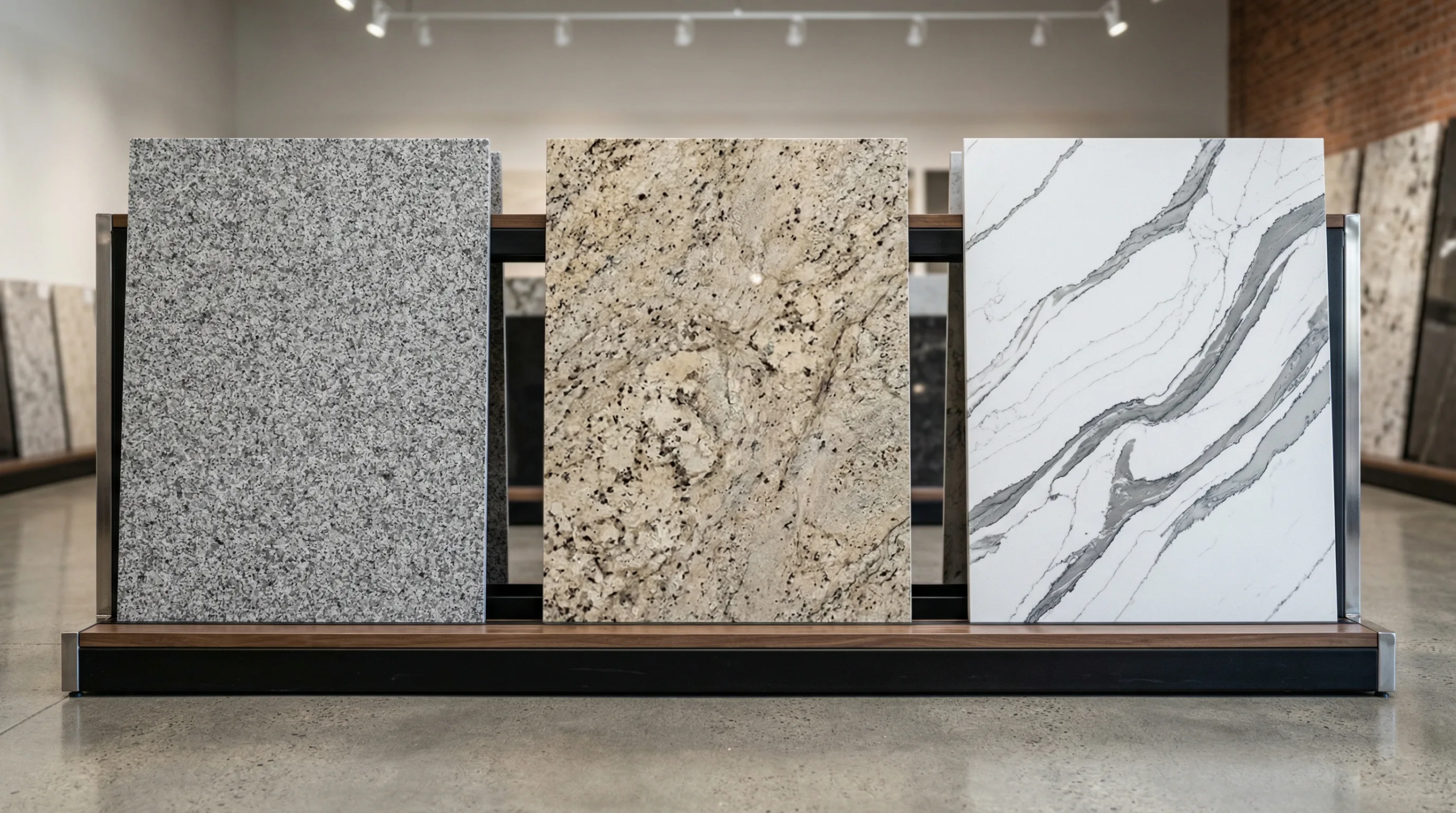
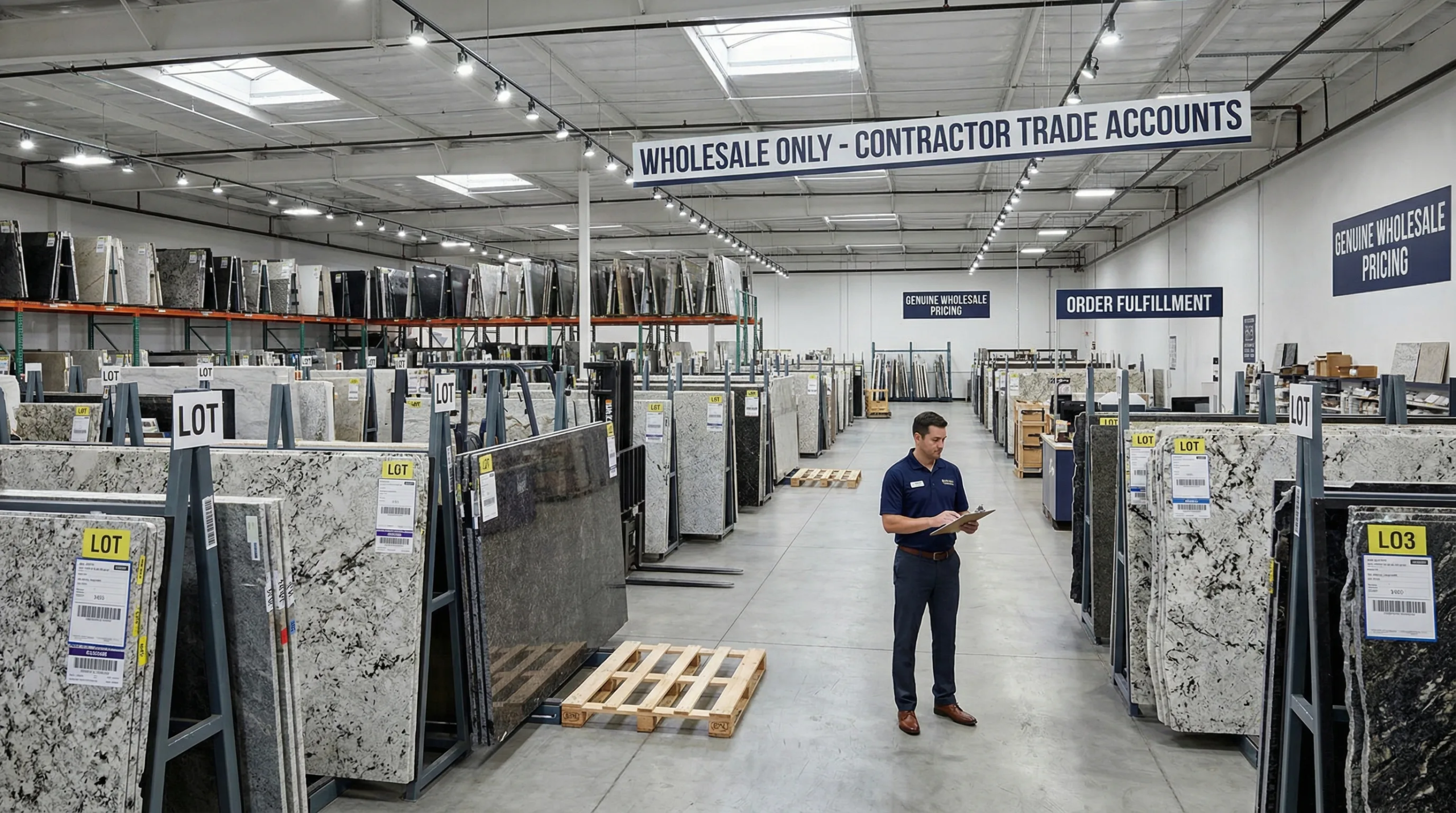
See below how a contractor who plans the stone procurement process correctly avoids every cost premium in this guide — the planning stage is where all seven savings are captured:
Strategy 1 — Switch to a Genuine Wholesale Supplier
The single largest cost lever available to any contractor ordering stone is the type of supplier they use — not the grade of stone they order.
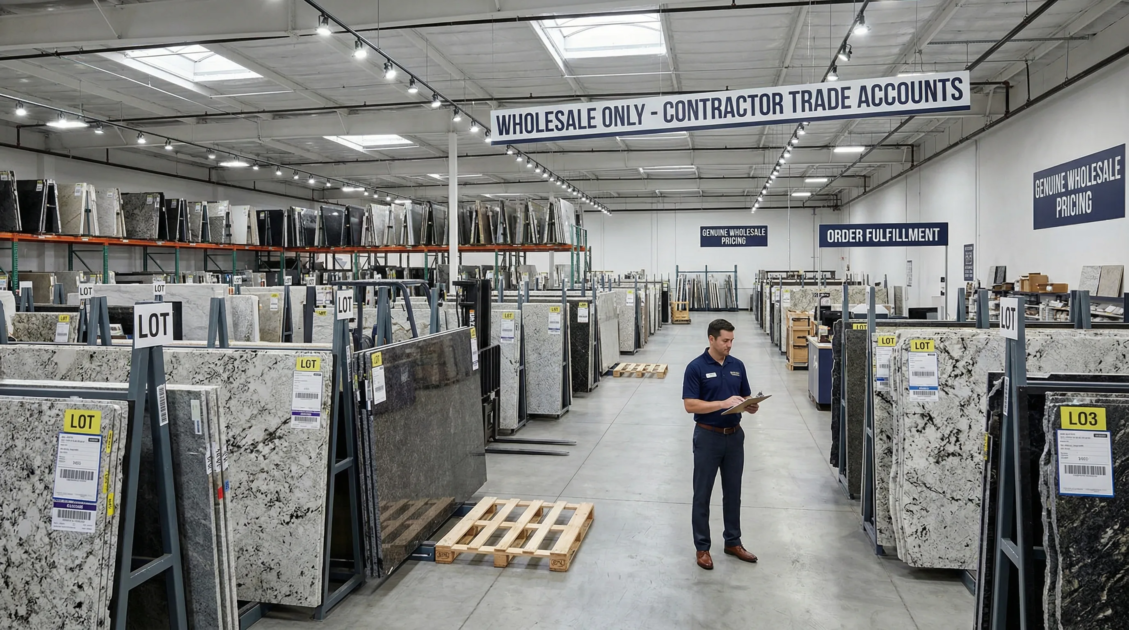
The USA stone supply market contains multiple business types that use identical language — ‘wholesale’, ‘contractor pricing’, ‘trade direct’, ‘B2B supplier’ — but operate at fundamentally different points in the supply chain with fundamentally different cost structures. A genuine contractor-direct wholesale supplier does not carry showroom overhead, retail marketing budget, or retail margin. Their cost structure is a warehouse, freight, and trade sales. A retail stone yard with a contractor discount embeds all of their retail costs into the price first, then applies a discount on top.
According to NAHB 2025 contractor purchasing research, the price difference between genuine contractor-direct wholesale pricing and retail stone yard trade pricing on the same grade of granite is 40 to 70 percent. That is not a marginal difference — it is the single largest cost variable in stone countertop procurement, and it has nothing to do with the quality of the stone.
The contractor who switches from a retail stone yard — even one they have used for years and trust — to a verified wholesale supplier typically saves more on their first bulk order than they would save on an entire year of other procurement optimisations combined. The price gap is that significant.
- The test: Ask for a confirmed per-sqft price on a 500 sqft Level 1 granite order. A genuine wholesaler answers within 2 hours. A retail operation gives you a number 40 to 70 percent higher.
- Verify before switching: Ask for the warehouse address. Ask whether they can confirm lot numbers before dispatch. Ask for the delivery timeline to your job site. All three should be immediate and specific.
- First order: No minimum on first orders at a genuine wholesale supplier. Place the first order on a real project and compare the per-sqft cost directly.
| Quick answer:
Switching from retail trade pricing to genuine contractor-direct wholesale pricing delivers 40 to 70 percent lower material cost for the same stone at the same grade. This single change saves more than all other procurement optimisations combined on most projects. |
| The one thing to remember:
Before placing any bulk stone order: verify the supplier type. Physical warehouse address, lot number confirmation capability, and a confirmed price within 2 hours are the three signals that distinguish a genuine wholesale operation from a retail yard using wholesale language. |
Strategy 2 — Match Grade to Market Tier Before Ordering
Ordering a higher grade than the project requires is the most common form of unnecessary material cost in stone countertop procurement — and it is always avoidable.
Granite and quartz grades — Level 1, Level 2, Level 3, and exotic — reflect visual complexity and quarry rarity. All grades share the same hardness, durability, and hygiene performance. The grade decision is entirely about aesthetics and the return that aesthetics delivers at the specific project market tier.
Over-specifying by one grade typically adds 15 to 40 percent to the per-sqft material cost. On a 500 sqft commercial project, that premium represents significant unnecessary material cost that the building owner, tenant, or buyer is not paying more for — and that erodes project margin without delivering any client outcome improvement.
The grade-to-market reference table below shows the right grade for every major project type — and what the over-specification costs in practice:
| Project Type | Right Grade | Overspend Grade | What the Extra Cost Buys |
| Budget rental / co-living kitchen | Level 1 | Level 2–3 | Nothing — tenants do not pay more rent for Level 3 stone. Margin is consumed for zero return. |
| Mid-range residential kitchen | Level 2 | Level 3 | Buyer satisfaction at mid-range tier does not increase with Level 3. The premium delivers no sale price uplift. |
| Commercial food service counter | Level 1 | Level 2–3 | Function — hygiene compliance — is what matters. Visual complexity adds cost with zero operational benefit. |
| Luxury residential kitchen | Level 3 | N/A — this is correct | Level 3 is appropriate here. The target buyer expects and pays a premium for natural stone uniqueness. |
| Hotel rooms — standard | Level 2 | Level 3 | Guests in standard hotel rooms do not notice or pay a premium for Level 3. The building owner absorbs the cost difference. |
| Corporate office fit-out | Level 2 | Level 3 | Professional neutral aesthetic. Level 3 drama is not what corporate office interiors are specified for. |
| Hotel lobby feature counter | Level 3 | N/A — this is correct | Uniqueness is the design intent. Level 3 delivers the return at the lobby feature application. |
Grade-to-market matching based on NKBA 2025 specification research and Pack Universe Supply contractor order data March 2026.
The grade conversation is uncomfortable for some contractors because it feels like recommending the cheaper stone. It is not. It is recommending the stone that delivers the right return for the project tier — which is a more sophisticated position than always recommending the most expensive option.
| Quick answer:
Decide the grade before calling the supplier — based on the project market tier and what the target buyer or building owner will actually pay more for. Over-specifying by one grade adds 15 to 40 percent to material cost with zero return at the project’s market tier. |
| The one thing to remember:
Grade is a value decision, not a quality decision. Level 1 and Level 3 are equally durable, equally non-porous, equally performant. The difference is aesthetics — and aesthetics only delivers a return when the market tier the project targets will pay for it. |
Strategy 3 — Order the Correct Quantity First Time
Emergency re-ordering mid-project is one of the most avoidable cost events in stone countertop procurement — and it is caused by a calculation that takes 30 seconds to fix before the original order is placed.
Stone slab installations generate waste from multiple sources that are invisible at the net area calculation stage: sink and appliance cutouts, edge offcuts, breakage in fabrication and transport, and pattern-matching allowance on veined stones. According to NSI fabrication data, waste on standard kitchen countertop installations averages 15 to 20 percent of net installed area. A contractor who orders net area only will almost always need to re-order mid-project.
Emergency re-orders carry three cost premiums: the sourcing premium on short-notice stock, an expedited delivery surcharge, and — most damaging — the risk of ordering from a different production lot when the original lot is sold out, which creates a visible seam variation in the finished installation. The NAHB 2025 survey found that emergency re-ordering adds an average 22 percent premium to the original material cost.
| ⚠ Real Risk — Real Consequence:
The risk: ordering the net square footage of the countertop area with no waste allowance. The consequence: emergency re-order at 20 to 40 percent premium from a potentially different lot — with a seam colour variation visible in the finished installation. |
- Standard layout — add: 15% to net area.
- Complex layout — multiple cutouts — add: 20% to net area.
- Veined stone requiring pattern matching — add: 25% to net area.
- Multi-unit project — same lot across all units — add: 15% plus one spare slab per 10 units.
| Quick answer:
NSI fabrication data: waste on standard kitchen stone installation averages 15 to 20 percent of net area. Ordering net area only almost guarantees a mid-project emergency re-order at a 20 to 40 percent premium. |
| The one thing to remember:
Write the waste allowance calculation into your standard project estimation template so it cannot be skipped under deadline pressure. Net area plus 15 to 25 percent depending on layout complexity. Every time. |
Strategy 4 — Consolidate Stone Types Under One Wholesale Account
Sourcing granite, quartz, marble, and flooring from three or four different suppliers adds delivery cost, admin time, and inconsistent pricing that accumulates into a meaningful overhead on every project.
A contractor who orders granite from one supplier, quartz from a second, marble from a third, and flooring materials from a fourth is paying four delivery charges, managing four account relationships, and dealing with four sets of lead times, invoices, and contact points on every project. None of this is adding value to the project. It is adding cost and complexity.
Consolidating all stone types under a single wholesale trade account with a supplier who carries a full range — granite, quartz, marble, and flooring — eliminates duplicate delivery costs, simplifies project budgeting, and typically unlocks volume pricing tiers that are not available on individual stone-type orders. The effective saving from consolidation is typically 5 to 15 percent across total project material cost.
The contractor who calls one number to order everything for a project — granite countertops, quartz vanity tops, marble feature surface, and timber flooring — spends fewer hours on procurement admin per project than the contractor managing four supplier relationships. Over a year’s worth of projects, that time difference is material.
- What to look for in a consolidation supplier: Do they stock granite, quartz, marble, and flooring from their own warehouse? Can they confirm all stock types on a single order? One invoice, one delivery.
- How to test it: Request a consolidated quote for a project requiring two or three stone types. Compare the total cost and delivery complexity against your current multi-supplier arrangement.
| Quick answer:
Consolidating all stone types to a single wholesale trade account typically saves 5 to 15 percent across total project material cost through eliminated duplicate delivery charges and unlocked volume pricing tiers. |
| Want to run these cost reduction strategies on your next order?
We stock granite, quartz, marble, flooring, lumber, and timber from our Charleston, SC warehouse — all from a single contractor trade account. +1 704-951-7822 | packuniversesupply.com/request-a-quote |
Strategy 5 — Lock the Specification Before Templating
Every specification change after templating has a price tag. Eliminating those changes costs nothing — it requires a sign-off document before templating begins.
Templating is the point at which the stone project transitions from planning to production. After the template is cut and the stone is ordered, any change to the stone type, thickness, finish, or edge profile generates real additional cost: cancelled or modified stone orders, additional fabrication setup, revised CNC cutting programmes, and in some cases a new delivery. According to NSI installation data, specification changes after templating add an average of $200 to $800 per change event to a residential countertop project budget.
On a commercial project with 50 or 100 units, a single specification change that propagates across all units can add tens of thousands of dollars to the project cost — all caused by a decision that was not finalised before production began.
Clients change their minds. Architects revise drawings. Building owners add surfaces. All of these are manageable before the template is cut. After it, each one is a cost event. A pre-templating sign-off document takes 15 minutes to produce and potentially saves thousands.
- Before templating: produce a pre-specification document listing stone type, grade, thickness, finish, edge profile, and all cutout positions.
- Get written client confirmation of every element on the document before templating is scheduled.
- State clearly: any change after this confirmation will be treated as a change order and quoted separately before work proceeds.
- File the signed document. If a dispute arises about what was specified and when, the document resolves it.
| Quick answer:
NSI data: specification changes after templating add $200 to $800 per change event on residential projects. On commercial multi-unit projects, the same change propagated across all units multiplies this cost by the unit count. |
| The one thing to remember:
A pre-templating specification sign-off document is the single most effective process change a contractor can make to reduce unexpected project cost. It costs 15 minutes to produce and eliminates an entire category of cost event. |
The lifecycle cost table below shows why calculating 10-year total cost — not just installation cost — changes the specification decision on commercial projects:
Strategy 6 — Calculate Lifecycle Cost, Not Just Installation Cost
A stone that appears cheaper at installation can be significantly more expensive over 10 years. Presenting the correct comparison to commercial clients changes the specification decision — and reduces their total cost.
Residential buyers see the installation cost — the per-sqft stone material and fabrication quote. They do not typically calculate 10-year maintenance cost. Commercial building owners who are managing a building for 10 to 15 years are making a different decision — and the correct comparison for a commercial stone specification is installation cost plus 10-year maintenance cost.
| Stone — 100 sqft | Install Cost | Annual Maint. | 10-Yr Maint. | 10-Yr Total |
| Quartz Level 2 | $3,200–$4,200 | $0 | $0 | $3,200–$4,200 |
| Granite Level 2 | $2,800–$3,800 | $150–$300 | $1,500–$3,000 | $4,300–$6,800 |
| Marble Level 2 | $3,500–$4,500 | $300–$600 | $3,000–$6,000 | $6,500–$10,500 |
Cost estimates based on NSI commercial maintenance guidelines and Pack Universe Supply market data March 2026. Sealing costs include labour and materials at commercial rates.
According to NKBA 2025 commercial specification research, facilities using quartz countertops reported 23 percent lower annual stone maintenance costs than those using granite over a 5-year period. On a 100-room hotel, the difference between quartz and granite total ownership cost over 10 years is not the per-sqft installation premium — it is the maintenance programme across 200 surfaces that the building owner no longer has to budget for.
The contractor who shows a commercial client a 10-year cost table — not just the per-sqft installation quote — is giving them genuinely useful information. More often than not, that conversation ends with a quartz specification that is better for the client and involves less project risk for the contractor.
| Quick answer:
For commercial projects: the 10-year total cost of quartz is consistently lower than granite when annual sealing, maintenance labour, and surface downtime across all units are included in the comparison. The per-sqft installation comparison alone is incomplete. |
| The one thing to remember:
Build a 10-year lifecycle cost comparison into every commercial stone specification presentation. The client who understands total cost makes better decisions. The contractor who provides that understanding builds a more trusted specification relationship. |
Strategy 7 — Open a Contractor Trade Account
Volume pricing tiers, priority stock access, and consistent pricing across all orders — the contractor trade account is the procurement structure that turns a series of one-off orders into a systematically lower cost operation.
A contractor trade account with a genuine wholesale supplier is the procurement structure that converts single-project savings into a systematically lower cost baseline across all projects. Trade accounts typically include volume pricing tiers that reduce the per-sqft cost as annual order volume increases, priority access to in-demand stock during high-demand periods, a dedicated account manager who understands the contractor’s project pipeline and specification preferences, and consistent pricing across all orders rather than the spot-pricing variability that comes with ad-hoc orders.
Most genuine wholesale suppliers open contractor trade accounts after the first successful order — no upfront commitment required. The account structure takes effect from the second order and improves with each subsequent order as volume accumulates toward the next pricing tier.
- How to open a trade account: Complete a first order with a wholesale supplier to verify their reliability. Ask about the trade account programme on the same call. Most accounts are opened within 24 hours of the first order.
- What to ask about: Volume pricing tiers, first tier threshold, account manager assignment, priority stock access process, and payment terms.
- What changes on the second order: Dedicated contact, consistent pricing, priority fulfilment, and the beginning of volume accumulation toward the next pricing tier.
| Quick answer:
A contractor trade account typically saves an additional 5 to 15 percent over spot pricing once the first volume tier is reached — and provides priority stock access and consistent pricing that ad-hoc ordering never delivers. |
| How Pack Universe Supply helps contractors reduce material cost:
Pack Universe Supply contractor trade accounts are opened after the first successful order — no upfront commitment, no minimum volume threshold to begin. Trade account benefits: volume pricing tiers, dedicated account manager, priority stock access during high-demand periods, consistent pricing across all orders. We stock granite, quartz, marble, flooring, lumber, and timber — all available from one trade account, one invoice, one delivery relationship. Ask about our trade account programme on your first order call: +1 704-951-7822. |
| Place Your First Wholesale Stone Order and Open a Trade Account:
No minimum first order. Trade account opened after first successful order. Charleston SC (USA) | Burlington ON (Canada) | Nationwide delivery.
→ Request a Quote: packuniversesupply.com/request-a-quote → Call: +1 704-951-7822 (Mon–Fri, 8am–5pm EST) → Canada: +1 (647) 362-1907 | WhatsApp: button at packuniversesupply.com |
Verdict — Seven Strategies, Same Quality, Lower Cost
| Verdict:
Every strategy in this guide reduces material cost without reducing specification quality — because none of them involve ordering cheaper stone. The savings come from buying the same stone from the right supplier type instead of the wrong one, ordering the right grade for the project tier instead of the highest available, calculating the correct quantity instead of under-ordering, consolidating procurement instead of fragmenting it, preventing change events instead of paying for them, calculating total cost instead of installation cost, and building a trade account structure instead of ordering ad-hoc. Together, these seven changes can reduce the total material cost of a stone countertop project by 30 to 50 percent compared to the procurement approach most contractors currently use — without the client or building owner receiving anything less than the specification they were promised. |