Honed vs Polished Granite: Which Finish Should Contractors Specify? [2026]
Honed vs Polished Granite: Which Finish Should Contractors Specify? [2026 Guide]
The complete 2026 specification guide to granite surface finishes for contractors — covering polished, honed, leathered, brushed, and flamed finishes with a full 10-factor comparison table, a 12-application specification reference, maintenance implications by finish type, and the outdoor anti-slip rule that applies regardless of project type. Data from NSI, NKBA, and MIA+BSI throughout.
| Honed or polished granite — which finish should contractors specify?
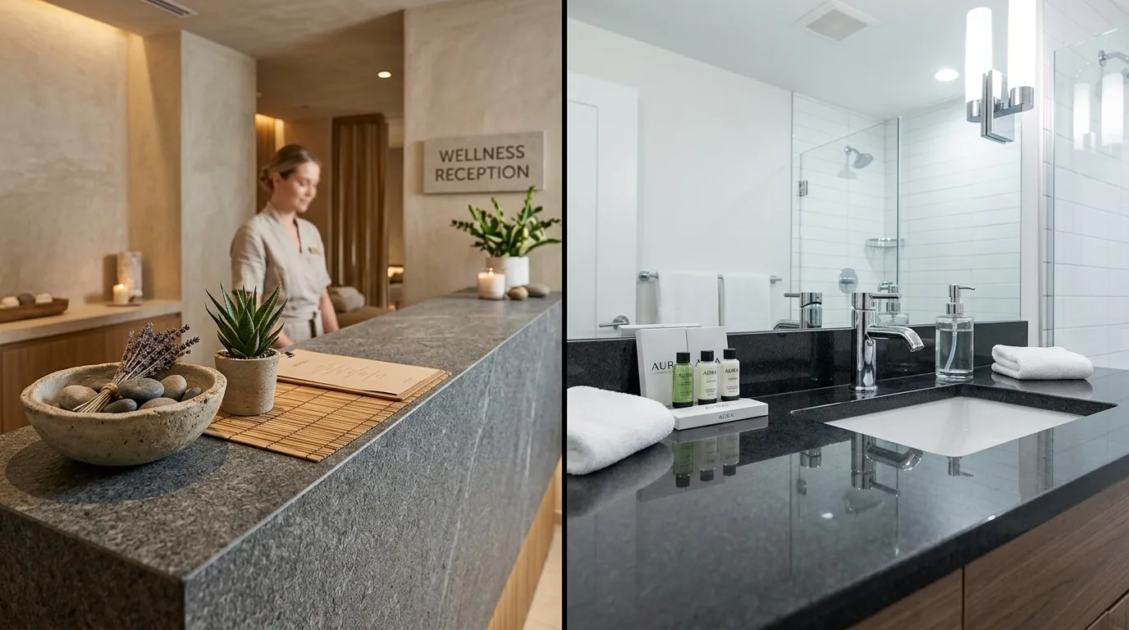
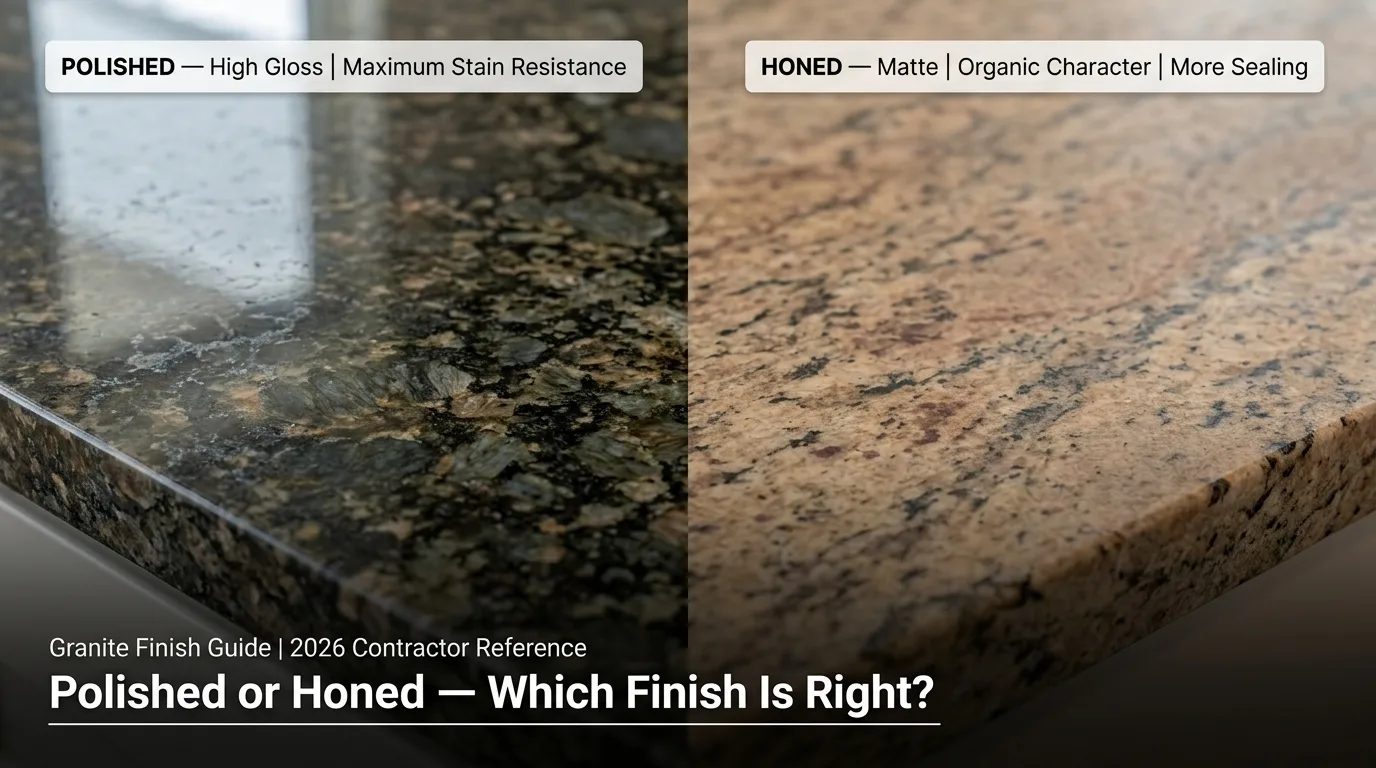
Polished granite is the standard specification for most commercial and residential countertop applications — it is the easiest to clean, the most stain-resistant, and the finish that shows the stone’s colour and veining at maximum depth. Honed granite is specified when a matte aesthetic is required, when glare reduction matters, or when the project brief calls for a softer, more organic stone character. The finish decision affects maintenance requirements, not performance or durability. The short answer by project type: • Commercial countertops — kitchens, bathrooms, offices: Polished. Easiest to clean, most stain-resistant, professional appearance standard for commercial environments. • Hotel bathrooms — standard and luxury: Polished. Housekeeping cleans with commercial products. Smooth polished surface resists staining and is fastest to clean. • Luxury residential kitchen — contemporary brief: Either, depending on the design direction. Polished for drama and depth. Honed for warmth and organic character. • Spa, wellness, boutique hospitality: Honed or leathered. Matte and textured finishes align with the tactile, natural aesthetic of wellness environments. • Outdoor surfaces — any granite application: Flamed or sandblasted for anti-slip performance. Never polished outdoors — too slippery when wet. Granite in all finishes — polished, honed, leathered, flamed — stocked at Pack Universe Supply. Wholesale contractor pricing. No minimum first order. Call +1 704-951-7822 | packuniversesupply.com/request-a-quote |
The finish of a granite slab is the last decision most contractors make — and the one that clients most often ask to change after the stone has already been ordered.
Surface finish is treated as a detail in most procurement conversations — something to confirm at the end, after stone type, grade, thickness, and edge profile have been locked. But finish affects maintenance requirements, sealing frequency, stain resistance, and the aesthetic character of the stone in ways that no other specification decision does. A client who was shown a polished granite sample and receives honed granite on installation day has a legitimate complaint, regardless of how technically correct the stone specification might be.
This guide covers all four major granite surface finishes in 2026 — polished, honed, leathered, and flamed — with the specific applications each one suits, the maintenance implications of each, and the ordering rules that prevent finish specification from becoming a post-delivery problem. Data from NSI, NKBA, and MIA+BSI throughout.
1. What Surface Finish Actually Is — and Why It Affects More Than Appearance
Granite surface finish is not a cosmetic choice — it is a manufacturing process that changes the porosity, stain resistance, maintenance requirement, and visual character of the same stone simultaneously.
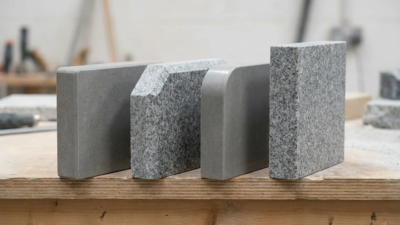
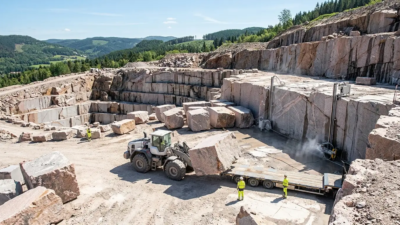
When granite is quarried, the raw slab surface is uneven and rough. The finishing process — which happens at the fabrication stage — determines the final character of the surface. Polishing closes the surface pores through progressive mechanical abrasion with increasingly fine diamond pads until the surface reflects light like glass. Honing stops the abrasive process at a lower grit — leaving the surface flat but not reflective. Leathering uses diamond-tipped brushes to open the surface texture of the stone while keeping a slight sheen. Flaming uses intense heat to cause the surface minerals to burst, creating a rough textured surface used specifically for outdoor anti-slip applications.
Each process produces a fundamentally different surface character — in appearance, in porosity, and in the maintenance the surface requires over its commercial or residential lifecycle. The finish is applied at the fabrication stage after the slab is cut from the wholesale stone — which means the finish must be specified at the wholesale order stage, not at the fabrication stage. Changing finish after the slab has been cut adds cost and delay that is avoidable with one confirmed decision at order time.
| Quick answer:
Granite surface finish must be confirmed at the wholesale order stage — not at fabrication. Polished is the default finish. Honed, leathered, and flamed must be explicitly confirmed in writing in the order. A finish mismatch between what was specified and what was delivered is not correctable on site — the slab must return to the fabricator. |
| Industry Data:
NKBA 2025 specification research: 68 percent of stone installation client complaints about surface character trace back to finish specification decisions — either the finish was not confirmed before ordering or it did not match what was shown to the client at the design stage. NSI installation guidelines: polished granite requires annual sealing in commercial environments. Honed granite requires sealing every 6 to 12 months commercially because its more open surface absorbs liquids faster than polished stone. MIA+BSI 2025 fabrication standards: finish changes requested after slab cutting add an average of $150 to $400 per slab to fabrication cost — because the refinishing process requires the slab to go back through the polishing or honing sequence from a lower grit starting point. Sources: NKBA 2025 (nkba.org) | NSI (naturalstoneinstitute.org) | MIA+BSI (marble-institute.com) |
| The one thing to remember:
Confirm finish in writing at the wholesale order stage — before the slab is cut. Polished is the default. Any other finish must be explicitly stated in the order confirmation. A finish that is wrong on delivery is a fabrication return — not an on-site correction. |
The full 10-factor finish comparison table below covers polished, honed, leathered, and flamed granite — including stain resistance, cleaning ease, sealing frequency, and best application for each:
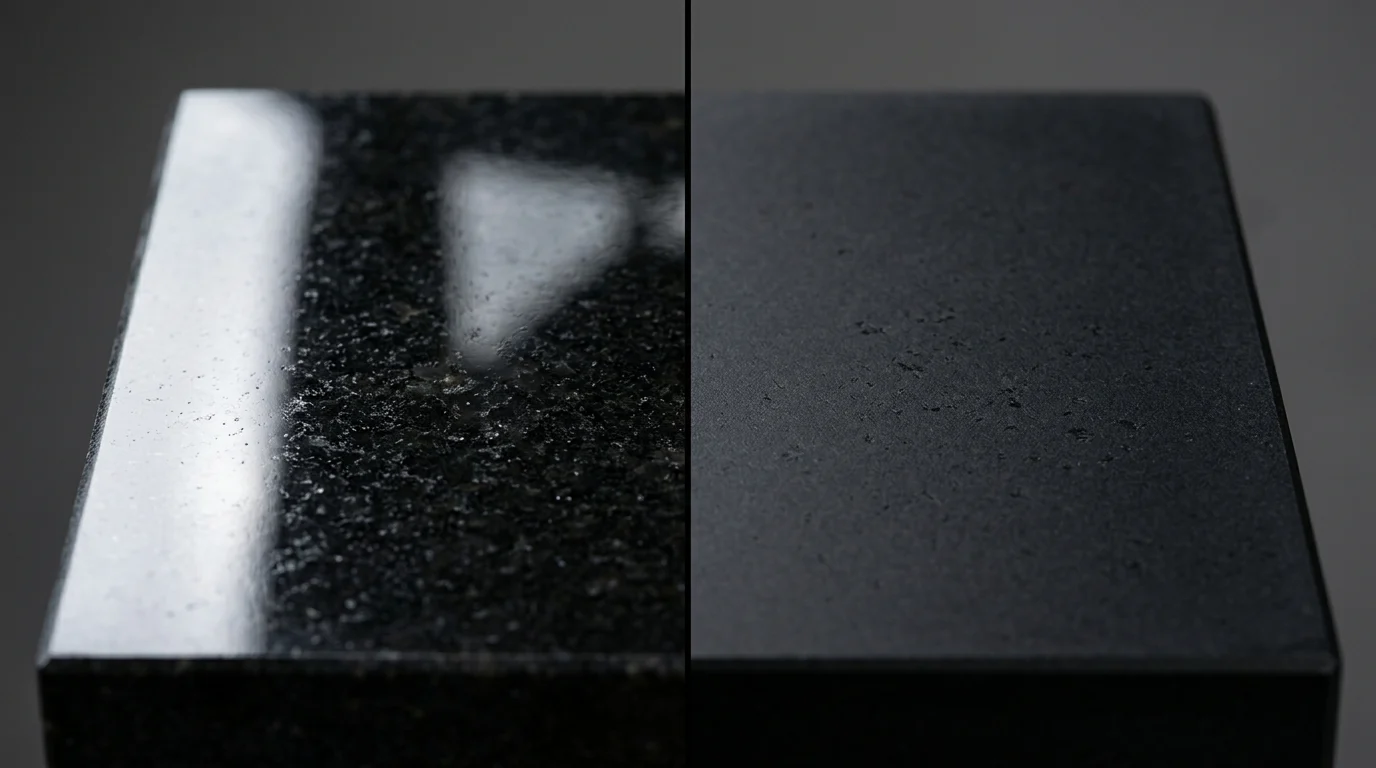
2. All Four Granite Finishes Compared — Full Reference
Polished, honed, leathered, and flamed granite compared across every factor that matters for contractor specification — appearance, stain resistance, maintenance, and the right application for each.
Use this table before confirming any granite finish specification. The Sealing Frequency row is the most important for commercial project specifications — it determines the ongoing facility management cost that the building owner will carry across the surface’s commercial lifecycle.
| Factor | Polished | Honed | Leathered / Brushed | Flamed / Sandblasted |
| Appearance | High gloss — reflective, deep colour, mirror-like surface | Matte — flat, soft, no shine or reflection | Textured matte — stone surface texture visible, slight sheen | Rough textured — coarse to medium surface texture |
| Colour depth | Maximum — polishing brings out the deepest colour and pattern | Slightly muted — colour is present but less intense than polished | Natural — colour reads as warm and organic rather than deep and dramatic | Lightest — texture scatters light and reduces colour intensity |
| Stain resistance | Best — smooth surface resists liquid penetration most effectively | Lower — more open surface requires more frequent sealing | Good — texture actually hides minor marks better than honed | Lowest — most porous surface finish, requires most frequent sealing |
| Ease of cleaning | Easiest — smooth surface wipes clean completely | Moderate — matte surface can show watermarks and residue | Good — texture conceals minor daily marks | Moderate to difficult — coarse surface traps debris |
| Sealing frequency | Annual for commercial, every 2 years residential | Every 6–12 months commercial, annual residential | Annual commercial, annual residential | Every 6 months commercial — most porous finish |
| Glare / reflection | High — reflective in direct light, particularly LED | None — zero reflection, ideal where glare is a concern | Minimal — slight sheen without directional reflection | None — rough surface absorbs light entirely |
| Scratch visibility | More visible — polished surface shows fine scratches | Less visible — matte texture diffuses light around scratches | Very low — texture conceals minor surface scratches well | Irrelevant — texture already present |
| Fingerprints / marks | More visible on dark stones — shows handling marks | Less visible — matte surface diffuses surface marks | Very low — best finish for hiding daily kitchen marks | Not applicable |
| Fabrication cost | Standard — lowest cost finish | Moderate — additional honing process adds cost | Higher — additional diamond brushing process | Highest — specialist thermal or abrasive treatment |
| Best application | Commercial countertops, hotel bathrooms, corporate, standard residential | Spa, wellness, contemporary residential, matte-brief hospitality | Premium residential kitchens, tactile luxury surfaces, feature counters | Outdoor granite only — anti-slip rated for exterior surfaces |
Finish data based on NSI surface finish classification standards, MIA+BSI fabrication guidelines 2025, and Pack Universe Supply specification data April 2026.
| Quick answer:
Polished granite has the best stain resistance and lowest sealing frequency of all granite finish types because its smooth closed surface is the least porous. Honed granite requires sealing every 6 to 12 months commercially. Leathered granite is middle ground — texture hides marks but surface is more open than polished. Flamed is most porous and requires most frequent sealing. |
3. Polished Granite — When It Is the Right Specification
Polished granite is the correct specification for the majority of commercial countertop applications, hotel bathrooms, and standard residential projects — because it is the easiest to clean, the most stain-resistant, and the most professionally neutral finish available.
The polishing process compresses and closes the surface pores of the granite through progressive mechanical abrasion — finishing at a grit level that produces a mirror-like reflective surface. This closed surface is what gives polished granite its stain resistance advantage over honed or leathered alternatives. Liquids bead on a polished surface and can be wiped away before penetrating the stone. On a honed surface, liquids find a more open surface with more entry points for penetration before the sealer threshold is reached.
For a hotel housekeeping team cleaning 80 bathroom countertops with commercial cleaning products daily, polished granite requires the least time per surface, shows cleaning results most clearly, and holds up most consistently under chemical exposure across its commercial lifecycle. According to NSI commercial maintenance guidelines, polished granite in hotel bathrooms typically requires annual professional sealing — half the frequency of honed granite in the same environment.
Where Polished Granite Is the Definitive Specification
- Commercial food service countertops: Maximum stain resistance essential. Polished surface is the most hygienic choice for food preparation environments.
- Hotel bathroom vanities: Daily commercial cleaning. Polished surface withstands commercial chemicals and cleans fastest under housekeeping cycles.
- Corporate office kitchenettes: Professional neutral appearance. Consistent across all floors. Zero maintenance complexity for facilities teams.
- Any application where low maintenance is a specification requirement: Polished granite is the lowest-maintenance natural stone finish available.
The facility manager who specified honed granite across 60 hotel bathrooms and is now managing a 6-month professional sealing programme for all of them is not happy about the maintenance calendar. The facility manager who specified polished granite runs annual sealing — and has more time for everything else.
| Quick answer:
Polished granite is the standard commercial specification because it has the lowest maintenance burden of any natural stone finish. Annual sealing commercially. Every 2 years in dry residential environments. The smooth closed surface resists staining, cleans fastest, and shows the deepest colour and pattern of the stone. |
4. Honed Granite — When the Matte Finish Is Worth the Maintenance Trade-Off
Honed granite is specified when the design brief calls for a matte, organic stone character — and when the building owner or homeowner understands and accepts the increased sealing frequency that comes with it.
The honing process stops the mechanical abrasion at a lower grit level than polishing — leaving the stone surface flat and smooth to the touch but without the mirror-like reflective surface of polished granite. The result is a soft, matte character that reads as warmer and more organic than polished granite, particularly on darker stones where the absence of high-gloss reflection allows the stone’s natural colour depth to read differently.
Honed granite is appropriate where the design intent specifically calls for a matte stone surface — spa and wellness environments, contemporary residential kitchens where a warmer, less formal surface is the brief, boutique hospitality where organic natural textures define the brand aesthetic. It is not appropriate where minimum-maintenance is a facility requirement, or where commercial cleaning chemicals will be applied frequently, because its more open surface requires sealing every 6 to 12 months commercially to maintain adequate stain protection.
Where Honed Granite Is the Right Choice
- Spa and wellness interiors: Zero glare, matte character, organic warmth — all align with the tactile natural aesthetic of wellness environments.
- Contemporary residential kitchen where warmth is the brief: Honed dark granite reads as sophisticated and warm in a way that polished stone does not.
- Boutique hospitality where natural texture is a brand signal: Matte stone surfaces communicate a specific quality register in boutique hotel and restaurant design.
- Any project where the client specifically requests matte: Confirm in writing and confirm they understand the increased sealing frequency before the order ships.
The conversation about honed granite is much more comfortable before the order is placed than after the building owner discovers they need professional sealing twice a year across their entire countertop inventory. Showing the sealing frequency data at specification stage is not a deterrent — it is the information that builds trust.
| Quick answer:
Honed granite requires sealing every 6 to 12 months in commercial environments — twice the frequency of polished granite. This must be communicated to the building owner or facilities team before specification is confirmed. For projects where minimum maintenance is a requirement, honed granite is the wrong specification regardless of aesthetic preference. |
| ⚠ Real Risk — Real Consequence:
The risk: specifying honed granite for a commercial or high-traffic residential application without communicating the increased sealing frequency to the building owner or facilities team. The consequence: inadequate sealing leads to staining within 6 to 12 months, visible surface deterioration, and a client who blames the contractor for a maintenance failure that was caused by a specification decision they were not fully informed about. |
The 12-application specification table below gives the correct finish for every major contractor application — commercial, hospitality, residential, and outdoor:
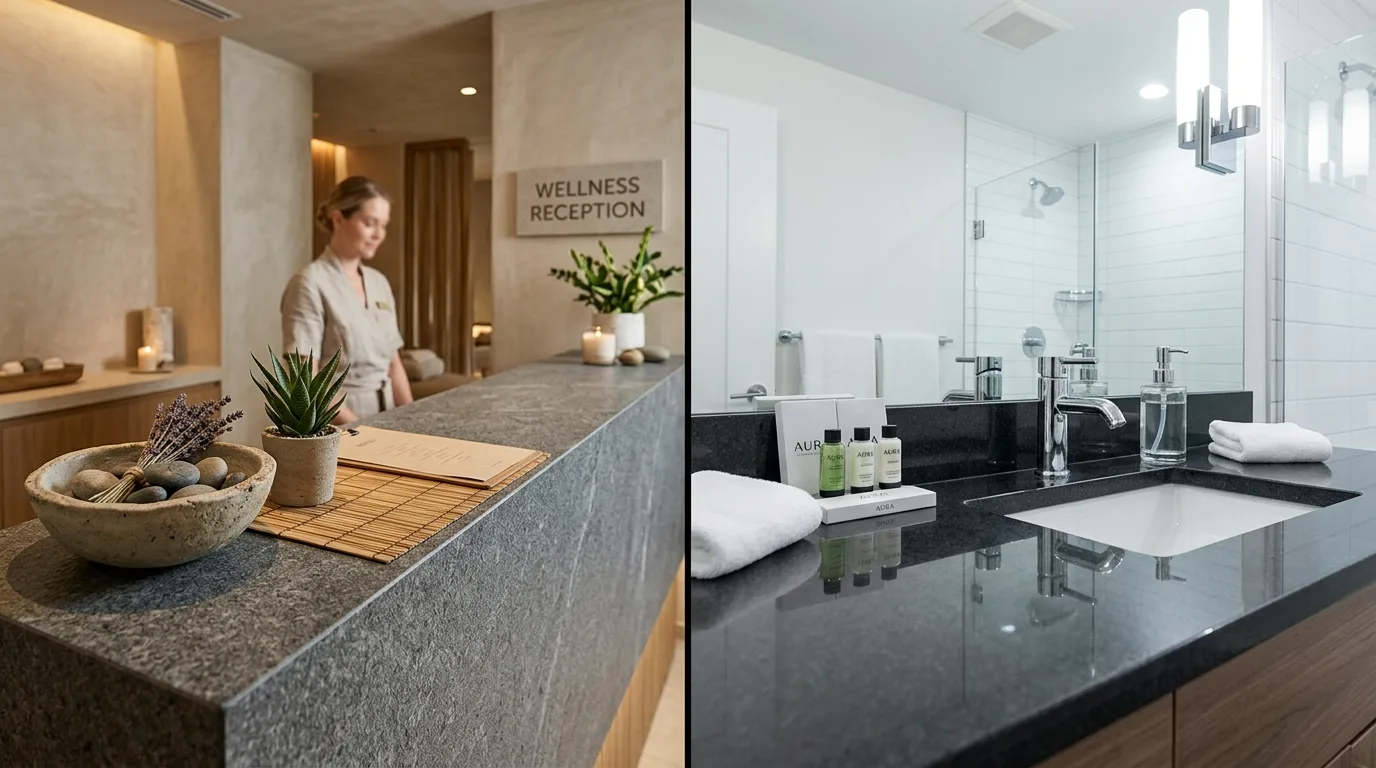
5. Granite Finish by Application — The Complete Specification Reference
The correct granite finish for every major contractor application — with the reason for each specification decision.
Use this table at specification stage before any granite order is placed. The Reason column gives the practical logic behind each recommendation — which is what you need when a client or architect asks why a specific finish was recommended for their application.
| Application | Specify | Reason |
| Commercial kitchen countertop | Polished | Easiest to clean under commercial cycling. Smooth surface resists staining. White or grey polished granite makes contamination visible. |
| Hotel bathroom vanity — standard | Polished | Housekeeping uses commercial cleaners. Polished surface is fastest to wipe clean and most resistant to chemical exposure. |
| Hotel bathroom vanity — luxury suite | Polished or honed | Polished for drama and depth. Honed where the design brief specifies a softer, more organic bathroom aesthetic. |
| Corporate office countertop | Polished | Professional standard. Consistent across all floors. Fastest to clean under daily office use. |
| Restaurant bar counter — front | Polished | Visual impact for guests. Easiest to clean at end of service. Polished surface shows spills immediately for fast cleaning. |
| Spa and wellness reception | Honed | Matte character aligns with wellness aesthetic. Zero glare. Natural stone texture supports the organic design intent. |
| Premium residential kitchen | Either — see brief | Polished for maximum colour depth and drama. Honed for warmth and contemporary organic character. Client decides with samples. |
| Luxury residential kitchen island | Polished or leathered | Polished for the most dramatic visual. Leathered for the most distinctive tactile experience. Both read as premium. |
| Residential bathroom vanity | Polished or honed | Both suitable. Polished for easier cleaning. Honed where the design brief calls for a spa-like matte quality. |
| Outdoor kitchen countertop | Flamed or sandblasted | Anti-slip essential on outdoor horizontal surfaces. Polished is dangerously slippery when wet. Flamed provides R11+ grip. |
| Outdoor pool surround / paving | Flamed or sandblasted | R11+ or above required for wet outdoor areas. Never polished, honed, or leathered outdoors. |
| Feature wall — interior commercial | Any finish | Vertical surfaces are lower-maintenance regardless of finish. Choose based on aesthetic intent without maintenance concern. |
Application specifications based on NSI commercial guidelines 2025, NKBA 2025, MIA+BSI fabrication standards, and Pack Universe Supply contractor specification data April 2026.
The outdoor row in this table is the most important one to get right — and the most frequently ignored. Polished granite on an outdoor kitchen countertop or pool surround is a slip hazard regardless of how well it is sealed. Flamed or sandblasted is the non-negotiable specification for any outdoor horizontal granite surface.
| Quick answer:
Outdoor granite surfaces — pool surrounds, exterior kitchen countertops, paving, terraces — must be specified in flamed or sandblasted finish with an R11 or above anti-slip rating. Polished, honed, and leathered granite are all dangerously slippery when wet. This rule applies regardless of project tier, client preference, or aesthetic brief. |
| Ordering granite for a current project?
Tell us your project type, application, and finish preference — we will confirm stock availability in the specified finish and give you a confirmed wholesale quote within 2 business hours. +1 704-951-7822 | packuniversesupply.com/request-a-quote |
6. Leathered, Brushed, and Flamed — When Specialist Finishes Apply
Three specialist granite finishes — leathered, brushed, and flamed — each serve a specific application that polished and honed cannot address as effectively.
Leathered Finish
Leathered finish is produced by running diamond-tipped brushes across a honed granite surface — opening the stone’s natural crystalline texture while leaving a slight sheen. The result is a surface that looks and feels like premium natural stone at its most tactile — warm, textured, distinctly natural. Leathered granite is specified for premium residential kitchen islands and feature counters where the client wants the most distinctive and luxurious possible granite surface. It hides fingerprints and minor marks better than polished or honed — the texture diffuses light around everyday surface marks in a way that flat finishes cannot. It costs more to produce than polished or honed and requires specialist fabrication capability.
Brushed Finish
Brushed finish is similar to leathered but with a lighter treatment — creating a soft, slightly textured surface between honed and leathered in character. It is specified for premium residential and boutique hospitality where a refined, slightly organic surface character is preferred over either the full drama of polished or the pronounced texture of leathered. The maintenance profile is similar to honed — annual sealing commercially, annual sealing in residential wet areas.
Flamed and Sandblasted Finish
Flamed finish is produced by exposing the granite surface to a high-temperature flame — causing surface minerals to burst and creating a coarse textured surface. The result is an anti-slip surface rated R11 or above that is the standard outdoor granite specification for pool surrounds, terraces, exterior kitchen surfaces, and paving. Sandblasted finish achieves a similar anti-slip texture through abrasive blasting rather than heat. Both finishes are appropriate for outdoor horizontal granite surfaces and inappropriate for indoor countertop or wall applications. The coarse texture is functional, not decorative — these finishes are never specified for interior countertops.
Leathered granite is the finish that surprises clients most positively at handover — because it looks and feels genuinely unlike anything they have seen in a showroom catalogue. It is the finish that generates the most unprompted client comments, and the most referrals from luxury residential projects.
| Quick answer:
Leathered granite is the specification for contractors who want to differentiate their premium residential projects from the competition. It is the one granite finish that genuinely cannot be replicated by quartz or any engineered alternative — and it is the finish most frequently cited in luxury residential project photography and design publications in 2026. |
| How Pack Universe Supply handles finish specification:
Pack Universe Supply stocks granite in polished, honed, and leathered finishes from our Charleston, SC warehouse. For honed and leathered finish orders: we confirm finish specification in writing before dispatch and provide sample pieces from confirmed lots for client approval before full volume ships. For flamed or sandblasted outdoor specifications: we can advise on anti-slip rating confirmation and minimum thickness requirements for outdoor horizontal surface applications. Call before confirming any finish specification for a current project: +1 704-951-7822. |
| Order Wholesale Granite in Your Specified Finish — No Minimum First Order:
Polished, honed, leathered, flamed — all finishes, all grades, confirmed before dispatch. Charleston SC (USA) | Burlington ON (Canada) | Nationwide delivery.
→ Request a Quote: packuniversesupply.com/request-a-quote → Call: +1 704-951-7822 (Mon–Fri, 8am–5pm EST) → Canada: +1 (647) 362-1907 | WhatsApp: button at packuniversesupply.com |
Verdict — Honed or Polished: Which Finish Should Contractors Specify?
| Verdict:
Polished granite is the correct specification for the majority of commercial and standard residential granite applications in 2026 — because it is the easiest to clean, requires the least frequent sealing, is the most stain-resistant, and delivers the deepest colour and visual character of any granite finish. Honed granite is correct where the design brief specifically calls for a matte, organic stone character and where the building owner or homeowner has been fully informed about the increased sealing frequency. It is not a substitute for polished in commercial applications where maintenance minimisation is a requirement. Leathered granite is the specification for premium residential feature surfaces where the most distinctive possible granite character is the brief. Flamed or sandblasted is the non-negotiable specification for any outdoor horizontal granite surface, regardless of aesthetic preference. The rule that prevents every finish specification problem: confirm the finish in writing at the wholesale order stage. Polished unless explicitly stated otherwise. Any other finish confirmed, documented, and communicated to the building owner before the slab ships. |
Sources & References
NSI — Natural Stone Institute, Surface Finish Classification and Commercial Maintenance Guidelines (naturalstoneinstitute.org) | NKBA — National Kitchen & Bath Association, Specification Survey 2025 (nkba.org) | MIA+BSI — Marble Institute of America + Building Stone Institute, Fabrication Standards 2025 (marble-institute.com) | Pack Universe Supply contractor specification data, April 2026
| Related Guides:
→ What is the difference between 2cm and 3cm quartz slab thickness? LINK: /blog/2cm-vs-3cm-quartz-slab-thickness-wholesale → What is the difference between Level 1, Level 2, and Level 3 granite? LINK: /blog/level-1-vs-level-2-vs-level-3-granite-contractor-guide → Which is better for commercial countertops — granite or quartz? LINK: /blog/which-is-better-commercial-countertops-granite-or-quartz → What mistakes do contractors make when buying countertops? |
About the Author
Sam Michele 15 years of direct experience supplying granite in all finishes — polished, honed, leathered, and flamed — to contractors and developers across the USA and Canada. Pack Universe Supply operates wholesale warehouses in Charleston, SC (USA) and Burlington, ON (Canada).