Wholesale Flooring Materials for Contractors: Complete Guide 2026
Wholesale Flooring Materials for Contractors: Complete Guide 2026
The full 2026 guide to wholesale flooring materials for contractors includes six categories of materials, a full performance comparison table, a 12-application specification guide, slip resistance ratings, outdoor suitability ratings, shade variation classifications for multi-unit projects, and a checklist for evaluating wholesale suppliers. For contractors, developers, and commercial specifiers who need to buy a lot of flooring in the US and Canada.
What flooring materials should contractors be ordering in bulk in 2026, and how do you pick the best one?
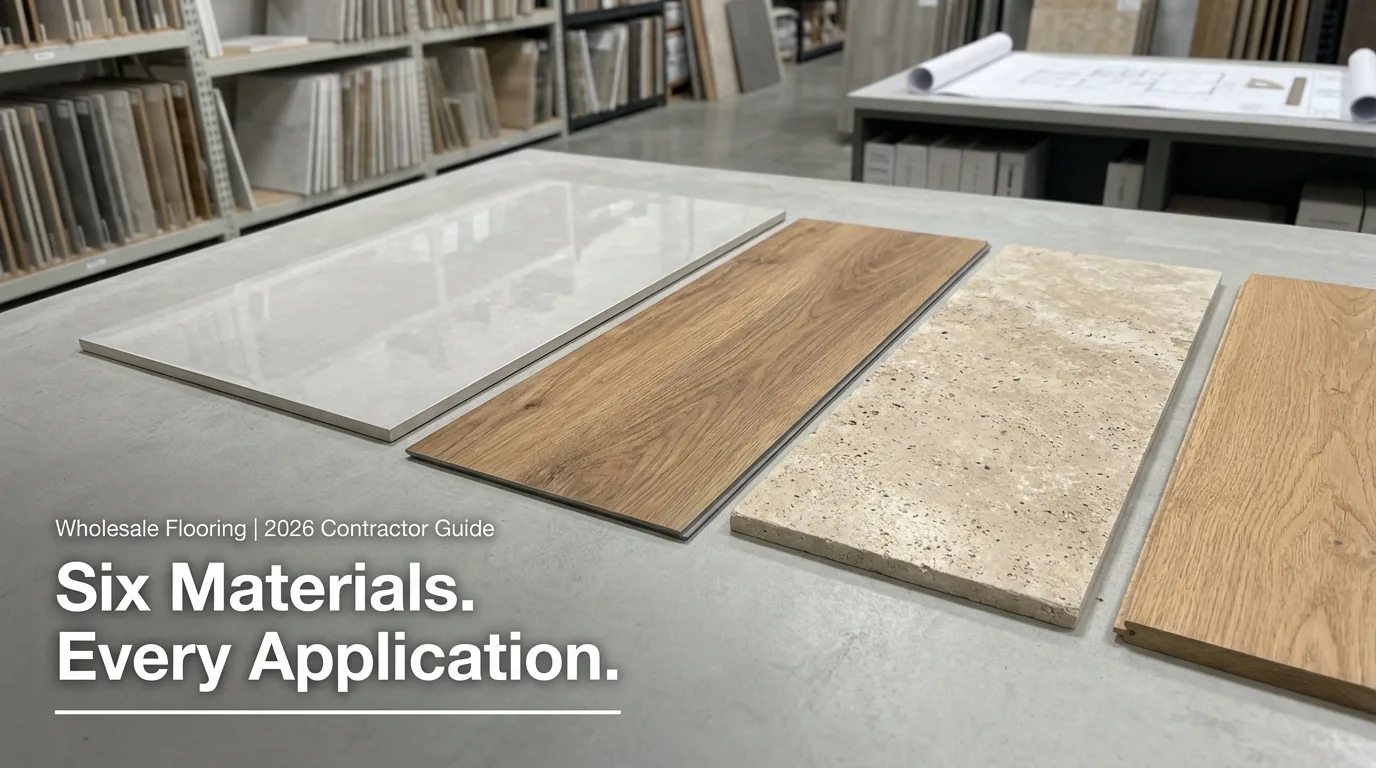
In 2026, six types of flooring will be the most popular for both commercial and residential contractors: large-format porcelain tile, luxury vinyl tile (LVT), engineered hardwood, natural stone, solid hardwood, and laminate. The type of project, the amount of traffic and use, and the building owner’s willingness to pay for the building’s lifetime costs all play a role in making the right choice. Making the right choice at the wholesale order stage stops the need for costly replacements during the building’s useful life.
| The short answer for each type of project is:
Commercial: a lot of foot traffic, wet or food service: large-format porcelain. It doesn’t absorb water, is rated as anti-slip, doesn’t need any maintenance, and meets hygiene standards. LVT or large-format porcelain for hotel rooms and short-term rentals. Waterproof, long-lasting even when tenants move out, and easy to replace if it gets broken. Luxury homes in dry areas: Engineered hardwood or natural stone. Visual warmth and a high-end feel that hard tile can’t match. For kitchens and bathrooms in build-to-rent homes, you can use LVT planks or porcelain. Waterproof, requires no maintenance, and is cheap when used in many units. For corporate offices and stores, use large-format porcelain or LVT. Matches the specs for commercial countertops, is easy to clean, and is the same on all floors. Porcelain that is safe for outdoor use or natural stone are good choices for outdoor commercial surfaces. For use outside, it is both UV-stable and slip-rated. Pack Universe Supply has a lot of flooring and stone for contractors at low prices. There is no minimum first order. Call +1 704-951-7822 or go to packuniversesupply.com/request-a-quote. |
When choosing flooring for a big commercial or residential project, the decision is not made once. It is made six or seven times for different areas that have different performance needs, traffic levels, and budget levels.
A contractor ordering flooring for a 100-unit build-to-rent development needs a different material in the bathroom to the bedroom, a different spec for the lobby to the individual units, and potentially a different product entirely for any outdoor terrace or communal space. There is a specification for each of those zones, and each specification comes with a wholesale order. If the order doesn’t use the right material for the job, it will cause maintenance or replacement problems during the building’s useful life.
This guide tells contractors everything they need to know about the most popular wholesale flooring materials in 2026, including what each one is, where it works, where it doesn’t, and what to ask before making a large order. NAHB, TCNA, and the National Floor Safety Institute all have data on this.
- The Six Types of Wholesale Flooring Materials and What They Are
In 2026, most contractor flooring orders will fall into one of six material categories. Knowing what each one is, not just how it looks, is the key to making the right choice for a specification.
Porcelain Tile in Large Sizes
Porcelain tile is made by firing refined clay and minerals at a high temperature. This makes a dense, vitrified panel that absorbs less than 0.5% of water according to ISO 13006. This means that porcelain is completely non-porous without any sealing. It comes in anti-slip ratings from R9 (for dry areas) to R13 (for wet industrial areas), making it the only flooring material that can reliably meet both hygiene and slip compliance standards at the same time. Large-format porcelain panels, which are 600x600mm or larger, cut down on the number of grout joints, make it harder for bacteria to grow, and make the installation process smoother with fewer interruptions. Outdoor-rated types (frost-resistant and at least 20mm thick for horizontal outdoor use) make porcelain useful for patios, pool areas, and building facades.
| Answer quickly:
Porcelain tile: completely non-porous, requires no maintenance, rated as anti-slip, and comes in outdoor styles. The most common type of commercial flooring for wet areas, food service, healthcare, and any other place where cleanliness and durability are a must. |
Luxury Vinyl Tile (LVT)
LVT is a type of engineered vinyl that has multiple layers. The photographic print layer is protected by a clear wear layer. The wear layer comes in thicknesses from 6 to 22 mils, depending on how much traffic the floor gets. It is completely waterproof all the way through, much softer underfoot than tile or stone, and comes in plank formats that look like hardwood and stone but cost less to make. In 2026, LVT will be the fastest-growing type of flooring for build-to-rent, hotel rooms, and healthcare. This is because it is waterproof, feels warm underfoot, and is easy to replace if individual planks are damaged. Waterproof SPC (Stone Plastic Composite) core types have mostly taken the place of traditional WPC in commercial settings because they are more stable across a wider range of temperatures.
Hardwood that has been engineered
Engineered hardwood has a real wood veneer surface layer bonded to a stable plywood or HDF substrate. This gives it the look and feel of real wood while being more stable across a wider range of humidity levels than solid hardwood. It is good for homes and businesses in dry areas where the look of natural wood is very important. It shouldn’t be used in bathrooms, wet areas, or anywhere else that gets wet often. You can sand and refinish the top layer of wood on the floor once or twice during its useful life. This is a big plus over LVT and laminate in high-end homes where looks are important.
Flooring made of natural stone
Natural stone floors, like granite, marble, travertine, limestone, and sandstone, are not made; they are quarried. This means that each installation is different. The only natural stone flooring that can be used outside is granite and quartzite. They are also the most durable. Marble and travertine are good for high-end homes and hotels, but they need to be sealed every so often and shouldn’t be used in commercial wet areas or food service areas. When you buy natural stone flooring at wholesale, you need to confirm that the lot is the same as the stone countertops. If you order from different batches of the same named stone, the tones of the different areas of the same floor can look different.
Hardwood that is solid
Solid hardwood is made from a single piece of wood and can be sanded and refinished many times over its useful life. This is a real advantage for premium residential dry area applications. It shouldn’t be used in wet areas, below-grade installations, or any commercial space that gets wet often. Solid hardwood changes size with humidity, so it’s important to install it and let it adjust to the new environment. In 2026, solid hardwood is still the standard for high-end residential dry areas where the buyer or tenant values the long life and ability to refinish real wood.
Laminate
The core of laminate flooring is made of high-density fiberboard (HDF), and the top layer is a photographic print layer and a wear layer. It is the cheapest option on the market and is good for residential use on a budget. In 2026, water-resistant types got a lot better, but they are still not completely waterproof. If they are in water for a long time, they will swell and the edges will lift. Laminate should not be used in businesses, wet areas, or places with a lot of foot traffic. It doesn’t get refinished and has a set replacement cycle. When ordering laminate for wholesale contractors, it should only be used in budget build-to-rent bedrooms and living rooms where the main concerns are cost and appearance.
Laminate in a wet area or LVT with a wear layer that is too thin for the traffic it gets are the two things that cause the most replacement conversations. Both of those mistakes can be seen within 18 months and can be completely avoided at the specification stage.
| Data from the industry:
The Tile Council of North America (TCNA) says that between 2022 and 2025, the use of large-format porcelain tiles in commercial construction grew by 34%. This was because food service, healthcare, and hospitality settings needed tiles that were both slip-resistant and hygienic. According to NAHB 2025 builder purchasing data, LVT with SPC core made up 41% of all residential flooring orders in new build-to-rent and co-living developments. This was the highest percentage of any flooring type in that sector. According to the National Floor Safety Institute (NFSI), slip-and-fall accidents on commercial floors that aren’t properly specified or maintained are the main cause of injuries to people who don’t work there in the US. |
The one thing to keep in mind is
The most costly flooring choice is not picking a high-end material over a low-end one; it’s choosing any material that isn’t in its performance range. Laminate in a place that gets wet. A commercial hallway with LVT and a 6-mil wear layer. Marble in a kitchen for food service. Each of these causes a replacement event within two years that costs more than the savings made by ordering.
The full performance comparison table below shows how all six types of flooring compare to each other in every way that is important to the contractor’s decision to order in bulk:
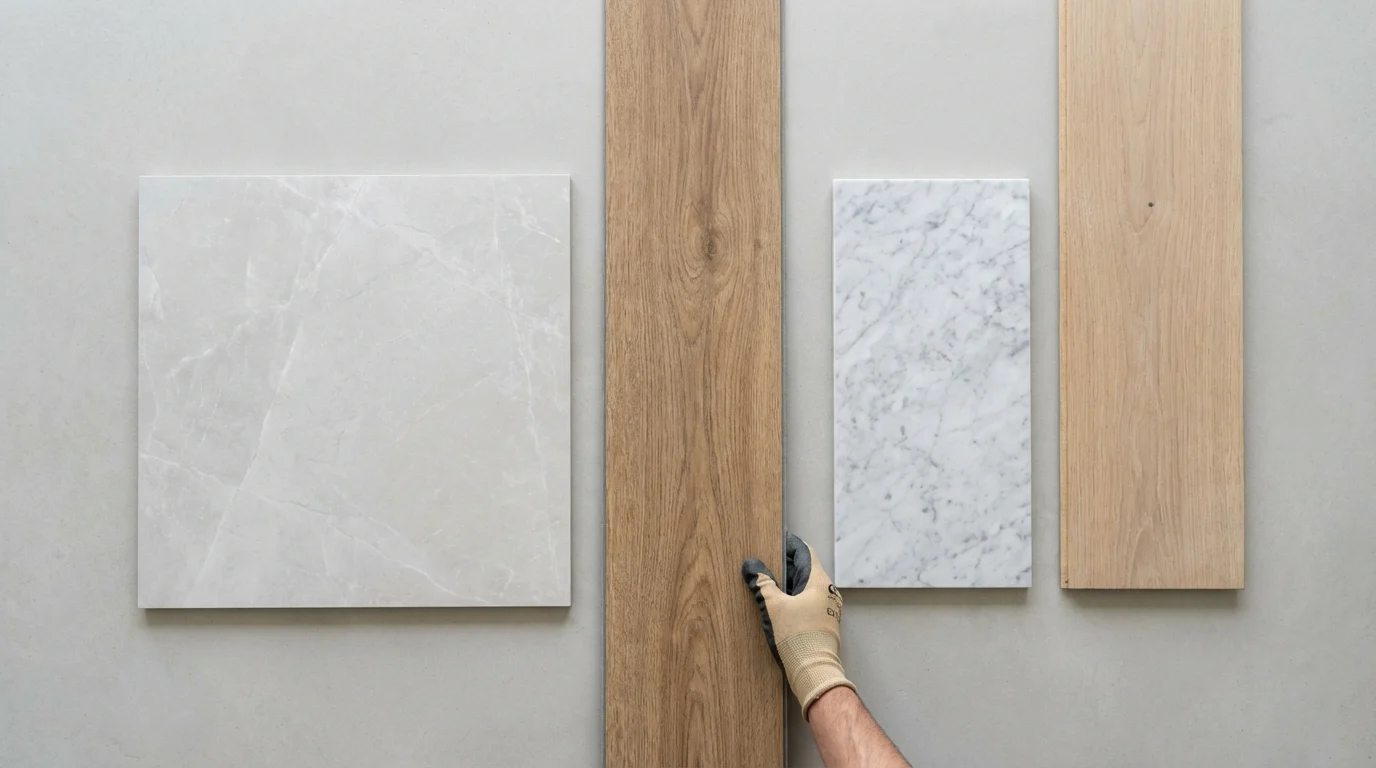
- A Full Performance Reference for Comparing Six Flooring Materials
For every performance factor that matters for a wholesale contractor specification decision, we compare all six material categories.
Before placing a large order for flooring, use this table at the specification stage. The Best Application column shows the right context for each material. It’s not the most general use case, but the specific jobs where each material works best at a contractor scale.
| Material | Durability | Waterproof | Maintenance | Wholesale Cost | Best Application |
| Large-format porcelain | Excellent — Mohs 6–7 | Yes — fully | Zero — no sealing | Entry to premium | Commercial, bathrooms, kitchens, outdoor-rated varieties available |
| Luxury Vinyl Tile (LVT) | Very good — wear layer rated | Yes — 100% | Very low — mop clean | Entry to mid | Hotel rooms, build-to-rent, retail, high-turnover residential |
| Engineered hardwood | Good — surface layer only | No — moisture-sensitive | Low — occasional refinish | Mid to premium | Premium residential dry areas, corporate offices, luxury hospitality dry zones |
| Natural stone (granite / marble) | Excellent — natural mineral | No — porous, needs sealing | Moderate — annual sealing | Mid to luxury | Luxury residential, hotel lobbies, feature floors, outdoor (granite only) |
| Solid hardwood | Good — fully refinishable | No — highly moisture-sensitive | Low to moderate | Mid to premium | Premium residential dry areas only — never commercial wet areas |
| Laminate | Moderate — surface layer | Partially — some water-resistant | Low — sweep and mop | Entry | Budget residential — not suitable for commercial or wet area use |
| The short answer is:Waterproof performance is the most important quality of any flooring that will be used in a wet area, like a bathroom, kitchen, or any other place where water is regularly present. Only porcelain and LVT are completely waterproof all the way through. Engineered hardwood, solid hardwood, and laminate are all sensitive to moisture and should never be used in wet areas.
Do you need a quote for wholesale flooring for your next project? Tell us what kind of project you have, where it will be used, and how many units you need. We will suggest the best flooring material for each zone and give you a confirmed wholesale quote within two business hours. +1 704-951-7822 | packuniversesupply.com/request-a-quote |
- Most contractors get this wrong: slip resistance.
In commercial construction, slip resistance is a requirement of the building code, not a choice. The right R rating can be very different for different areas of the same building.
The R rating system (R9 to R13) rates the slip resistance of tile and stone surfaces based on certain test conditions. For dry residential areas, R9 is the lowest standard. For homes and businesses that only use water sometimes, R10 is required. R11 is needed for commercial kitchens and other places where water is present. R12 and R13 are for wet floors in factories and other specialized uses. Using R9 tile in a commercial kitchen is against building codes, not just a performance issue.
The National Floor Safety Institute says that slip-and-fall accidents on commercial floors that are not properly specified or maintained are the most common cause of injury to people who don’t work there in the US. In a business setting, specifying the wrong R rating can lead to a lot of liability. However, this risk can be completely avoided by making sure that the right R rating is chosen at the wholesale order stage instead of leaving it up to installation.
- R9: Dry areas in homes, like bedrooms, living rooms, and hallways.
- R10: Homes with kitchens and bathrooms, as well as businesses that sometimes get wet.
- R11: commercial kitchens, changing rooms, outdoor areas that are covered, and pool changing areas.
- R12: Wet industrial areas, food production floors, and industrial kitchens.
- R13: Special industrial wet areas, like fishmongers and slaughterhouses, where there is a high risk of slipping.
The name of the R rating is almost never on a specification drawing. The contractor is responsible for making sure that the tile they are ordering has the right R rating for the area where it will be used. It only takes one question to confirm this at the wholesale order stage. If you don’t do this, the building code inspector will have a problem.
| Answer quickly:
Before you order flooring, always tell the company what the R rating requirement is for each zone. R9 for dry homes. R10 for bathrooms and kitchens. R11 for professional kitchens. Before you order, check the supplier’s product specification sheet to make sure the tile is rated correctly. |
| ⚠ Real Risk—Real Consequence:The risk is ordering flooring tile for a commercial kitchen, food service area, or wet commercial area without checking the R rating for slip resistance.
The result is that the building code will not be followed during the inspection, the business may be liable for slip-and-fall accidents on a poorly defined commercial floor, and the cost of replacing the floor will be much higher than the cost of the original installation. |
The 12-application specification table below shows the right type of flooring, format, and important specification note for every major contractor application, such as outdoor surfaces and healthcare:
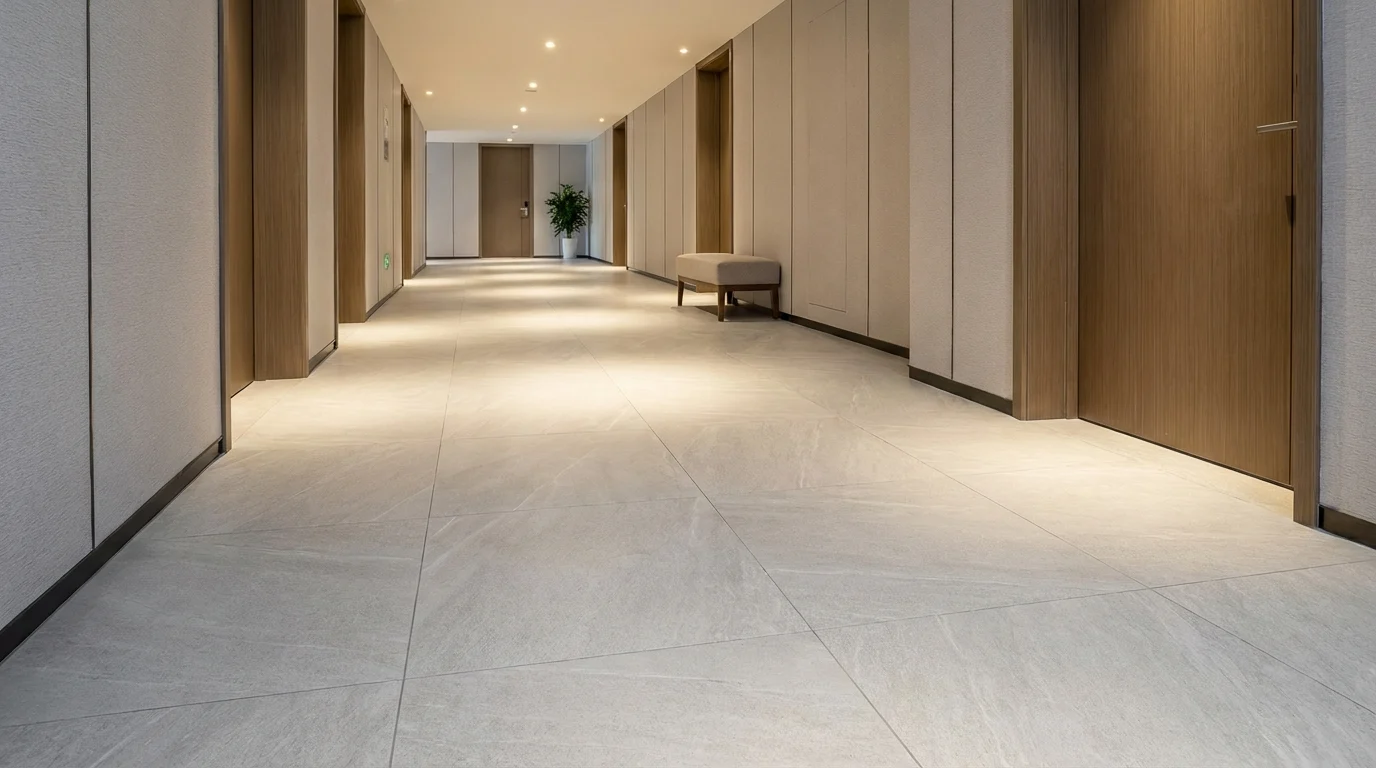
- The Complete Reference for Wholesale Flooring Specification by Application
For every major contractor job in 2026, whether it’s for a business or a home, inside or outside, you need the right flooring material, format, and key specification note.
Before you order a lot of flooring, use this table. The Key Specification Note column shows the one thing that needs to be checked before the material ships. This is the detail that is most often missed and costs the most when it is.
| Application | Flooring Material | Format / Grade | Key Specification Note |
| Commercial kitchen — food service | Large-format porcelain — anti-slip rated | 300×300 to 600x600mm, R10+ slip rating | Slip resistance is non-negotiable. Specify R10 minimum for wet kitchen floors. Food-safe grout required. |
| Hotel bathroom — standard | Large-format porcelain or LVT | 600x300mm or LVT plank | Porcelain: waterproof, zero maintenance. LVT: softer underfoot, warmer feel, equally waterproof. |
| Hotel room — bedroom area | LVT plank or engineered hardwood | Plank format — 150mm+ width | Warm, residential feel underfoot. LVT for high turnover. Engineered hardwood for boutique tier. |
| Corporate office — open plan | Large-format porcelain or LVT | 600x600mm or plank LVT | LVT over existing substrate is faster to install. Porcelain for premium open-plan office specification. |
| Retail store — customer floor | Large-format porcelain | 600x600mm or 800x800mm | High traffic, easy clean. Large format reduces grout lines visible to customers. Neutral tone recommended. |
| Build-to-rent — kitchen and bathroom | LVT or porcelain | LVT plank or 600x300mm porcelain | Both waterproof. LVT is warmer underfoot. Porcelain is harder and more scratch-resistant long-term. |
| Build-to-rent — living and bedroom | LVT plank | Wide plank — 150mm+ width | Wood-look LVT reads premium at build-to-rent tier. Waterproof for rental durability. Easy to replace. |
| Luxury residential — kitchen | Natural stone or large-format porcelain | 600x600mm or larger stone slab | Stone: unique character. Porcelain: consistent and zero-maintenance. Match tonal tier of countertop. |
| Luxury residential — bathroom | Natural stone or large-format porcelain | Matching or complementary to countertop | Honed marble or travertine at luxury tier. Confirm lot numbers if using natural stone on both floor and wall. |
| Outdoor commercial — pool surround | Outdoor-rated porcelain or granite | Anti-slip rated for wet outdoor use | R11 or above for pool surrounds. Never LVT or laminate outdoors. Confirm outdoor-rated specification. |
| Outdoor residential — patio / terrace | Outdoor-rated porcelain or granite | Minimum 20mm thickness for outdoor use | Thermal cycling requires thicker panels outdoors. Confirm outdoor-rated and frost-resistant specification. |
| Healthcare facility | Large-format porcelain — seamless joint | Minimum grout joints, coved skirting | Hygiene compliance requires minimal grout lines, cleanable transitions, and non-porous surface. |
Specifications based on TCNA installation standards, NFSI slip resistance guidelines, NSI stone guidelines, NAHB 2025, and contractor order data from Pack Universe Supply for March 2026.
The outdoor row is the most useful one for contractors who work on a lot of different types of projects. More projects than they should have end up with non-outdoor-rated tile on an outside terrace because no one checked. One thing to think about before the order ships.
| Answer right away:
If you’re going to use flooring in a wet area, outside, or in a commercial kitchen or healthcare setting, make sure of three things before the order ships: the waterproof rating (or non-porous specification for stone), the slip resistance R rating, and the outdoor-rated classification if it applies. You can confirm all three with a single call to the wholesale supplier. |
- Shade Change and Lot Confirmation for Flooring Projects with Multiple Units
The shade variation classification of a porcelain or ceramic tile product is the most important detail for any flooring order of more than five units. It is almost never on the specification drawing.
Tile makers of porcelain and ceramic tiles sort their products by shade variation, from V1 (minimal—tiles are basically the same) to V4 (substantial—tiles differ a lot within the same product run). This classification exists because the kiln firing process makes each tile’s color and shade different from the others. The amount of variation determines whether the floor looks consistent or patchwork across a 100-unit development.
- V1—Uniform: There isn’t much difference between the tiles. Required for any multi-unit development that needs to look the same. Also good for businesses where the goal is to have a smooth floor.
- V2—Slight: A small change. Good for most residential and commercial uses in the middle range. Can make a natural effect that isn’t too obvious and doesn’t look wrong.
- V3—Moderate: There is some variation. Gives a natural look, but if the tiles aren’t mixed carefully during installation, they can show clear tonal differences between different parts of a big floor.
- V4—Substantial: There is a big difference between the tiles. For use in rustic or natural-looking settings. Not good for projects that need all the units to look the same.
If a development has more than five units that need the same floor plan, V1 or V2 should be the most it can have. Natural stone flooring follows the same lot confirmation rules as countertop stone. Slabs from different production batches of the same named stone can have tonal differences that can be seen when two areas of the same floor are looked at together.
You almost never see the V rating on an architectural drawing. It can be found on the product data sheet from the maker. The contractor who doesn’t ask for it before placing an order is the one who handles the developer’s complaint about the floor’s consistency at handover.
| Quick response:
For any multi-unit residential or commercial development floor, you must say what the maximum shade variation is for V1 or V2. Use the same lot confirmation method for natural stone floors as you do for stone countertops. When installed next to each other, different production batches show visible tonal differences. |
- The Wholesale Flooring Supplier Evaluation List
Six questions to ask before you order a lot of flooring at once. What a good answer looks like and what a bad answer says about the supplier.
The same rules for checking out wholesale stone suppliers also apply to wholesale flooring suppliers. A real wholesale business will answer all six of these questions right away and in detail. If any of them hesitate, it means that the supplier may not be able to handle a large order.
The checklist table below shows the six questions you should ask before you order, the right answer, and what it means if the supplier can’t answer:
| Question to Ask | Reliable Answer | What It Signals If They Cannot Answer |
| What is the shade variation classification on this porcelain batch? | V1 or V2 for multi-unit projects requiring consistency | V3 or V4 means visible variation between tiles — not suitable for large uniform-floor developments |
| What is the slip resistance rating for this tile? | Specific R rating — R9 for dry areas, R10 for kitchens, R11 for wet outdoor | No rating or vague answer — may not meet building code requirements for your application |
| Can you confirm the production batch/lot before my order ships? | Yes — confirmed as standard procedure | Batch mismatch risk — particularly on natural stone and handmade-look tiles with inherent variation |
| What is the delivery lead time to my site address? | Specific days and confirmed delivery cost | Vague timeline — suggests no established freight relationship for your region |
| Is this product rated for outdoor use? | Clear yes or no with supporting specification sheet | Ambiguous answer — specifying non-outdoor-rated material outdoors voids warranty and risks frost damage |
| Is there a minimum order on a first purchase? | No minimum on first orders | First-order minimum transfers risk to you before you have tested the supplier’s performance |
| Quick answer:
A wholesale flooring supplier who can’t quickly tell you the slip resistance rating and shade variation classification for a product they are selling is not ready to handle a big order from a commercial or multi-unit contractor. There are clear answers to both questions on the product specification sheet. |
| How Pack Universe Supply takes care of flooring orders:
Pack Universe Supply has a wide range of flooring materials in bulk, as well as granite, quartz, and marble, all from one contractor trade account. For flooring orders, we check the shade variation classification (V1/V2 for multi-unit projects), the slip resistance R ratings for each application zone, and the outdoor-rated specifications for outdoor surfaces. For big orders of development, we can handle both countertop stone and flooring material from the same account. This includes confirming lot numbers, sending samples from confirmed batches, and setting up phased delivery schedules. Before you order your next floor, call +1 704-951-7822. |
| Order wholesale flooring and stone for your next project. There is no minimum order.
You can get porcelain, LVT, natural stone, granite, and quartz all from one wholesale contractor account. Charleston, South Carolina (USA) Burlington, Ontario (Canada) Delivery to all of Canada. → Get a Quote: packuniversesupply.com/request-a-quote → Call: +1 704-951-7822 (Monday through Friday, 8 a.m. to 5 p.m. EST) → Canada: +1 (647) 362-1907 | WhatsApp: button at packuniversesupply.com |
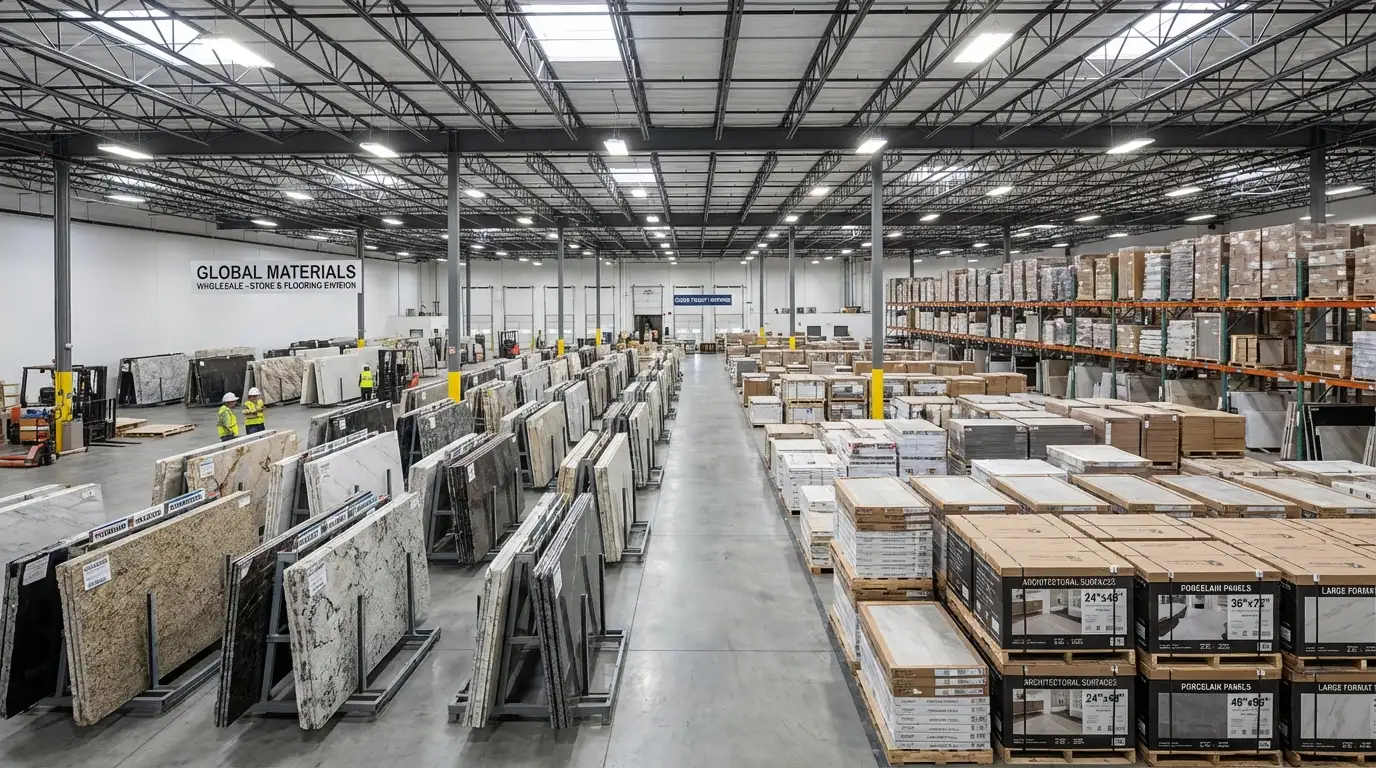
Verdict: Picking the Best Wholesale Flooring Material in 2026
The answer is:
Choosing the flooring isn’t just one decision; it’s a process that takes place in each zone. There are different levels of traffic, moisture exposure, compliance requirements, and buyer or tenant expectations in each zone of a building. The material that works for the hotel bedroom is not the same as what works for the commercial kitchen. The right material for a luxury residential bathroom is not the same as the right material for a build-to-rent bathroom.
Before ordering, the contractors who get the flooring right across big developments check three things for each zone: the right material for the job, the right R rating for the slip resistance requirement, and the right shade variation classification for the consistency requirement across units.
The contractors who start replacement conversations are the ones who ordered the same material for every zone, skipped the R rating check, or ordered from a supplier who couldn’t answer the question about shade variation classification.
| Other Guides:
→ How do you match countertops and floors in big buildings? LINK: /blog/how-to-match-countertops-flooring-large-developments → What do contractors do wrong when they buy countertops? LINK: /blog/7-mistakes-contractors-make-when-buying-countertops → What is the best way to find a trustworthy wholesale stone supplier in the US? LINK: /blog/how-to-find-reliable-wholesale-stone-supplier-usa → How can I cut costs on materials without lowering quality? LINK: /blog/how-to-reduce-stone-material-costs-without-compromising-quality |
About the Writer
Sam Michele has 15 years of direct experience supplying contractors and developers in the US and Canada with wholesale flooring and stone materials. Pack Universe Supply has wholesale warehouses in Burlington, Ontario, Canada, and Charleston, South Carolina, USA.