Environmental Benefits of Natural Stone in Commercial Construction [2026]
Natural stone has environmental benefits for commercial construction [2026 Contractor Guide]
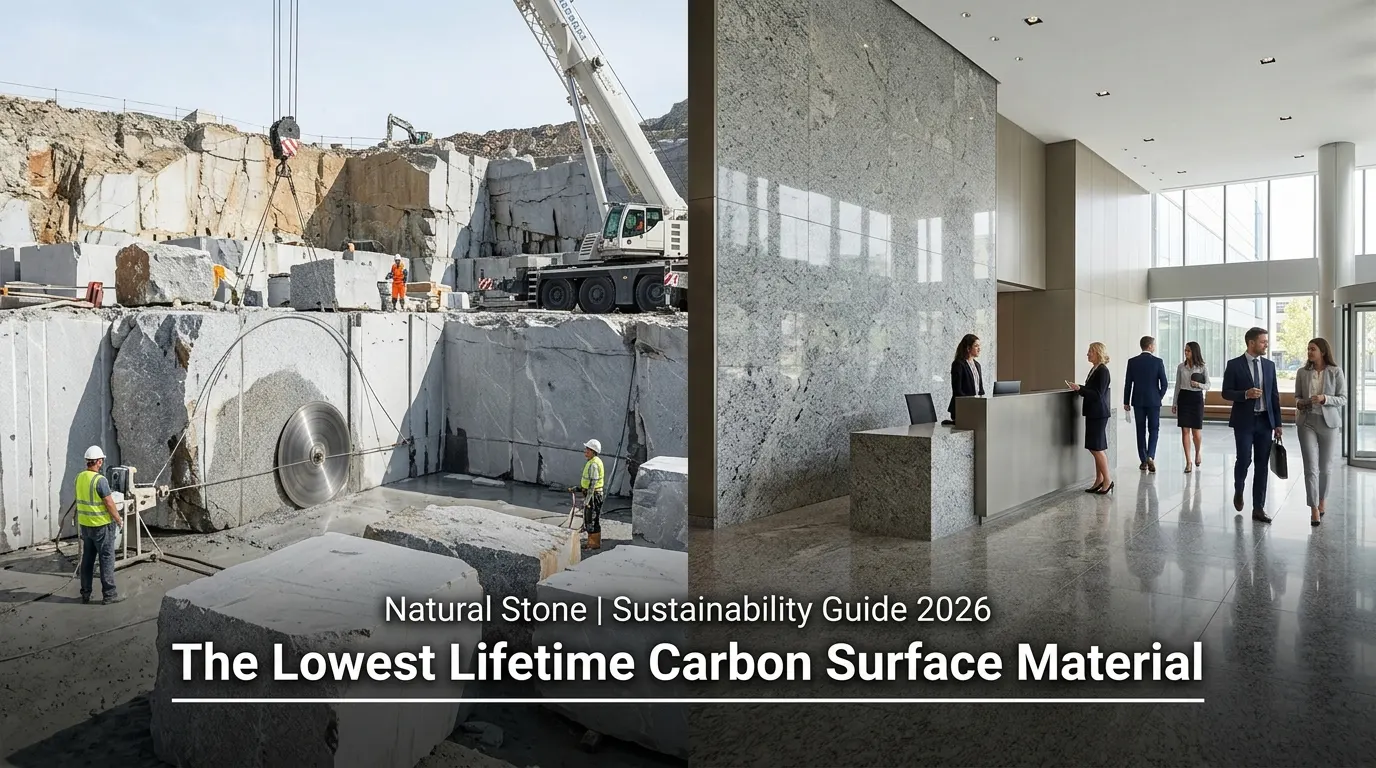
The full 2026 guide to the environmental benefits of using natural stone in commercial construction. It includes information on embodied carbon, lifecycle analysis, zero VOC performance, reclamation and reuse, LEED and BREEAM certification credits, and a direct comparison of lifetime carbon per square meter across six major surface materials. For contractors, developers, and commercial specifiers who need to follow sustainability rules. Data from the British Geological Survey, the National Science Institute, the US Green Building Council, and BRE all the time.
What are the environmental benefits of using natural stone in commercial buildings?
Natural stone has the least amount of embodied energy of any structural surface material used in commercial construction. This is because it doesn’t need to be made, doesn’t need synthetic binders, and doesn’t need chemical treatment. It also lasts longer than any other option, which means that it doesn’t need to be replaced as often, which is what causes most surface material lifecycle emissions. When it comes to getting LEED certification, BREEAM ratings, or WELL building standards for commercial projects, natural stone helps meet many of the requirements.
| Natural stone has five environmental benefits when used in commercial construction:
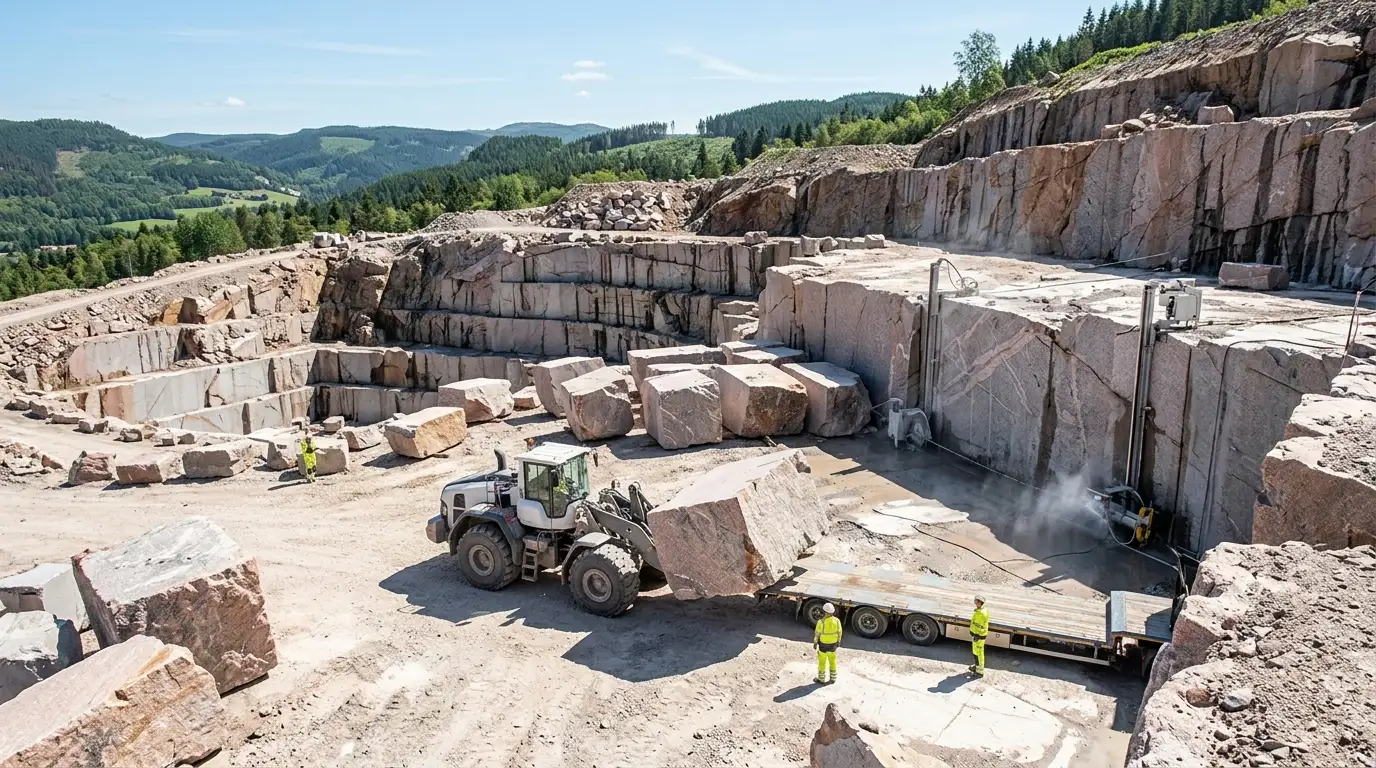
Natural stone has the least embodied energy because it doesn’t need to be made; it is simply quarried, cut, and finished. At the same grades, it has a lot less embodied carbon than engineered alternatives. Indefinite lifespan: If you specify and care for a natural stone surface correctly, it will last 50 to 100 years or more in a business setting. Every 10 to 25 years, engineered surfaces need to be replaced. Each time they are replaced, they release embodied carbon. No synthetic binders or chemicals: Natural stone doesn’t have any polymer resins, adhesive binders, or chemical treatments that release VOCs into the air inside commercial buildings. Natural stone that has been taken out of a building can be recycled and used again in a new way. As composite waste, it does not go to a landfill. LEED and BREEAM credits: Natural stone can help you get credits in the Materials and Resources, Indoor Environmental Quality, and Regional Materials categories in both the LEED and BREEAM systems. Pack Universe Supply has all grades of natural stone in stock. They have wholesale contractor prices and no minimum first order. Call +1 704-951-7822 or go to packuniversesupply.com/request-a-quote. |
Natural stone is the first environmentally friendly building material. In 2026, as commercial construction faces stricter embodied carbon requirements and more pressure to get green certification, it is being rediscovered in exactly those terms.
For the past ten years, the conversation about sustainability in commercial construction has been mostly about new manufacturing methods, like low-carbon concrete, insulation made from recycled materials, and certified wood. Natural stone hasn’t been a big part of that conversation because it doesn’t do well on sustainability metrics, but also because its environmental credentials are simple rather than new. There is no need for a manufacturing process. It doesn’t have any synthetic binders that let VOCs escape. You don’t have to replace it every 15 years. These are not new properties; they are the ones that have made stone the most common material for long-lasting buildings for thousands of years.
This guide breaks down those properties into the specific metrics that will be important for commercial construction in 2026. These include embodied carbon per square meter over the life of the building, LEED and BREEAM certification credits, VOC emission classifications, reclamation value, and the questions contractors need to ask to show that natural stone is environmentally friendly for a green-rated commercial project. The British Geological Survey, NSI, USGBC (LEED), and BRE (BREEAM) all have data all over the place.
- Why the lifecycle benefits of natural stone are bigger than they seem at first glance
Some engineered materials have more embodied carbon per square meter than natural stone, but when you factor in replacement cycles, natural stone always has less total lifetime carbon than any synthetic surface material.
We measure embodied carbon in kg CO₂ equivalent per square meter. This is the carbon that is released when a building material is taken out, made, transported, installed, and eventually thrown away. Natural granite costs about 15 to 25 kg CO₂e/m² for one installation. This is a little more than laminate flooring but less than engineered quartz. At first glance, this seems to give engineered alternatives a small environmental edge.
When you look at the whole life cycle of the building, the comparison changes a lot. The useful life of a commercial building is between 50 and 100 years. If you install a natural granite surface correctly, it will last for the whole life of the building without needing to be replaced. Every 15 to 25 years, engineered quartz needs to be replaced. Every 10 to 15 years, LVT needs to be replaced. Every time you replace something, you add more embodied carbon, not just for the new material but also for taking it out, throwing it away, and putting it back in. British Geological Survey lifecycle analysis data shows that the total lifetime carbon per square meter of natural stone in a 50-year commercial building is always 60 to 80 percent lower than that of engineered surface alternatives when full replacement cycles are taken into account.
When people talk about embodied carbon in commercial construction, they almost always compare the carbon that is used to install things. That is not a good comparison for a building that is meant to last 60 years. The right comparison looks at every replacement cycle over the life of the building. Based on that, natural stone doesn’t hold up as well as engineered options. It is definitely better.
The table below compares the embodied carbon, commercial lifespan, and estimated total lifetime carbon per square meter for six major surface materials over a 50-year building life.
| Surface Material | Embodied Carbon (kg CO₂e/m²) | Lifespan (Commercial) | Lifetime Carbon per m² (approx.) |
| Natural granite slab | ~15–25 kg CO₂e/m² | 50–100+ years | ~15–25 kg total over building life |
| Natural marble slab | ~18–30 kg CO₂e/m² | 30–80 years | ~18–30 kg total (if not replaced) |
| Engineered quartz countertop | ~45–70 kg CO₂e/m² | 15–25 years | ~90–210 kg over 50 years (2–3 replacements) |
| Ceramic / porcelain tile | ~20–35 kg CO₂e/m² | 20–30 years | ~40–105 kg over 50 years (1–2 replacements) |
| Luxury vinyl tile (LVT) | ~30–50 kg CO₂e/m² | 10–15 years | ~100–250 kg over 50 years (3–5 replacements) |
| Laminate flooring | ~15–25 kg CO₂e/m² | 8–12 years | ~62–156 kg over 50 years (4–6 replacements) |
Life Cycle Assessment data from the British Geological Survey (bgs.ac.uk) shows embodied carbon. Estimates of the commercial lifespan: NSI installation longevity data and NAHB builder survey data from 2025. Lifetime carbon calculations are just estimates; the real numbers depend on where the quarry is, how far away it is, and how often it needs to be replaced.
| In short:
The embodied carbon in natural stone (15–25 kg CO₂e/m²) is about the same as or lower than that of most engineered options. It has 60 to 80 percent less carbon over its lifetime than engineered surfaces because it doesn’t need to be replaced. BGS lifecycle analysis is the source. |
| Information about the industry:
British Geological Survey lifecycle analysis: when replacement cycles are taken into account over a 50-year building life, the total lifetime carbon footprint of natural stone surfaces in commercial buildings is 60 to 80 percent lower than that of synthetic surface alternatives. NSI installation longevity data: properly specified and cared for natural granite and marble surfaces in commercial buildings have been shown to last 50 to 100 years or more, which is 2 to 8 times longer than any other engineered surface. USGBC LEED v4 framework: Materials and Resources credits are given for building materials that have Environmental Product Declarations (EPDs) and long service lives. Sources: British Geological Survey (bgs.ac.uk), NSI (naturalstoneinstitute.org), and the USGBC LEED v4 Technical Reference |
The most important thing to remember is
Total lifetime carbon, not upfront installation carbon, is the right way to compare commercial surface materials in terms of their impact on the environment. When you take into account the replacement cycles, natural stone is the commercial construction surface material with the lowest lifetime carbon. It lasts 50 to 100 years.
The table below shows the green certification credits that natural stone helps with, including LEED, BREEAM, and WELL Building Standard credits. It lists the different credit categories and points that are available.
- How Natural Stone Helps Buildings Get Green Building Certification Through LEED, BREEAM, and WELL
Natural stone helps you earn credits under LEED v4, BREEAM, and WELL Building Standard in a number of ways, such as through embodied carbon documentation, regional material sourcing, VOC-free interior environment performance, and responsible sourcing certification.
In 2026, getting a green building certification will be a standard requirement, not just a nice-to-have, for Class A commercial construction in the US and Canada. Owners of buildings that want LEED Gold or Platinum, BREEAM Excellent, or WELL certification are making choices about the materials they use that will affect their scores. If the stone comes from a supplier who can provide the right paperwork, the environmental benefits of natural stone can be turned into specific, documentable credits under each framework.
| Certification | Relevant Credit Category | How Natural Stone Contributes | Points / Credits Available |
| LEED v4 | Materials & Resources — Building Product Disclosure | EPDs (Environmental Product Declarations) available from major quarry operators. Stone with EPD qualifies for MR credit. | Up to 2 points under MR Building Product Disclosure |
| LEED v4 | Materials & Resources — Sourcing of Raw Materials | Stone quarried within 500 miles of the project site qualifies as a regional material — reducing transport embodied carbon. | 1 point under MR Sourcing of Raw Materials |
| LEED v4 | Indoor Environmental Quality — Low-Emitting Materials | Natural stone contains no VOC-emitting binders, adhesives, or coatings — qualifies as a low-emitting surface material. | Contributes to IEQ Low-Emitting Materials credits |
| BREEAM | Mat 01 — Life Cycle Assessment | Natural stone’s high durability and low replacement frequency reduces lifetime material impact scores favourably in Mat 01 LCA assessment. | Contributes to Mat 01 — weight depends on full building LCA |
| BREEAM | Mat 03 — Responsible Sourcing | Stone from quarries with ISO 14001 environmental management certification qualifies under BREEAM Responsible Sourcing criteria. | Up to 3 credits under Mat 03 |
| WELL Building Standard | Feature 26 — Hazardous Material Reduction | Natural stone contains no synthetic VOC-emitting materials — contributes to WELL preconditions around surface material chemical emissions. | Supports WELL precondition compliance |
| WELL Building Standard | Feature 29 — Enhanced Material Caution | Stone with published EPD and no added synthetic chemicals satisfies WELL enhanced material documentation requirements. | Supports WELL optimisation credits |
Most contractors lose the certification credit because they don’t have the right paperwork. There is no doubt about how well the stone works for the environment. What is in doubt is whether the supplier can give an EPD, a certificate of responsible sourcing, or proof of the distance to a regional quarry. Before the order ships, ask for these papers. Not after.
| The short answer is:
Natural stone can help you get LEED credits in the following areas: Materials and Resources (EPD documentation, regional sourcing), Indoor Environmental Quality (VOC-free surface), and BREEAM Mat 01 and Mat 03. The credits are available, but only if the supplier can show proof of the order. |
Before ordering stone for a LEED or BREEAM project, contractors should ask these questions:
Availability of EPD: Find out if the stone product has an Environmental Product Declaration (EPD) from a reputable third-party verifier. More and more major quarry operators are making EPDs available, but not all of them.
Location and distance of the quarry: For LEED regional material credits, make sure you know where the quarry is. Stone that is quarried within 500 miles of the project site is considered a regional material. This lowers the carbon emissions from transportation and adds to MR sourcing credits.
For BREEAM Mat 03 credits, check to see if the quarry has ISO 14001 environmental management certification or an equivalent responsible sourcing certification.
VOC emission data: Make sure that the stone doesn’t have any applied surface coatings, sealers, or treatments that contain VOCs. This is important for both LEED IEQ and WELL Building Standard requirements.
Chain of custody documentation: If a project needs to know where all the materials came from, ask the supplier if they can give you chain of custody documentation from the quarry to the site.
| Are you looking for natural stone for a business project?
Let us know the certification goal and stone specifications for your project. Before your order ships, we will check the quarry distance, EPD availability, and sourcing documentation. Call +1 704-951-7822 or go to packuniversesupply.com/request-a-quote. |
- VOC-Free Performance: Natural Stone and Indoor Air Quality in Commercial Buildings
Natural stone doesn’t have any polymer resins, synthetic binders, or chemical treatments that release volatile organic compounds into the air inside commercial buildings. This makes it the best choice for projects that need to meet strict indoor air quality standards.
Indoor air quality (IAQ) has become a major factor in designing commercial buildings in 2026. This is because tenants want to be healthy, the WELL Building Standard is being adopted, and people are more aware of their health after the pandemic. Resins in engineered stone, plasticizers in LVT, and formaldehyde in laminate adhesives all release VOCs that make the air inside buildings dirty. This can hurt people’s health, productivity, and building certification scores.
Natural stone doesn’t give off any VOCs. There are no synthetic binders, chemical treatments, or polymer coatings in the base material. When used correctly, natural stone—without VOC-emitting adhesives and without chemical sealers when the stone type doesn’t need them—helps make the inside of a commercial building a place where surface materials don’t release chemicals into the air.
The Sealer Question for Natural Stone and Indoor Air Quality
To keep their hygiene performance up in commercial settings, some types of natural stone, like marble and limestone, need to be sealed every so often. The type of sealer used changes the surface’s VOC emission profile after it is applied. For projects with strict IAQ requirements, use water-based, low-VOC sealers that have VOC content data that has been made public. Commercial interiors that want to get WELL certification or spaces that are already occupied by sensitive groups should not use solvent-based sealers with high VOC content.
Granite is harder and less porous than marble or limestone. This means that it doesn’t need to be sealed as often in commercial settings and can be cleaned with low-VOC water-based products for its entire life. Granite and quartz (which don’t need to be sealed at all) are the best surface materials for commercial projects with the strictest IAQ standards because they need the least amount of chemical maintenance.
| Answer quickly:
Natural stone doesn’t have any synthetic materials in its base that give off VOCs. For WELL Building Standard or LEED IEQ commercial projects, use natural stone with water-based low-VOC sealers instead of solvent-based ones. There is no need to seal quartz at all, which means no VOC exposure. ⚠ Real Risk, Real Consequence: The risk is that you choose natural stone for a WELL-certified commercial building and then use a high-VOC solvent-based sealer when you install or maintain it. The result is that the VOC emissions from the sealer product lower the indoor air quality performance that the stone specification was meant to provide. This could also affect the assessment of WELL Feature 26 compliance. |
Natural stone has as many benefits for the environment at the end of its life as it does for making things. Here is how natural stone stacks up against synthetic options:

- The Case for Natural Stone in Reclamation, Reuse, and the Circular Economy
Natural stone is the only surface material that keeps its full value after a building is torn down. It can be reclaimed, cut, and used again in a new way without losing any of its structural or aesthetic qualities.
The circular economy framework—reduce, reuse, recycle—applies to building materials both during construction and at the end of their life. Most synthetic surface materials can’t be reused in any useful way. LVT, laminate, and composite engineered stone are all types of composite materials that can’t be separated at the end of their life. Instead, they are thrown away as mixed waste. You can crush porcelain tile and use it as aggregate, but you can’t cut it again to make new surfaces. Engineered quartz, which has polymer resin in it, is harder to recycle than natural stone.
Specialized stone reclamation contractors can take natural stone slabs out of a commercial building, cut them to new sizes, and use them in a new project. People are actively buying and selling reclaimed stone from Victorian commercial buildings, nineteenth-century civic buildings, and twentieth-century hotel fit-outs in the commercial stone market. This shows that the material has an indefinite useful life and keeps its value after the first use.
The building that called for natural stone in 1985 and is now being renovated in 2026 has a surface material that is still worth a lot on the market. The building that asked for engineered alternatives in 2005 is now paying to get rid of them. Not only the sustainability report, but also the project budget, show that difference.
Value of Reclamation by Type of Stone
Granite has the highest reclamation value. After years of use, it’s dense, stable in size, and tough. Many new commercial projects use reclaimed granite slabs.
Marble: High reclamation value in high-quality grades. Needs to be checked for etching, staining, and wear on the surface, but reclaimed marble that is structurally sound is sold.
Quartzite: Good for reclaiming. Reclaimed quartzite is very hard, stable in size, and not very common on the market, so it costs more.
Moderate reclamation value for limestone and travertine. Softer stones wear out more quickly, but they can still be used again in places with less traffic or as exterior cladding after being used in a commercial setting.
| The quick answer is
Natural stone is the only surface material that can be fully reclaimed at the end of its life. In the US stone market, people buy and sell reclaimed granite and marble from commercial buildings. Engineered surface alternatives like LVT, laminate, and composite quartz have no real value when they reach the end of their life and are thrown away. |
The one thing you should remember is:
When looking at the environmental credentials of surface materials for a business project, make sure to include their end-of-life reclamation value. At the end of a building’s life, natural stone still has its full value. Synthetic options do not. You can’t see this difference in the upfront embodied carbon numbers.
- Regional Sourcing and Transport Carbon: The Stone Procurement Decision That Impacts Certification
The distance between the quarry and the project site is the biggest factor in the actual embodied carbon footprint of natural stone. The contractor can control this completely at the time of purchase.
The carbon footprint of transporting natural stone from North America to a project in South Carolina is very different from that of transporting stone from Brazil to an import facility in Miami, then to a regional distributor, and finally to the site. Both may be the same kind of stone. It is possible that both have the same carbon output. The transport part, which can double the total embodied carbon for imported stone compared to stone from the US or Canada, depends entirely on which supplier is chosen and which quarry the stone comes from.
For commercial projects that want to earn LEED v4 Materials and Resources credits, stone that comes from a quarry within 500 miles of the project site counts as a regional material. This helps the MR Sourcing of Raw Materials credit. This geographic requirement encourages the exact buying behavior that lowers transport carbon: getting materials from the closest quarry that meets the specifications.
The Carbon Calculation: Stone from the US vs. Stone from Abroad
Granite from the US, such as Georgia, Vermont, New Hampshire, and the Carolinas, has a much smaller carbon footprint for transporting to projects in the Southeast US than granite from Brazil, India, or China. The stone itself might look the same. The specifications and performance traits may be the same. The embodied carbon difference between transport and other types of transportation is big. For LEED-registered projects, the regional sourcing credit is only available for domestic stone and not for imported stone.
This doesn’t mean that stone from other countries shouldn’t be used for commercial projects that want to get green certification. It means that the carbon from transportation should be included in the environmental assessment, not just assumed to be unimportant. When it comes to exotic stone types that can only be found in certain places around the world, the project’s overall sustainability story must weigh the visual or performance benefit against the cost of transporting the stone.
Most commercial contractors aren’t talking to their stone suppliers about where the quarry is located when they talk about sustainability. Not because it’s hard to talk about—it only takes one question—but because most contractors think that the environmental assessment stops at the type of material. No, it doesn’t. It tells you where the material came from and how far it went.
| Short answer:
For the LEED v4 regional material credit, stone must be quarried within 500 miles of where the project is happening. Granite from quarries in the Southeast US can be used for projects in the Carolinas, Georgia, Tennessee, and nearby states. Before placing an order for any LEED-registered project, make sure you know where the quarry is. How Pack Universe Supply helps with eco-friendly stone specification: Pack Universe Supply gets natural stone from quarries in the United States and from verified international sources with documented provenance. For commercial projects that are LEED-registered, we can verify the quarry’s location and distance from the project site, provide EPD documentation if it’s available, and confirm the chain of custody for the stone used in certified projects. For BREEAM projects, we can check the ISO 14001 certification status of the stone we get and give you responsible sourcing paperwork for the Mat 03 credit assessment. Before you order stone for any commercial project with a green rating, call +1 704-951-7822. |
| Order Natural Stone in Bulk for Your Business or Green-Rated Project—No Minimum First Order:
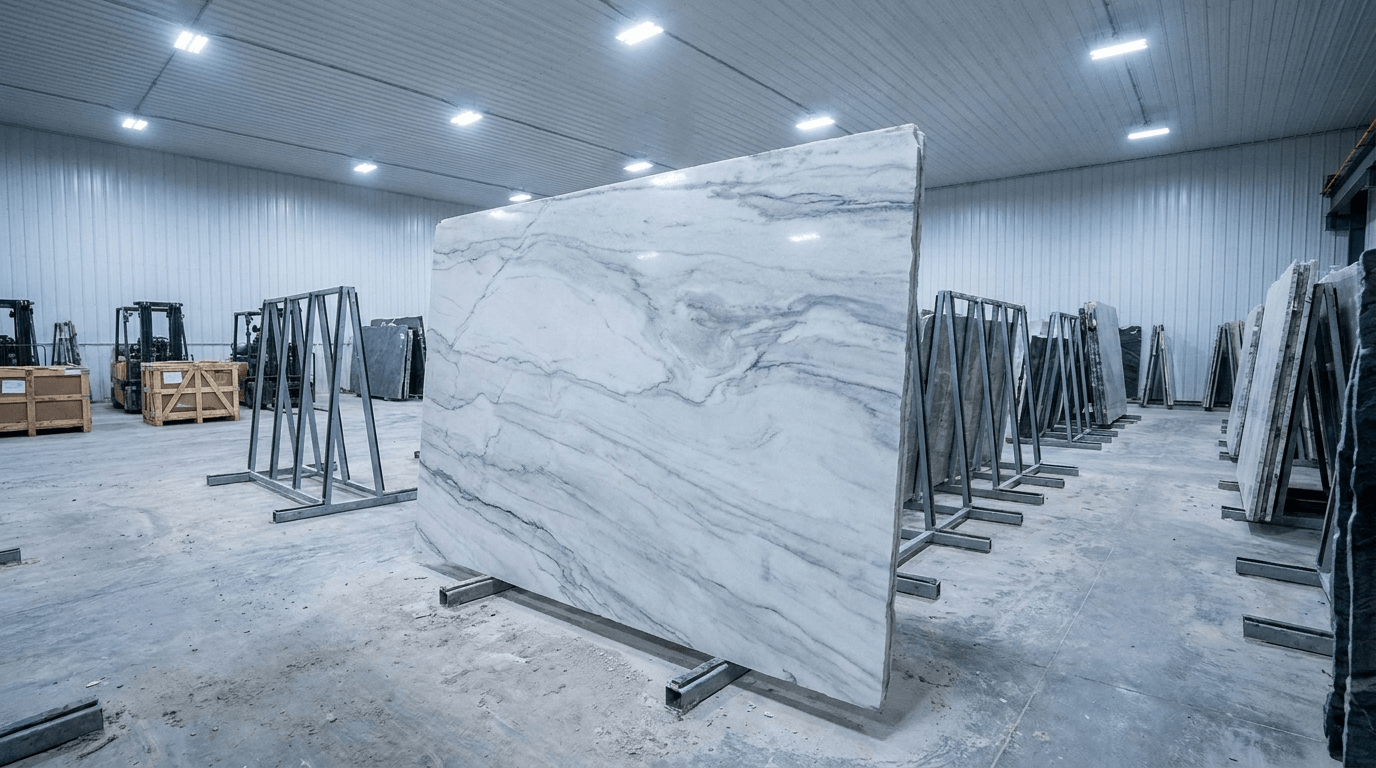
Granite, marble, and quartzite in all grades, with proof of origin and EPD support. Charleston, SC (USA) and Burlington, ON (Canada) are both places where you can get your order delivered. → Get a Quote: packuniversesupply.com/request-a-quote → Call: +1 704-951-7822 (Monday through Friday, 8 a.m. to 5 p.m. EST) → Canada: +1 (647) 362-1907 | WhatsApp: button at packuniversesupply.com |
| Is Natural Stone the Best Choice for Long-Term Commercial Construction in 2026?
The decision is: Natural stone does better than any other engineered surface option when it comes to the metrics that matter for commercial construction in 2026, such as lifetime embodied carbon, VOC-free indoor air quality, end-of-life reclamation value, and green certification credits. The only problem is that you need to document it. Natural stone is good for the environment, but that doesn’t mean it’s always good for the environment. They need an EPD from a trusted verifier, a quarry location that is within the certification distance limits, certification of responsible sourcing from the quarry operator, and low-VOC maintenance products for the whole life of the surface. A contractor who can provide that chain of documents gives a specification that supports a project with a green rating. A contractor who can’t is missing out on certification credits. The stone itself isn’t the problem. The discipline of procurement and documentation is. And both start at the wholesale order stage, which is before the first slab leaves the factory. |
| Other Guides:
→ What is the difference between natural stone and engineered stone? LINK: /blog/engineered-stone-vs-natural-stone-contractor-buying-guide-2026 → Is granite or quartz better for countertops in businesses? LINK: /blog/which-is-better-commercial-countertops-granite-or-quartz → How do you match countertops and flooring in big buildings? LINK: /blog/how-to-match-countertops-flooring-large-developments → What is the best way to find a trustworthy wholesale stone supplier in the US? LINK: /blog/how-to-find-reliable-wholesale-stone-supplier-usa
|
About the Writer
Sam Michele 15 years of direct experience supplying natural stone for commercial construction projects across the USA and Canada, including projects seeking LEED and BREEAM certification. Pack Universe Supply has wholesale warehouses in Burlington, Ontario, Canada, and Charleston, South Carolina, USA.