What Is the Most Durable Countertop for a Busy Commercial Kitchen in 2026?
What Is the Most Durable Countertop for a Busy Commercial Kitchen in 2026?
The Ultimate Guide to Commercial Kitchen Countertop Durability in 2026: Comparing the 7 Major Materials on Scratch Resistance, Heat Tolerance, Stain Resistance and Maintenance Requirement, 10-Zone Kitchen Specification Table, HACCP Food Safety Requirements Preventing Stone Use in Commercial Kitchens, Where Granite and Quartz Are Suitable and Not Suitable Data throughout from NSF International and NKBA.
Best countertop material for commercial kitchen in 2026
Stainless steel is the toughest countertop material for a commercial kitchen and the material of choice for most NSF-compliant professional foodservice environments. If you’re a contractor specifying stone surfaces for commercial kitchen-adjacent or restaurant dining areas, polished granite is the most durable natural stone option – scratch-resistant, heat-tolerant and cleanable under commercial food service protocols. Do not use engineered quartz in commercial kitchens cooking areas. The polymer resin in quartz can be damaged by prolonged exposure to high heat.
| Kitchen Zone response:
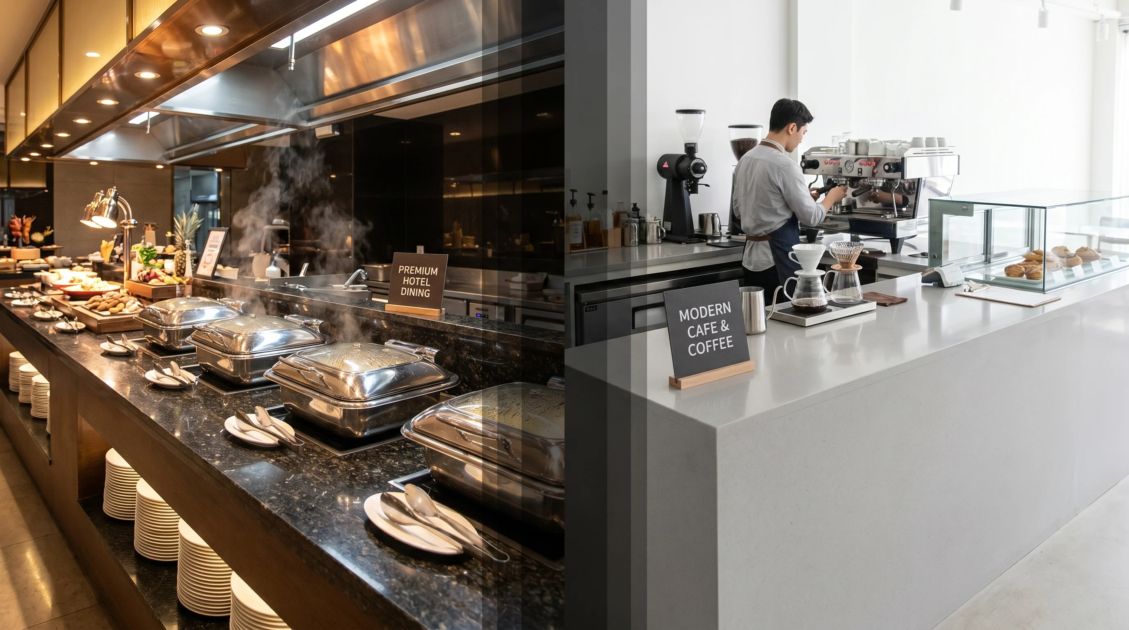
Cooking zone – professional kitchen: stainless steel. Heat resistant, cleanable according to HACCP principles, NSF certified. No stone spec matches the active cooking zone. Pass-through and service counter: Level 1 polished granite. It is heat tolerant, scratch resistant and can be cleaned with commercial degreasers. Sealing required annually. Restaurant front-of-house bar and counter: Polished granite or manufactured quartz. Granite for heat resistance. Maintenance free quartz. Essential eased edge. Hotel restaurant buffet counter: Polished granite Level 1 or 2. Heat resistant for chafing dishes. Scratch resistant under normal commercial use. Level 1: Engineered quartz – Café & coffee counter. No maintenance. Stain resistant to coffee and milk. Uniform look at chain locations. Pack Universe Supply stocks commercial kitchen and food service granite and quartz, wholesale contractor pricing, no minimum first order. Request a Quote Call +1 704-951-7822 | packuniversesupply.com/request-quote |
The most durable countertop for a busy commercial kitchen depends entirely on which zone of the kitchen you are specifying for – and most contractors asking this question are specifying the wrong zone.
Commercial kitchen countertops durability is not a single material issue. Professional kitchens are divided into several distinct zones – active cooking, prep, pass-through, service and front-of-house – and the durability requirements, hygiene requirements and suitable materials are different for each zone. Many contractors make the mistake of specifying a single material for all zones based on durability alone, ignoring the HACCP food safety standards that restrict materials in food contact zones, or the heat tolerance limitations that exclude certain materials near cooking equipment.
This guide discusses all seven major countertop materials available to commercial kitchen contractors in 2026, compares them on the four durability factors that matter in a food service environment, and provides a zone-by-zone specification reference for every application from the active cooking zone to the outdoor terrace.
-
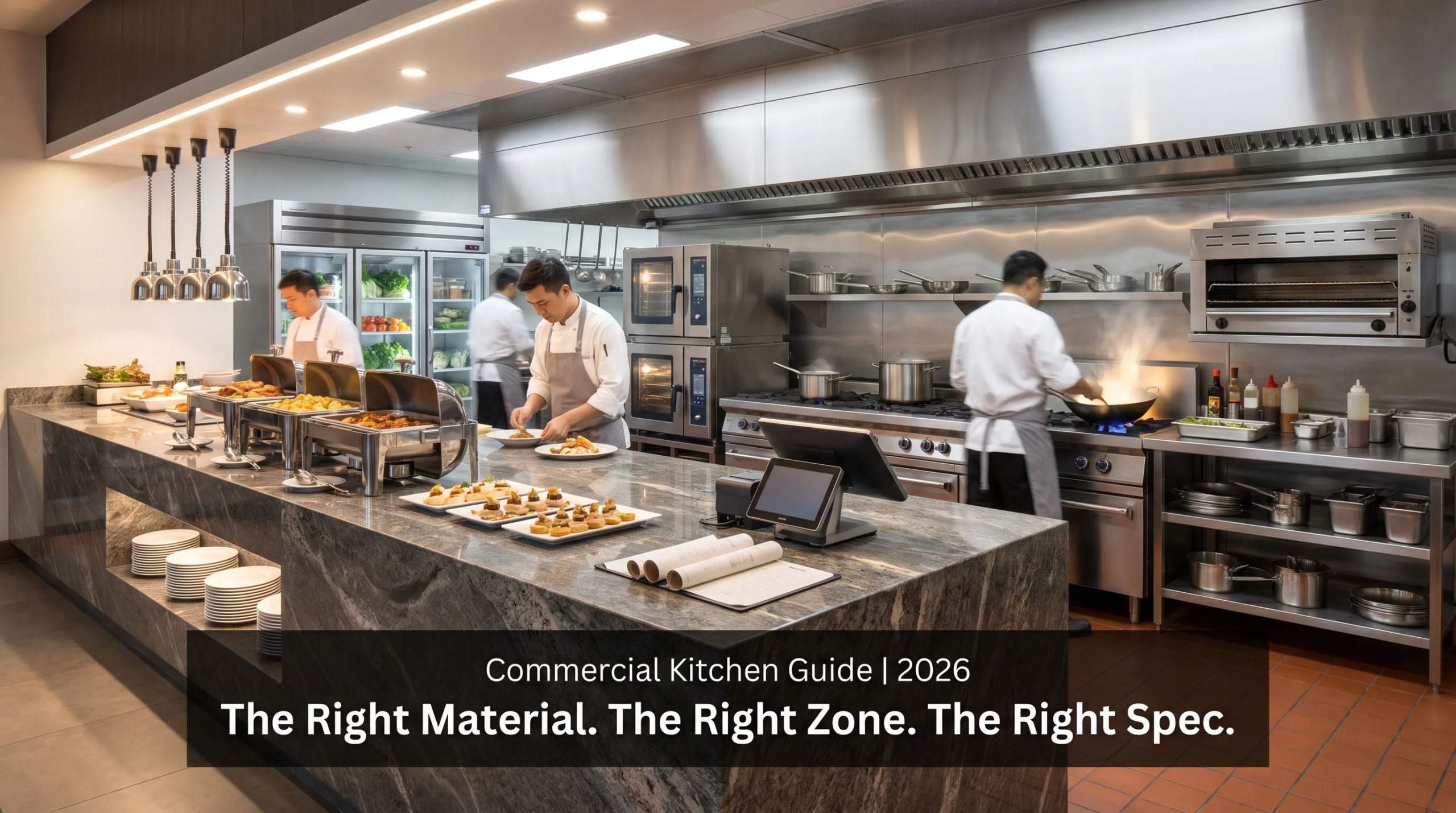
The commercial kitchen is not a single surface — it’s five zones
In every commercial kitchen there are five different surface zones, and the most common commercial kitchen specification mistake is specifying the same countertop material for each of them.
Zone 1 is the active cooking zone – the area around and next to cooking equipment, such as hobs, ovens, grills and fryers. In this zone, stainless steel surfaces, certified by NSF, are required in accordance with HACCP. There is no stone specification applicable here. Zone 2 is the prep counter, where ingredients are chopped, assembled and prepped. The most hygienic specification is stainless steel. If a contractor is specifying stone, polished granite is ok, if properly sealed and meets local health code requirements.
Zone 3 is the pass-through counter – the space between the kitchen and the service area. Polished granite can withstand the constant heat of chafing dishes and covered service containers. Zone 4 is the front of house service counter where food is plated or presented. Both granite and quartz are suitable here. Zone 5 is the front-of-house surface—the bars, the buffet counters, the caf counters, the counters in the restaurant that face the guests. Stone specifications – granite, quartz, marble – are appropriate only in Zones 3, 4 and 5.
| Short answer:
Commercial kitchen stone specification rule Granite and quartz are suitable in Zone 3 (pass through), Zone 4 (service counter) and Zone 5 (front of house bar, buffet, cafe counter). Zones 1 and 2 are the active cooking and prep areas and must be NSF-certified stainless steel to meet HACCP requirements. There are no exceptions to this in a professionally run food service kitchen. |
| Industry Data:
NSF International (nsf.org) NSF/ANSI Standard 2 requires that food contact surfaces be non-porous, smooth, corrosion-resistant, and cleanable with no crevices or pores where bacteria can harbour. Stainless steel is the most reliable material to meet all NSF/ANSI 2 requirements for active food contact zones. NKBA commercial specification research 2025 (nkba.org) — polished granite is specified for 34 percent of commercial restaurant pass-through and service counters. Engineered quartz makes up 41 percent of café and coffee counter specifications. One thing to keep in mind: In commercial kitchens surface specifications are governed by the HACCP food safety system. Any stone specification in a commercial kitchen must be verified with local health authority requirements prior to order. |
Below is the full 7-material durability comparison table for all the major commercial kitchen countertop materials — scratch resistance, heat tolerance, stain resistance, maintenance and best kitchen zone for each:
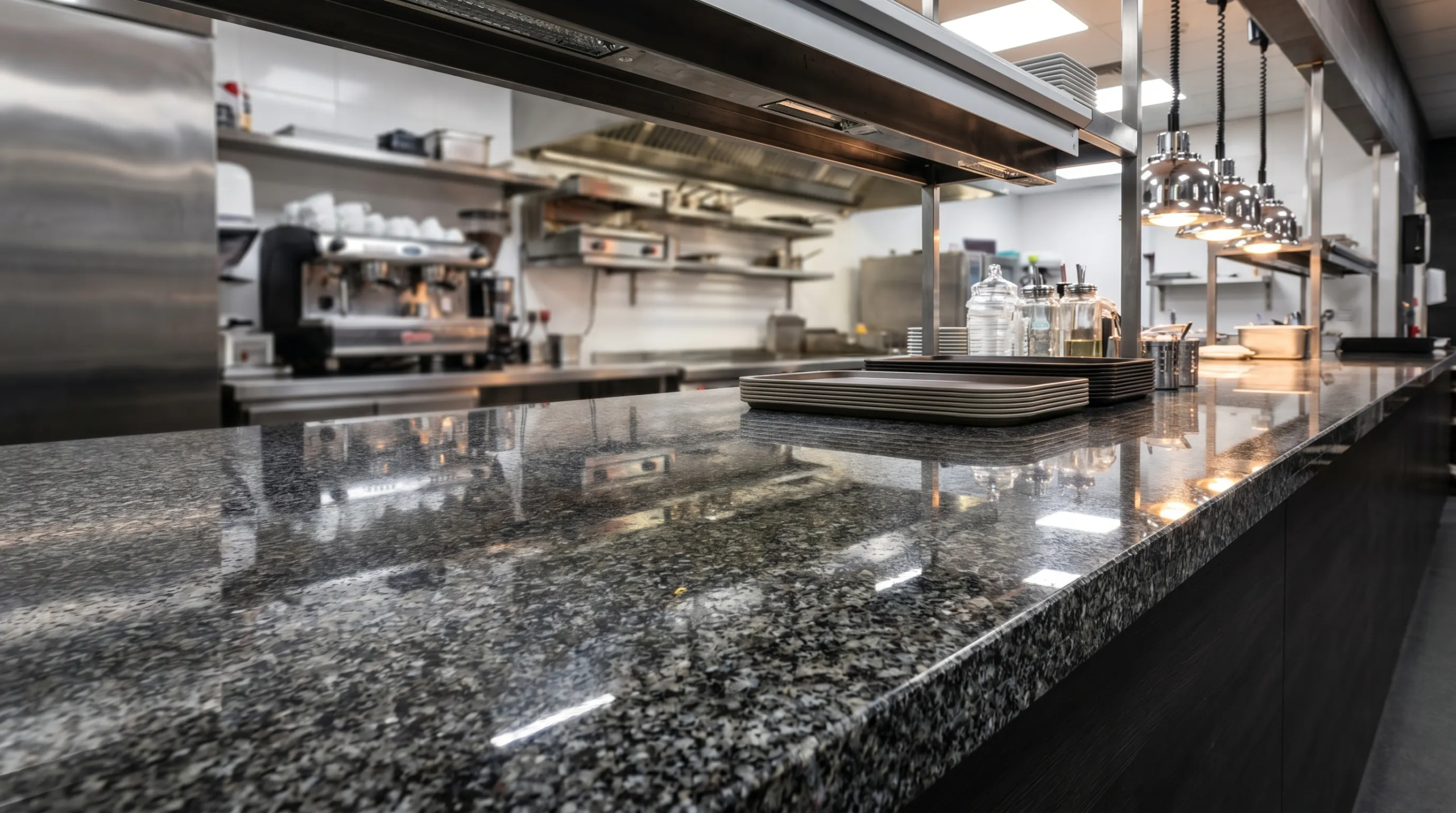
- All Seven Materials Compared – Durability, Maintenance & Zone Suitability
Seven commercial kitchen countertop materials tested on scratch resistance, heat tolerance, stain resistance, maintenance requirement and the kitchen zone each is appropriate for.
The single most important column to guide commercial spec decisions is the Best Kitchen Zone, which reflects both durability performance and HACCP compliance requirements. No matter how well a material performs as a surface, a material that is too durable but inappropriate for the specified zone creates a compliance problem.
| Material | Scratch Resistance | Heat Resistance | Stain Resistance | Maintenance | Best Kitchen Zone |
| Stainless steel | Excellent — dents but does not scratch meaningfully | Excellent — fully heat-proof, no damage from pans or equipment | Good — non-porous, but shows fingerprints and watermarks | Wipe clean. Commercial degreasers. No sealing. | Active cooking and prep zones — HACCP-compliant |
| Polished granite | Excellent — Mohs 6–7, harder than most kitchen implements | Excellent — handles hot pans, chafing dishes, and steam | Good when sealed — requires annual professional sealing | Annual sealing. Commercial cleaners safe. | Pass-through, service counter, buffet, bar top |
| Engineered quartz | Very good — Mohs 7, scratch-resistant under normal use | Moderate — polymer resin vulnerable to sustained heat above 150°C | Excellent — non-porous, no sealing required | Zero sealing. Wipe clean. Avoid sustained heat. | Front-of-house bar, café counter, coffee bar |
| Honed granite | Good — same hardness as polished but more open surface | Excellent — same heat resistance as polished granite | Moderate — more porous than polished, needs more frequent sealing | 6–12 month sealing commercially. More maintenance. | Not recommended for food service — too porous |
| Marble | Moderate — Mohs 3–4, scratches under kitchen use | Good — handles moderate heat but can thermal-shock at extremes | Poor — porous, etches with acidic food, stains readily | Frequent professional sealing. Etching cannot be cleaned. | Not appropriate for any commercial kitchen application |
| Porcelain | Very good — hard, scratch-resistant surface | Excellent — handles high heat without damage | Excellent — fully vitrified, zero porosity | Wipe clean. No sealing. Highly chemical-resistant. | Wall cladding, splashbacks, non-food-contact surfaces |
| Stainless + granite composite | Excellent — stainless working area, granite perimeter | Excellent in stainless zones, very good in granite zones | Good in both zones with correct maintenance | Stainless: wipe daily. Granite: annual sealing. | Complete commercial kitchen with defined zones |
Commercial kitchen with defined areas fully equipped
Durability data based on NSF International food service standards, NSI commercial standards and Mohs hardness scale classification.
Fast answer:
The most durable natural stone specification for commercial food service applications in Zone 3, 4, and 5 is polished granite, which scores 6–7 on the Mohs hardness scale, can withstand sustained heat from chafing dishes without damage, and cleans under commercial degreaser protocols with annual sealing. Quartz is more stain-resistant but less heat-resistant – do not place hot pans or chafing dishes directly on quartz surfaces.
Why Marble Is Not Suitable for Any Commercial Kitchen Application
Marble scores 3 to 4 on the Mohs hardness scale – softer than most knife blades, food service implements and hard objects that come into contact with kitchen surfaces on a daily basis. It scratches with normal commercial kitchen use, is chemically etched with the acidic foods found in food preparation environments (citrus, vinegar, wine, tomato), and requires frequent professional sealing to maintain any level of hygiene performance. NSI commercial maintenance guidelines do not recommend marble for any food service surface.
The restaurant owner who wants marble counter tops in their commercial kitchen because they saw it in an Italian restaurant in a design magazine isn’t being told that the Italian restaurant has a dedicated stone maintenance contractor who refinishes and seals those counter tops every three months. The marble kitchen brief needs a maintenance conversation, not a material order.
| Fast answer:
Marble is not a suitable material for any surface in a commercial kitchen, be it food contact or front of house. It scratches with everyday kitchen use, etches with acidic food products and cannot meet the hygiene standard a commercial food service operation requires without a maintenance programme that most operators will not consistently provide. Direct clients seeking marble, opt for polished granite instead. |
- Kitchen Zone Specification – The Full Reference
The right countertop material for each zone of a commercial kitchen—from the active cooking zone to the outdoor patio—the reasoning behind it and the critical spec note.
Use this table as a reference before you specify any commercial kitchen countertops. The Why Stainless or Stone column provides the reasoning, which is what you need to justify the specification decision to a client or building operator who asks why a particular material was recommended for their application.
| Kitchen Zone | Specify | Why Stainless or Stone? | Key Note |
| Active cooking — hob, grill, fryer surround | Stainless steel only | NSF-certified. Fully heat-proof. HACCP-compliant for food contact surfaces near cooking equipment. | No stone specification in the active cooking zone. Stone near hob or fryer creates food safety and thermal risk. |
| Prep counter — chopping, cutting, assembly | Stainless steel or polished granite | Stainless for full HACCP compliance. Polished granite if stone is specified — hard enough to resist knife and implement scratching. | Specify eased edge on granite prep counters to reduce chip risk from implement impact at the counter edge. |
| Pass-through counter — kitchen to service | Polished granite Level 1 or quartz | Hot food passes through this counter. Granite handles sustained heat from chafing dishes. Quartz suitable if no direct hot pan placement. | Granite preferred where chafing dishes are placed directly on surface. Quartz acceptable where food arrives in covered containers. |
| Service counter — front of house adjacent | Polished granite or engineered quartz | Both appropriate. Granite for natural character. Quartz for zero maintenance. Staff-facing surface — not public-facing. | Eased edge on both granite and quartz service counters — chip resistance under daily commercial service. |
| Restaurant bar top — guest-facing | Polished granite Level 1–2 or engineered quartz | High-visibility guest-facing surface. Granite for natural character. Quartz for consistent appearance across chain locations. | Eased edge essential — chip-resistant under glass and bottle impact. Polished finish easiest to clean after service. |
| Hotel buffet counter — hot and cold | Polished granite Level 1 | Hot chafing dishes placed directly on surface. Granite handles sustained heat without damage. Quartz not appropriate here. | 3cm granite for structural self-support at buffet counter width. Annual sealing on programme. |
| Café and coffee counter | Engineered quartz Level 1 | Zero maintenance. Coffee, milk, and sugar stain resistant. Consistent appearance essential for chain café brand standard. | Quartz preferred over granite at café counters — zero-maintenance profile suits high-turnover operation. |
| Splashback — behind cooking area | Porcelain only | Stone splashbacks near cooking equipment are vulnerable to thermal shock from steam and heat. Porcelain handles this without risk. | Never specify marble or unsealed granite as a splashback adjacent to a hob or cooking equipment. |
| Kitchen island — open-plan restaurant | Polished granite Level 2 | Visible to diners. Granite Level 2 communicates quality. 3cm for self-support. Eased edge. | Open-plan kitchen island is a guest-facing surface — specification should match the restaurant’s quality register. |
| Outdoor kitchen — restaurant terrace | Flamed granite only | Outdoor horizontal surface. R11+ anti-slip essential. Granite only outdoors — quartz and marble not rated for exterior use. | Never specify quartz, marble, or polished granite outdoors. Flamed granite is the only correct exterior horizontal specification. |
| Short answer:
In restaurant and hotel applications, the most common misspecification is the outdoor kitchen terrace row. Polished granite on an outdoor horizontal surface is treacherously slick when wet. The only correct specification for horizontal granite outdoors is flamed granite with an R11+ anti-slip rating. No aesthetic argument is worth the slip risk. The hotel that specifies polished granite for its rooftop bar counter because it matches the lobby stone inside has created a liability every time it rains in service. The flamed granite conversation is easy before the order gets placed. It’s much more difficult when a guest falls. When specifying countertops for a commercial kitchen project? Let us know your commercial kitchen zone, application and stone preference – we will confirm the correct specification and give you a wholesale quote within 2 business hours. +1 704-951-7822 | packuniversesupply.com/request-a-quote |
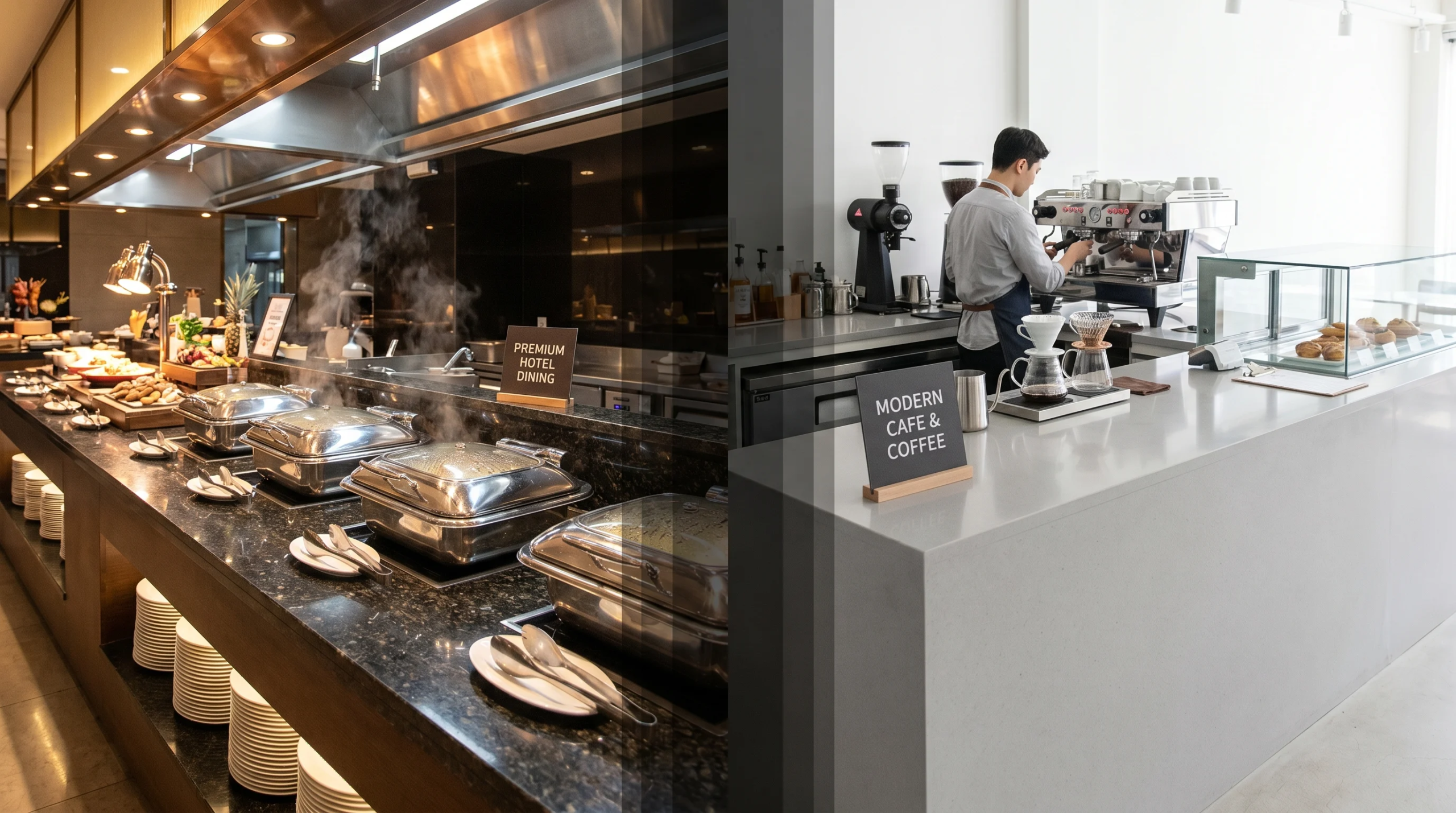
- Granite vs Quartz in Commercial Food Service: The Definitive Choice
In commercial food service zones where stone is appropriate — pass-through, service counters, bars, buffets and café fronts — the choice between granite and quartz boils down to heat tolerance, maintenance preference and visual requirement.
When to Specify Granite:
Hot items go right on the surface: you need granite for hotel buffet counters, restaurant pass-throughs and any counter where chafing dishes or hot equipment will touch the stone directly. Due to the presence of polymer resin in quartz, it can get damaged by heat if exposed to direct heat for a long period of time at a temperature above 150°C.
The application calls for natural stone character: Restaurant dining counters, hotel lobby service surfaces and fine dining environments where the natural character of stone is a specification intention.
High physical impact on the surface: Granite is very hard and resistant to chipping at the edges, making it a great choice for restaurant bar tops and service counters in high traffic areas. Specify eased edge on all commercial granite tops.
The operator has a facilities management programme in place which means annual sealing can be consistently delivered. A sealer presently on polished granite will remain true for 15 to 20 years of commercial food service conditions.
When to Choose Quartz
Zero maintenance is a specification requirement: The zero-sealing profile of quartz is a benefit for café chains, fast-casual restaurant groups and operators without a dedicated facilities management team.
Multiple sites, same look: Chain café brands, hotel brand standard programmes and franchise restaurants who specify across multiple sites enjoy the engineered colour consistency of quartz.
The surface is not suitable for direct placement of hot items: Front-of-house bars where drinks are served, coffee counters, reception surfaces and any application where food is delivered in covered containers.
Chemical cleaning resistance is critical: Quartz’s non-porous surface is safe for commercial kitchen cleaning chemicals including degreasers, sanitisers and descalers.
The contractor who chose engineered quartz for a hotel buffet counter because it was the zero-maintenance option didn’t consider the direct placement of chafing dishes. Three months into service, the quartz showed heat discolouration where the chafing dishes had sat. The granite conversation was available at specification stage for a 15 per cent premium on material cost. The quartz replacement is much more expensive.
| Quick answer:
Granite, Heat. Quartz for upkeep. For any commercial food service area that will have direct hot item placement, specify polished granite. Quartz is the better operational specification for coffee bars, front-of-house service counters and any application where there is no direct heat contact, because it has the zero-maintenance advantage. |
| ⚠ Actual Effect — Actual Hazard:The risk: engineered quartz in a hotel buffet or restaurant pass-through counter with chafing dishes sitting directly on top.
Result: Thermal discolouration of the surface of the quartz polymer resin can be observed within a few months of service. The discolouration will not polish out, the damaged area is a full countertop replacement. Chafing dishes may be set directly on polished granite without harming the surface. |
- Things to Check Before You Order a Commercial Kitchen Stone
Six confirmations before any order for a commercial kitchen stone is placed – covering food safety compliance, zone appropriateness, durability requirements, and the maintenance programme that keeps the specification performing correctly.
Zone confirmation: For which kitchen zone is the stone being specified? If it’s Zone 1 or 2 (cooking or active prep) then switch to stainless steel. Stone is Zone 3, 4 and 5 only.
Health authority compliance: Check with the building operator that the specification has been reviewed for local health authority requirements before ordering any stone for a food contact zone.
Heat exposure confirmation: Will hot items be placed on surface? If yes – specify, granite . If not, quartz is fine.
Sealing program confirmation Confirm that the schedule for building maintenance includes an annual professional sealing program for granite in a commercial kitchen application.
Edge Profile – Eased Edge: Specify eased edge on all commercial food service stone counters. The slight radius is the most chip-resistant profile against everyday commercial impact.
Finish – Only polished in food service Polished granite is not suitable for food service areas due to its more porous surface which cannot maintain the same hygiene standard as polished granite with proper sealing.
These six questions are quicker to ask before the order than to answer after the health authority inspection. None of these are difficult to answer. All of them are more difficult to answer once the stone’s in place.
Brief answer:
Commercial kitchen stone pre-order checklist: Only zone 3, 4 or 5. Health Authority confirmed compliance. Heat test OK. Granite for hot, quartz for room. We seal granite once a year. Edge relaxed. Specified. Only in food service areas, polished finish.
| How Pack Universe Supply helps with commercial kitchen countertop orders:
Pack Universe Supply is your source for commercial food service grade polished granite and engineered quartz from our wholesale warehouse in Charleston, SC. We verify zone suitability for commercial kitchen stone orders, walk you through NSF compliance needs and suggest the right grade and finish before any order ships. For hotel buffet and restaurant pass-throughs where a heat tolerant granite is needed: we confirm stock availability and lot numbers for consistent colour across multi-location orders. Call before you order any commercial kitchen stone. +1 704-951-7822 Wholesale Stone for Commercial Kitchens and Food Service Applications No Minimum on First Order: Commercial food service grades polished granite and engineered quartz, verified finishes, nationwide delivery. Charleston SC (USA) | Burlington ON (Canada) | Delivery Across Country. Request a Quote: packuniversupply.com/request-a-quote Phone: +1 704-951-7822 (Monday–Friday, 8am–5pm EST) → Canada: +1 (647) 362-1907 | WhatsApp: button on packuniversesupply.com |
Verdict – The Toughest Countertop for a Busy Commercial Kitchen in 2026
Verdict:
Stainless steel is the only HACCP compliant and most durable material for active cooking and food preparation zones in any commercial kitchen. No stone specification substitutes for stainless steel in Zone 1 or Zone 2.
Polished granite is the most durable stone specification for commercial food service applications in Zone 3 (pass-through), Zone 4 (service counter) and Zone 5 (front-of-house). It can withstand constant heat from chafing dishes, resists scratching in commercial service and can be cleaned using commercial degreaser protocols – with annual professional sealing on programme.
Engineered Quartz is the specification for café counters, front of house bars and service applications where there is no direct hot item placement and where zero maintenance is a specification requirement. Never specify quartz for any application where hot pans, chafing dishes or continuous heat will be in direct contact with the surface.
Marble is not suitable for any commercial kitchen or food service application.
Specification decision zone driven, material second. Every commercial kitchen stone specification that makes this order wrong creates either a food safety problem or a material failure within the first year of service.
Sources & References
NSF International – NSF/ANSI Standard 2, Food Equipment | NKBA – National Kitchen & Bath Association, Commercial Specification Survey 2025 | NSI – Natural Stone Institute, Commercial Guidelines
About the Author
Sam Michaele 15 years direct experience in supplying granite and quartz for commercial kitchen and food service applications in restaurant, hotel and cafe group settings throughout the USA and Canada. Pack Universe Supply has wholesale warehouses in Charleston, SC (USA) and Burlington, ON (Canada).