Which Stone Slab Lasts Longest in a Commercial Building? Granite, Quartz, or Marble [2026]
Which Stone Slab Lasts Longest in a Commercial Building? Granite, Quartz, or Marble [2026]
Service life by application, the 3 failure modes that end a stone slab early, 10-year maintenance cost comparison, and 8 FAQs — the complete contractor reference.
| Quick answer:
Granite lasts longest across the widest range of commercial applications — 30 to 50 years with correct specification and annual sealing. Quartz matches granite in protected indoor applications (25 to 40 years) with zero maintenance — but fails in commercial kitchens from heat and outdoors from UV. Marble has the shortest commercial service life at 10 to 25 years. Acid from food, drink, and standard cleaning products permanently damages its surface in most commercial environments. The material does not determine service life. The application, the thickness, and the maintenance programme do. |
1. Service Life by Commercial Application
The right material depends on the room — not just the building tier. The same developer can correctly specify all three materials in the same project.
Granite is the only material in this table that is correct for commercial kitchens and outdoor surfaces. Quartz is correct for BTR and standard hotel bathrooms where maintenance cannot be confirmed. Marble is conditional in every application where it appears — requiring confirmed pH-neutral cleaning and 6-monthly professional sealing.
| Commercial Application | Granite | Quartz | Marble |
| Commercial kitchen counter | 30–50 yrs | 25–40 yrs | Not suitable |
| Restaurant bar top | 25–40 yrs | 25–35 yrs | Not suitable |
| Hotel lobby desk | 30–50 yrs | 25–40 yrs | 15–25 yrs* |
| Hotel bathroom vanity | 25–40 yrs | 25–40 yrs | 10–20 yrs* |
| Corporate reception desk | 35–50 yrs | 25–40 yrs | 15–25 yrs* |
| BTR kitchen counter | 25–40 yrs | 25–40 yrs | Not suitable |
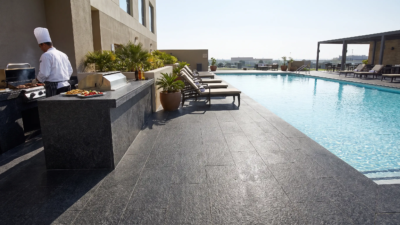
| Outdoor pool / BBQ surface | 20–35 yrs | Not suitable | Not suitable |
| Feature wall cladding | 40+ yrs | 30–40 yrs | 15–30 yrs* |
* Marble requires confirmed pH-neutral cleaning and 6-monthly professional sealing in these applications. Without both, service life is significantly shorter than shown. NSI commercial specification guidelines 2025. Pack Universe Supply order data, June 2026.
| Data:
NSI 2025 — granite is specified in 67% of US commercial kitchen stone countertop installations. Primary reasons: heat resistance, acid resistance, 30-50 year service life with annual sealing. NAHB 2025 — premature stone slab failure in commercial buildings is caused by: wrong material for the application (44%), under-specified thickness (31%), absent maintenance programme (25%). |
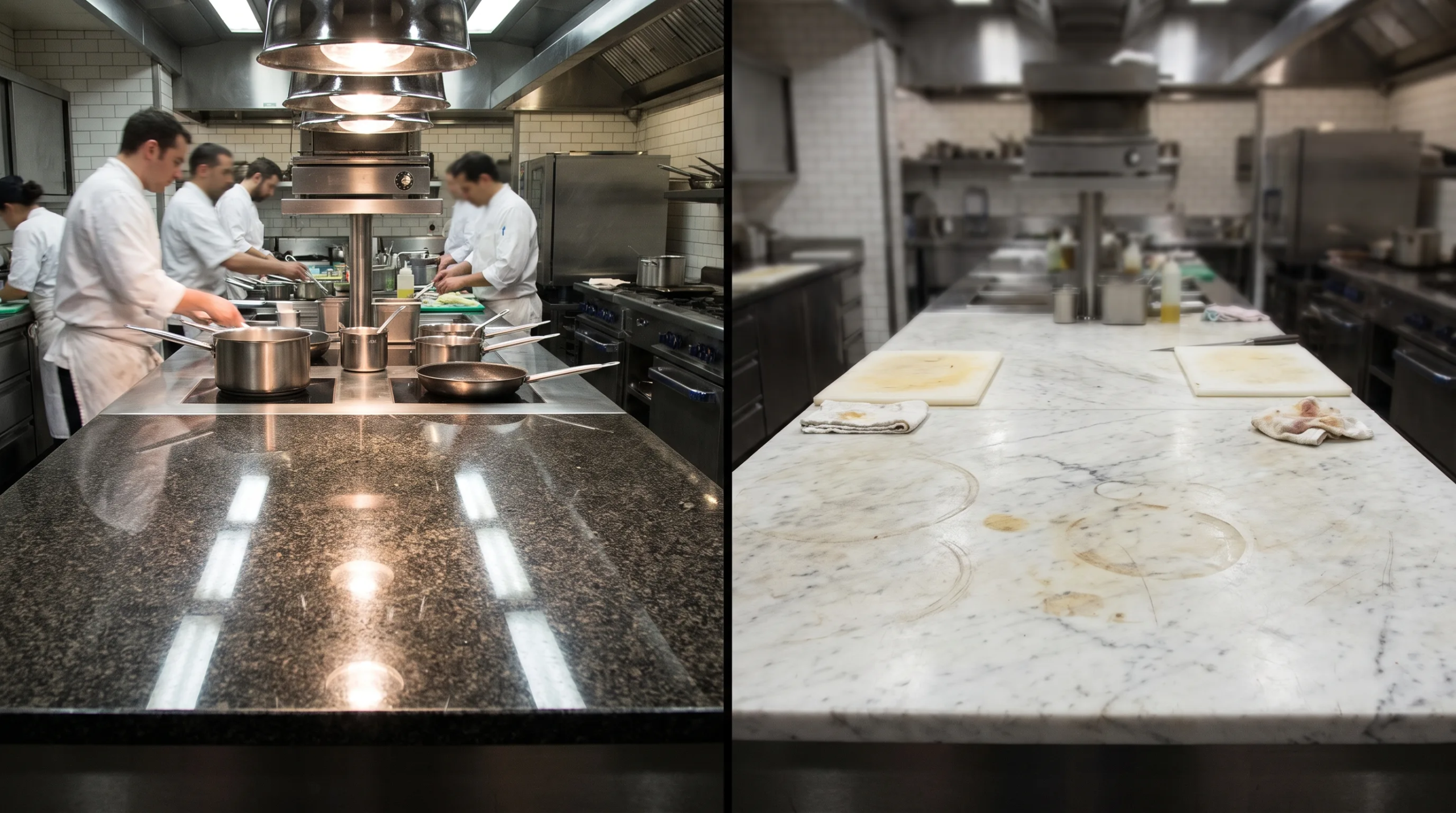
2. The 3 Failure Modes That End a Stone Slab Early
No stone slab wears out from age alone. Every early commercial stone failure traces back to one of three specification decisions.
Failure Mode 1 — Wrong Material for the Application
Marble in a restaurant kitchen. Quartz on an outdoor terrace. These are not gradual failures — they are immediate ones. Marble etches from the first glass of wine. Quartz begins UV degradation in the first summer. The specification failed, not the material.
Rule: confirm heat, acid, UV, and loading conditions before selecting the material. Eliminate materials that cannot handle those conditions. What remains is the correct specification.
Failure Mode 2 — Under-Specified Thickness
2cm stone in an application that requires 3cm is the most common cause of physical fracture in commercial stone installations. NSI specifies 3cm for any self-supporting counter with unsupported spans over 18 inches and for any application with an overhang.
The cost difference between 2cm and 3cm at wholesale: $3 to $5 per sqft. The replacement cost of a fractured 2cm counter: $800 to $2,000. The thickness conversation takes two minutes at the order stage.
Failure Mode 3 — Absent Maintenance Programme
Granite without sealing stains within 12 to 18 months of commercial food contact. Marble without pH-neutral cleaning etches within weeks. The stone performs correctly — the maintenance programme was not delivered.
The fix: confirm sealing frequency and cleaning protocol with the building operator in writing before installation. Not on page 14 of a handover document. Before installation.
| Common mistake:
Common mistake: specifying granite for a BTR kitchen because it looks more premium than quartz, without confirming the building management programme includes annual professional sealing. What happens: sealing lapses within 18 months. Cooking oil staining appears around the hob. At the 2-year inspection, the granite reads as poorly maintained. Quartz in the same application would look identical to day one. |
3. What Actually Kills Each Material — Condition by Condition
The same application can produce very different outcomes depending on which material was specified. This table shows why.
| Hazard | Granite | Quartz | Marble |
| Acid contact (wine, citrus, cleaners) | Resistant — does not etch | Resistant — resin inert | Critical failure — etches permanently |
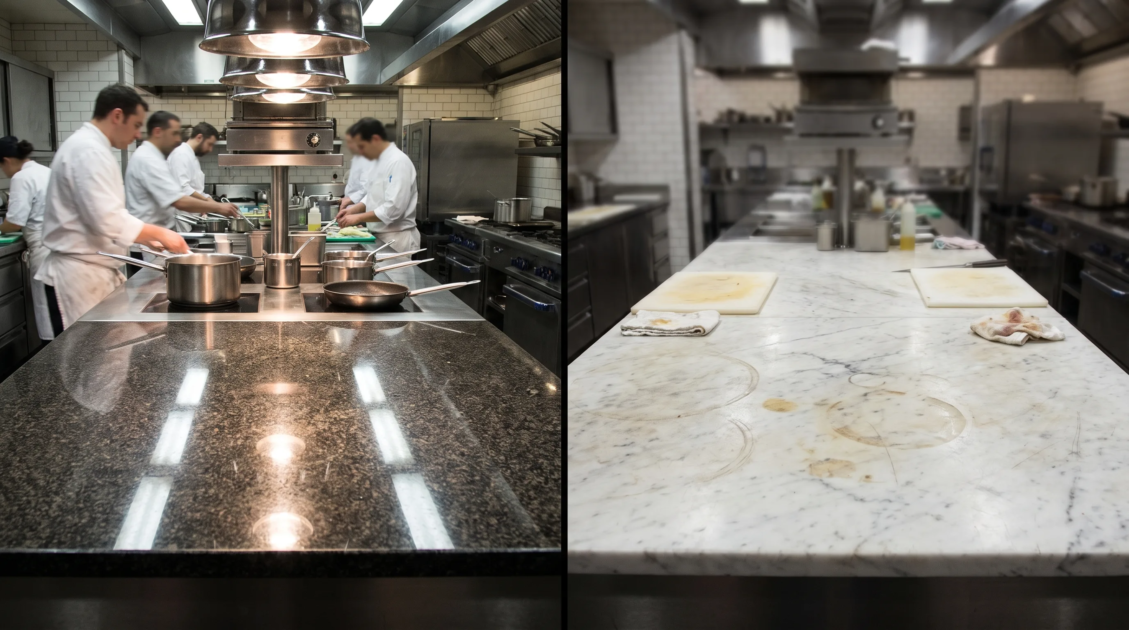
| Heat from hot cookware | No damage — no limit | Scorches above 150°C — permanent | Moderate risk at extremes |
| UV / outdoor exposure | Stable — does not fade | Degrades — resin yellows 2-3 yrs | Not suitable for exterior |
| Scratching | Resistant — Mohs 6-7 | Resistant — Mohs 7 | Vulnerable — Mohs 3-4, softer than steel |
| Freeze-thaw (outdoor) | Survives with annual sealing | Not for outdoor use | Not for outdoor use |
| No sealing programme | Staining in 12-18 months | No effect — none needed | Etch damage within weeks |
| Wrong cleaning products | Gradual dull without pH-neutral | No effect — any product ok | Immediate etch damage |
Green = resistant. Red = failure or not suitable. Amber = risk under specific conditions. Source: NSI material performance standards, ASTM testing data, Pack Universe Supply data June 2026.
| Key point:
The marble column is the one that surprises most contractors. Marble’s Mohs hardness of 3 to 4 means it is softer than steel — a steel knife can score it. Its calcium carbonate composition means any acid etches it permanently. Wine is pH 3.3. Coffee is pH 5. Most cleaning sprays are pH 3 to 5. In any environment where these appear daily, marble fails. |

4. Maintenance Cost — The Number Most Specifications Miss
Service life is how long the stone survives. Total cost of ownership is what it costs to survive that long. They are different numbers.
Quartz has a 10-year maintenance cost of $0. Granite has a predictable low cost that must appear in the building operator’s budget to be delivered. Marble has the highest cost — and the most severe consequence when that cost is not delivered.
| Maintenance item | Granite | Quartz | Marble |
| Sealing required | Annual or 6-monthly | Never | Every 6 months |
| Cleaning products | pH-neutral only | Any product | pH-neutral only, always |
| Professional refinishing | Every 8-10 yrs if needed | Not required | Every 3-5 yrs — etch |
| 10-yr cost per 30 sqft | $360–$720 | $0 | $600–$1,400+ |
| Zero maintenance consequence | Stains within 2 yrs | Performs identically | Etch damage within weeks |
Cost data based on NSI sealing guidelines 2025 and US market professional sealing rates. Indicative — varies by market and surface area.
| Data:
NAHB 2025 — 61% of commercial building operators had not received a maintenance cost disclosure for natural stone at installation. Of these, 44% reported their sealing programme lapsed within 3 years — the primary cause of premature stone surface degradation in those buildings. |
| Which stone is correct for your project — and what will it actually cost?
Pack Universe Supply provides material recommendation and 10-year cost guidance before any order. -> Call: +1 704-951-7822 (Mon–Fri, 8am–5pm EST) -> Request a Quote: packuniversesupply.com/request-a-quote -> Canada: +1 (647) 362-1907 |
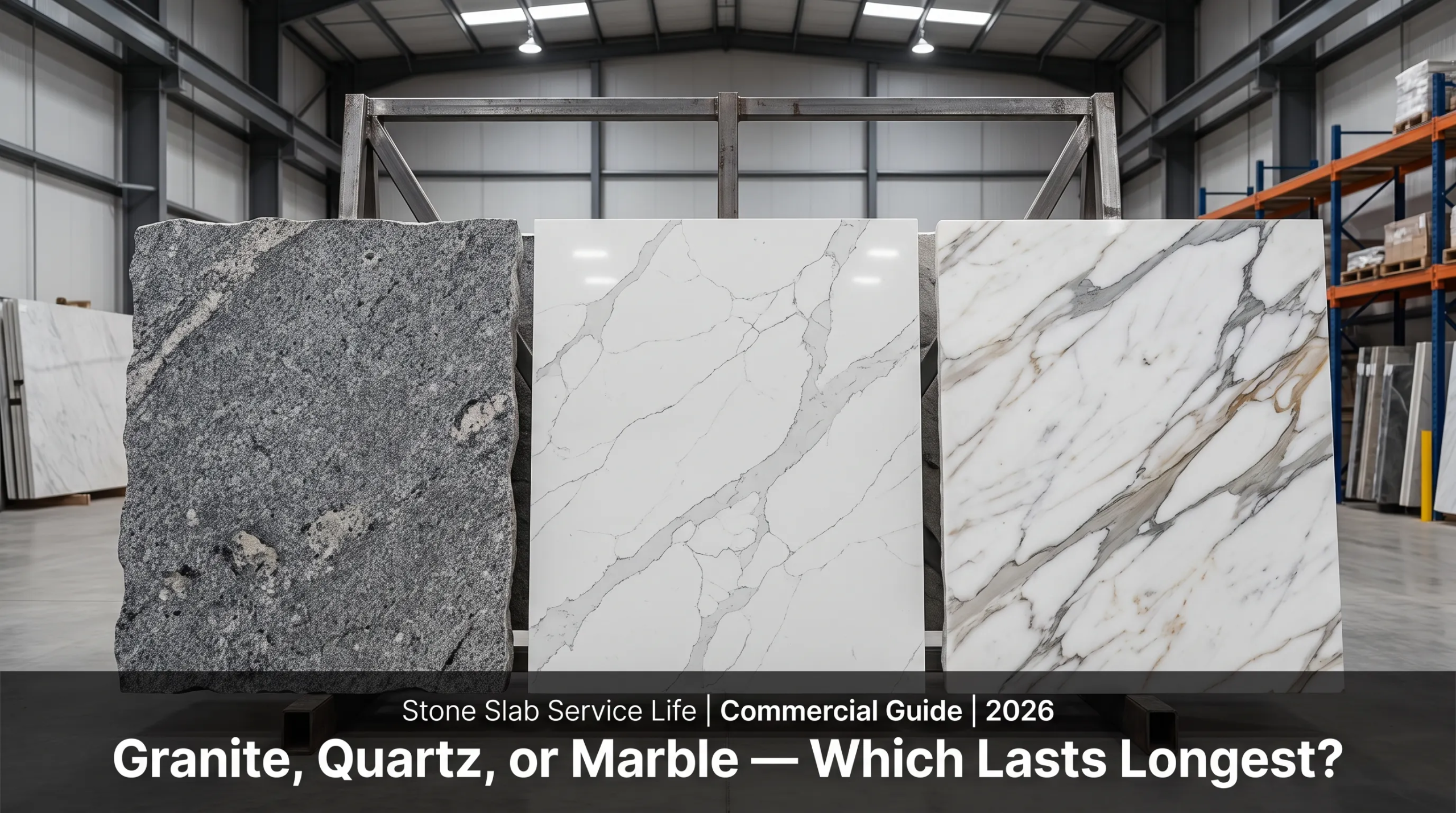
| IMAGE 4 | Pack Universe Supply warehouse — commercial granite, quartz, and stone slabs organised
1200x630px WebP | Alt: Pack Universe Supply wholesale commercial stone granite quartz contractor order Charleston SC 2026 WordPress: Upload -> paste alt text -> insert at this position |
8 Questions Contractors Ask About Stone Slab Service Life
[ WordPress: Use FAQ Block with FAQPage schema markup for each Q&A. ]
| Question | Answer |
| Which stone slab lasts longest? | Granite lasts longest across the widest range of commercial applications — 30 to 50 years with annual sealing. Quartz matches it in protected indoor applications (25 to 40 years) with zero maintenance. Marble has the shortest commercial service life at 10 to 25 years because acid from food, drink, and cleaning products permanently damages its surface. |
| Does marble last in commercial buildings? | Only in low-acid, low-contact applications — corporate boardrooms, feature walls, and boutique hotel bathrooms with a confirmed pH-neutral cleaning and 6-monthly sealing programme. Not suitable for commercial kitchens, restaurant bars, or any surface with daily acid contact. In unsuitable applications, marble shows permanent etch damage within weeks. |
| Does quartz last as long as granite? | In protected indoor applications it matches granite in service life (25 to 40 years) with zero maintenance. Granite outperforms quartz in three conditions: commercial kitchens where cookware exceeds 150°C, outdoor applications where UV degrades quartz resin, and luxury applications where natural stone authenticity is required. |
| What causes stone slabs to fail early? | Three causes: wrong material for the application (marble in kitchens, quartz outdoors), under-specified thickness (2cm where 3cm is required — fractures under commercial loading), and absent maintenance programme (unsealed granite stains, unsealed marble etches). All are specification decisions made before installation. |
| How often does commercial granite need sealing? | Every 6 months for food service and hospitality. Every 12 months for lower-contact applications such as offices and hotel bathrooms. The water bead test confirms timing: if water absorbs within 4 minutes rather than beading on the surface, reseal immediately. |
| Can any stone be used outdoors? | Granite only. It is UV-stable, frost-resistant when sealed annually, and handles outdoor thermal cycling. Quartz resin yellows within 2 to 3 years of UV exposure. Marble is not suitable outdoors due to UV discolouration, acid rain etching, and freeze-thaw damage in cold climates. |
| What thickness do commercial stone slabs need? | 3cm (1.25 inch) for any self-supporting counter, overhang, or unsupported span over 18 inches. 2cm only for fully supported bathroom vanities with no overhang. Under-specifying to 2cm in a self-supporting application is the leading cause of commercial stone fracture. NSI specifies 3cm for all unsupported commercial spans. |
| Where can contractors order wholesale stone slabs? | Pack Universe Supply stocks commercial granite, quartz, and engineered stone from Charleston, SC (USA) and Burlington, ON (Canada). Lot-confirmed, correct thickness, nationwide delivery. No minimum on first orders. Call +1 704-951-7822 or visit packuniversesupply.com/request-a-quote. |
| Verdict:
Granite lasts longest across the widest range of commercial applications — 30 to 50 years in kitchens, bars, lobbies, and outdoor surfaces. It requires annual sealing and a confirmed maintenance programme. Quartz matches granite in protected indoor applications with zero maintenance. Correct for BTR, hotel bathrooms, and offices. Not for commercial kitchens or outdoors. Marble has the shortest service life and the narrowest range of suitable applications. Correct only in low-acid, low-contact settings with a confirmed maintenance programme. Everywhere else, it etches. Service life is determined by correct application, correct thickness (3cm for self-supporting), and a delivered maintenance programme — not by which material is most durable in isolation. |
Sources & References
NSI — Natural Stone Institute: naturalstoneinstitute.org | NAHB — National Association of Home Builders 2025: nahb.org | ASTM material standards | Pack Universe Supply data, June 2026.