SPC vs LVT Flooring — What Is the Difference and Which Should Contractors Order? [2026]
SPC vs LVT Flooring — What Is the Difference and Which Should Contractors Order? [2026]
2026 ultimate guide for contractors on SPC vs LVT flooring – including core construction, dimensional stability, indentation resistance, waterproof performance, acoustic differences, full 11-factor comparison table, 12-application specification reference and the specific cases where LVT remains an acceptable option. Data from Grand View Research and NAHB throughout.
SPC vs. LVT flooring: What’s the difference and which should contractors order?
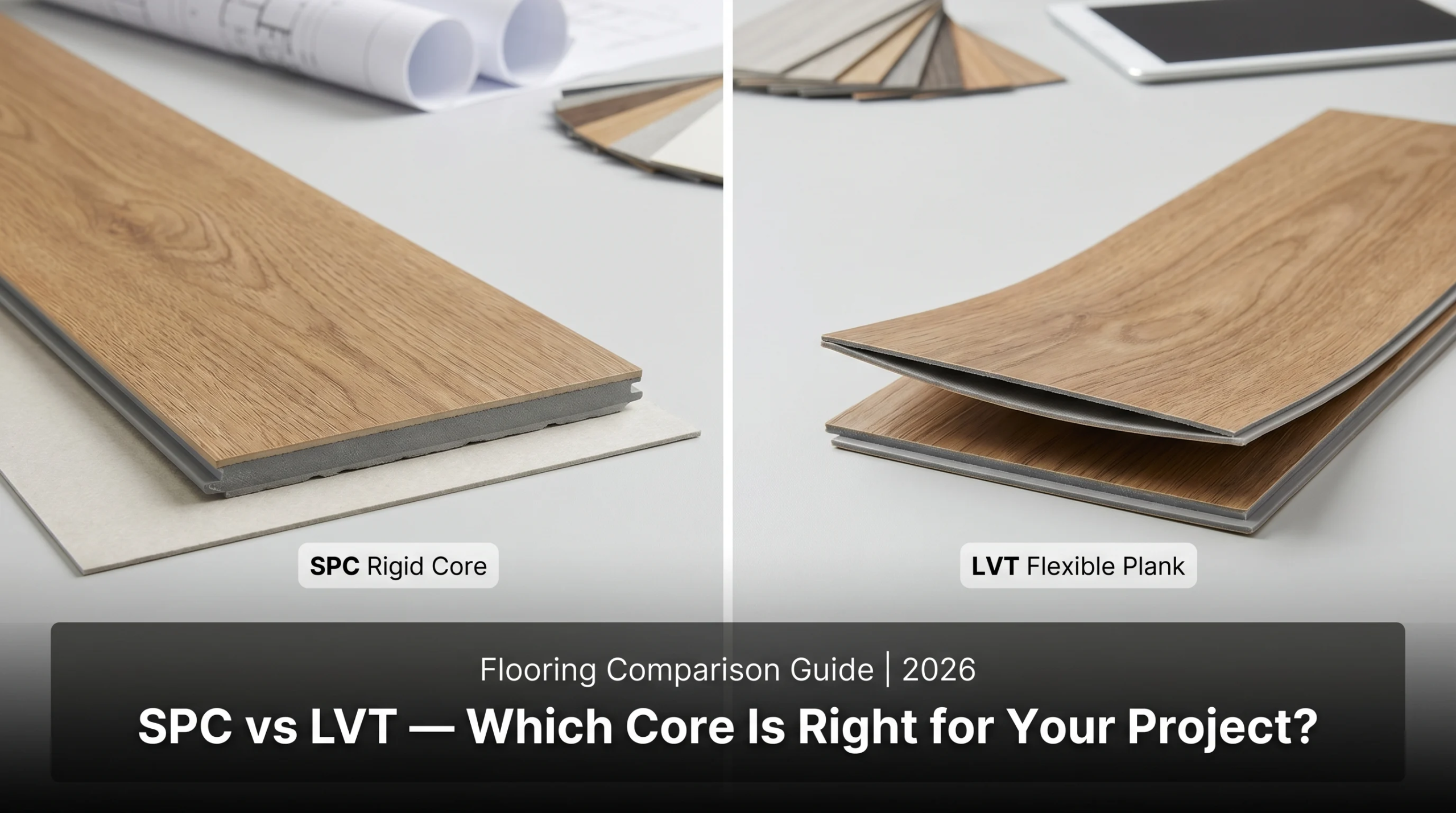
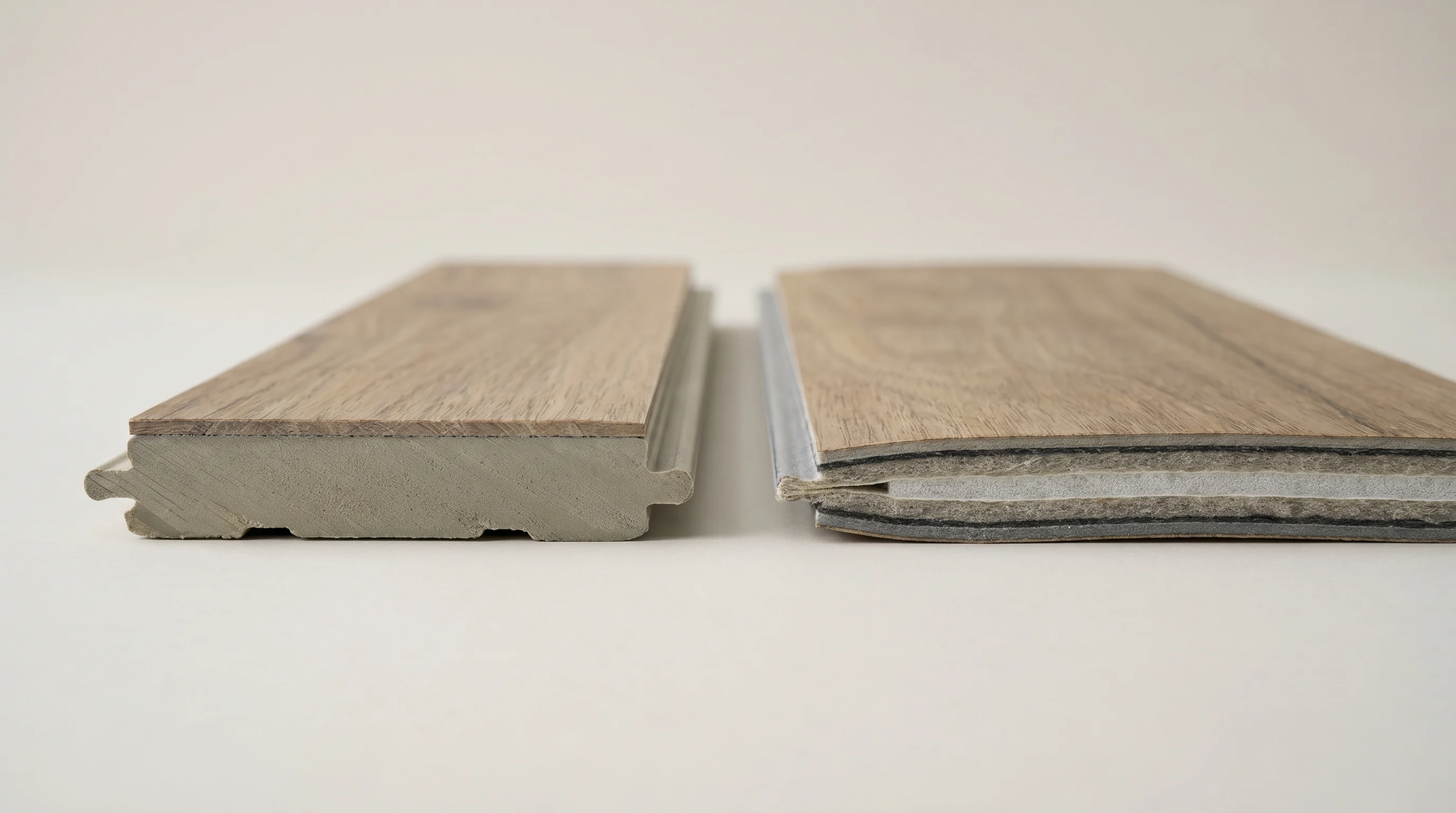
Both SPC (Stone Plastic Composite) and LVT (Luxury Vinyl Tile) are types of vinyl flooring with a photographic print layer and a wear layer on top — but their cores are very different. SPC is a rigid stone plastic composite core that is dimensionally stable, indent resistant and suitable for commercial high traffic use. LVT has a flexible core – foam, felt or WPC – that performs well in typical residential conditions, but is less suited to commercial loading, temperature variation and subfloor imperfection. SPC will be the preferred specification for most commercial applications in 2026, replacing LVT.
The short answer per application is:
Request A Quote | +1 704-951-7822 | packuniversesupply.com |
On the surface, SPC and LVT may appear identical: the same wood-look print, the same wear layer, the same click-lock installation. The difference is all in the core, and the core is what determines whether the floor will perform correctly in a commercial environment.
The most common flooring specification mistake contractors make in 2026 is confusing SPC and LVT – not because either product is poorly understood in isolation, but because they are marketed using overlapping terminology. Both are marketed as “waterproof vinyl flooring”, both are available in wide-plank styles that look like wood, both have click-lock installation systems. The important difference for specification – whether the core is rigid or flexible – is often buried in product datasheets, rather than being discussed with suppliers.
This guide draws the line, compares the two products on every factor that matters in commercial specification, and offers a 12-application reference table that removes the guesswork from which product belongs in which environment. Source: Grand View Research Market Data, NAHB Purchasing Surveys (All)
- The Core Difference: Why SPC and LVT are Fundamentally Different Products
The only difference between SPC and LVT is the core. That one difference is a performance gap that’s invisible in a showroom but huge in a commercial building.
LVT, or Luxury Vinyl Tile, was the leading resilient flooring product during the 2010s. Its core is flexible – usually a combination of foam, felt, wood fibre or WPC (Wood Plastic Composite). This flexibility provides a comfortable, cushioned and reasonable acoustic performance underfoot for LVT. It also makes LVT vulnerable to dimensional change with temperature – the core expands and contracts as the building heats and cools seasonally, which can result in gaps between planks in cold conditions and buckling in hot ones if the expansion gap is too narrow.
Around 2020, SPC started replacing WPC and flexible LVT in commercial specifications. Its core is rigid, consisting of limestone powder and PVC with stabilisers pressed into a dense composite. This maintains its dimensions over a wider temperature range and resists indentation under commercial loads. Its rigidity eliminates the issue of expansion and contraction that flexible LVT faces in commercial buildings that experience temperature fluctuations, and it provides the load-bearing capabilities needed for commercial high-traffic environments.
| Quick answer:SPC core: rigid – limestone powder + PVC + stabilizers. Resistant to temperature changes in dimensions. Indents resistant under heavy commercial loads. LVT core: flexible – foam, felt, WPC or fibre. More comfortable on foot. More vulnerable to dimensional change with temperature and indented under high loads.
Industry Data: Grand View Research 2026 (grandviewresearch.com) — The global SPC flooring market was valued at USD 6.35 billion in 2026 and is projected to grow at a CAGR of 7.2%. The commercial segment is the fastest growing at 7.6% CAGR as SPC replaces flexible LVT in hotel, BTR, and office specs.” NAHB 2025 (nahb.org) — SPC with rigid core accounted for 41% of all residential flooring orders in new build-to-rent developments in 2025, the highest single-category share — mirroring the commercial preference for dimensional stability and waterproof performance. |
| The one thing to know:
The one rule of specification that will end all SPC vs LVT substitution errors: Confirm the substrate type, rigid or flexible, before specifying any commercial flooring. Rigid SPC for commercial, wet areas, below grade & temperature change areas. Flexible LVT for normal residential dry areas with stable temperatures and light traffic only. |
Here is the complete 11-factor SPC vs LVT comparison table covering every performance and specification variable that matters for commercial decisions:
- SPC vs LVT – A Complete 11-Factor Comparison
Compare the eleven performance factors, from dimensional stability and indentation resistance to acoustic performance and price, and the application each product is best suited for, and you’ll see why.
The Commercial Suitability and Best Application rows are the most important for specifying decisions. LVT is only effective for a restricted range of commercial applications: stable temperature, light load, dry conditions. SPC is the right specification outside of that range.
| Factor | SPC Flooring | LVT Flooring |
| Core construction | Rigid — limestone powder + PVC + stabilizer’s. Dense, hard, dimensionally stable. | Flexible — foam, felt, WPC, or fibre core. Softer underfoot, more pliable. |
| Dimensional stability | Excellent — rigid core holds its shape under temperature swings of 20°C+. Minimal expansion and contraction. | Moderate — flexible core expands and contracts more with temperature changes. Can gap or buckle in temperature-variable environments. |
| Indentation resistance | Excellent — resists indentation under heavy furniture, rolling loads, and commercial foot traffic. Does not deform under point loads. | Moderate — flexible core can deform under heavy furniture legs and rolling loads. Furniture protectors recommended. |
| Subfloor tolerance | Good — rigid core bridges minor subfloor imperfections without telegraphing them to the surface. 3mm over 1.8m tolerance. | Lower — flexible core can telegraph subfloor imperfections to the visible surface. Requires flatter subfloor preparation. |
| Waterproof performance | 100% waterproof throughout full plank depth — no organic material in core to absorb moisture. | 100% waterproof at surface — but flexible core (especially WPC) can be affected by sustained moisture exposure at edges and seams. |
| Acoustic performance | Lower acoustic comfort than WPC LVT — rigid core transmits more impact sound. Pre-attached underlayment improves this significantly. | Better acoustic comfort than SPC — flexible core absorbs more impact sound. Standard specification for above-ground residential. |
| Commercial suitability | Excellent — the preferred commercial specification in 2026 for hotels, BTR, offices, and retail. | Good for light commercial — appropriate for standard-load, temperature-stable, dry commercial environments only. |
| Installation over existing floors | Excellent — rigid core tolerates minor subfloor variation better than flexible LVT. | Good — but subfloor must be flatter and cleaner for optimal results. |
| Wear layer options | 6 mil to 40 mil+ — 20 mil minimum for any commercial application. | 6 mil to 20 mil — 20 mil for light commercial. Rarely available above 20 mil in standard LVT products. |
| Price point | Slightly higher per sqft than comparable LVT — rigid core manufacturing premium. | Lower per sqft than SPC on comparable grades — flexible core is less expensive to manufacture. |
| Best application | Commercial high-traffic, wet areas, below-grade, BTR, hotel rooms, temperature-variable environments. | Standard residential dry areas, light commercial with stable temperature and minimal moisture exposure. |
| Short answer:
The most important comparison in this table: Dimensional Stability. SPC holds its dimensions through temperature swings of 20°C+. Flexible LVT expands and contracts more with temperature – creating gap or buckle risk in BTR ground floor units, hotel rooms with underfloor heating and any commercial building with significant seasonal temperature variation. |
When LVT Continues to be a Valid Specification
In 2026, LVT is suitable in three particular commercial circumstances. First, the normal residential dry areas – the bedrooms and living rooms on the upper floors with their even temperatures, light traffic and no exposure to moisture. Under these conditions the SPC premium is not warranted and LVT provides adequate performance at a lower cost. Second, light commercial applications with very stable indoor temperatures and low loading, small private offices, meeting rooms and low-traffic residential common areas. Third, residential projects with budget constraints, where the difference in performance of SPC and LVT is not relevant to the application conditions
SPC is the correct specification in all other commercial situations including hotel rooms, BTR kitchens and bathrooms, open plan offices, retail floors, below grade installations and any environment with temperature variation or moisture exposure.
The contractor who replaced LVT with SPC on a BTR ground floor kitchen, after being told by the supplier they were ‘basically the same product’ found out the difference at the first winter heating cycle, when the flexible LVT planks showed gaps at the joints as the core contracted in the cold and the expansion gap was calculated for SPC dimensional tolerances. Pretty much the same product. Not the same specifications.
| Short answer is:
LVT performs well in normal residential dry areas with stable temperatures and moderate traffic. Not suitable for commercial high traffic areas, wet areas, below grade installations or any building with seasonal temperature variation over 15°C. SPC is the specification required in those applications — not the premium option. |
| ⚠ Real Risk — Real Consequence:
The risk: accepting a supplier’s substitution of LVT for SPC on a commercial order because “both are waterproof vinyl flooring”. The result: dimensional instability in varying temperature conditions, indentation under commercial loads and potential subfloor telegraphing in buildings where the subfloor was prepared to SPC’s higher tolerance threshold. All three problems were post installation, not on delivery. |
Below is the 12-application specification table indicating the correct product, wear layer and reason for each major commercial and residential flooring application:
- Full Specification Reference SPC and LVT by Application
The right product, minimum wear layer and specification rationale for every major commercial and residential flooring application – from hotel rooms to healthcare corridors.
Refer to this table prior to confirming any order for resilient flooring. It clearly identifies the two areas where LVT is acceptable – standard residential bedrooms and living rooms. All other applications listed in the table require SPC.
| Application | Specify | Reason |
| Hotel room — standard and mid-range | SPC — 20 mil | Rigid core handles commercial cleaning, rolling luggage, and temperature variation. Waterproof for bathroom-adjacent areas. |
| Hotel room — boutique and luxury | SPC with pre-attached underlayment — 20 mil | Premium SPC with acoustic underlayment delivers the quiet, solid underfoot feel that boutique hotel rooms require. |
| BTR apartment — kitchen and bathroom | SPC — 12–20 mil | Waterproof throughout. Temperature-variable ground floor units need SPC dimensional stability. Zero maintenance for tenants. |
| BTR apartment — bedroom and living | SPC or LVT — 12–20 mil | Both suitable in dry, stable-temperature upper-floor units. SPC preferred for dimensional stability. LVT acceptable where budget is constrained. |
| Corporate office — open plan | SPC — 20 mil | Heavy commercial foot traffic, rolling chair loads, and daily commercial cleaning. Rigid core required. |
| Retail store floor | SPC — 20 mil | Heavy foot traffic, trolley loads, and commercial cleaning. LVT not appropriate for high-traffic retail. |
| Co-working space | SPC — 20 mil | Variable commercial loading and daily cleaning. Rigid core essential for durability across diverse tenant activity. |
| Residential bedroom — standard | LVT — 12 mil | Light residential traffic, stable temperature, no moisture. LVT cost advantage justified in standard residential dry areas. |
| Basement or below-grade | SPC only | SPC waterproof core and dimensional stability are essential for below-grade moisture conditions. LVT not appropriate below grade. |
| Commercial kitchen adjacent area | SPC — 20 mil | Moisture and temperature variation from adjacent kitchen. SPC rigid core and waterproof performance required. |
| Gym and wellness facility | SPC — 20–28 mil | Heavy equipment loads, moisture from sweat and cleaning. Rigid core and heavy commercial wear layer essential. |
| Healthcare corridor | SPC — 28 mil | Heavy clinical equipment loads, aggressive chemical cleaning, and seamless hygiene requirements. Heavy commercial SPC only. |
The clearest example is the below-grade basement row in this table. Under no circumstances is there room for flexible LVT below grade. The rigid SPC core was designed for the moisture, temperature fluctuation and subfloor unevenness that are typical of below-grade installations, conditions for which the flexible LVT was not. This is not a cost-premium decision, this is a suitability-decision.
| Short answer:
SPC always specifies installation of basement and ground floor slabs below grade. What below-grade conditions represent is the performance gap between rigid SPC and flexible LVT, a combination of moisture exposure, temperature variation and subfloor irregularity. It is a specification error to install LVT below grade no matter what the product is marketed as. |
| Are you ordering SPC or LVT flooring for a current project?
Tell us your project type, application areas and wear layer required and we’ll confirm if SPC or LVT is the correct spec and give you a confirmed wholesale quote within 2 business hours. +1 704-951-7822 | packuniversesupply.com/request-quote |
- What to Confirm Before You Order SPC or LVT
Five confirmations before any resilient flooring order – including product type, wear layer, acoustic performance, shade variation and the production batch code which guarantees colour consistency across a large development.
Core Type Confirmation: Kindly confirm in writing whether the product has a rigid SPC core or a flexible core. Don’t buy “waterproof vinyl” or “rigid core LVT” until you’ve checked the exact core construction. Please provide the ASTM product standard – ASTM F3261 for SPC, ASTM F1700 for LVT.
Thickness of wear layer: Minimum 20 mil of any commercial use. Minimum 12 mil for kitchens and bathrooms (residential). 28 mil Heavy commercial health care, education, high traffic hospitality. Please confirm in writing.
Pre-attached underlayment: If you’re looking for acoustic comfort in hotel rooms and BTR living areas, see if the product has pre-attached underlayment. SPC without underlayment is not as acoustically comfortable as LVT, but the underlayment largely closes the gap.
V1 shade variation classification: For multi-unit development orders, specify V1 shade variation classification and confirm the production batch code before Phase 1 ships. Colour variation exists between production runs for both SPC and LVT.
FloorScore or GREENGUARD Certified: For commercial projects with indoor air quality requirements, look for products that are FloorScore or GREENGUARD Gold Certified for low VOC emissions.
These 5 questions take less time to ask before the order than to answer after the wrong product is installed. If there is a substitution error, an acoustic complaint or a shade variation problem across a development, it comes back to one of these five confirmations not being made before the order ships.
| The bottom line:
Pre-order Checklist for All Resilient Flooring Orders: Rigid SPC core confirmed in writing for commercial use. Confirmed 20 mil commercial minimum wear layer thickness. Acoustic underlayment approved. V1 shade classification and batch code development orders confirmed. Confirmed IAQ-sensitive projects FloorScore or GREENGUARD certified. |
| Order SPC & LVT flooring with Pack Universe Supply:
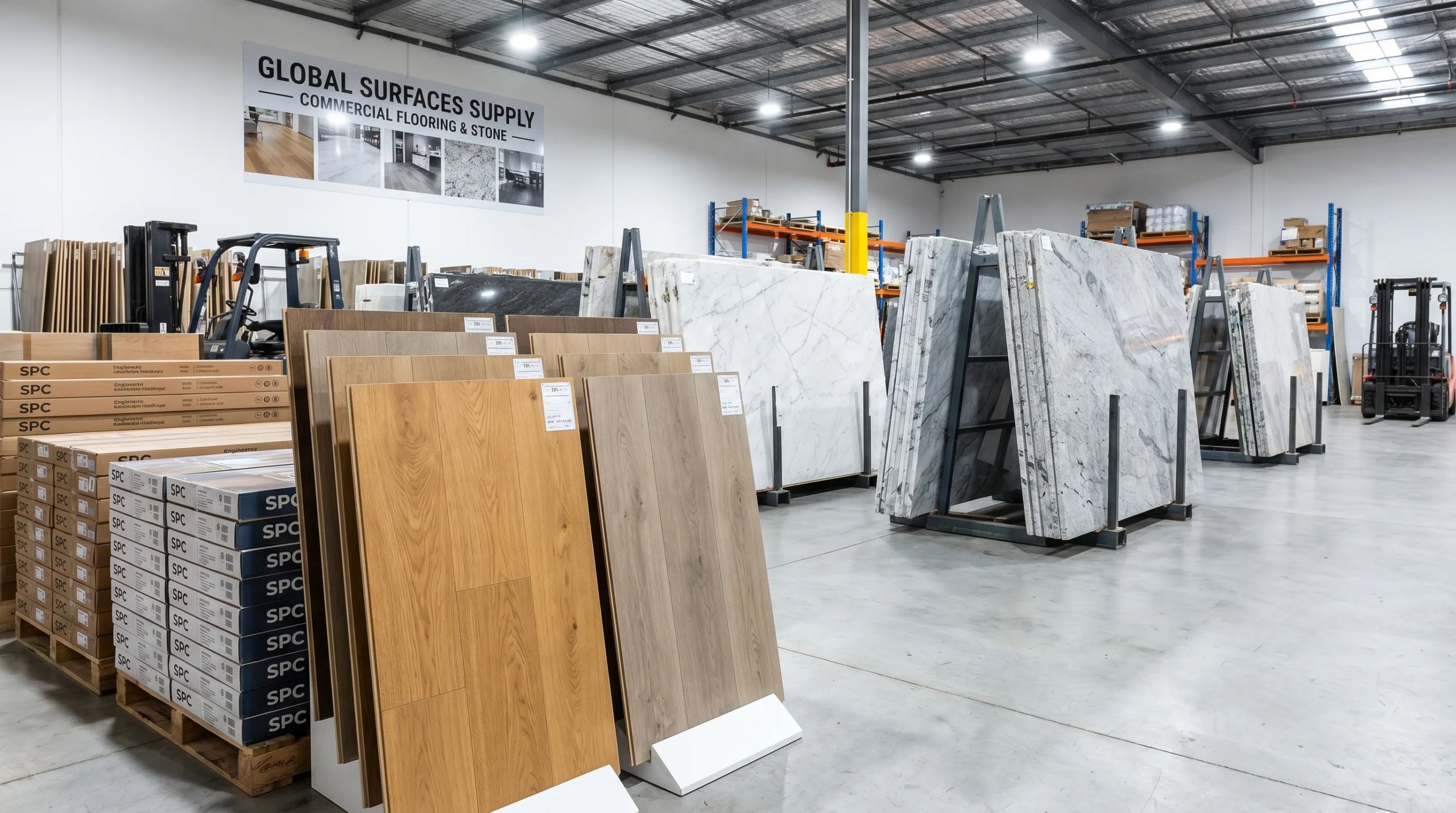
SPC Flooring Pack Universe Supply carries SPC flooring in commercial and residential grades 12 mil through 28 mil wear layers from our warehouse in Charleston, SC. For every commercial SPC order, we check the core type (rigid SPC, not flexible LVT), the wear layer specification, FloorScore certification status and the shade variation classification before it ships. |
| Buy Commercial SPC Flooring in Bulk – No Minimum First Order:
Residential and commercial grade rigid core SPC, verified wear layer, certified, batch-matched. Charleston SC (USA) | Burlington ON (Canada) | Delivery Nationwide. → Get a Quote: packuniversesupply.com/request-a-quote → Phone: +1 704-951-7822 (Mon-Fri, 8am-5pm EST) Canada: +1 (647) 362-1907 | WhatsApp: button at packuniversesupply.com |
SPC vs LVT: Which Should Contractors Be Ordering? Verdict
Decision:
SPC is the correct specification for all commercial applications, wet areas, below grade installations, BTR kitchens & bathrooms, hotel rooms and any area with temperature variation or heavy loading. Its rigid core gives it the dimensional stability, indentation resistance and load-bearing performance that flexible LVT cannot reliably deliver in those conditions.
LVT is OK for standard residential dry areas – upper floor bedrooms and living areas with stable temperatures, light traffic and no moisture. In those specific conditions the cost advantage over SPC is justified. It is not beyond them.
The confirmation that eliminates all SPC vs LVT substitution errors: ask the supplier in writing for the core type before ordering any commercial flooring. Commercial rigid SPC core. Core only, flexible for standard residential dry areas. Not the same thing.
About the Author
Sam Michaele 15 years of direct experience in providing SPC and LVT flooring to commercial and residential projects across the USA and Canada. Pack Universe Supply has wholesale warehouses located in Charleston, SC (USA) and Burlington, ON (Canada).
For large development orders: we confirm production batch codes, supply samples from confirmed batches and control phased delivery against the development programme.