Granite vs Quartz vs Marble — Complete Commercial Comparison 2026
Granite vs Quartz vs Marble — Complete Commercial Comparison 2026
The definitive 2026 commercial comparison of granite, quartz, and marble — the full 11-factor side-by-side table, a 12-application decision guide, acid resistance explained, heat resistance compared, maintenance requirements for each material, the applications where each material is the undisputed correct specification, and the applications where one material categorically fails. NSI, MIA+BSI, and NAHB data throughout.
| Granite vs quartz vs marble — which is best for commercial countertops in 2026?
For commercial countertops in 2026, the answer depends on the application. Granite is the strongest all-round commercial specification — acid-resistant, scratch-resistant, requires annual sealing, and lasts 30 to 50 years. Quartz (engineered stone) is the zero-maintenance specification — non-porous, no sealing required, consistent colour across large orders, but not heat-resistant and not natural stone. Marble is the premium aesthetic specification — uniquely beautiful, irreplaceable in luxury hotel bathrooms and spa surfaces, but etches on acid contact and requires a confirmed maintenance programme. No single material is best for all applications. Quick specification guide by application: • Commercial kitchen counter: Granite. Acid-resistant, scratch-resistant, handles heat from cookware. Sealing every 6 months. • Hotel bathroom vanity — standard to mid-range: Quartz. Zero maintenance. No sealing. Housekeeping uses any product. Marble-look options available. • Hotel bathroom vanity — boutique and luxury: Marble or quartz depending on whether the confirmed maintenance programme is in place. • Restaurant bar top: Granite or quartz. Never marble — wine and spirits etch marble surfaces. • Corporate reception desk: Granite or marble depending on design brief and contact level. Quartz where zero maintenance is required. • Office break room: Quartz. Zero maintenance. No sealing. Handles commercial cleaning products without damage. Granite, quartz, and marble in all commercial grades available at Pack Universe Supply — wholesale contractor pricing. Call +1 704-951-7822 | packuniversesupply.com/request-a-quote |
Every commercial stone specification question eventually reduces to three options — and each of the three is the correct answer for a different application. The contractor who knows which is which does not have to guess.
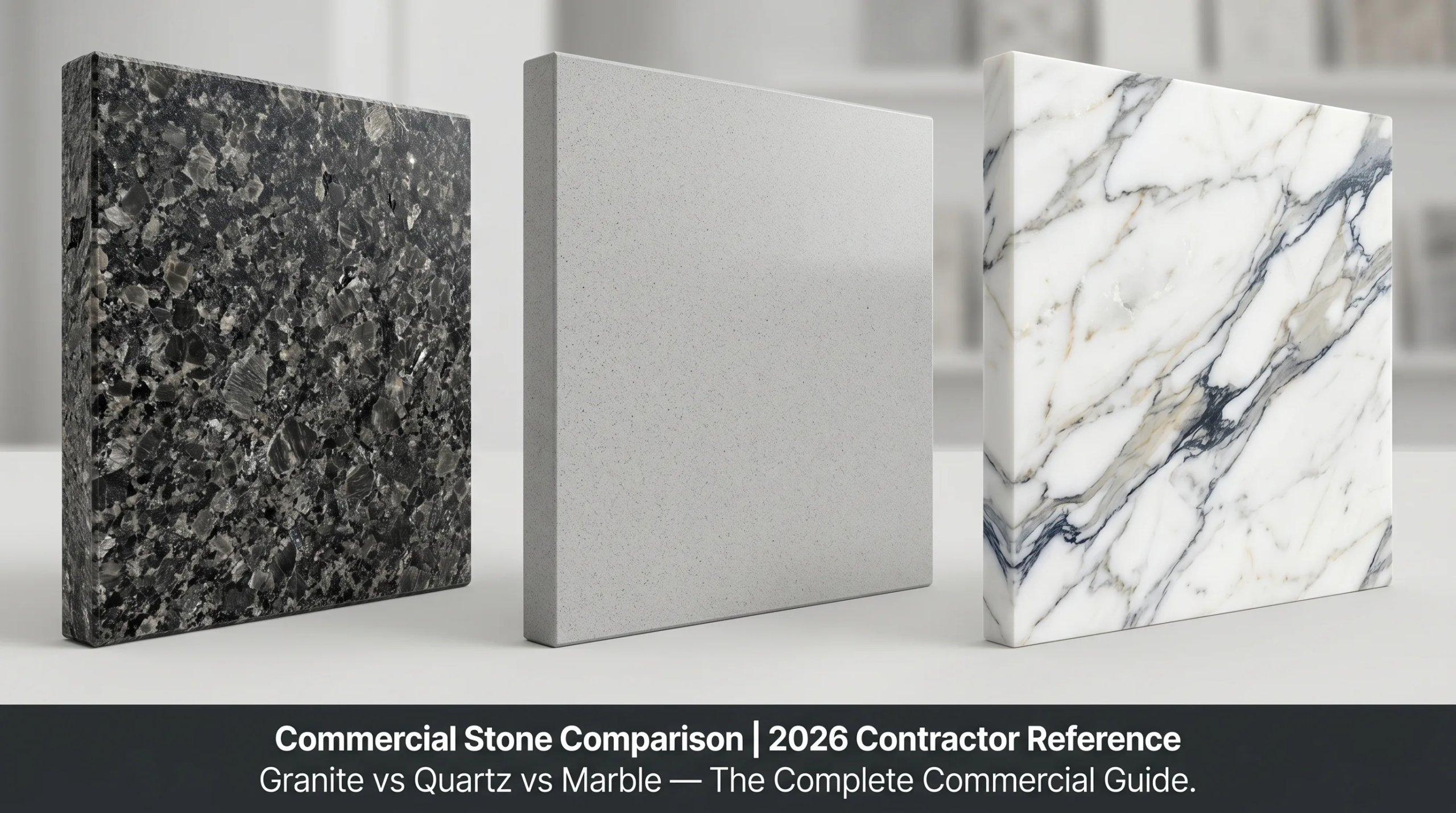
Granite, quartz, and marble are the three materials that cover the majority of commercial countertop, vanity, and feature surface specifications in hotels, restaurants, offices, and retail developments. They are frequently treated as interchangeable premium alternatives — which they are not. They have different physical properties, different maintenance requirements, different failure modes, and different applications where each is the unambiguous correct specification.
Granite: natural stone, acid-resistant, the strongest all-round commercial specification. Quartz: engineered stone, zero maintenance, the most consistent commercial specification. Marble: natural stone, acid-susceptible, the highest aesthetic specification where the conditions for it are met. This guide compares all three across eleven performance factors and twelve commercial applications — with a direct specification recommendation for each application rather than a ‘it depends’ that leaves the decision to guesswork.
1. The Core Properties — What Makes Each Material Different
The three materials differ fundamentally in composition, and composition determines every performance property that matters for commercial specification.
Granite is an igneous rock formed by the slow cooling of magma deep in the earth’s crust. Its primary minerals — quartz and feldspar — give it a Mohs hardness of 6 to 7 (harder than steel at 5.5) and a chemical composition that does not react with acid. Granite does not etch. It does not scratch from normal commercial contact. It is the most physically robust of the three materials in commercial use.
Quartz is an engineered composite — approximately 93 percent crushed quartz aggregate bound with polymer resin under heat and pressure. The manufacturing process produces a consistent, fully non-porous surface that requires no sealing. The resin binder makes quartz slightly less heat-resistant than natural stone — polymer resin scorches at temperatures above approximately 150 degrees Celsius, which means hot cookware directly on quartz can cause permanent resin damage. No natural stone has this limitation.
Marble is a metamorphic rock formed by the recrystallisation of limestone under heat and pressure. Its primary mineral is calcite — calcium carbonate — which reacts chemically with acids to form a permanent etch mark on the polished surface. This single property determines every commercial application decision about marble: any surface where acid contact is likely is not a marble surface.
| Quick answer:
The one property that separates marble from granite and quartz for commercial specification: acid resistance. Granite and quartz do not etch from wine, citrus, vinegar, or commercial cleaning chemicals. Marble etches on contact with all of these. In any commercial application where these substances are present — bars, restaurants, hotel bathrooms with commercial housekeeping — this distinction is the primary specification decision. |
| Industry Data:
NSI (naturalstoneinstitute.org) — granite is specified in 67 percent of commercial kitchen stone countertop installations; marble in 19 percent of luxury hospitality bathroom vanity specifications; engineered quartz in 71 percent of standard commercial bathroom vanity specifications where maintenance simplicity is a design constraint. NAHB 2025 (nahb.org) — quartz is the most specified countertop material across all commercial application categories combined, due primarily to zero maintenance and consistent colour — factors that outweigh natural stone character at the standard commercial tier. |
| The one thing to remember:
The specification decision framework: use granite where acid resistance, heat resistance, and maximum durability are the primary requirements. Use quartz where zero maintenance, consistent colour, and ease of commercial cleaning are the primary requirements. Use marble where the premium aesthetic is specifically required by the brief and the acid exposure and maintenance conditions are controlled. |
The 11-factor comparison table below covers every property that matters for commercial specification — from hardness and acid resistance to cost, colour consistency, and commercial service life:
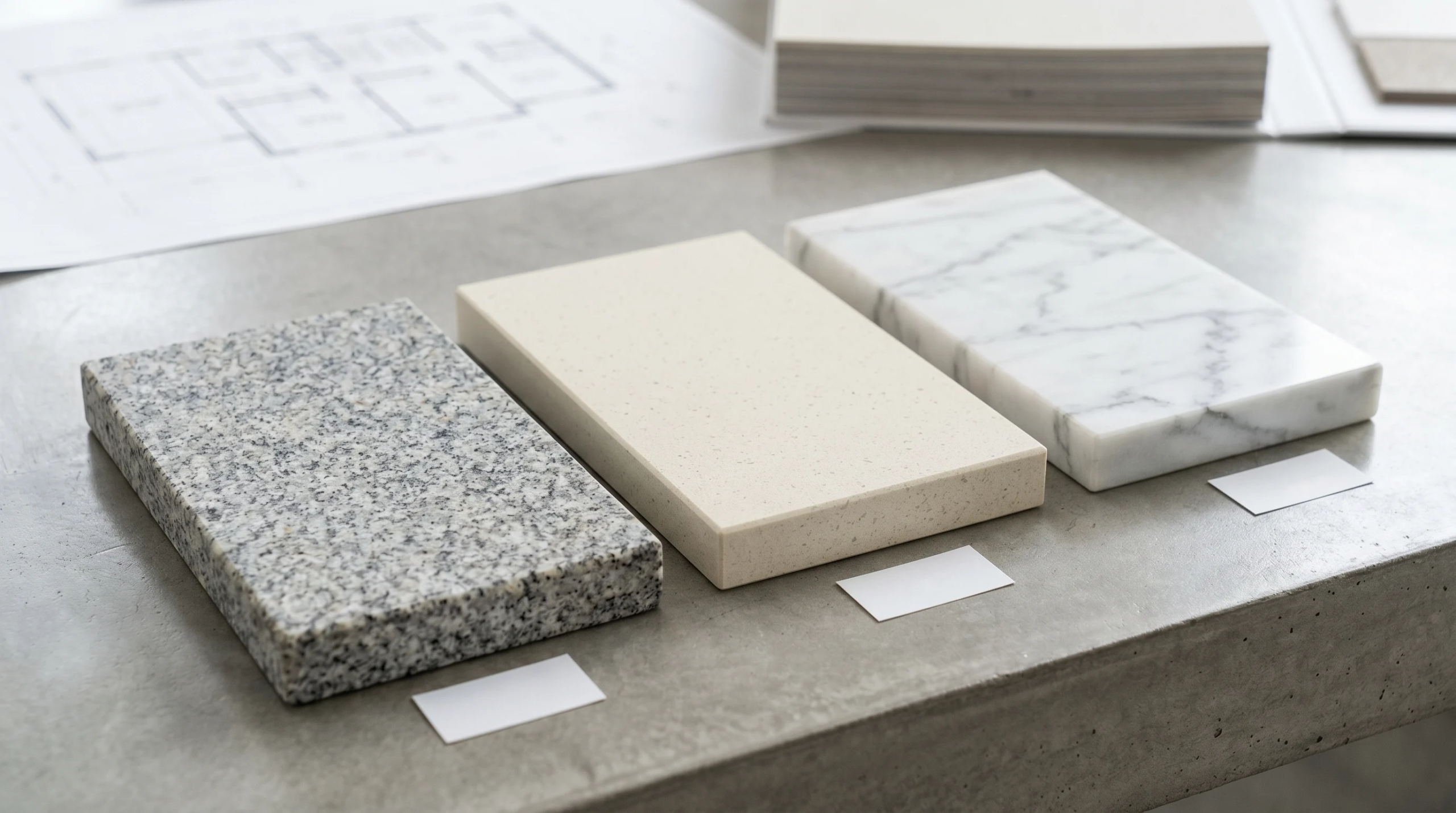
2. Granite vs Quartz vs Marble — Full 11-Factor Comparison
Eleven performance factors compared across all three materials — the complete reference for every commercial specification decision from acid resistance and heat tolerance to maintenance cost and service life.
The Sealing Requirement row is the most practically significant for commercial building operators. Granite requires annual sealing for low-contact applications and 6-monthly sealing for food service. Marble requires 6-monthly professional sealing regardless of application. Quartz requires no sealing at any interval — ever. For hotel operators, BTR developers, and commercial property managers who need to specify materials that will be maintained by non-specialist teams, the sealing requirement is a primary decision driver that the aesthetic comparison alone does not capture.
| Factor | Granite | Quartz (Engineered) | Marble |
| Material type | Natural igneous rock — quartz, feldspar, mica. Each slab unique. | Engineered — 93% crushed quartz bound with polymer resin. Consistent across slabs. | Natural metamorphic rock — calcium carbonate. Each slab unique. |
| Hardness (Mohs) | 6 to 7 — harder than steel. Scratch-resistant from all normal commercial contact. | 7 — slightly harder than granite. Scratch-resistant but resin binder can be scratched by harder materials. | 3 to 4 — softer than steel. Can be scratched by knives and commercial equipment. |
| Acid resistance | Excellent — does not etch from wine, citrus, vinegar, or commercial cleaning chemicals. | Excellent — the resin binding does not react with commercial acid concentrations. | Poor — calcium carbonate etches immediately on contact with wine, citrus, and most cleaning chemicals. |
| Heat resistance | Excellent — hot cookware directly on granite surface causes no damage. | Moderate — polymer resin can scorch at temperatures above 150C. Trivets required for hot cookware. | Good — calcium carbonate tolerates moderate heat better than quartz resin, but polished surface can be damaged by thermal shock. |
| Sealing requirement | Yes — annual for low-contact commercial. Every 6 months for food service. | No — fully non-porous resin binding. No sealing required at any interval. | Yes — every 6 months for commercial. Does not prevent etching — only reduces staining. |
| Colour consistency across slabs | Variable — natural stone varies between slabs and quarry lots. Lot confirmation essential for multi-unit orders. | Very high — manufactured product. Consistent within production run. Shade variation between batches. | Variable — natural stone varies between slabs. More variation than granite. Lot confirmation critical. |
| Edge profile options | Full range — eased, bullnose, bevel, mitre, ogee. Fabricated from solid stone. | Full range — fabricated from engineered slab. Mitre joins show resin-bound aggregate at edge. | Full range — eased, bullnose, bevel, mitre. Polished edges show natural crystal at cut face. |
| Available colours | Wide — from near-black to near-white, green, blue, red, and multi-colour. All natural. | Extensive — white, grey, black, and stone-look patterns including Calacatta and Carrara replicas. | Limited to white, grey, and cream tones with veining. Colour range narrower than granite or quartz. |
| Commercial service life | 30 to 50 years maintained. 15 to 25 unmaintained. | 25 to 40 years — resin can yellow in high UV. No sealing required. | 10 to 25 years depending on acid exposure and maintenance. Etch damage accelerates degradation. |
| Cost (wholesale) | Medium — varies by grade. Level 1 lower, Level 3+ higher. Generally mid-range. | Medium to high — premium engineered products cost more than standard granite grades. | High — Calacatta and premium grades significantly more expensive. Carrara more accessible. |
| Natural stone authenticity | Yes — geological origin. No manufactured material replicates natural stone character. | No — engineered product. Pattern is printed or distributed in manufacturing, not formed geologically. | Yes — geological origin. Calacatta and quartzite veining is the most distinctive natural stone character available. |
Comparison data based on NSI material performance standards, MIA+BSI surface classification, NAHB 2025 data, and Pack Universe Supply specification data April 2026.
| Quick answer:
The heat resistance row is the commercial specification detail that product marketing consistently downplays about quartz. Polymer resin scorches at temperatures above approximately 150 degrees Celsius. Hot cookware removed from an oven or burner can exceed 200 degrees Celsius on contact with a quartz surface. The damage is permanent and irreversible — the resin discolours in a mark the size of the pot base. Trivets are required for quartz in any kitchen application. Granite does not have this limitation. |
The commercial kitchen that specified quartz for its prep counters because the design team preferred the consistent colour and zero maintenance proposition discovered the heat limitation during the first service when a 220-degree cast iron pan was placed directly on the surface. The quartz scorch mark is not a cleaning problem — it is a permanent resin discolouration that requires slab replacement. Granite in the same kitchen, with the same pan, at the same temperature: no damage. The heat resistance conversation belongs at the specification stage, not at the first inspection.
3. Granite vs Quartz vs Marble — Complete Application Decision Guide
Twelve commercial applications with a direct specification recommendation — granite, quartz, or marble — and the key reason that makes each material the correct choice for that application.
The three applications where the recommendation is unambiguous regardless of design brief: commercial kitchen counters (granite — heat and acid resistance required), outdoor commercial surfaces (granite — quartz resin degrades in UV, marble is not exterior-appropriate), and office break room counters (quartz — zero maintenance, commercial cleaning products, no sealing). Every other application in the table involves a specification trade-off that the design brief and maintenance conditions determine.
| Commercial Application | Specify | Key Reason |
| Commercial kitchen counter (full service) | Granite — 3cm, 6-monthly sealing | Acid resistance to all food acids and commercial degreasers. Heat resistance for cookware. Scratch resistance. 20-25 year service life with programme. |
| Office break room counter | Quartz | Zero maintenance. Handles any commercial cleaning product. No sealing. Same appearance after 10 years as day of installation. |
| Hotel bathroom — standard to mid-range | Quartz (marble-look) | Housekeeping uses general cleaning products. Marble etches under these conditions. Quartz delivers marble aesthetic at zero maintenance. |
| Hotel bathroom — boutique tier | Marble (honed, confirmed programme) or quartz | Marble confirms luxury positioning. Only specify if pH-neutral cleaning and 6-monthly sealing confirmed in writing with facilities team. |
| Hotel bar top and restaurant bar | Granite or quartz | Wine, spirits, and citrus etch marble. Granite and quartz are acid-resistant. Quartz if zero maintenance required. Granite where heat resistance matters. |
| Restaurant kitchen — prep surfaces | Granite — 3cm | Heat resistance, scratch resistance, acid resistance. The strongest all-round specification for food contact environments. |
| Corporate reception desk | Granite or marble (low contact) | Granite for durability signal. Marble for premium aesthetic where contact is low and maintenance is confirmed. Quartz where zero maintenance is required. |
| Luxury spa reception counter | Marble or quartzite | The material register of the space. Confirms natural stone luxury. Low contact. Honed. Confirmed maintenance. Quartzite as stronger alternative to marble. |
| BTR apartment kitchen | Quartz | Tenant use is unpredictable. Commercial cleaning products will be used. Zero maintenance. Consistent colour across all units. Quartz is the practical specification. |
| BTR apartment bathroom | Quartz | Same reasoning as kitchen. No sealing obligation on tenant. No etch risk. Consistent across all units. |
| Outdoor commercial counter | Granite — 3cm, annual sealing | UV-stable, frost-resistant with sealing. Marble is not suitable outdoors. Quartz resin degrades in prolonged UV exposure. Granite is the only natural stone specification for exterior commercial surfaces. |
| Hotel lobby feature wall (cladding) | Granite or marble (low contact) | Granite for durability. Marble for premium aesthetic. Both at confirmed cladding grade. Porcelain slab as zero-maintenance alternative. |
Application data based on NSI commercial specification guidelines, MIA+BSI standards, and Pack Universe Supply commercial contractor order data April 2026.
| Quick answer:
The BTR kitchen and bathroom rows both specify quartz for the same reason: tenant behaviour is unpredictable. Tenants use cleaning products that are not pH-neutral. Tenants do not maintain sealing programmes. Tenants place hot cookware on kitchen counters. Quartz tolerates all of these conditions. Granite tolerates most. Marble tolerates none. For BTR, quartz is not the aesthetic compromise — it is the specification that performs correctly under actual tenant use conditions. |
The developer who specified Carrara marble for the bathrooms in a premium BTR development because the render looked exceptional in the marketing brochure had a correct specification for the render and a challenging specification for the actual tenants. Six months after occupancy, three of the twelve show-flat bathrooms had etch marks from bathroom cleaning products used by tenants who had not read the marble care guide included in the welcome pack. Quartz in the same bathroom, in a marble-look finish that reads identically in the same marketing render, requires no care guide.
| Specifying stone for a commercial project?
Tell us the commercial application, traffic level, and maintenance programme status — we will confirm the correct material and give you a confirmed wholesale quote with all three options priced. Call +1 704-951-7822 | packuniversesupply.com/request-a-quote |

4. The Maintenance Decision — The Variable That Changes the Correct Specification
The correct material for a commercial application depends as much on who maintains the building as on what the surface needs to do — and this question is rarely asked at the specification stage.
The comparison in Section 2 shows three materially different maintenance requirements: granite needs annual or 6-monthly sealing, marble needs 6-monthly sealing and a confirmed pH-neutral cleaning protocol, quartz needs nothing. In a commercial building operated by a professional facilities management company with a scheduled stone maintenance programme, granite and marble are viable specifications across the full range of appropriate applications. In a commercial building maintained by a general cleaning contractor with no stone-specific protocol, only quartz is reliably maintainable.
The maintenance question that every stone specification should answer before the order is placed: ‘Does the building operator have a confirmed stone maintenance programme — and will it be delivered consistently across the building’s tenancy or service life?’ If the answer is yes, granite and marble are available options. If the answer is uncertain, quartz is the material that removes the maintenance obligation from the specification. This is not a compromise — it is the correct engineering response to an operational constraint.
When Natural Stone Is Still the Right Answer Despite Maintenance Complexity
There are applications where the premium character of natural stone — its geological uniqueness, tactile depth, and inability to be replicated by any engineered product — is itself the specification requirement. Boutique hotel bathrooms, luxury spa reception counters, corporate boardroom surfaces, and trophy residential properties are applications where the client’s brief is explicitly for natural stone, and where a confirmed maintenance programme is a condition of specifying it. In these applications, the specification conversation is not granite vs quartz — it is which natural stone, at what grade, with what finish, and who delivers the maintenance. Quartz is the correct specification for applications where the maintenance conversation cannot be had or won.
| Real Risk — Real Consequence:
The risk: specifying marble or granite for a commercial application where the building operator’s maintenance programme cannot be confirmed, because the design brief called for natural stone and the contractor did not escalate the maintenance question. The consequence: granite staining from absence of sealing, or marble etch damage from incorrect cleaning products, within 18 months of a specification that was technically correct for the material and operationally incorrect for the building. The material failure is attributed to the stone — not to the maintenance programme that was never delivered. |
The conversation that prevents every granite staining and marble etching failure in a commercial building is: ‘Who in this building maintains the stone surfaces, and what is their programme?’ It takes two minutes. It determines whether the specification will perform correctly across the building’s service life. The contractor who asks it before ordering has done due diligence. The contractor who does not ask it has left the performance of a premium natural stone specification to a facilities management team that may never have maintained natural stone before.
| Quick answer:
Maintenance question before any commercial granite or marble order: who in the building maintains stone surfaces? Do they have a confirmed programme? Is pH-neutral cleaning and professional sealing scheduled as a calendar event? Yes to all three: natural stone is viable. No to any: specify quartz, present the natural stone options alongside, and explain the maintenance condition clearly. This is the professional conversation. |
| How Pack Universe Supply supports commercial stone specification:
Pack Universe Supply stocks granite, quartz, and marble in all commercial grades from our Charleston, SC warehouse. For mixed specifications: we help contractors spec the right material for each application in a development — granite for kitchens, quartz for standard bathrooms, marble or quartz for boutique bathrooms — and provide a single consolidated wholesale quote. For contractors comparing all three materials: call us with the application and maintenance conditions and we will give you a direct recommendation — not a ‘depends’ answer. Call: +1 704-951-7822. |
| Order Wholesale Granite, Quartz, or Marble — Complete Commercial Specifications:
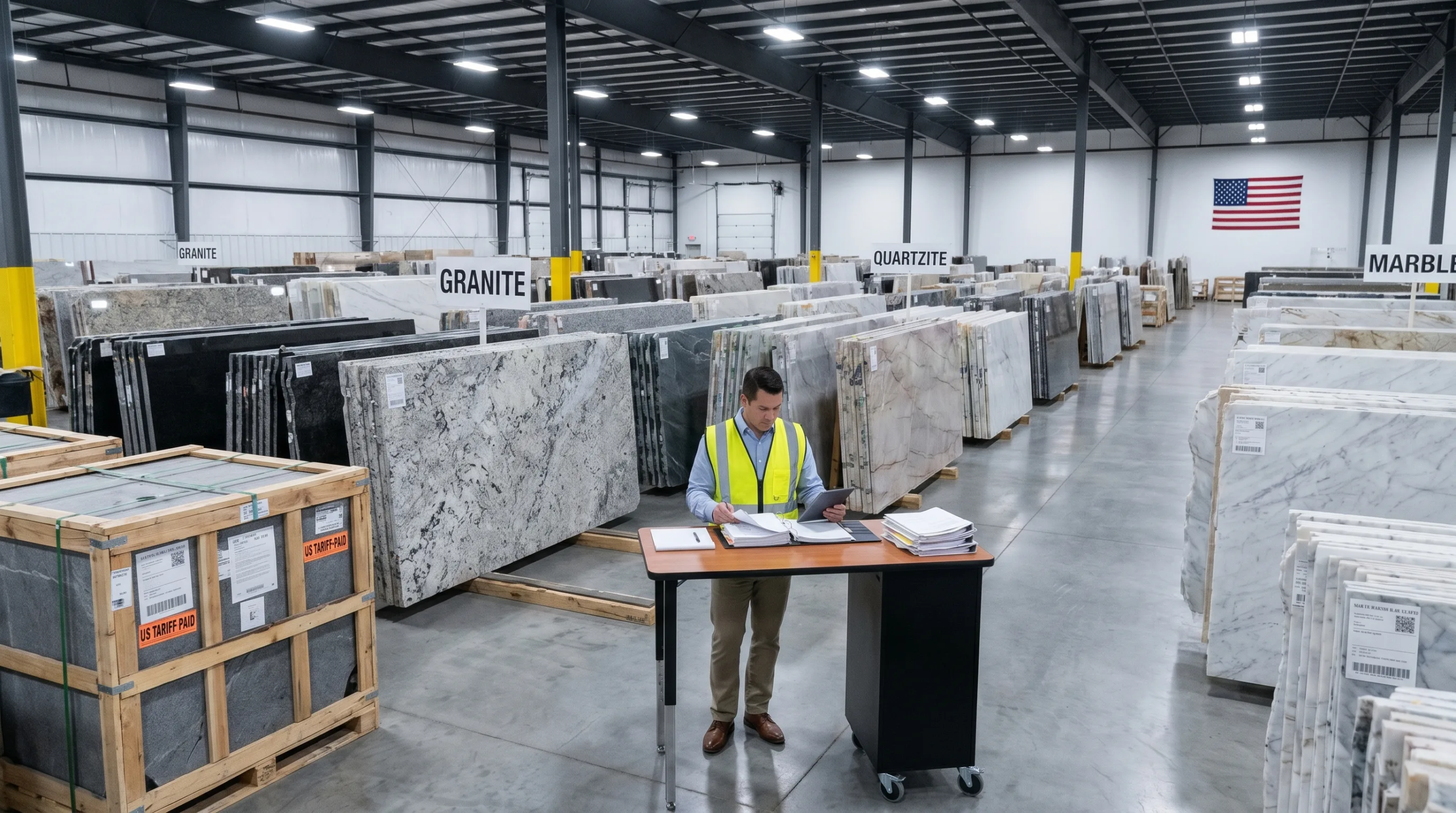
All three materials in commercial grades — single supplier, consistent quality, confirmed grades and lots. Charleston SC (USA) | Burlington ON (Canada) -> packuniversesupply.com/request-a-quote | Call +1 704-951-7822 |
Verdict — Granite vs Quartz vs Marble for Commercial Use in 2026
| Verdict:
Granite is the strongest all-round commercial specification — the right material for commercial kitchens, restaurant bars, outdoor surfaces, and any application where heat resistance, acid resistance, and maximum durability are the primary requirements. It requires sealing, and the sealing programme must be confirmed before installation. Quartz is the correct specification for any commercial application where zero maintenance is the operational reality — standard hotel bathrooms, BTR kitchens and bathrooms, office break rooms, and any building where the maintenance programme cannot be confirmed. It is not a compromise — it is the correct engineering response to a maintenance constraint. Marble is the right specification for boutique hotel bathrooms, luxury spa counters, corporate boardrooms, and applications where the premium aesthetic of natural stone is the brief and the maintenance conditions are controlled. It is not appropriate for bar tops, restaurant kitchens, or any surface where acid contact is routine — regardless of how the design brief reads. The specification that uses all three materials correctly — granite in the kitchen, quartz in the standard bathrooms, marble in the luxury suite — is not indecisive. It is accurate. |
Sources & References
NSI — Natural Stone Institute, Commercial Specification Standards: naturalstoneinstitute.org | NAHB — Commercial Construction Survey 2025: nahb.org | Pack Universe Supply commercial order data, April 2026.
About the Author
Sam Michael 15 years experience in sales and supplying granite, quartz, and marble for commercial projects — hotels, restaurants, BTR developments — across the USA and Canada.