How Long Do Granite Countertops Last in Commercial Buildings? [2026 Contractor Guide]
How Long Do Granite Countertops Last in Commercial Buildings? [2026 Contractor Guide]
The definitive 2026 contractor guide to granite countertop service life in commercial buildings – the 8-application service life reference table, what determines how long granite lasts, the three primary failure modes and how to prevent each, thickness requirements by application, the commercial sealing programme, and the difference in maintenance between a 15-year granite installation and a 40-year one. NSI and NAHB data throughout.
How long do granite countertops last in commercial buildings – and what determines their service life?
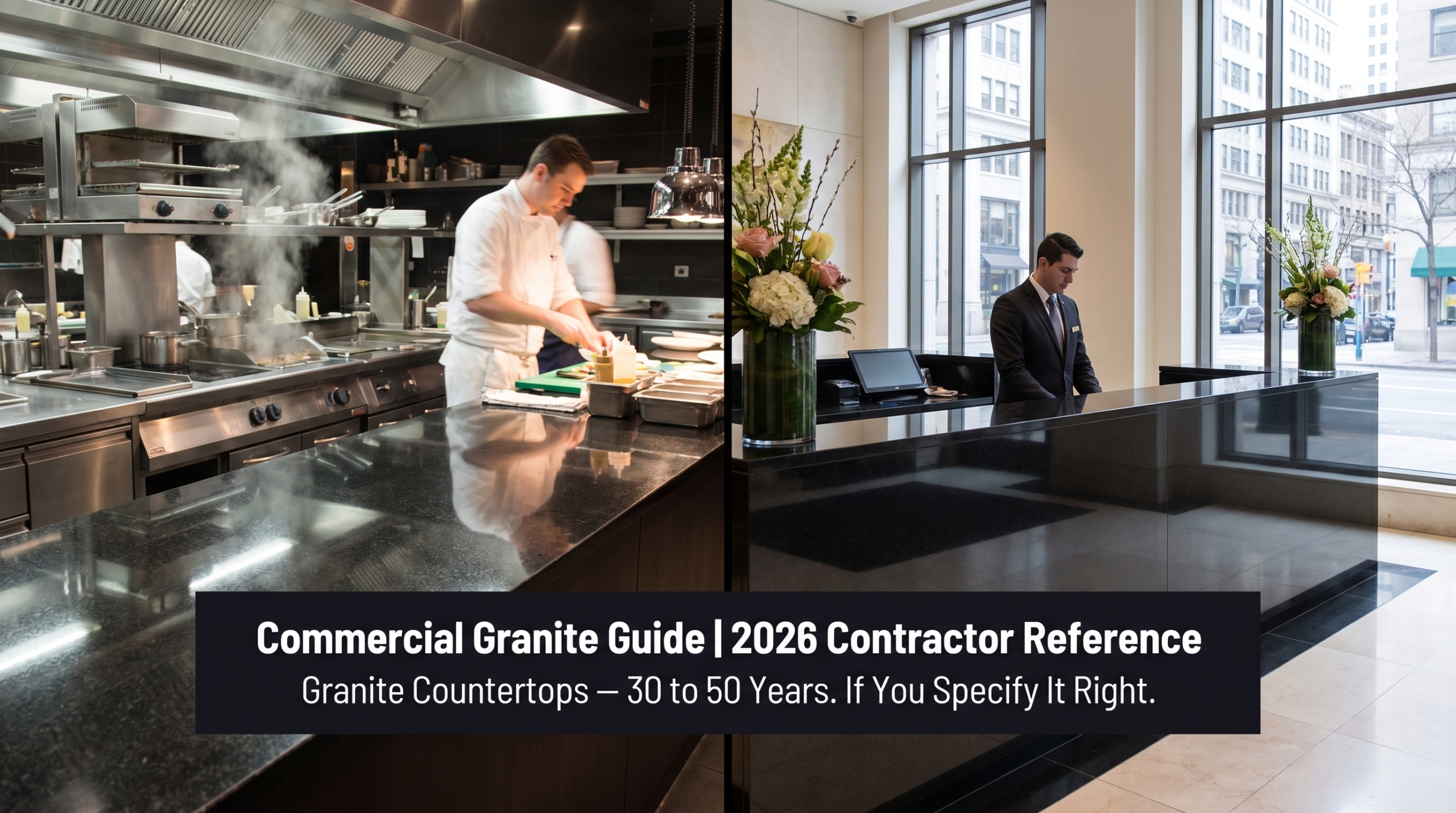
Granite countertops in commercial settings will last 30 to 50 years if properly maintained, and indefinitely in areas with low contact if they receive continuous care. Granite itself is extremely durable and does not wear out over time; its Mohs hardness exceeds that of steel, and when sealed, it does not absorb liquids or stain from acids. The ultimate end-of-life for a commercial granite countertop is not determined by material deterioration but rather by impact damage from heavy object drops, accumulated chips on the edges and corners, or the eventual failure of the sealing program.
| A well-maintained commercial granite countertop will last longer than any other countertop material with the exception of quartzite.
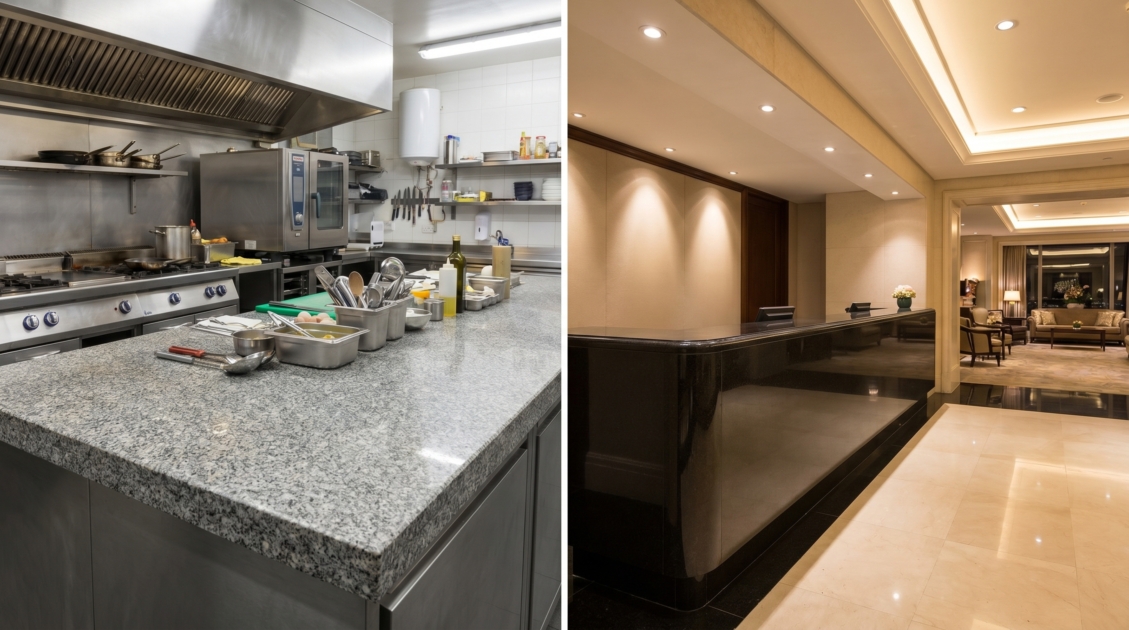
Service life benchmarks by application: Hotel lobby reception desk: 25 to 40 years. Low physical impact. Regular sealing. No acid exposure. Commercial office kitchen counter: 20 to 30 years. Daily use, knife contact, commercial cleaning chemicals. Annual sealing required. Restaurant kitchen countertop: 15 to 25 years. Heavy commercial loading, daily cutting board contact, commercial degreasers. 6-monthly sealing. Restaurant front-of-house bar or counter: 20 to 35 years. Moderate loading, acid-resistant to wine and citrus. 6-monthly sealing. Outdoor commercial surface (sealed): 20 to 30 years depending on UV exposure and climate. Annual sealing for exterior applications. Commercial granite countertops in all grades stocked at Pack Universe Supply – confirmed thickness, grade, and finish before dispatch. Call +1 704-951-7822 | packuniversesupply.com/request-a-quote |
The longevity of granite countertops in commercial settings is entirely dependent on the maintenance program implemented and whether the initial specification took the actual physical demands of the intended use into account.
Granite is an igneous rock that is primarily composed of quartz and feldspar and has a Mohs hardness ranging from 6 to 7 (on a scale where steel is 5.5). It is not susceptible to etching from acid contact, which is a common problem with marble. Furthermore, granite is resistant to scratches and will not chip or delaminate from typical commercial use or with exposure to commercial cleaning agents, provided it is properly sealed. Granite, installed at the correct thickness for its intended application, will last for decades in any commercial setting.
Under-specifying thickness, failing to implement a sealing program, or neglecting to address impact damage near unprotected edges are all common factors that can shorten the commercial lifespan of a granite countertop. All three can be prevented by ensuring the correct specifications are used during the ordering process. This guide provides a breakdown of service life benchmarks for eight commercial applications, the three potential failure modes and how to avoid them, and the maintenance procedures that differentiate a 15-year installation from one that lasts 40 years. All information is backed by NSI material performance data and NAHB commercial construction data.
- Granite’s Physical Properties – Why It Outperforms Every Alternative in Longevity
Granite’s exceptional durability and longevity, when compared to all other commercial countertop materials, are due to its remarkable hardness and acid resistance.
Granite’s Mohs hardness of 6 to 7 means it can withstand scratching from typical commercial surfaces such as knives, cookware, cutting boards, and commercial cleaning equipment. In contrast, steel has a Mohs hardness of approximately 5.5. Therefore, running a steel knife over granite will not scratch the surface; instead, it will leave a temporary streak of steel that can be easily wiped away. This is contrary to common assumptions and explains why granite kitchen counters in commercial food preparation areas show no signs of knife scoring, even after years of extensive use.
Granite’s acid resistance is also a crucial advantage in commercial settings. Unlike marble, which is composed of calcium carbonate and is prone to etching from acidic substances such as wine, citrus fruits, vinegar, and many commercial cleaning agents, granite contains no calcium carbonate. Its quartz and feldspar composition makes it chemically inert to typical commercial acid concentrations. While spilling red wine and leaving it overnight on an unsealed granite surface might result in a temporary stain from food absorption, the granite itself will not be etched. This stain can be removed by resealing the surface, whereas the etch mark on marble would require professional refinishing.
| Quick answer:
Granite Mohs hardness: 6 to 7 – harder than steel (5.5). Granite composition: quartz and feldspar – chemically inert to commercial acid concentrations. Granite does not etch. Granite does not scratch from normal commercial use. The material does not fail – the maintenance program and installation thickness determine the service life. Industry Data: NSI (naturalstoneinstitute.org) – granite has a Mohs hardness of 6 to 7 and an acid resistance classification of ‘resistant to etching from commercial acid concentrations’. NSI commercial installation guidelines specify 3cm thickness for self-supporting countertops and 6-monthly professional sealing for commercial food service applications. NAHB 2025 (nahb.org) – granite is specified in 67 percent of commercial kitchen countertop installations where stone is the specified material, primarily because of its combination of hardness, acid resistance, and service life in food contact environments. The one thing to remember: Granite itself doesn’t dictate its own lifespan; the specification is what matters. For commercial granite countertops, achieving a lifespan of 15 to 40 years is entirely dependent on the correct specification: 3cm thickness for unsupported commercial countertops, 6-monthly professional sealing for food service areas, annual sealing for lower-contact applications, and adequate substrate support during installation. |
The 8-application service life table below provides maintained and unmaintained service life benchmarks for each of the major commercial granite applications, along with the primary failure mode and prevention method for each:
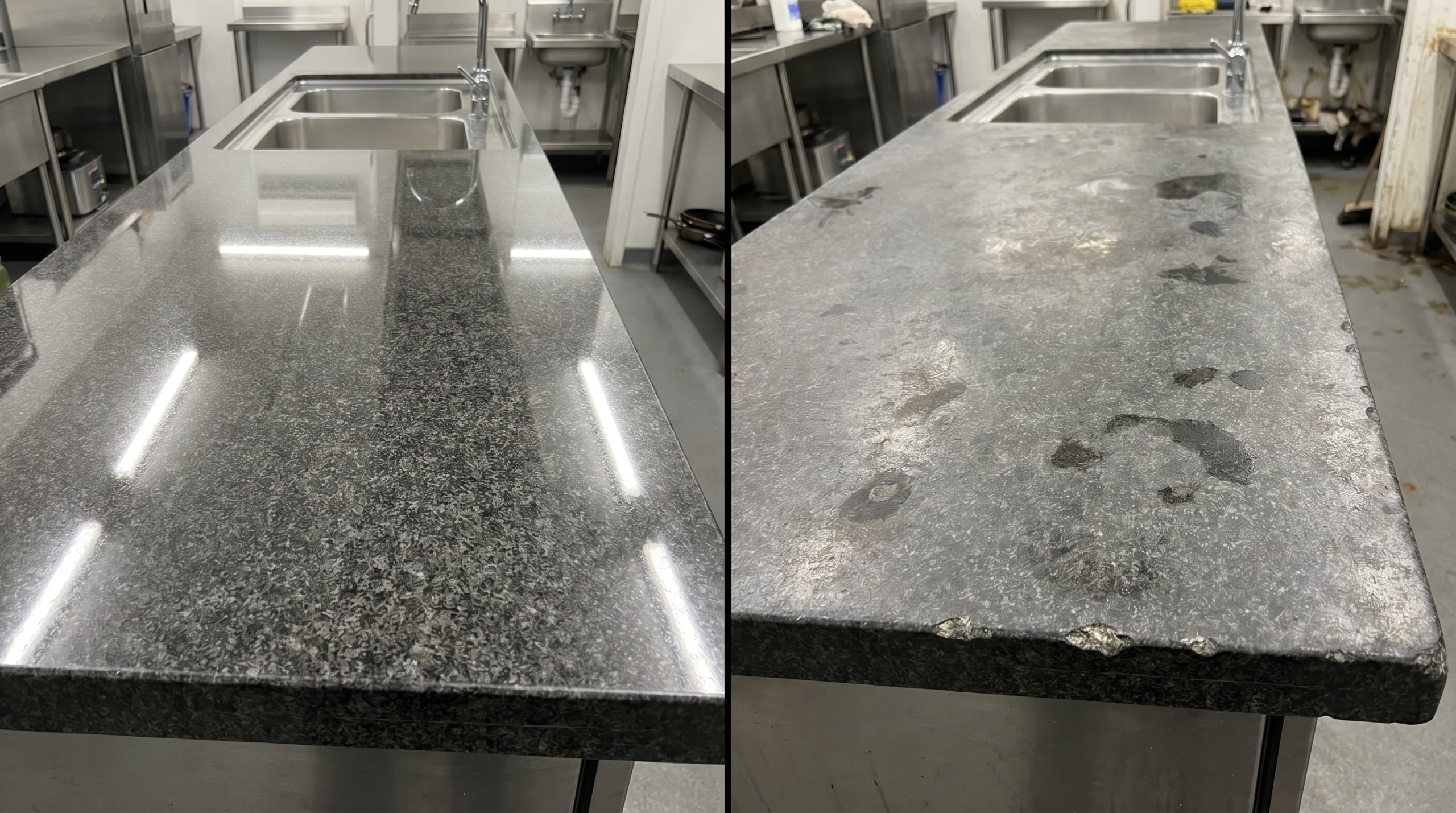
- Service Life by Commercial Application – The 8-Application Reference
Eight commercial applications with maintained and unmaintained service life benchmarks, the primary failure mode for each, and the specification or maintenance action that prevents it.
The difference between the “Maintained” and “Unmaintained” columns indicates the impact of the maintenance program. A granite countertop in a restaurant kitchen that lasts 15 to 25 years when correctly specified and sealed every six months could only last 8 to 12 years if not properly maintained. Staining from food absorption and surface degradation due to chemical exposure would become apparent within the first year of use in an unsealed environment. The granite material is the same; it is the post-installation treatment that differentiates the lifespans.
| Commercial Application | Service Life (Maintained) | Service Life (Unmaintained) | Primary Failure Mode and Prevention |
| Hotel lobby reception desk | 30-50 years | 15-25 years | Impact chip from heavy luggage — 3cm thickness required. Low acid and stain risk when sealed annually. |
| Office kitchen countertop | 20-30 years | 10-15 years | Surface dulling from acidic food and commercial cleaners without sealing. Annual sealing and pH-neutral cleaner prevents this. |
| Restaurant kitchen counter | 15-25 years | 8-12 years | Crack propagation from repeated heavy object drops near unsupported edges. Cutting board contact wears polish — not granite. 3cm thickness, 6-monthly sealing. |
| Restaurant bar and front-of-house counter | 20-35 years | 12-18 years | Corner chips from bar equipment impact. Staining from drink absorption without sealing. Granite resists acid from wine and citrus — key advantage over marble. 6-monthly sealing. |
| Commercial kitchen island (prep surface) | 15-20 years | 8-10 years | Impact damage from heavy cookware drops the primary failure. Edge chip accumulation. 3cm thickness essential. 6-monthly sealing minimum. |
| Hotel bathroom vanity | 25-40 years | 15-20 years | Staining from bathroom products absorbed through unsealed surface. Soap and shampoo will not etch granite — unlike marble. Annual sealing. |
| Corporate boardroom table surround | 40+ years | 25-35 years | Near-zero failure in low-contact application. Chip risk from chairs and equipment. Annual sealing. |
| Outdoor commercial counter or bar | 20-30 years | 5-10 years | UV discolouration is minimal in most granite varieties. Primary failure is freeze-thaw cycle damage to unsealed granite in cold climates. Annual sealing mandatory outdoors. |
In short,
The gap between maintained and unmaintained service life for outdoor commercial row on the table is largest between 20-30 years for maintained, down to 5-10 years for unmaintained. Unsealed granite exposed to a freeze-thaw environment will draw water through its pores, which freezes, expands and systematically fractures the surface over season after season. Maintaining annual sealing for outdoor granite is not optional; it’s a specification that guarantees the installation will survive the third winter.
The hotel that received its polished black granite reception desk in 1998 is not running 2026 with its original surface due to some dumb luck in material. The facilities maintenance team resealed it annually, and also used only pH-neutral cleaners throughout its life. Granite in a reception desk setting, sealed, will look identical 28 years later as it did in 2000; there’s simply nothing in a reception desk environment capable of degrading sealed granite, nor will it “age”. It’s simply a maintenance plan keeping the material pristine.
- Three Failure Modes – What Truly Terminates a Commercial Granite Countertop.
Commercial granite countertop surfaces are terminated by one of three modes: impact fracture, absent seal stain, and edge chip buildup. None of these modes are impossible with either specification or maintenance.
- Impact Fracture with Heavy Object Drops
Granite does not deform. When you drop a heavy object (commercial blender, big stock pot, machinery carrying case) onto granite from a height and with no substrate under the drop point, the impact travels through the stone and through pre-existing crystalline boundaries, causing a crack or fracture. This is the most terminal of the three failure modes. An installation where this mode occurs, across a kitchen counter top for example, means total slab replacement.
Prevention consists of two specification decisions: make sure that 3cm granite is used where the unsupported over hang is in play; 2cm granite is much more vulnerable to this failure. It’s also necessary to specify continuous substrate support on the underside of all granite counter surfaces within twelve inches of the edge. A 12 inch unsupported over hang that you then rely on to stay in place, without a support system under it, is an installation guaranteed to fracture when a heavy item is dropped on its edge.
For example, an installation with a 12 inch overhang supported by continuous steel, at the edge will perform well. The identical installation without steel support will not.
- Absent Seal Stain Absorption
No stone can be perfectly non-porous. The natural porosity of granite varies from .2 to .5%. For commercial food service, oil, wine, coffee, protein stains will all work their way into granite at different rates and into the underlying surfaces through its pores, causing permanent stains that can never be wiped off the surface layer and which cannot be lifted from below the surface. Professional sealants will fill this porosity, leaving it virtually non-absorbent to typical food stainages. Food-service, and food-contact, countertops can begin staining from the first year if they are not properly sealed.
All food-service, commercial use granite should be re-sealed every six months, and tested using a drop test. Water bead up indicates the seal is good; water soak-in will make the stone turn dark in 2-4 minutes, and require immediate re-sealing by a professional before further food contact.
- Edge & Corner Chip Accumulation
Edges and corners are the single weakest part of a commercial countertop. Any contact with commercial equipment, trolleys, chairs, or a heavy box will cause individual chips. After years of usage and interaction with commerce, a sharp 90-degree polished edge becomes degraded by accumulated chips across the profile-from 2-5 millimeters apiece. That edge has no possibility for field restoration; a chipped edge represents permanent degradation of the countertop surface after 10 years of hard, commercial use.
Specification to prevent this include rounded, bullnose or bevelled edge profiles rather than a sharp 90-degree polished edge. The increased geometry across which contact force is applied minimizes chips to the point that the surface, rather than the edge profile, degrades slowly over 10 years. 90-degree polished edges is a residential cosmetic choice that should never be specification on a commercial install.
| In short,
Three failure modes for commercial granite, and their prevention: impact fracture – 3cm and full substrate support; staining from porous surfaces – six month sealant professional treatment and the water bead test; chipped edges – specify rounded (eased, bevelled, or bullnose) rather than sharp 90-degree edges. Each of these is a specification, not a maintenance, decision made pre-installation. |
Ordering commercial granite?
Just describe the commercial use and traffic levels of the installation, and we will confirm the correct granite grades, thickness, and edge profile for your job and issue you an instant, confirmed quote. Call 704 951 7822. Packuniversesupply.com/request-a-quote
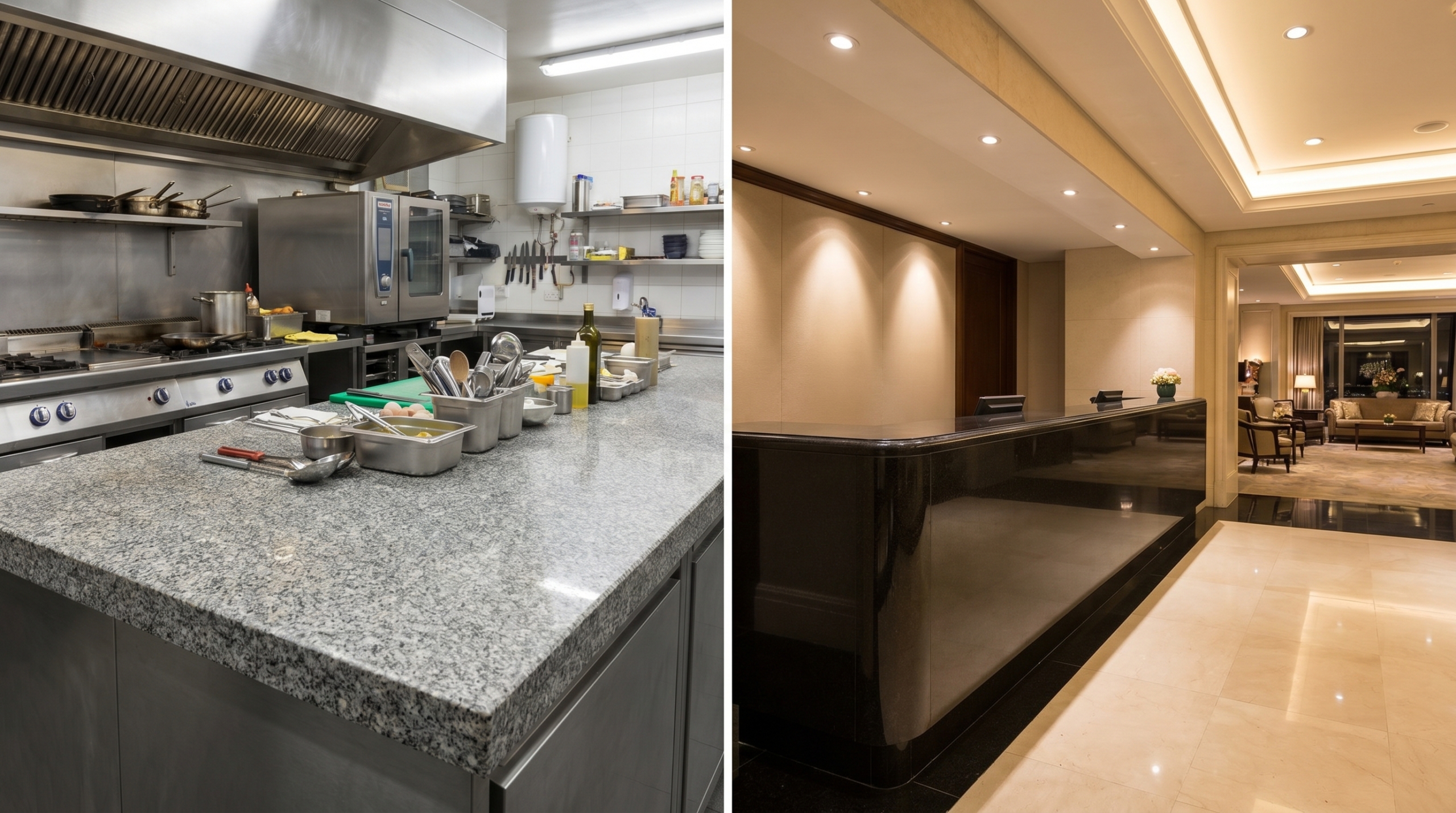
- The Commercial Granite Sealing Programme – Confirm it before handover.
The single factor which makes the difference between 15- and 40-year granite is the sealing programme – it must be confirmed at handover and not merely put on paper in a document that is never acted upon.
Commercial granite sealing is not complicated – it’s a maintenance event, usually takes 2-4 hours in a standard commercial counter and needs a professional application of a penetrating impregnating sealer (chosen to match the granite). The maintenance operative doesn’t have to be a stonemason; it’s simple with the right briefing.
It’s not a difficult procedure that causes commercial granite sealing programmes to fail, but a scheduled event that never makes it on to the building’s maintenance rota.
- Install Sealing – Day 0: Apply penetrating sealer to dry, clean, dry granite surface prior to grouting. Re-seal again post grouting and final clean. The baseline against which all other maintenance is built.
- 3-month Check: Water bead test on all surfaces. If it’s absorbing, not beading within 4 mins, reseal immediately. Certain commercial granites may need earlier resealing depending on porosity.
- Commercial Food Service – 6-monthly Sealing: Calendar event, part of the building’s maintenance rota. Proactive. It will never just be noted when someone sees the counter looks dull. Scheduled.
- Low-use Commercial – Annual Sealing: Bathroom hotel work, office reception, board rooms. Annual water bead test, seal on the result.
- Professional Refinishing – As needed: Polished granite exhibiting surface dulling through insufficient sealing can be rejuvenated through professional diamond polishing. No need to remove. For food service environments scheduled on a 5-10 year basis.
| REAL RISK – REAL CONSEQUENCE:
Risk: Finishing a commercial granite installation, handing it over to building facilities management without having confirmed that a schedule for sealing is in place and documented. Consequence: The sealing programme documented on handover will never be completed. Within 18 months, cooking oil absorption shows staining on the kitchen granite, within three years, soap scum has penetrated the bathroom granite. The granite has failed the maintenance, not the material has failed. |
The sealing programme, confirmed in writing during handover, logged in the building’s FM system will happen. The sealing programme on page 14 of the handover document that went straight into the filing cabinet, never read, will not. The conversation at handover to ensure the former takes no longer than ten minutes, defining the life of the installation in decades, rather than years dictated by the life of the first facilities management contract.
| Quick Answer: During handover, the building’s FM department should be given a single A4 document detailing the specific sealer product being used, detailed application instructions and scheduled maintenance entries. Two entries will suffice: Food Service 6-monthly, all other commercial annual, with the water bead test as the trigger for unscheduled re-sealing. This should be kept separate from any lengthy handover document. |
Pack Universe Supply’s support for commercial granite specification:
We stock commercial granite at our Charleston, SC warehouse in both 2cm and 3cm thicknesses in all grades. For all commercial granite orders, we can confirm the correct grade, thickness and finish (and recommend appropriate edge details), and will supply commercial sealing and maintenance guidance with every order. For contractors who are placing a first commercial granite order for high-intensity use, we will be glad to confirm the optimum specification before order placement – Call: +1 704-951-7822.
Order wholesale commercial granite – thickness, grade and edge specified correctly.
Commercial granite in 2cm and 3cm – all grades, polished and honed.
Eased and bullnose edges available, all confirmed in each lot.
Charleston, SC (USA) / Burlington, ON (Canada). –> packuniversesupply.com/request-a-quote. Call: +1 704-951-7822.
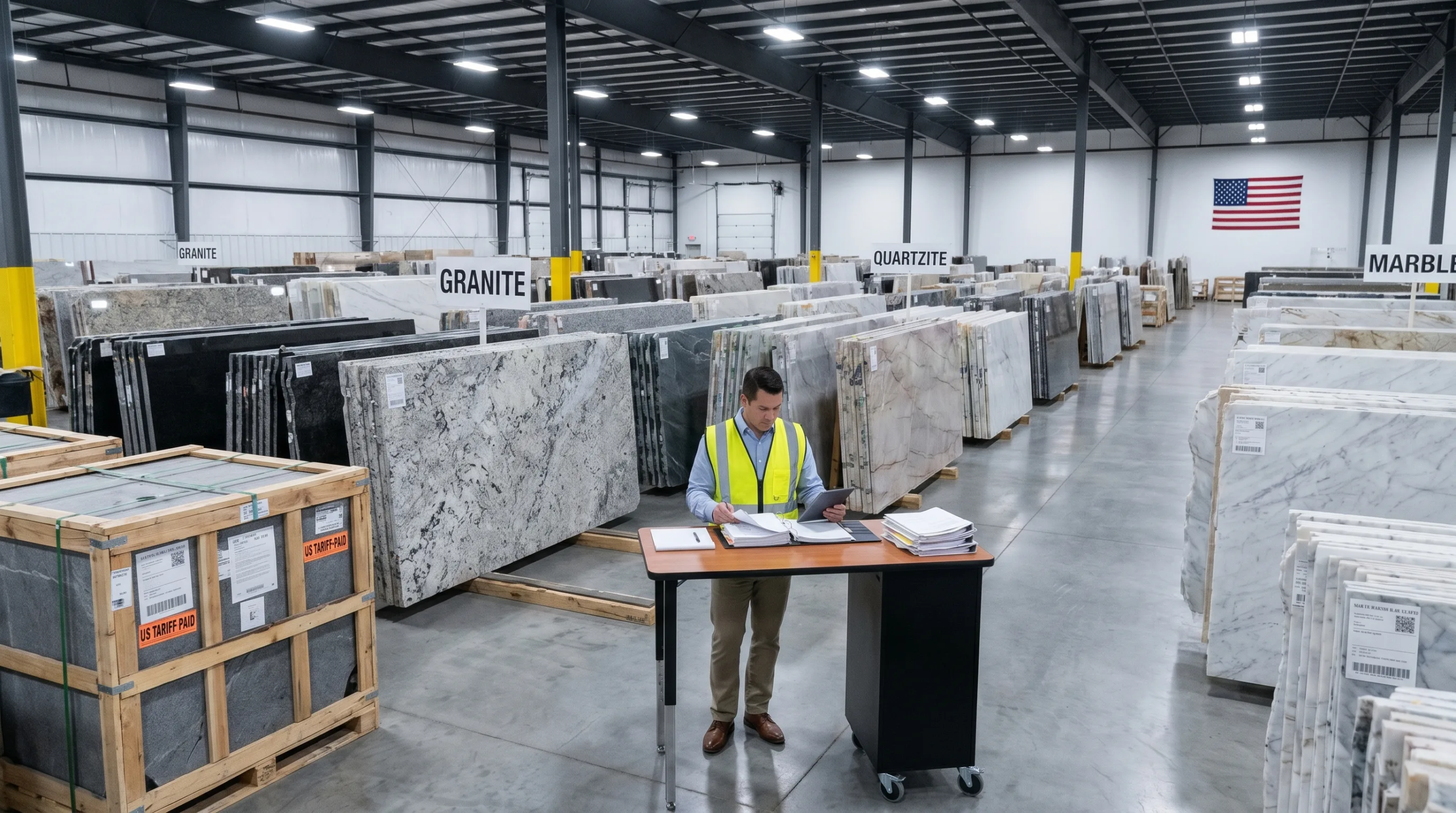
VERDICT – HOW LONG DO COMMERCIAL GRANITE COUNTERTOPS LAST?
Verdict:
30-50 years is the minimum service life expectation for granite in commercial environments with correct specification and sustained maintenance. Without it, much less is likely. This is a maintenance issue, not a material failure issue. The three critical specification decisions are 3cm thick slab on all unsupported commercial countertops, eased or bullnose edge details (rather than 90 degrees), and an installed maintenance schedule recorded within the FM system, confirmed at handover. The differences between maintained and unmaintained lives shown in the table are about maintenance regimes and the differences are dramatic: The 40-year vs the 12-year unit is the same material but different maintenance strategies.
Sources & References
NSI – Natural Stone Institute, Commercial Installation and Maintenance Standards: naturalstoneinstitute.org | NAHB – Commercial Construction Survey 2025: nahb.org | Pack Universe Supply commercial order data, April 2026.
About the Author
Sam Michaele 15 year of experience in Slab and Building materials specifying and supplying commercial granite for hotel, restaurant and commercial development projects.