
How US Stone Import Tariffs Affect Contractor Prices in 2026 — A Practical Guide
How US Stone Import Tariffs Affect Contractor Prices in 2026 — A Practical Guide
The complete 2026 contractor guide to production lots in natural and engineered stone – what a lot is, why stone from different lots of the same material looks different, the 7-level project risk table, how to confirm lot numbers before any multi-slab order, what to do when the required lot is exhausted, and the one question that prevents every lot variation failure on a multi-unit or phased project. NSI and Pack Universe Supply data throughout.

What is a production lot in stone – and why should contractors always confirm it before ordering?
A production lot is a specific quarry extraction batch or manufacturing run from which a group of stone slabs is taken. Slabs that belong to the same production lot should match in background color, veining pattern, mineral density and tonal quality. Even with the same named material-Absolute Black, Kashmir White or Bianco Carrara-slabs cut from different lots can look quite different once they are laid side by side. Lot confirmation is the only sure way that, on projects requiring more than one slab or on staged or phased deliveries, all stone used in the project will look the same.
| Why lot confirmation matters-and when it is non-negotiable:
Multi-unit residential or BTR development: All 60 bathroom vanities must match. If you don’t confirm production lot, the slabs used in phase 2 may come from a different batch and have a slightly different background color from the phase 1 slabs. Hotel renovation – multiple rooms: A hotel room is expected to be a predictable experience; so, all guest bathrooms must look consistent. If you use40 hotel rooms with lot variation, you can guarantee complaints. Commercial development with phased delivery: Phase 1 is delivered and then, sometime later, Phase 2 arrives-without reservation of an entire lot of stone for the job, this shipment may have originated in a different lot with different characteristics than Phase 1. Feature wall or book-matched application: Book-matched slabs must be cut from the same lot of stone-ideally consecutive stones cut from the same quarry extraction face. Any order in which the total quantity of stone will be delivered in more than one shipment, or even across two trucks on one order if not properly handled: You can inadvertently cross over from one lot to the next even on a single-project order if the supplier does not reserve an entire lot for you when you place your order. Pack Universe Supply confirms production lot on every multi-slab order-reserving the entire required quantity from a confirmed lot before shipping. Call +1 704-951-7822 | packuniversesupply.com/request-a-quote |
Production lot variation is the single most common source of complaints on commercial and multi-unit stone jobs, and it’s the easiest to prevent.
It requires a one-sentence question at quote stage: ‘What is the production lot number for this material—and can you reserve the full project quantity from a single lot?’ Any reputable stone supplier can and will answer you, and any contractor who asks this question before ordering avoids the lot variation discussion with the client. It sounds like this in practice: a contractor does not confirm production lot and installs 40 hotel bathrooms where the first 20 use granite that has a cool, white-gray background, and the last 20 use granite from a different lot that has a slightly warmer background tone because the supplier ran out of material in the first lot and automatically started using material from the next one.
This guide will cover exactly what a production lot is, how and why it leads to visual variance even when materials share the same name, a risk assessment table to identify specific project types and their respective lot confirmation risk levels, and practical advice for handling the “exhausted lot” situation, as well as that one simple, fail-safe question. NSI guidelines and Pack Universe Supply procedures are referenced throughout.
- What a Production Lot Is-Natural vs. Engineered Stone
Production lots are handled somewhat differently depending on whether the stone is natural or engineered, and the risk profile for each is quite different in critical ways to consider in project specification.
For natural stone (e.g., granite, quartzite, sandstone), the production lot refers to a specific quarry extraction event. When a quarry face is blasted or cut, a batch of rough blocks are removed from that area and processed into slabs. All of the slabs that were cut from this particular batch will share the same geological makeup-the same mineral deposits, depth in the rock formation and ambient chemical conditions when it was formed. It will then be a more homogeneous group of slabs that will appear more consistent than those cut from other areas or at different depths. Even within a quarry that has produced a specific named stone for many decades, each extraction event will create slabs that carry the same name but are visibly distinct in the installed environment from other batches that were cut at a different time.
For engineered stone (e.g., quartz surfaces, sintered stone), a production lot represents a specific manufacturing run. Engineered stone is created by blending and processing ground quartz, resin and pigments in very precise proportions under heat and pressure. Slight variations in the pigment batches, particle size distribution or manufacturing process can lead to minute differences in background tone, surface texture or density between individual runs, though engineering stone inherently shows less lot variation than natural stone due to the controlled nature of the manufacturing process. The biggest potential for variation will occur with veined or patterned engineered stones.
| Quick Answer:
What is a production lot? A production lot is the specific batch from which raw stone blocks were taken when they were quarried (natural stone) or the manufacturing run from which engineered stone slabs were produced. Slabs cut from a specific lot are visually consistent. Slabs from different lots carrying the same name may vary significantly in color or pattern when placed side-by-side, especially with some varieties of natural stone. |
| Industry Data:
NSI (naturalstoneinstitute.org) -NSI traceability guidelines advise all suppliers to note production lot numbers for any commercial stone order totaling five or more slabs, and all contractors to ask suppliers for this information in writing before accepting any delivery with multiple slabs. Lot variation is a frequent cause of stone appearance disputes. NAHB 2025 (nahb.org)-According to their findings, 34% of contractors had reported post-installation disputes related to stone appearance during a three-year period. Seventy-eight percent of these issues stemmed from projects where production lots had not been specified. |
| The One Thing You Need to Remember:
A one-sentence question is all it takes: ‘What is the production lot number for this material and will you reserve the entire quantity required for my project from this lot?’ A responsible stone supplier will have the answer, and any supplier who doesn’t provide one in a timely and clear manner deserves a second look. This inquiry will take you about ten seconds; resolving lot variation issues afterward will take significantly longer. |
The 7-Level Project Risk Table outlines the different levels of lot confirmation risk for every possible project type, from a single slab in a home to a large-scale multi-unit complex:
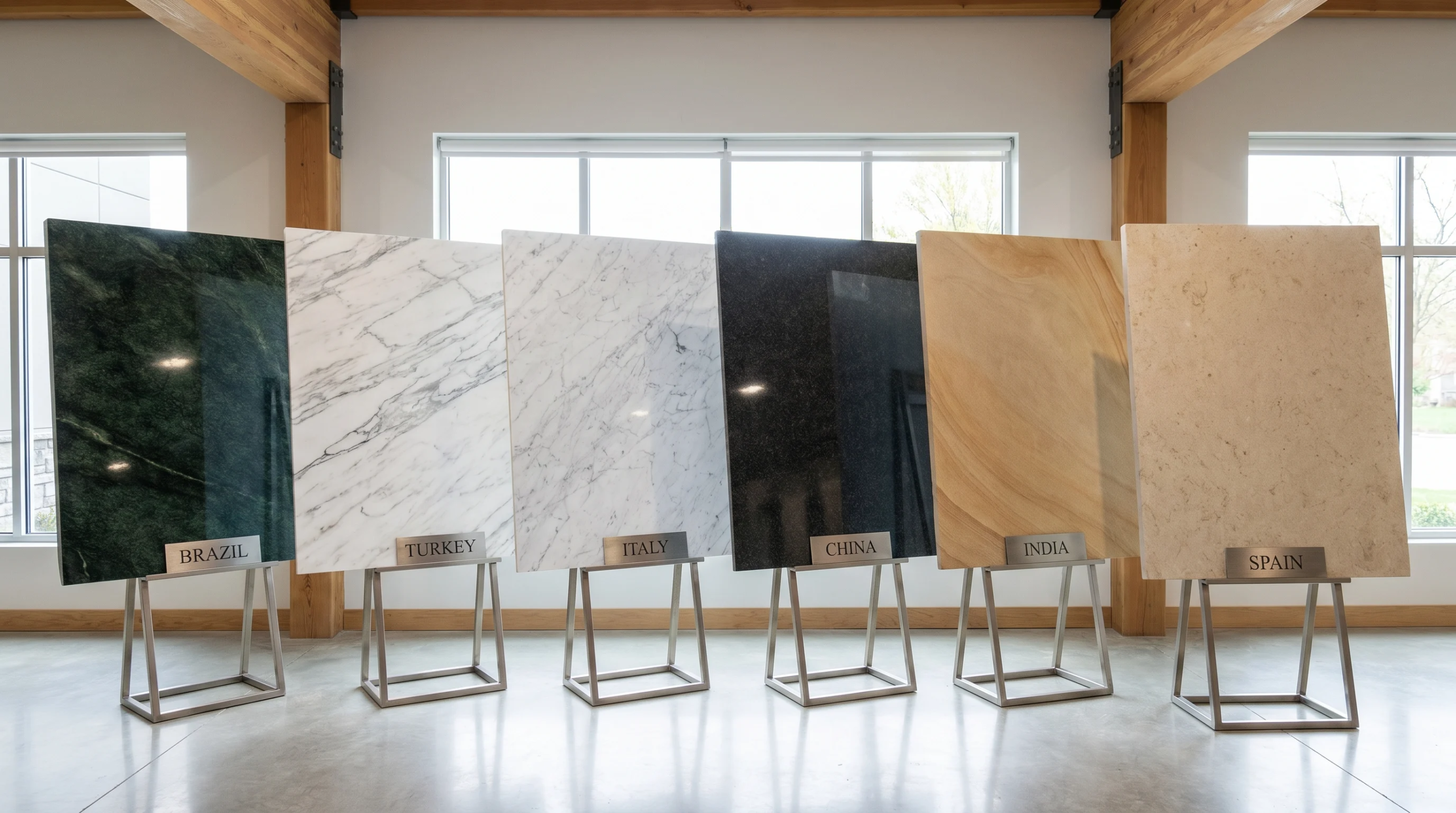
- Lot Risk by Project Type – When Lot Confirmation Is Non-Negotiable
Seven types of projects, from low-risk residential single-slab to extreme-risk phased developments where lot consistency is critical for the finished product’s appearance, were evaluated for production lot risk.
The Extreme risk level is assigned to phased developments with 100+ slabs and book-matched feature walls. Large phased developments can quickly exceed the yield from a single production lot. The supplier must be able to identify multiple lots in advance, supply samples from each, and assist the contractor in sequencing installation to minimize the visibility of lot boundaries. Book-matched feature walls, which require consecutive slabs from the same block face, may show variations even if they come from the same production lot but not the same extraction sequence.
| Project Type | Lot Risk Level | Why It Matters Here |
| Single slab — single residential counter | Low — single slab has no lot variation risk | One slab, one lot by definition. Lot confirmation still useful to document the supply chain but not a consistency risk. |
| 2 to 5 slabs — residential kitchen and bathrooms | Medium — small lot variation risk | Adjacent counters from different lots may show subtle tonal variation. Confirm lot for any project where granite or quartz runs across multiple adjacent surfaces. |
| 10 to 30 slabs — small hotel or office renovation | High — significant lot risk | 10 rooms from two lots will show visible variation at mid-renovation. Full quantity reservation from single lot before any slab ships. |
| 30 to 100 slabs — mid-scale hotel renovation or BTR | Very high — lot management critical | Multi-phase delivery almost certain. Without lot reservation and management, early and late deliveries will not match. Dedicated lot reservation at order stage mandatory. |
| 100+ slabs — large development or phased hotel | Extreme — requires lot coordination | May exceed the yield of a single lot. Supplier must provide visual samples from each lot used and confirm installation sequencing to minimise lot-boundary visibility. |
| Book-matched feature wall — any scale | Extreme — requires consecutive slab selection | Book-matching requires consecutive slabs from the same extraction — not just the same lot. Supplier must confirm slab sequence, not just lot number. |
| Phased project (Phase 2 ordered months after Phase 1) | Very high — lot may be exhausted | Phase 1 lot may not be available for Phase 2. Full Phase 2 quantity must be reserved and ring-fenced at Phase 1 order stage, or re-specification with matched alternative is required. |
| Quick answer:
The biggest operational risk here is for phased projects. Phase 1 is ordered and installed. Three months later, Phase 2 is ordered. The original lot is now unavailable, and a new lot is shipped for Phase 2. Both lots are correctly named and graded and pass quality inspection, but their visual appearance differs. The only way to prevent this is to reserve and ring-fence the quantity for Phase 2 at the time of ordering Phase 1, before the original lot is depleted. |
A hotel renovation contractor ordered granite for 40 bathroom vanities using two separate purchase orders-the first for 25 vanities, the second for 15 after client approval. They were unaware of the issue until the last 15 bathrooms had a distinctly warmer tone than the first 25. This was due to a change in the production lot at the supplier, as their original order was fulfilled from one lot and the later one from another. Both lots were correctly named, graded, and invoiced as the same material. If the contractor had asked for a lot confirmation on the first order and reserved all 40 vanities at that point, this problem would have been avoided.

- How to Confirm a Production Lot Before Any Stone Order
Here are four steps that ensure lot consistency on any multi-slab project, from order confirmation through to delivery:
Step 1 – Request the Lot Number at Quote Stage
The lot number should be included as a line item on the supplier’s quote, along with the material’s name, grade, finish, and thickness. If it isn’t listed, ask for it before you commit to the quote. Suppliers who quote without providing a lot number can’t guarantee that the slabs you receive will come from a single, consistent batch, especially if they need to pull stock from various locations.
Step 2 – Reserve the Full Project Quantity from the Confirmed Lot
Confirming the lot number alone isn’t enough. The supplier must “ring-fence” the entire project quantity from that specific lot to prevent it from being sold to other clients before your delivery. For phased projects that might not have all quantities delivered for several months, this reservation might need to extend to Phase 2 and Phase 3 quantities. A supplier who is unable or unwilling to reserve the total quantity from a single confirmed lot cannot guarantee lot consistency for a phased project.
Step 3 – Request a Physical Sample from the Confirmed Lot
For any project where visual consistency is important (more than 10 units, feature walls, or where the client has approved a specific sample), ask for a physical sample cut from a slab within the confirmed lot before approving the full order. Supplier stock photos may not reflect the current stock’s appearance, and a physical sample from the lot in question ensures visual matching with the material you will receive.
Step 4 – Document the Lot Number on the Order Confirmation
The lot number must be clearly stated on the written order confirmation, not just mentioned in an email or conversation. This written document establishes what was ordered and should be delivered. If delivered slabs do not match the confirmed lot, the order confirmation will be the evidence needed to resolve the discrepancy. A verbal confirmation of a lot number is not legally binding in cases of a mismatch.
| Quick answer:
The four-step lot confirmation process is: lot number on quote, full quantity reserved from confirmed lot, physical sample from confirmed lot for projects over 10 units, and lot number documented on the written order confirmation. All steps should be completed before any slabs are shipped. If a supplier cannot perform all four steps for a commercial multi-slab order, direct clarification is required before the order is placed. The lot number listed on the order confirmation is not just a formality; it’s what makes the supplier responsible for delivering what was specified. Without it, a lot mismatch results in a disagreement about what was agreed upon. With it, the situation becomes a simple matter of correcting a documented specification failure. The distinction between these two scenarios lies in a single line item on an order form. Planning a stone order for a multi-unit or phased project? Contact us with your project type, quantity, and delivery schedule, and we’ll confirm the production lot, reserve the full quantity, and provide a physical sample before any slabs ship. Call +1 704-951-7822 | packuniversesupply.com/request-a-quote |
- What to do if your required lot runs out.
If your project is unable to be completed as it has run out of its specified lot before your full quantity has been used; you can choose from three options, depending on how far the project has gone and just how close in visual character your subsequent lot is.
Lot runs out in a phased project more than contractors expect. When a natural stone is quarried, a section (face) of it will be worked and when that batch is finished it can run out, the subsequent batch will use another face of the stone which will be the same name and the same grade, but it will come from a slightly different place on the stone body and might vary in reading.
Option 1: Re-specify a matched alternative to your full project scope.
Where your project is early enough that you are only just placing an order or if lot runs out and you haven’t installed yet it is easier to re-specify an alternative stone or a matched lot that fits the specification of the project better. The supplier would confirm with the contractor which two or three other stones that are visually similar to the project stone, the contractor orders with the confirmed lots that meet the specification.
Option 2: Manage installation across two visually similar lots.
If you have two different adjacent lots that are visually very similar, this is only viable if you check that these lots have visual compatibility prior to any installation. This option is often only workable in specific locations on the project, such as: on an end wall, in corners, on alcoves or behind installed kitchens as these are less viewed than say, a kitchen counter or a feature wall.
Option 3: Fully order and confirm the whole project quantity prior to dispatch of the Phase 1 consignment.
The easiest solution that requires least hassle is, when ordering at phase 1 stage for your project, at this stage your full project quantity can be ordered under one specified lot number, prior to dispatch. The supplier then confirms all the required stone is available from this one batch and then all subsequent orders can then be supplied and stored in one large batch. The main advantage of this system is that all subsequent stone ordered for subsequent phases will all match.
| The real danger in this is:
if a contractor is ordering stone on phases of their project; they don’t book out the total quantity of the stone required before the phase 1 dispatch occurs, as the total required quantity for phases 2 & 3 are yet to be confirmed. Once the phase 1 consignment has been installed it becomes apparent the consignment runs out for phase 2 and this means that phase 2 will be a different visually matched (or mismatched) lot which leads to visible variations in tone. When this happens it may be necessary to re-specify part of your order, re-install part of the job or negotiate with client. The solution is one simple question at phase 1 ordering, no complex answers needed. |
Everyone who has contracted stone will agree that dealing with issues regarding lots at the very beginning of ordering and installing is easier to deal with, than a hotel who calls after they’ve installed phase 2 bathrooms and noticed they’re a slightly different shade, than their phase 1 bathrooms. The problem cannot then be solved easily or cheaply. They could have requested and agreed to book out their 120 units with the supplier prior to phase 1 delivery and not have had any problem at all.
| In brief:
Lot runs out? Option 1 – visually match to new specification (best for projects in the initial stages of ordering), Option 2 – careful planning of lot location if visually close (installation has yet to be confirmed in terms of compatibility), Option 3 – fully order lot quantity prior to phase 1 delivery (no problem ever occurs with this option, as the whole lot has been purchased prior to shipment). |
| Our solution:
Pack Universe Supply confirms production lot of every order over 5 slabs without the contractor having to request. On commercial and phased projects: We will provide you with a quotation confirming your production lot number and secure all the necessary quantity prior to dispatch of any part of the consignment; we can provide physical samples of the selected batch for any orders greater than 10 slabs. For phased orders: We work with the contractor on phased orders to secure all of the required project quantity prior to dispatch of the first phase. |
Charleston SC (USA) | Burlington ON (Canada)
+1 704-951-7822
Order wholesale stone with a guaranteed production lot—the entire project quantity pre-purchased before any dispatch.
Granite, Quartz, Quartzite.
-> packuniversesupply.com/request-a-quote
Verdict: What is a Production Lot and Why Should Contractors Always Confirm It?
Verdict:
A production lot represents a specific quarry extraction or manufacturing run for a certain stone material. This batch ensures visual consistency, meaning stones from the same production lot will look similar when installed side-by-side. Stones from different lots of the same material may have slight variations in background color, veining, or tonal range.
Lot confirmation is crucial for all multi-unit, phased, book-matched, or hotel projects. By asking a single question at the quote stage, you can avoid most disputes regarding stone appearance after installation.
The four essential steps to confirm a lot number: the lot number must be on the quote; the full quantity must be reserved from that confirmed lot; if the order is for over 10 units, a physical sample from that confirmed lot is required; and the lot number must be documented on the written order confirmation. All four steps should be completed before any slabs are shipped.
Sources & References
NSI – Natural Stone Institute, Stone Traceability and Lot Management Guidelines: naturalstoneinstitute.org | NAHB – Developer Purchasing Survey 2025: nahb.org | Pack Universe Supply commercial order management data, April 2026.
About the Author
Sam Michaele 15 years managing production lot confirmation for commercial stone orders – hotels, BTR developments, and large-scale renovations – across the USA and Canada.