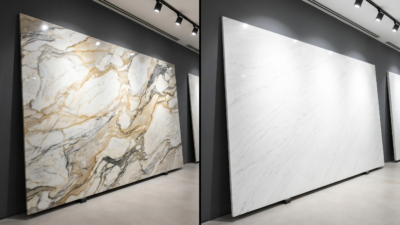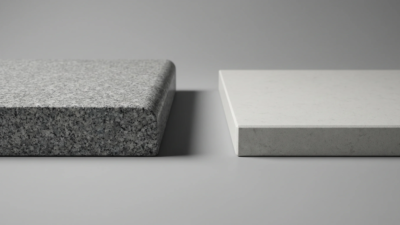
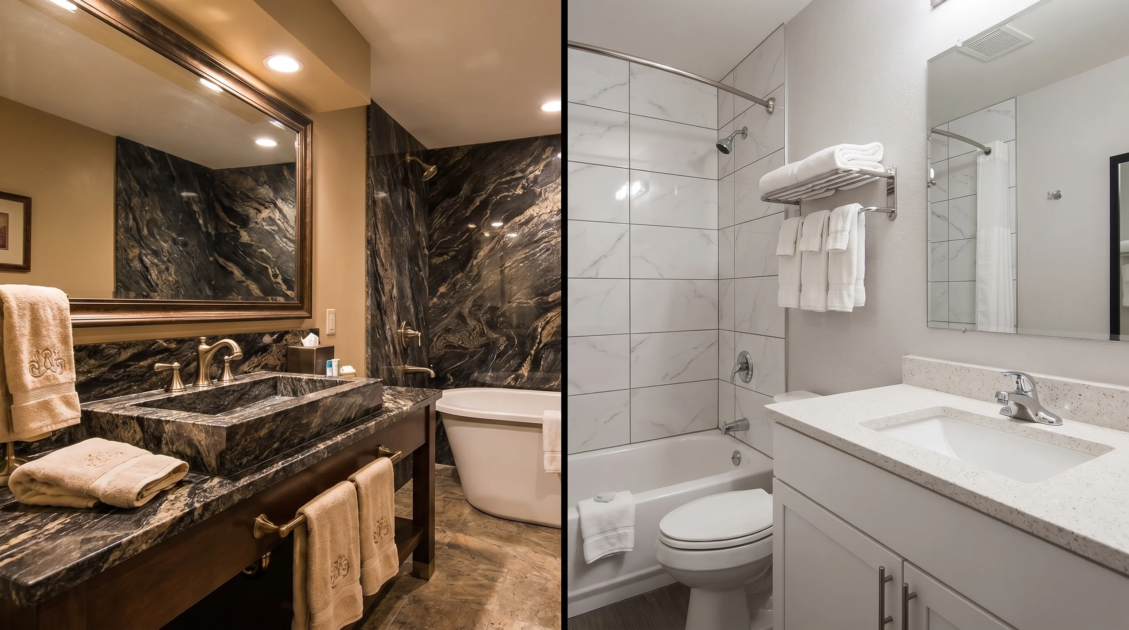
Boutique Hotel vs Budget Hotel Stone Specification — What Changes and Why [2026 Guide]
Boutique Hotel vs Budget Hotel Stone Specification — What Changes and Why [2026 Guide]
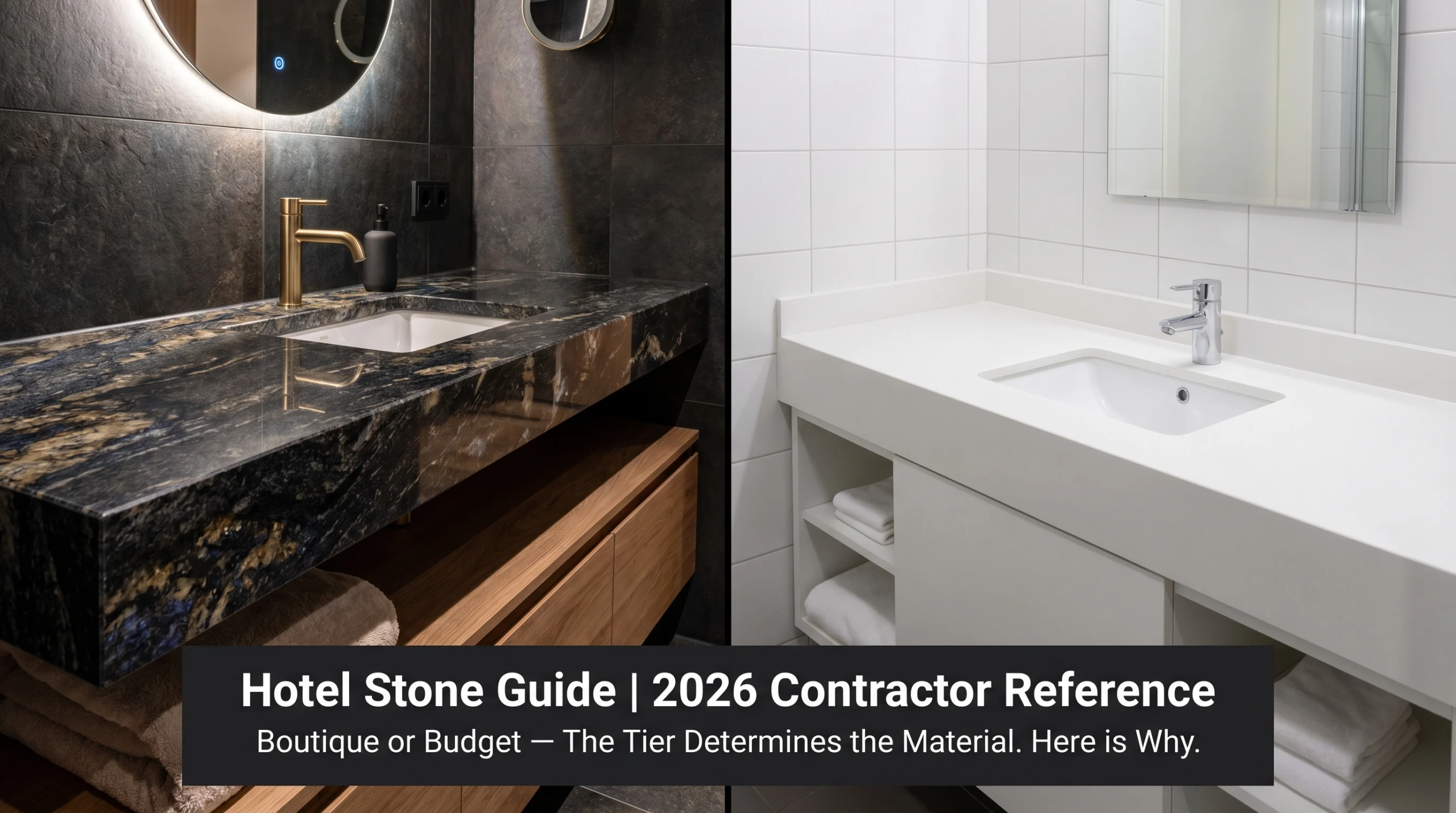
The definitive 2026 contractor guide to hotel stone specification across tiers – from luxury and boutique to budget and economy – covering the 5-tier specification matrix, the 8-factor comparison between luxury and budget specifications, why the maintenance capability of each tier drives the material choice, the mistakes contractors make specifying natural stone at the wrong tier, and the single question that determines whether natural stone or engineered quartz is the correct hotel specification. STR and NAHB data throughout.
| What differentiates boutique hotel and budget hotel stone specification, and why does the tier dictate the material?
The hotel tier dictates the stone specification because of the varying interplay between material cost, maintenance capability, and guest expectation. At the boutique and luxury tiers, natural stone-granite, quartzite-conveys a quality register that cannot be duplicated by engineered alternatives, and a certified professional maintenance plan is a reasonable operational assumption. At the standard and budget tiers, engineered quartz or premium porcelain provide the stone aesthetic while ensuring a maintenance level that hotel housekeeping staff can feasibly achieve without specialized protocols. Specification Summary by Hotel Tier: Luxury and Boutique (5-star, design hotels): Natural granite or quartzite for bathroom vanities, accent walls, and lobby areas. Lot-confirmed. Documented maintenance program. 3cm thickness. Premium finish. Upper-Upscale (4-star): Granite or premium quartz, based on brand standards and maintenance capability. Natural stone where the maintenance is confirmed. Quartz where it is not. Upscale (3-4 star branded): Engineered quartz as standard. Granite for lobby and reception areas where brand standards dictate natural stone. No natural stone in bathrooms unless maintenance program is verified. Mid-scale and Economy (2-3 star): Engineered quartz or large-format porcelain. Zero maintenance obligation. Housekeeping staff can use any cleaning products. Lower cost per square foot. Consistent color across all rooms. Budget (1-2 star, limited service): Large-format porcelain or engineered quartz of lower grade. Durability and cleanability are the top specification criteria. All grades of hotel stone specification are available through Pack Universe Supply-wholesale contractor pricing, confirmed lots, nationwide delivery. Call +1 704-951-7822 | packuniversesupply.com/request-a-quote |
The hotel tier does not mandate the quality of the specification; rather, it determines the most appropriate specification for that tier’s operational reality. Natural granite in a budget hotel bathroom is not a premium specification; it is a maintenance issue that the housekeeping staff is likely to create.
Hotel stone specification is an area where the distinction between a premium appearance and correct performance is of significant commercial importance. A boutique hotel with 40 rooms and a professional facilities management program can support natural granite bathroom vanities and ensure their correct maintenance and presentation to guests in a manner that justifies the hotel’s higher pricing. A budget hotel with 120 rooms and a housekeeping staff that uses general-purpose cleaning products cannot maintain natural granite to the same standard, and the granite that initially appeared premium will begin to show gradual staining and surface dulling within 18 months of commercial use.
This guide outlines the correct stone specification for each hotel tier, the eight factors that differ between boutique and budget specifications, and the operational question that ultimately determines which material is best suited for a given hotel project-regardless of the client’s design preferences. It includes data from STR and NAHB.
- Why Hotel Tier Dictates Material-Not Just Cost
The connection between hotel tier and stone specification is not primarily about budget but rather about maintenance capability. Maintenance capability at each tier determines whether natural stone will perform correctly throughout the hotel’s renovation lifecycle.
According to 2025 STR Global hospitality data, the average room rate in the luxury tier is approximately 4.2 times that of the economy tier.
This difference reflects not only the physical quality of the space but the operational cost of maintaining it, including the professional maintenance program required for natural stone to perform correctly. Luxury hotels typically allocate funds for quarterly professional stone services, specialized cleaning agents, and periodic professional re-finishing in their facilities management budgets.
Economy hotels, given their operational volume and price points, cannot afford or sustain such a program in their housekeeping budgets.
The practical implications for contractors are that the correct stone specification is determined by two questions, not just one: First, what material does the design brief specify? Second, does this hotel’s maintenance program support that material’s requirements? A boutique hotel that answers yes to the second question can use natural granite or quartzite; a budget hotel that answers no should opt for engineered quartz or porcelain, which will provide the stone aesthetic with no maintenance obligation and a cost per square foot that aligns with the hotel’s renovation budget.
| Quick Answer:
Before any hotel stone specification is decided upon, ask the operational question: “Does this hotel possess a facilities management program capable of providing the necessary maintenance for this material?” Typically, luxury and boutique tiers say yes. Budget and economy tiers usually say no. If the answer is no, specify quartz or porcelain-it will perform correctly at that tier. Natural granite in a budget hotel bathroom is not an upgraded specification; it’s a specification that will deteriorate faster than the quartz alternative. |
| Industry Data:
STR Global 2025 (str.com)-The average daily rate at US luxury hotels is roughly 4.2 times higher than at economy tier hotels. Facilities management budgets scale proportionally; luxury hotels pay for specialized stone maintenance, while economy hotels do not. The stone specification must account for this operational distinction. NAHB 2025 (nahb.org)-In a survey, 71% of hotel renovation contractors reported at least one instance where natural stone was specified for a hotel tier where the maintenance program was insufficient to sustain it, leading to premature surface wear within 24 months of renovation completion. |
| Key Takeaway:
The common specification error causing premature stone deterioration in hotels: specifying natural stone for a tier where housekeeping uses standard cleaning products instead of pH-neutral stone cleaners, and where no professional sealing program is included in the facilities management schedule. The material is suitable for a higher tier but incorrect for the actual operating environment. |
The following 5-tier specification matrix outlines the correct material for each hotel tier, for bathroom vanities and lobbies, highlighting the key determinant for each specification:
Here are the rewritten parts in a more natural, human-like tone:
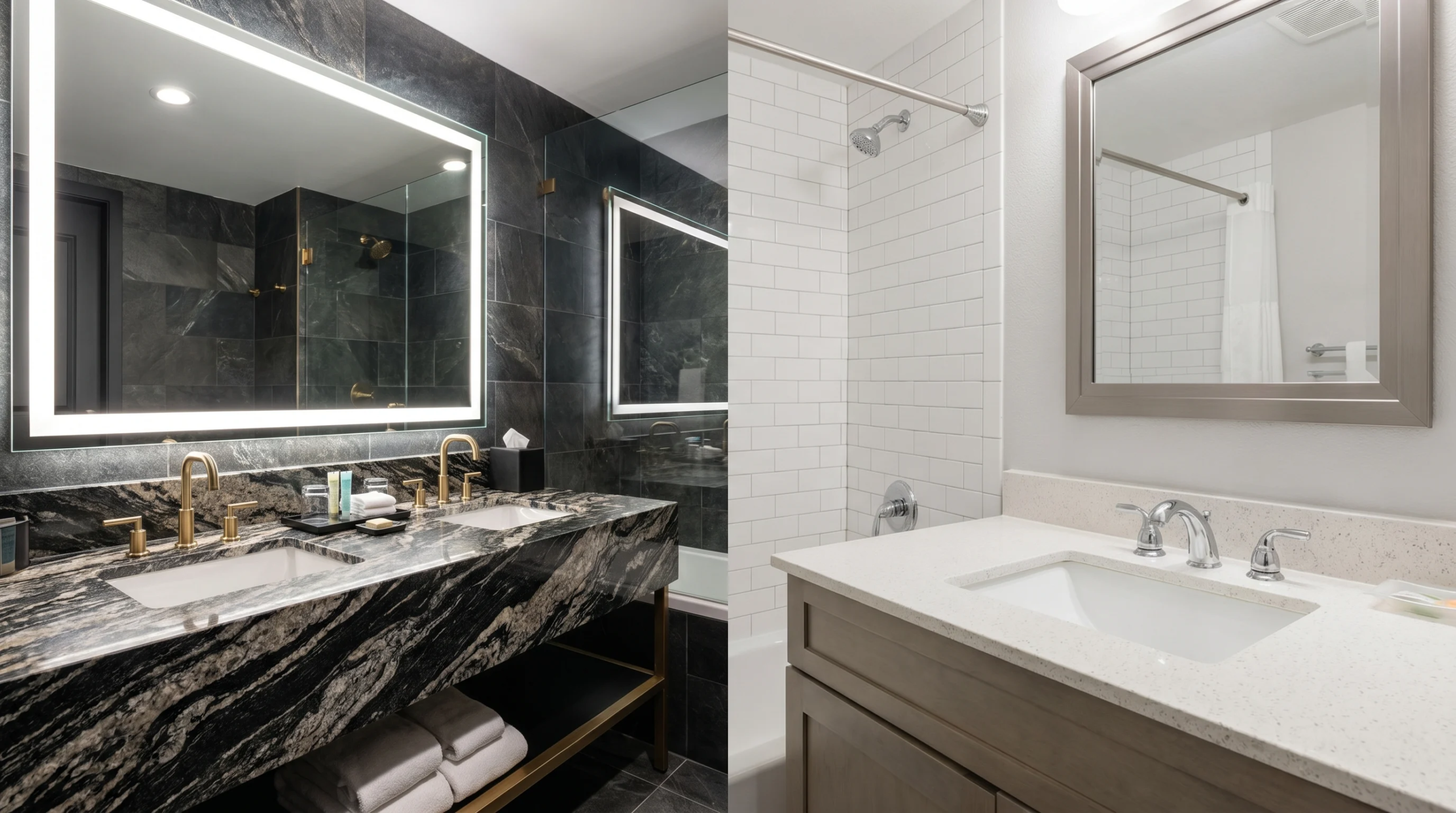
- The 5-Tier Hotel Stone Specification Matrix
Here’s a breakdown by five different hotel tiers – from the most luxurious to the most budget-friendly – outlining the appropriate stone specification for both bathrooms and lobbies, as well as the key operational factor that validates that choice for each tier.
The row detailing Upper-Upscale (4-star branded) is crucial for contractors working on 4-star brand projects. At this level, both natural stone and quartz are acceptable choices, but you’ll need to determine whether the hotel brand requires natural stone or if the hotel’s operations would better suit quartz. Always check the brand’s specific specification guide when working on branded projects, and on independent 4-star hotels, the maintenance plan is the defining factor for material choice.
| Hotel Tier | Bathroom Vanity | Lobby and Reception | Key Specification Driver |
| Luxury / Boutique (5-star, design) | Natural granite or quartzite — 3cm, polished or honed, lot-confirmed | Natural granite or premium quartzite — feature wall and desk. Full stone specification. | Material authenticity is the brand signal. Guests recognise and expect natural stone. Maintenance programme is professionally managed. |
| Upper-Upscale (4-star branded) | Premium quartz or granite — depends on brand standard and maintenance confirmation | Granite or premium large-format porcelain for lobby surfaces. Natural stone where brand requires it. | Brand standard sets the specification floor. Natural stone where maintenance is confirmed. Quartz where operational simplicity is the priority. |
| Upscale (3-4 star branded) | Engineered quartz — 20mm, stone-look finish, consistent colour across all rooms | Large-format porcelain or quartz for reception. Granite reserved for lobby feature elements only. | Consistency across high room counts. Housekeeping sustainability. Brand standard compliance without specialist maintenance. |
| Midscale (3-star branded) | Engineered quartz or large-format porcelain — lower grade, consistent tone | Porcelain or engineered quartz throughout. No natural stone. | Cost per sqft is a specification driver. Zero maintenance. Any cleaning product. Durable at commercial housekeeping intensity. |
| Economy / Budget (2-star, limited service) | Large-format porcelain — 60x30cm minimum, neutral tone, matte finish | Porcelain or composite throughout. No stone specification of any type. | Pure durability and cost. No stone. Porcelain survives the most aggressive cleaning and the most varied use. |
| Quick answer:
The lobby specification should be consistent with the hotel’s overall tier. A boutique hotel lobby with natural granite sends a clear signal of genuine luxury. A budget hotel with a natural granite lobby and porcelain bathrooms is an obvious mismatch. Guests notice. Well-done porcelain in a budget hotel lobby feels more honest and is more practical than out-of-place natural stone. |
A budget hotel renovation that featured polished black granite in the lobby due to its appearance and competitive price ended up with a stained desk just twelve months later from spilled coffee, hand lotions, and general cleaning sprays used by staff. While natural granite isn’t inherently bad for lobby desks, it’s not suitable for hotels lacking the budget and personnel for a proper maintenance plan. Quartz in the same application would have required virtually no maintenance.
- The 8-Factor Difference Between Boutique and Budget Stone Specification
An analysis of eight key specification factors comparing luxury/boutique hotels with budget/economy hotels, and the rationale behind the distinctions.
| Specification Item | Boutique / Luxury | Budget / Economy | Why the Difference |
| Bathroom vanity material | Natural granite or quartzite | Engineered quartz or porcelain | Natural stone signals material quality at luxury tier. Quartz and porcelain are zero-maintenance at budget tier where housekeeping protocols are not specialist. |
| Stone thickness | 3cm self-supporting | 20mm quartz or 10mm porcelain | 3cm natural stone at luxury tier for durability and premium weight/feel. Thinner engineered materials at budget tier reduce cost and installation weight. |
| Surface finish | Polished or honed — client decision | Polished quartz or matte porcelain | At luxury tier the finish is a design decision. At budget tier polished quartz is lowest maintenance; matte porcelain hides housekeeping marks better. |
| Production lot confirmation | Mandatory — all rooms from confirmed lot | Standard batch confirmation | Luxury tier: visible consistency across rooms is a guest expectation. Budget tier: individual rooms not compared; standard batch adequate. |
| Stone grade | Level 2 to Level 3 or premium | Level 1 or commercial grade | Premium grade at luxury tier shows maximum character and uniform quality. Commercial grade at budget tier is durable and consistent at lower cost. |
| Lobby specification | Natural stone — feature wall, book-matched | Porcelain or composite | Lobby is the brand’s first impression at all tiers. Natural stone in a budget lobby signals a mismatch between aspiration and execution — porcelain is more honest. |
| Sealing programme | Confirmed professional sealing — 6-monthly | No sealing required (quartz/porcelain) | Natural stone at luxury tier requires professional maintenance programme. Quartz and porcelain at budget tier require no sealing — any product cleans them. |
| Wear layer / thickness for flooring | SPC 20 mil or engineered hardwood | SPC 20 mil — no engineered hardwood | At luxury tier hardwood or premium SPC. Budget tier: SPC 20 mil only — lowest maintenance, most durable in commercial turnover conditions. |
| Quick answer:
Production lot confirmation is the most critical difference between boutique and budget specification from an operational standpoint. In a boutique hotel with 40 rooms, a noticeable color variation from Room 1 to Room 40 would be a guest complaint waiting to happen, especially in today’s world of photos and social media. Budget hotel guests, even in a 200-room property, generally don’t compare rooms as intensely. Lot confirmation is therefore essential for boutiques and standard practice for budget hotels. |
A specification that works perfectly in a boutique hotel with 40 rooms and a skilled maintenance team won’t necessarily work as well in a 120-room budget hotel with general cleaning staff. It’s the same material but in a different operating environment, and the performance will differ. A contractor who asks the right maintenance questions upfront is the one who won’t get calls about damage 18 months later.
| Looking to specify stone for your hotel project?
Tell us your hotel’s tier, the total number of rooms, and whether you have a maintenance plan in place. We can confirm the ideal stone specification for each area and provide a combined wholesale quote. Call +1 704-951-7822 | packuniversesupply.com/request-a-quote |
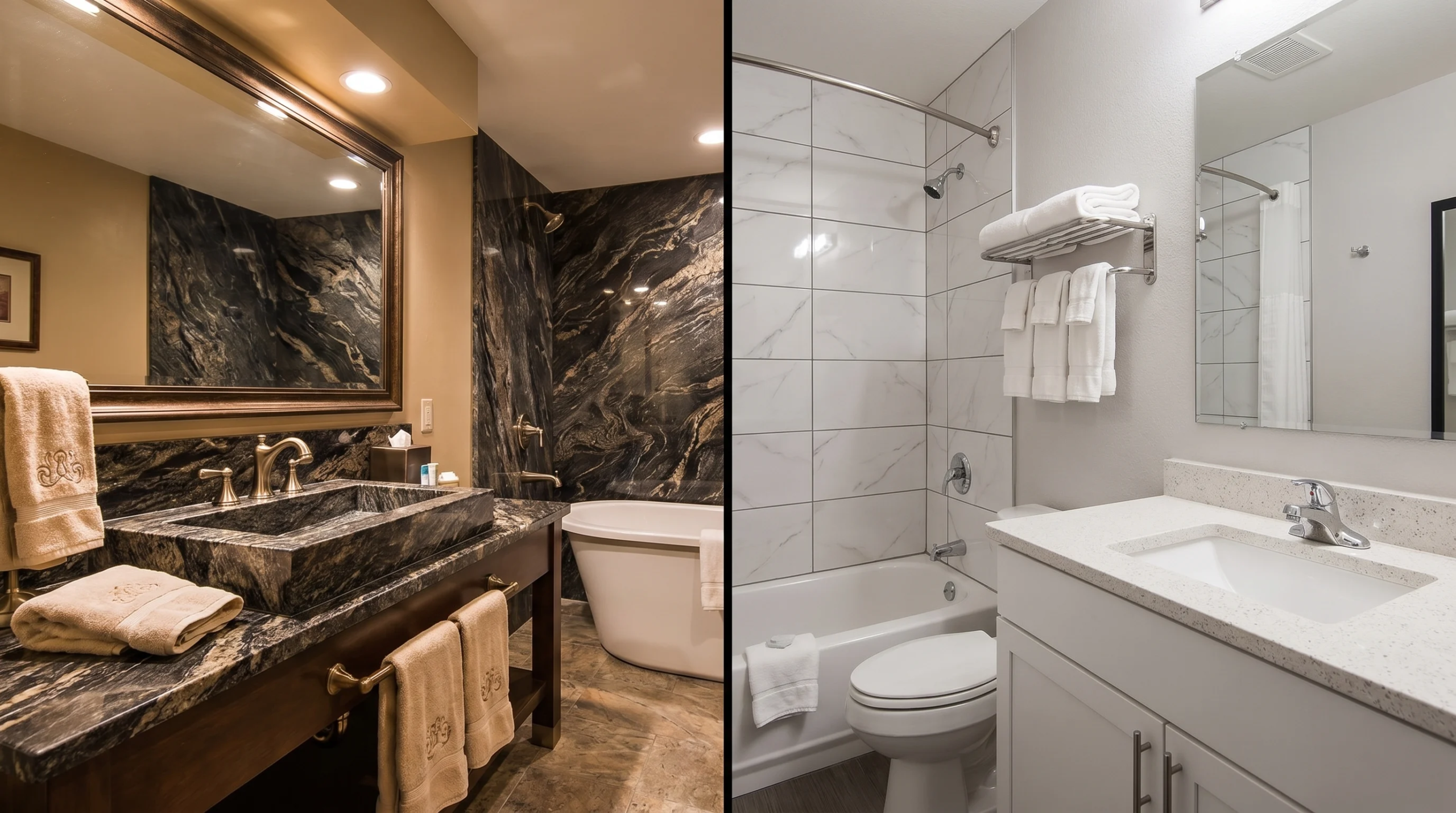
- Hotel Stone Specification Mistakes Made by Contractors
These four common stone specification errors in hotel renovation projects all stem from using a specification correct for one tier in a project at a different tier.
Mistake 1 – Natural granite specified for a tier that cannot stand up to it
This is by far the most common stone specification error made in hotel renovations – natural granite used in an economy or budget hotel bathroom, because the wholesale cost difference between natural granite and quartz isn’t large enough to warrant being flagged, and granite appears to present a higher quality in the specification document. However, the hotel housekeeping service uses whatever cleaning solution the maid has on the cleaning trolley. Within eighteen months the granite begins to dull on its surface due to the use of acidic cleaning solutions and stain due to soap and shampoo seeping into the porous surface and shows etch marks from use of limescale removing solutions. A quartz vanity installed in the same room, under the same housekeeping routine, exhibits none of these flaws. The stone specification error wasn’t in the quality of the natural granite, it was in using a product inappropriate for the operational environment it was placed in.
Mistake 2 – Quartz specified when the brand standard requires natural stone
This is the inverse error. Quartz is selected over natural stone for a 4-star or boutique hotel project when the brand standard or client brief specifies natural stone. The reasons the contractor selects quartz over natural stone are its simplicity, low-maintenance qualities, and consistent ease of specifying it across large numbers of rooms. When the client looks, they notice. Always verify the FF&E specification standards of the brand before submitting quartz as an alternative to granite in a branded hotel project. For an independent boutique hotel project, a client who requested natural stone should receive natural stone – subject to the discussion about maintenance being a condition.
Mistake 3 – Specification is inconsistent across different types of rooms
This means boutique tier specification (natural granite) for premium rooms and budget tier specification (quartz) for standard rooms within the same hotel renovation project, without the guests who stayed in both rooms being aware of any discrepancy between them. Guests expect that the upgrade of the room will correspond to an upgrade of features when guests are being encouraged to move between room types. A homogeneous quartz specification across all room types may be more defensible than one that introduces a visible hierarchy through material choice.
Mistake 4 – Lot confirmation ignored on multi-room hotel projects
This refers to when a hotel requires 60 hotel bathrooms, the contractor orderes two purchase orders: first 30 when phase 1 approval comes, and the second 30 when phase 2 budget approval comes. Neither phase’s order contains a reservation for the whole 60 units within the production lot designated during phase 1. Rooms 31-60 arrive and are manufactured from a different production lot. They have a subtle tonal difference from rooms 1-30, which is visible and detracts from quality when used in a boutique hotel, particularly when guests are comparing room types and photographing everything they encounter. Solution: one lot reservation should be made when the purchase order is placed at Phase 1 stage.
|
Real risk. Real consequence.
Risk: Specifying natural granite for hotel bathroom renovations at a tier where housekeeper service personnel will be using general-purpose cleaning products, without a confirmed stone maintenance program being implemented and properly executed. Consequence: Progressively developing surface dullness and staining within 18 to 24 months of completion. The professional cost to remove any residue and resurface or re-seal the stone falls on the hotel owner, and often gets passed back to the contractor. A quartz installation in the same environment under the same housekeeping protocol requires no maintenance. |
A contractor who does not investigate this question is only specifying half of the stone installation, not all of it. That specification has no idea of how the product will perform over the five years until refurbishment. Always ask the maintenance question-it takes two minutes to obtain, but the absence of the answer will cost far more in dollars and negative guest reviews.
| Quick Answer: Before specification of any hotel natural stone, confirm that the hotel has a facilities management plan including professional sealing at the required frequency, housekeeping staff is utilizing pH-neutral cleaners, and funds are available for periodic professional refinishing. If these cannot be guaranteed, use quartz. Its look is similar, and its maintenance is zero. |
How Pack Universe Supply is your ally for hotel stone specification at any tier:
Pack Universe Supply offers hotel stone at any tier, from the high-end of natural granite and quartzite used for boutique and luxury tier projects through premium engineered quartz and large format porcelain used in upscale and budget tier renovations. We will assist contractors in specifying correct materials for each tier and application, provide for lot confirmation on all multi-room orders and supply a single quote for all surfaces required. Call if you are a new hotel specification contractor and wish help determining the correct materials for your room type, guest room count and proposed maintenance regimen.
Call +1 704-951-7822
Order Hotel Stone at any Tier – Correct Material, Confirmed Lot, Single Quote:
Natural Granite/Quartzite – Boutique/Luxury; Quartz/Porcelain – Upscale-Budget.
Charleston SC (USA) | Burlington ON (Canada)
-> packuniversesupply.com/request-a-quote | Call +1 704-951-7822
Verdict – What Changes Between Boutique and Budget Hotel Stone Specification?
Verdict:
The material changes. The reason it changes is maintenance capability – not design aspiration. At the luxury and boutique tier, natural granite and quartzite perform correctly because a professional maintenance programme supports them. At the budget and economy tier, engineered quartz and premium porcelain perform correctly because they require no specialist maintenance and tolerate any cleaning protocol.
The 5-tier matrix and the 8-factor comparison in this guide identify the correct specification at each tier. The operational question that validates any hotel stone specification: does this hotel’s maintenance programme support what this material requires? If yes, specify the material. If no, specify quartz or porcelain and present the aesthetic honestly.
The hotel that receives the right specification for its operational tier has surfaces that look correct at the 2-year inspection. The hotel that receives the wrong specification has a remediation conversation instead.