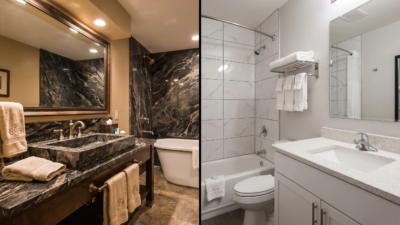
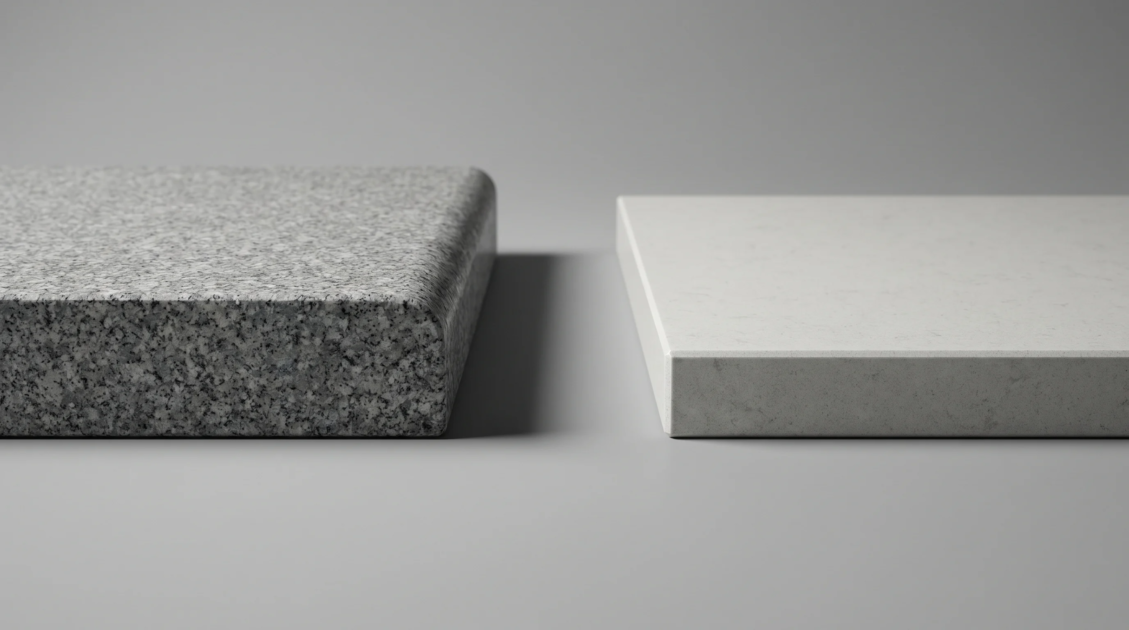
What Is the Correct Stone Thickness for Commercial Countertops?- 2cm vs 3cm Guide
What Is the Correct Stone Thickness for Commercial Countertops? -2cm vs 3cm — 2026 Guide
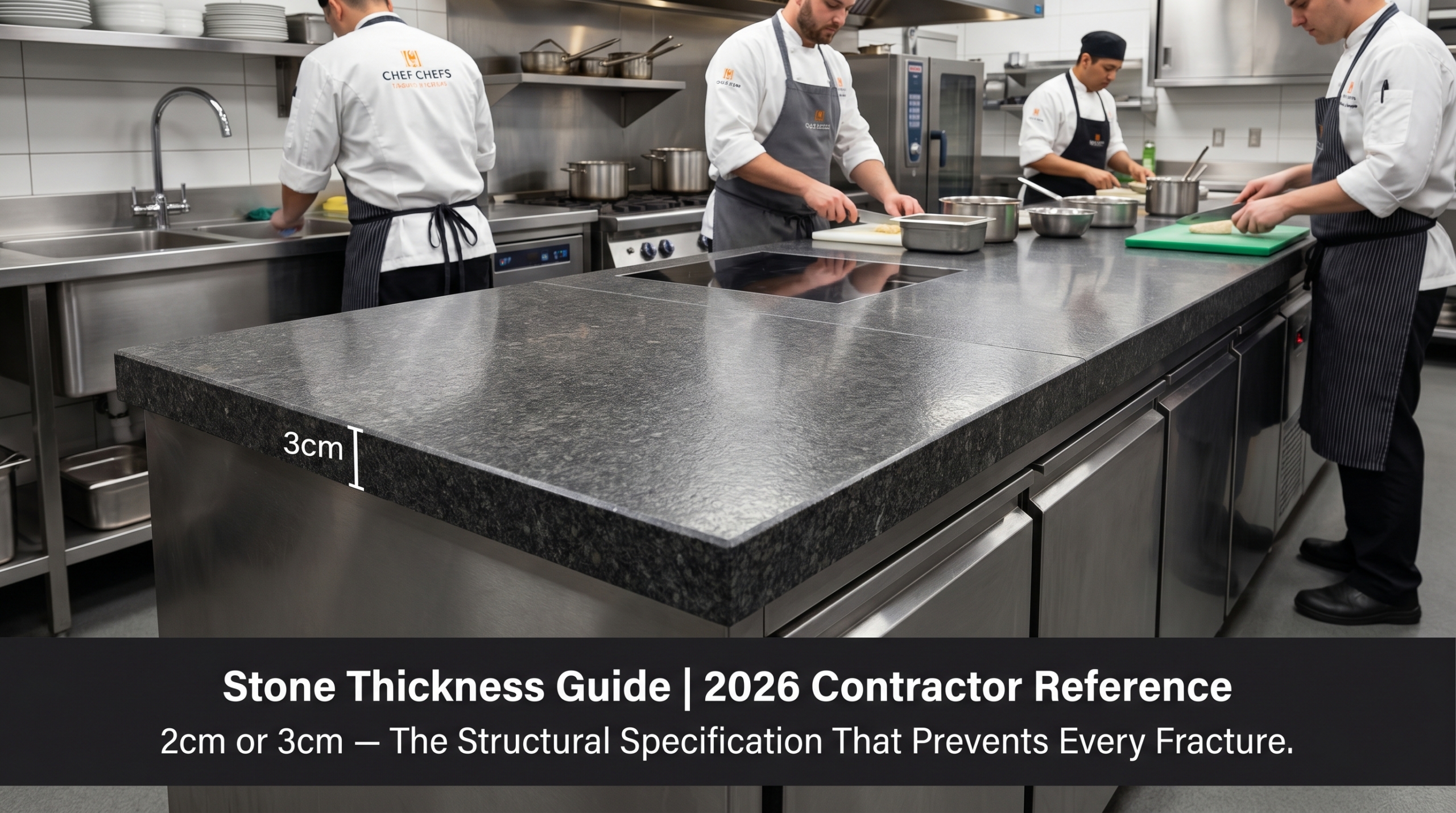
The ultimate contractor’s guide to stone countertop thickness for 2026 – how to choose between 2cm and 3cm structurally, the definitive thickness guide for 10 common applications, when 2cm is and isn’t safe to use in commercial settings, how unsupported spans and overhangs affect thickness choices, the NSI standard specification, what can go wrong if 2cm is used instead of 3cm in a commercial setting, and the one specification that can avoid every fractured commercial stone countertop.
| What thickness is correct for a commercial countertop, and when is 2cm an acceptable material, and when must a 3cm slab be used?
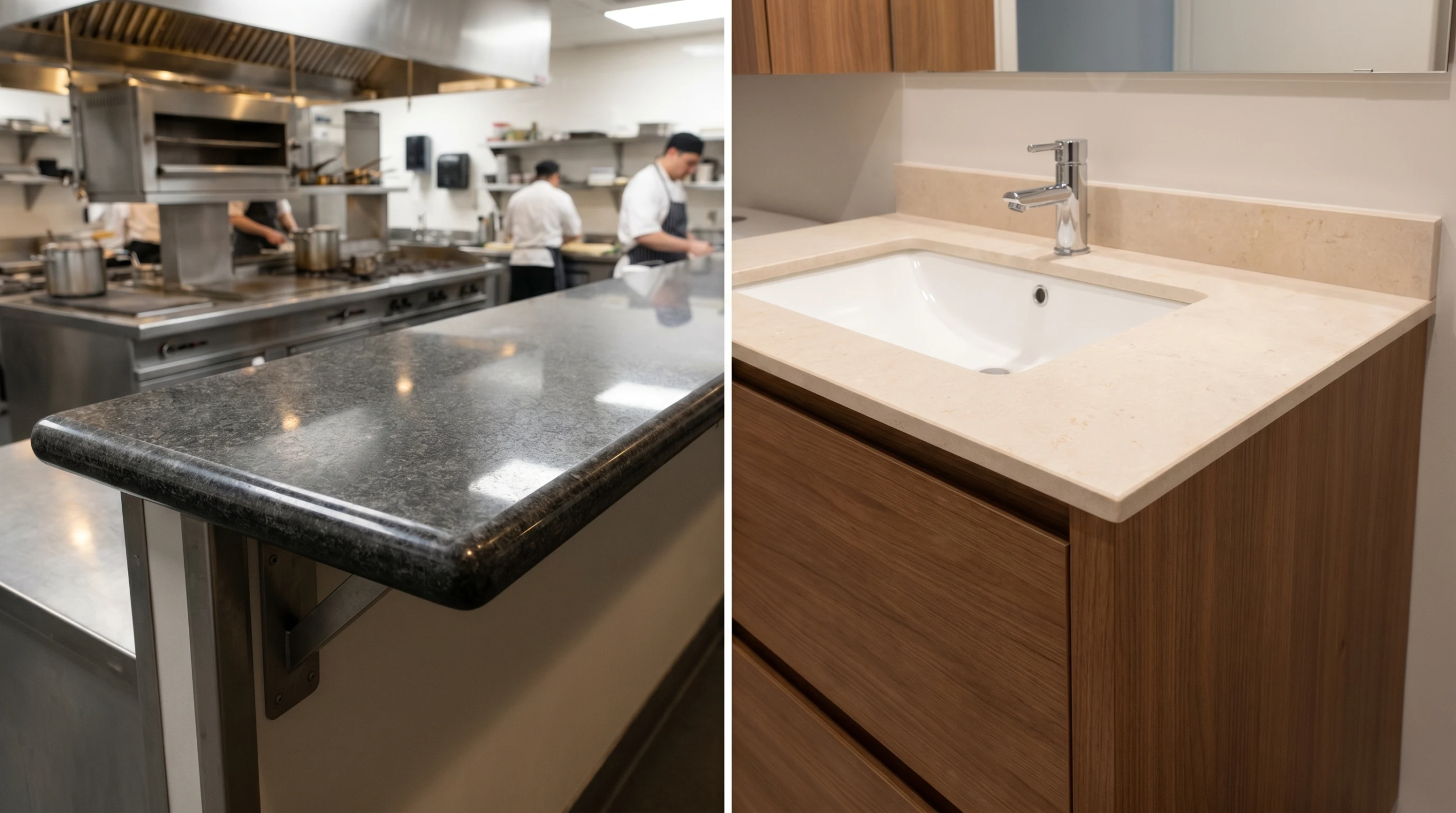
3cm (equivalent to 1.25 inches) is the only structurally correct thickness for any commercially specified self-supporting stone countertop.This includes self-supporting surfaces where the countertop must span gaps or hold its own weight across unsupported areas or overhangs like a breakfast bar or an unsupported span. A 2cm slab (equivalent to 0.75 inches) can only be considered in cases where the entire countertop span will be continuously supported by a solid substrate directly underneath the stone, like on a fully-enclosed, no-overhang cabinet. The decision regarding thickness is a structural specification, not a pricing concern. A 2cm stone slab, when used in a self-supporting commercial capacity, will fracture. Summary of stone thickness requirements by commercial application: Commercial kitchen countertop – self-supporting: Requires 3cm thick stone. There are absolutely no exceptions to this rule. It is due to potential for heavy loading, increased risk of impact damage, and the inherent unsupported spans present on prep areas and breakfast bars. Restaurant bar top: Requires 3cm thick stone. This is because of high likelihood of impacts from glassware and bottles, as well as potential for damage from heavy bar equipment. Unsupported areas around the service area are also a concern. Hotel reception desk: Requires 3cm thick stone. Like bar tops, reception desks face the possibility of impacts from luggage and other equipment. Any portion of the desk with an unsupported span should be 3cm. Bathroom vanity (supported fully by cabinets and without overhang): 2cm is acceptable. This is because the continuous cabinet support structure bears all the weight of the stone, eliminating the possibility of unsupported spans or stress concentrations. Feature wall cladding: 2cm thick stone or even thinner (down to 10mm for certain porcelain panels) can be used. When stone is mounted vertically, there is no requirement for it to bear any weight, so its structural strength becomes less critical. All commercial grades of granite, quartz, and quartzite available in 2cm and 3cm at Pack Universe Supply – every slab checked for correct thickness. Call +1 704-951-7822 | packuniversesupply.com/request-a-quote |
The thickness of a stone countertop for commercial applications is purely a structural matter, not a budgetary one. In an unsupported application, a 2cm stone slab will break. A 3cm slab will not. The difference in cost between 2cm and 3cm stone is roughly 30% to 40% of the material’s cost. However, a fractured 2cm commercial kitchen countertop will require complete replacement at a total cost of 100% installation expense again.
When ordering stone countertops from suppliers, the question of whether to use 2cm or 3cm is typically addressed at the quotation phase. Frequently, a decision to proceed with 2cm may be presented as a cost savings, rather than a discussion about the structural implications for the specific application. It is critical that the reasons behind specifying 3cm be communicated clearly alongside the cost comparison so that the contractor, client, and supplier are on the same page regarding structural integrity and the potential for premature failure with 2cm stone in an inappropriate application.
The NSI’s published standard for stone countertop thickness in unsupported commercial applications is the prevailing industry guideline. This standard is in alignment with ASTM stone installation specifications. Specifically, it mandates 3cm thickness for any self-supporting natural stone slab with an unsupported span of greater than 18 inches, for all commercially specified countertops with any overhang, and for all commercial kitchen and food service applications regardless of how they are supported. This guide is designed to make that specification easy to understand for all major commercial countertop uses.
- Why 2cm Stone is Prone to Fracture Where 3cm Will Endure
Stone is an inherently brittle material; it does not bend before it breaks. Thickness is therefore the most crucial factor when considering how much force and impact a stone slab can withstand before the stresses at a weak point exceed its fracture threshold.
A heavy impact-such as a dropped blender, a cast iron pan, or a large piece of equipment being set down on a countertop-will send a stress wave through the stone. If a 3cm slab is installed with proper continuous substrate support, this wave will distribute over a larger volume of material and across the supporting base. In contrast, if the same impact occurs to a 2cm slab in the same configuration, the material’s lower cross-sectional area will concentrate the stress more rapidly, causing the material’s fracture point to be reached sooner. This is precisely why NSI recommends 3cm thickness for commercial applications with unsupported spans and overhangs.
The overhang portion of a commercial countertop is where the most stress is typically concentrated.
A 2cm granite countertop with a 12-inch overhang offers no support below the overhanging edge, meaning that all downward force on the edge relies entirely on the material’s inherent strength to resist the bend. When repeatedly loaded-whether by someone leaning on the edge, an object placed at the outermost extent, or commercial equipment set down on the overhang-micro-fractures will begin to develop at the support line in a 2cm slab. These fractures will eventually propagate and cause the entire piece to fail. However, a 3cm slab is more robust and has enough cross-sectional strength to tolerate repeated commercial loading for years.
| Quick answer:
For stone countertops in commercial settings, always specify 3cm thick material if there’s an unsupported span greater than 18 inches, any overhang, or any expected heavy impact loading typical for a commercial kitchen or bar environment. 2cm thickness should only be used if the entire countertop will be continuously supported by a solid substrate below, with absolutely no overhang. Keep in mind that 3cm stone typically costs about 30-40% more than 2cm stone as a material, but the replacement cost of a fractured 2cm commercial countertop could easily run to 100% of the installation expense, plus the cost of the material. |
| Industry Data:
NSI (naturalstoneinstitute.org) – According to NSI installation guidelines, natural stone countertops used in commercial settings must be 3cm thick if they have any unsupported spans over 18 inches, any overhang over 6 inches, and in all commercial kitchen and food service applications regardless of substrate configuration. NAHB 2025 (nahb.org) – Commercial warranty claims regarding countertop failures frequently cite 2cm stone in self-supporting applications as the primary cause. The failure point typically appears within the first three years of commercial use, and it always occurs on an unsupported span or an overhang. |
| The single most important takeaway:
There is one rule that guarantees your commercial stone countertops will not fail due to insufficient thickness: Always use 3cm thick stone for any self-supporting commercial countertop, which includes anything with an unsupported span, any overhang, and all commercial kitchen or bar applications. The only instance where 2cm is acceptable is for a standard bathroom vanity that is fully supported by a continuous cabinet substrate and has no overhang. Below is a reference table that details the appropriate stone thickness for ten major commercial countertop applications, explaining why each application requires either 2cm or 3cm. |
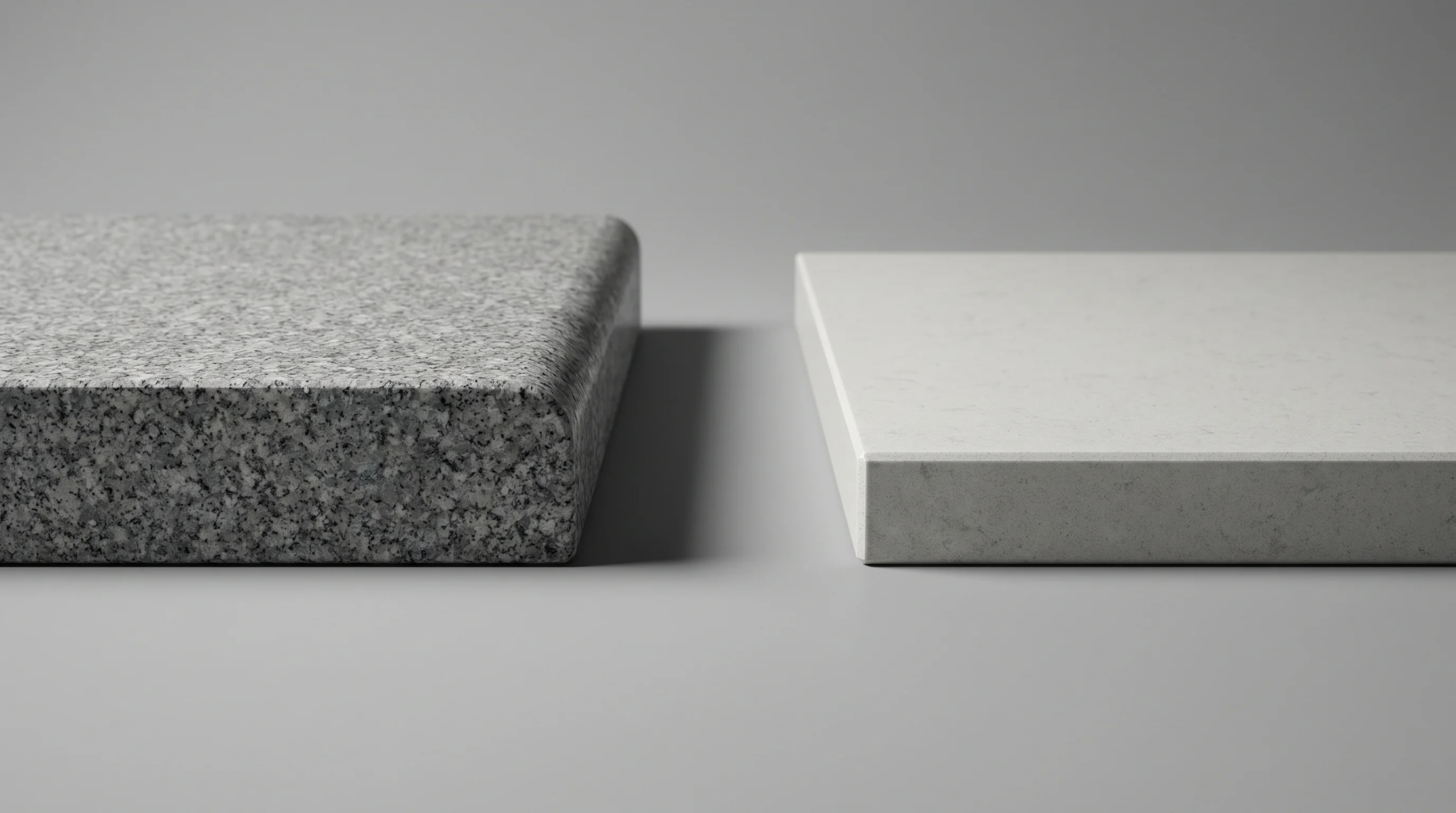
- The 10-Application Thickness Reference – 2cm vs. 3cm.
Ten commercial countertop applications with correct thickness specification, reason structurally for this specification, and for the two of those where the 2cm is red underlined- why 2cm is a structurally wrong application thickness specification.
Only for the bathroom vanity at full cabinet support with no overhang is 2cm structurally correct for this table application. In every other application,commercial kitchen, bar tops, reception desks, freestanding islands,BTR kitchen counters with self-supporting spans, the specification is for 3cm. The predominance of 3cm requirements in commercial applications reflects the reality that most commercial countertop designs include one or more elements- unsupported span, overhang, or a condition of high usage load- which outstrips the load capacity of a 2cm stone.
| Commercial Application | Correct Thickness | Reason and Structural Basis |
| Commercial kitchen counter — self-supporting span | 3cm mandatory | Unsupported spans at hob, sink, and preparation areas. Heavy impact loading from cookware. 3cm distributes impact stress before fracture threshold. NSI specifies 3cm for unsupported spans over 18 inches. |
| Restaurant kitchen — prep counter with overhang | 3cm mandatory | Overhanging sections above 6 inches must be 3cm regardless of cabinet support below the non-overhanging section. Overhang without 3cm will fracture under repeated loading. |
| Restaurant bar top — public side | 3cm mandatory | Heavy glassware impact, commercial equipment loading, and public use mean 3cm is required across the full bar span including the service and customer-facing sections. |
| Hotel reception and lobby desk | 3cm mandatory | Impact from luggage, commercial equipment, and heavy use. Any unsupported section of the desk surface requires 3cm. Full-cabinet support with no overhang: 2cm acceptable. |
| Bathroom vanity — full cabinet support, no overhang | 2cm acceptable | Cabinet provides continuous support. Stone spans no unsupported gap. No overhang loading. 2cm performs correctly in this configuration. |
| Bathroom vanity — with overhang or cantilever | 3cm required | Any overhang over the cabinet front, drawer support, or open sink area requires 3cm. 2cm with overhang will fracture at the cantilever point under normal bathroom use. |
| BTR apartment kitchen — self-supporting spans | 3cm mandatory | Same as commercial kitchen. Tenant use creates the same impact loading as commercial kitchens. Under-specifying to 2cm in BTR is a warranty failure waiting for a tenant. |
| Feature counter or island — freestanding | 3cm mandatory | No perimeter cabinet support. The stone spans its full width in free air. 3cm is the minimum for any freestanding countertop application. |
| Wall cladding — vertical installation | 2cm, 1.5cm, or 10mm (porcelain) | Vertical installation removes horizontal loading. Stone is supported by adhesive or mechanical fixings across its full area. Thickness is a weight and handling decision, not a structural span decision. |
| Outdoor counter or BBQ surround | 3cm mandatory | Thermal movement, impact from outdoor use, and freeze-thaw cycling in cold climates all require the structural mass of 3cm to resist fracture over seasonal cycles. |
| Quick answer:
The bathroom vanity row is the only entry in this table with 2cm acceptable. The requirements are: fully supported below all the way across the span and cantilever over no open sections and no cantilever. When the vanity has an integrally molded sink, and there is no cabinet directly underneath the span of the stone around the cut out of the sink it is a span across that opening without any cabinet support underneath it. For standard undermount sink vanities ensure that there is cabinet support under the entirety of the perimeter of the sink when ordering 2cm. |
The BTR developer, who thought that ordering 2 cm granite for the kitchen counters would save approximately $4 per square foot, learned of the structural error upon completion of the first installation and the fact that the 14 inches overhang of the breakfast bar over the island cabinet base had not been supported by a substrate beneath the overhang section. The available choices at the time were to install a concealed support under the overhang section at additional cost, re-work the overhang to avoid the cantilevered span and eliminate the cantilevered span, or increase the stone to 3 cm at the full material cost plus fabrication overage. In each case the choice increased the initial $4 per square foot saving. A two-minute conversation about the stone thickness occurs at the time the quote is requested.
- How Unsupported Spans and Overhangs Determine Thickness
The single variable which dictates whether 2cm or 3cm stone should be used for a given counter configuration is the existence of an unsupported span or overhang.
- Unsupported span: Any section of the stone countertop crossing a void between cabinets, a void beneath a breakfast bar, the span of kitchen countertop bridging a gap between a sink cabinet and a hob cabinet. The stone spanning the void carries its own dead load, and any load imposed on the stone over the span exacerbates the stress at the supporting edges of the span.
- Overhang: Any section of stone countertop projecting beyond the edges of a supporting substrate or cabinet below it. An overhang exists if there is a 3-inch portion projecting beyond the edge for seating at a kitchen countertop, or a 6-inch portion extending beyond the edge of a restaurant bar serving counter, or a 14-inch cantilever for a breakfast bar. The portion of stone beyond the edge of the substrate is unsupported; its cross-sectional strength resisting gravity force is all that is keeping it from sagging, bending, or fracturing downward.
The NSI Unsupported Span Rule
According to NSI installation guidelines, spans of unsupported natural stone countertops over 18 inches require 3cm stone thickness. For unsupported spans 12 to 18 inches, a steel or stone support beam under the stone is necessary if 2cm stone is specified. A 2cm stone may span an unsupported section under 12 inches, such as in standard residential kitchens with tightly spaced cabinets, as long as it is adequately supported by continuous cabinets below it. In commercial settings with varying cabinet spacing, a conservative specification is 3cm stone across the entire countertop regardless of span length.
The NSI Overhang Rule
NSI installation guidelines dictate that stone overhangs beyond 6 inches must be 3cm stone thickness, regardless of the substrate below the remaining part of the countertop. 2cm stone with a 6- to 12-inch overhang necessitates additional structural support underneath (e.g., corbel, bracket, or flush mount support panel) in order to provide a load-bearing surface. Overhangs greater than 12 inches (cantilevers) must be specified with 3cm stone, and requires structural engineering approval for anything over 24 inches. For any countertop in commercial settings, 3cm stone is the appropriate specification regardless of overhang length, effectively eliminating the issue of potential fractures at the overhanging edge from the specification stage.
| Quick Answer:
NSI rule on overhang thickness: Any countertop overhang beyond 6 inches requires either 3cm stone or a support beneath it. Any overhang over 12 inches needs 3cm stone, with an engineering assessment recommended if it’s an extremely long overhang. For any commercial countertop, always specify 3cm stone with overhangs regardless of dimension-this rules out every single possibility for fracture at an overhang edge when writing specifications. |
When a contractor orders 2cm stone for a commercial kitchen, expecting it will work with a 9-inch overhang at the breakfast bar, and the fabricator correctly flags it, he is doing the contractor a favor by catching it now. If the fabricator instals 2cm, and it fractures, they are leaving the client with the bill and a warranty claim. By calling for 3cm stone, the contractor ensures the contractor doesn’t need to call anyone later with questions about the stability and safety of their countertop.
| Looking for commercial project countertop ordering advice?
Tell us your project details – configuration, overhang size, and the support method used for the supported sections, and we will ensure you are correctly advised on the proper stone thickness, and provide a solid wholesale quotation. Call: 704-951-7822 or visit packuniversesupply.com/request-a-quote |
- The Cost Difference and Why It is Not a Specification Justification
Although 3cm stone costs approximately 30-40% more at wholesale prices than 2cm stone, that material price increase does not provide sufficient reason to spec 2cm when 3cm would be more appropriate for structural integrity.
For a typical 30 sqft commercial kitchen counter at wholesale prices, the material cost difference between 2cm and 3cm granite comes in between $90 and $150. This is often where the numbers get analyzed, with project managers searching for ways to lower overall material cost. This savings at the point of material specification is consistently what leads to the most expensive post-installation warranty conversations.
The replacement cost of a fractured 2cm commercial kitchen counter must include: removal and disposal of the damaged countertop, purchase of new 3cm stone (the thickness that should have been specified), fabrication, and reinstallation. A fractured commercial kitchen countertop means downtime. The additional business interruption cost, combined with the aforementioned costs, generally brings total replacement cost for a 30 sqft countertop to $800-$2,000, or 5-13 times the original savings.
- 2cm vs 3cm material cost difference – 30 sqft kitchen counter: $90 to $150 at wholesale. Per sqft: $3 to $5.
- Replacement cost after 2cm fracture – same counter: $800 to $2,000 including removal, new 3cm material, fabrication, reinstallation, and business interruption.
- Cost difference ratio: Replacement cost is 5 to 22 times the original thickness specification saving.
- The correct specification conversation: 3cm for commercial self-supporting applications. The material premium over 2cm should be weighed against the cost of fracture and replacement, which is usually significantly higher even within the first year of commercial use.
| Real Risk – Real Consequence:
The risk: You choose to specify 2cm stone for a commercial kitchen countertop or bar top in order to minimize material cost, but fail to ensure continuous substrate support under every portion of the counter and that there are no unsupported spans or overhangs. The consequence: The 2cm countertop breaks at the point of unsupported span or overhang under normal commercial loading. Replacement is then required at 5-22 times the original savings from specifying 2cm rather than 3cm stone. Unless the contractor takes explicit responsibility, the warranty liability will likely lie with the contractor, who specified the thickness in the first place. |
A contractor who specifies 3cm for every commercial self-supporting stone counter will only need to have this one thickness conversation. He avoids the fracture conversation altogether. A contractor who spec’s 2cm to try and save $90-$150 per counter in material opens himself up to a warranty liability that could cost him $800-$2000, with a business interruption factor thrown on top. It isn’t a debate about whether the thickness is too expensive; it’s about determining whether the installation will come with a warranty or not.
| Quick Answer:
Cost comparison for any commercial self-supporting countertop: 2cm material saving of $90-$150 per standard counter versus 3cm replacement cost of $800-$2,000 per fractured counter. The risk-adjusted cost of 2cm in a 3cm application exceeds the cost of 3cm within the first commercial use event that exceeds the 2cm fracture threshold. Specify 3cm. The conversation takes two minutes. The fracture takes two seconds. |
| This is how Pack Universe Supply handles commercial thickness specification:
At Pack Universe Supply, we stock commercial thickness granite, quartz and quartzite at our Charleston, SC warehouse-both in 2cm and 3cm. For all commercial stone orders, we will check the correct thickness for the intended application based on counter configuration, substrate, and overhang and will note if the specification is for a 2cm when it is actually structurally required to be 3cm before the order ships. For contractors who aren’t sure what thickness is needed for your application, simply explain the configuration of your counter and we will confirm before you place the order. Call us at +1 704-951-7822. Order Commercial Stone with Correct Thickness – 2cm or 3cm Confirmed Prior to Shipping Granite, quartz, quartzite – 2cm & 3cm, confirmed for intended application, nationwide delivery. Charleston SC (USA) | Burlington ON (Canada) -> packuniversesupply.com/request-a-quote | Call +1 704-951-7822 |
VERDICT-What Is the Correct Stone Thickness for Commercial Countertops?
VERDICT:
Use 3cm for any self-supporting commercial stone countertop-commercial kitchen counters, restaurant bars, hotel reception desks, freestanding islands, BTR kitchen counters that have unsupported spans, and any counter that has any length of overhang. There are no exceptions. Use 2cm only where the full span of the counter is completely supported by continuous solid substrate directly beneath the stone without overhangs. The most common commercial application is a bathroom vanity placed on a full cabinet unit. The price difference between 2cm and 3cm at wholesale costs between $3-5/sq ft and the replacement price for a fractured 2cm commercial counter ranges from $800-$2,000. Use the proper specifications rather than solely looking at cost.