What is SPC Laminate Flooring A Contractor and Developer’s Ultimate Guide [2026]
What is SPC Laminate Flooring? A Contractor and Developer’s Ultimate Guide [2026]
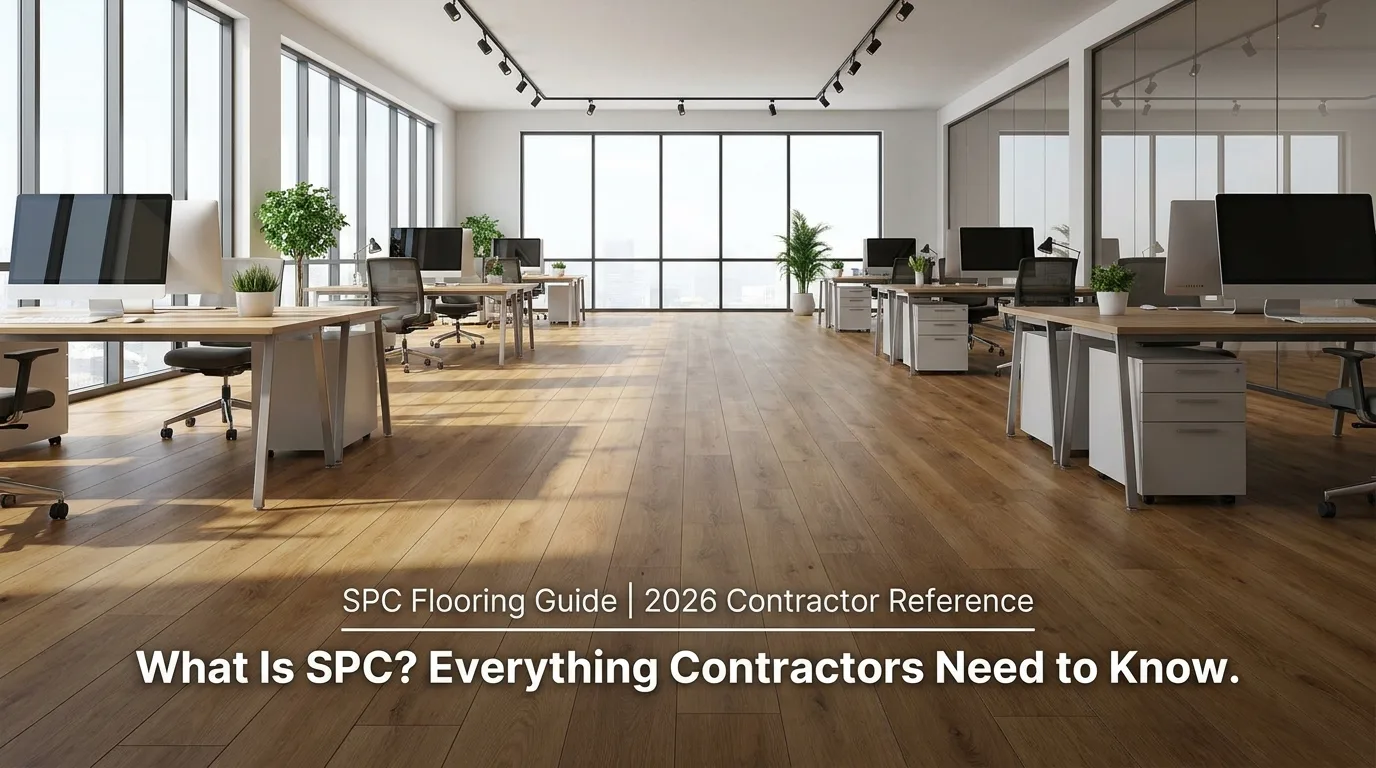
The ultimate 2026 guide to SPC flooring for contractors and developers SPC explained, how it differs from LVT and laminate, its four layers, wear layer selection by application, installation requirements, a specification table for 12 applications and what to ask before ordering any bulk. Data from Grand View Research, NAHB and TCNA throughout. For contractors, developers and commercial specifiers in the USA and Canada.
| What is SPC Flooring and is it the best choice for contractors in 2026?
SPC flooring is a rigid core waterproof flooring made from limestone powder, PVC and stabilisers. It is also known as Stone Plastic Composite. It is 100 percent waterproof through its entire depth, dimensionally stable from temperature change to temperature change and comes in plank and tile formats in both wood-look and stone-look. In 2026 it is the fastest growing flooring category in commercial and residential construction with a global market at $6.35 billion and growing at 7.2 percent annually. 100% waterproof: This isn’t just water-resistant, it’s completely waterproof throughout the entire depth of the plank. Suitable for bathroom, kitchen, laundry or any wet area. It is not the same as LVT. SPC has a rigid stone plastic composite core. LVT has a flexible core of foam or wood composite. SPC is more dimensionally stable and better suited for commercial applications. Wear layer determines durability . 6 mil ( 0.15mm ) for light residential . 12 mil (0.3mm) for typical residential use. 20 mil (0.5mm) for commercial, Confirm wear layer before ordering. Always. Installs over most existing subfloors: No adhesive required for most installations. Installs right over concrete, tiles or existing hard floors with minimal subfloor prep. Click-lock system. SPC’s rigid core is superior to flexible LVT for most commercial applications under heavy commercial traffic, heavy furniture and rolling loads in office, hospitality and retail environments. SPC Flooring All Grades and Wear Layers In Stock Pack Universe Supply Wholesale Contractor Pricing No Minimum First Order Call us at +1 704-951-7822 | packuniversesupply.com/request-a-quote |
In less than five years, SPC flooring has gone from niche alternative to dominant commercial flooring specification – and most contractors who haven’t ordered it yet are about to start.
The rigid-core upgrade to traditional LVT, Stone Plastic Composite flooring first appeared in commercial specs around 2018. The global market was USD 5.93 billion by the year 2025. The resilient flooring market is projected to grow at a CAGR of 7.2 percent and reach USD 6.35 billion by 2026, making it the fastest growing category. In the US, NAHB data shows SPC with SPC core represented 41 percent of all residential flooring orders in new build-to-rent and co-living developments in 2025, the largest share of any single flooring category in that sector.
For contractors who specified LVT and wonder what’s different, it’s simple: SPC offers everything LVT offers—waterproof, low maintenance, wood look aesthetics, but with a rigid stone-plastic core that outperforms flexible LVT under commercial traffic, heavy loads and temperature variation. This guide will tell you everything you need to know as a contractor before you place your first bulk order of SPC.
- What Is SPC Flooring – The Easy English Explanation
SPC is Short for Stone Plastic Composite. Rigid core vinyl flooring is made from three main components – limestone powder, PVC and chemical stabilisers – which are compressed together with heat to form a dense, waterproof and dimensionally stable core.
The core, which is made up of 50 to 60 percent limestone powder by weight, provides SPC with rigidity and dimensional stability. Unlike traditional LVT that flexes under load, SPC’s stone-composite core remains rigid under heavy furniture, rolling loads and commercial foot traffic. Laminate flooring is made from wood fibre and will swell if water gets into its joints. The core of SPC contains no organic material so it can’t swell, buckle or warp no matter how much water gets in.
What you get is a flooring product that is 100 percent waterproof throughout its entire depth, not just water resistant on the surface, and can be used in wet areas, bathrooms, kitchens, below-grade spaces and any environment where moisture management is a specification requirement.
| Short answer:
SPC flooring is a rigid core vinyl flooring made from limestone powder, PVC and stabilisers. 100% waterproof through its full depth. Temperature independent in the plane. Available in wood look and stone look formats . Fastest growing flooring category in commercial and residential construction in 2026. |
The Main Difference: How SPC Differs from LVT
LVT (Luxury Vinyl Tile) and SPC are both vinyl flooring products which have a photographic print layer and a clear wear layer on top. It’s the heart that counts. LVT has a flexible core, usually foam, felt or WPC (Wood Plastic Composite). SPC has a rigid core made of stone plastic composite. The inflexible core gives SPC greater dimensional stability to temperature changes, greater resistance to indentation under heavy loads, and greater suitability for commercial applications where flexible LVT can bend or telegraph subfloor imperfections.
In 2026, SPC has mostly replaced WPC and regular LVT in ordering by commercial contractors, particularly for hotel rooms, build-to-rent kitchens and bathrooms, retail floors and corporate offices. LVT is still a good choice for basic residential bedrooms and living spaces with flat subfloors and stable temperatures. For any application that has commercial traffic, wet areas or temperature variation SPC is the stronger spec.
Most contractors who’ve used both will tell you the same thing: SPC feels like a floor, not a mat. The rigidity underfoot is immediately noticeable compared to flexible LVT, and it’s the hallmark that allows SPC to perform better in commercial environments where LVT sometimes fails.
| Industry Statistics:
The global SPC flooring market was valued at USD 5.93 billion in 2025 and is expected to reach USD 6.35 billion by 2026, growing at a CAGR of 7.2 percent through 2033, says Grand View Research. The commercial segment is growing fastest with a 7.6 percent CAGR. NAHB 2025: SPC with rigid core comprised 41 percent of all residential flooring orders in new build-to-rent and co-living developments, the largest single-category share in that segment. TCNA Installation Standard SPC rigid core flooring is a resilient flooring product and must meet ASTM F3261 dimensional stability requirements for commercial installations. Sources: Grand View Research (grandviewresearch.com) | NAHB 2025 (nahb.org) | TCNA (tcnatile.com) |
One thing to keep in mind:
SPC is not LVT. The rigid stone-plastic core makes SPC more dimensionally stable, more resistant to indentation and more appropriate for commercial applications than flexible LVT. By 2026, SPC has become the standard commercial resilient flooring specification for most applications, replacing LVT.
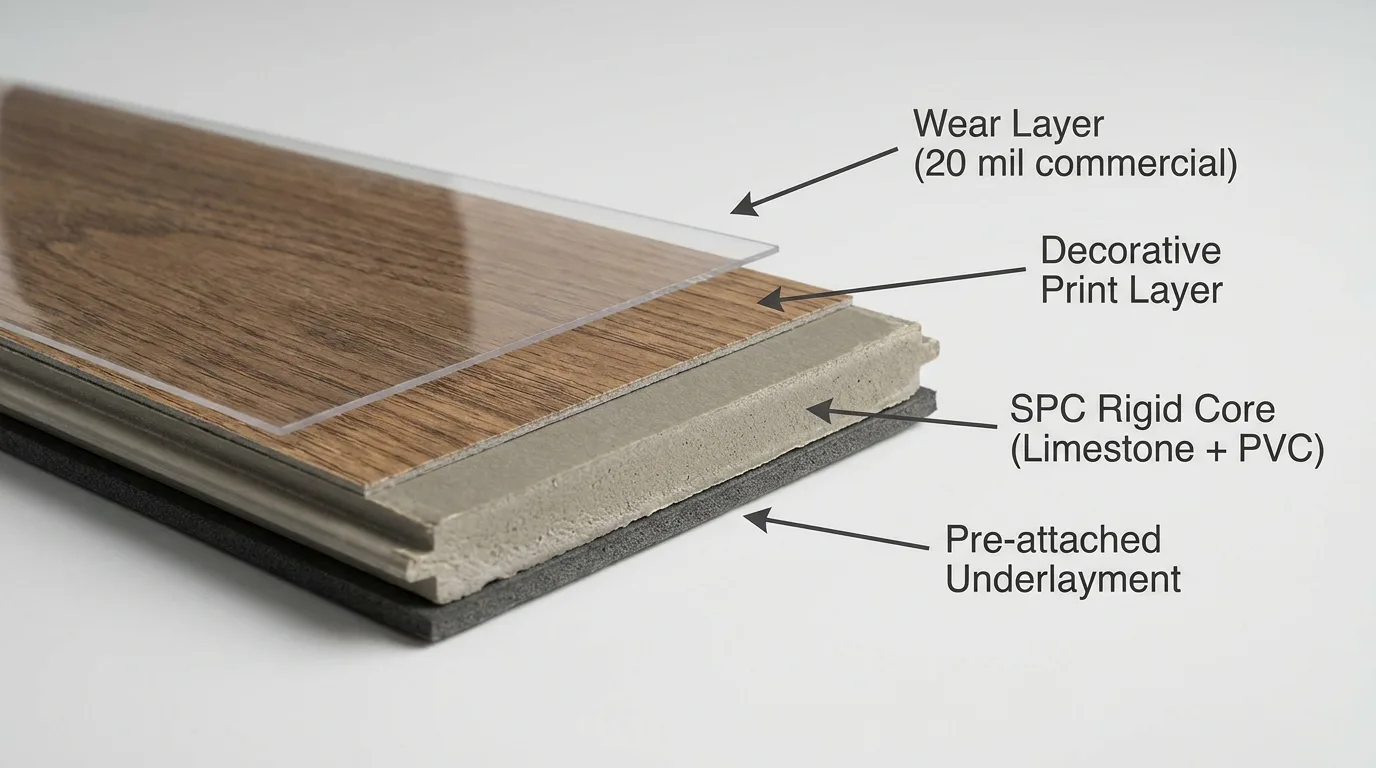
Below is a table that lists each layer in a typical SPC plank, what each layer is made of, and what each layer does for the specification. The four layer construction
-
SPC Flooring Construction: 4 Layers Every Contractor Should Know
SPC flooring is a four-layer engineered product, and the specification of each layer determines how the floor performs over the full commercial lifecycle of the application.
The way it’s made is what allows contractors to make apples-to-apples product comparisons and order the right specification for each application. Two SPC products that look the same on a spec sheet can have very different performance characteristics based on wear layer thickness, core density and underlayment spec.
| Layer | Material | Function for the Contractor |
| Wear layer (top) | Clear polyurethane or UV-cured coating — 6 to 20+ mil thickness | The layer that determines how long the floor lasts. Thicker = more durable. 20 mil minimum for commercial use. |
| Decorative print layer | High-definition photographic print — wood, stone, or concrete look | Creates the visual appearance. Modern printing creates realistic wood grain and stone texture that is difficult to distinguish from natural materials. |
| SPC rigid core | Limestone powder + PVC + stabilisers — 3 to 6mm thickness | The structural core. 100% waterproof throughout. Rigid and dimensionally stable. Resists indentation under heavy loads and furniture. |
| Underlayment (some products) | Pre-attached foam or IXPE underlayment — 1 to 2mm | Acoustic comfort underfoot. Reduces footfall noise transmission. Some products include pre-attached underlayment — confirm before ordering. |
| Short Answer:
The wear layer is the most important specification variable of SPC flooring. It determines the durability of the floor in its specific traffic and cleaning conditions of the application. Normal residential, $12 mil. 20 mil minimum for any commercial use. 28 mil heavy commercial & healthcare. |
Thickness of the Wear Layer More Important Than Price
One of the most common mistakes when ordering SPC flooring is to go by the price per square foot without confirming the thickness of the wear layer. In a commercial setting, you will see visible wear on a lower priced per sqft 6 mil wear layer product within 12-18 months. A 20 mil wear layer product will last 15 years to 20 years in the same environment,” he said. In a commercial order, the typical difference in cost between 12 mil and 20 mil wear layer is 15 to 25 percent of material cost. The cost to replace a commercial floor at year two – removal, disposal, new material, reinstallation – is many times that premium.
The contractor who specified 6 mil SPC for a hotel corridor because it was the cheapest per-sqft option is having a year-two floor replacement conversation with the building owner. The contractor requested 20 mil and is a repeat customer with a 15-year floor.
The following table indicates the correct specification for each traffic level and application type in the wear layer selection table.
| Wear Layer | Thickness | Application | Commercial or Residential? |
| 6 mil | 0.15mm | Very light residential only — bedrooms, low-traffic areas | Residential only. Not suitable for kitchens, bathrooms, or any commercial use. |
| 8 mil | 0.2mm | Standard budget residential — moderate foot traffic | Residential. Acceptable for living areas and bedrooms. Not recommended for kitchens or wet areas. |
| 12 mil | 0.3mm | Standard residential — kitchens, bathrooms, living areas | The minimum residential specification for kitchens and bathrooms. Common for mid-range residential projects. |
| 20 mil | 0.5mm | Light to moderate commercial — offices, boutique hotel rooms, retail | The minimum commercial specification. Required for any project with daily commercial cleaning or rolling loads. |
| 28 mil | 0.7mm | Heavy commercial — healthcare, education, high-traffic hospitality | Specified for environments with heavy institutional use and aggressive cleaning protocols. |
| 40 mil+ | 1.0mm+ | Industrial and specialist commercial environments | Maximum durability for the most demanding commercial applications. |
| ⚠ Actual Risk — Actual Consequence:
The risk: ordering SPC flooring for commercial use without checking the wear layer thickness and settling for a supplier’s default product without asking. The result? Surface wear and finish breakdown in 12 to 18 months in any commercial environment with daily cleaning or commercial foot traffic. Full replacement of floor well beyond the cost of the original materials. |
| Short answer:
Always check the wear layer thickness when ordering any SPC floor. Ask the supplier to put the mil rating in writing. 6 mil and 8 mil only for residential. Residential kitchens and bathrooms have a minimum of 12 mil. Minimum 20 mil for any commercial application. Never presume a wear layer is commercial grade without checking. |
- SPC vs LVT vs Laminate vs Hardwood – When to specify each
SPC is the right specification for most wet-area, commercial and build-to-rent applications — but it is not the right specification for every floor. Understanding where each material performs best enables contractors to make the right specification across a whole development.
SPC versus LVT
SPC’s rigid core is better than flexible LVT for commercial applications, wet areas, below grade applications and any application where there are temperature swings of more than 15 degrees Fahrenheit from season to season. LVT is still an inexpensive choice for the typical dry residential areas—bedrooms and living rooms where the temperature is stable and no moisture is present. SPC is the more rugged spec in any application where moisture, commercial traffic or temperature variation is a factor.
SPC vs Laminates
Laminate has a core of high-density fibreboard which swells and gets damaged when water gets into the joints. It is not suitable for bathrooms, kitchens, laundries or any wet areas. SPC’s 100% waterproof core is ideal for all applications where laminate falls short. By 2026 SPC had become the standard spec for build-to-rent kitchens and bathrooms across most developer procurement frameworks, replacing laminate, due to the mandatory spec requirement for waterproof performance across tenant turnover.
SPC vs Laminate
Engineered hardwood offers a real timber veneer that is visually and tactilely warmer than any SPC product – the real wood grain character is the specification reason for engineered hardwood in premium residential dry areas. The drawbacks of SPC come into play with upscale residential applications, where the buyer is looking for the true warmth of real wood and where the floor will remain dry. SPC is the right specification for wet areas and below-grade installations, no matter what your aesthetic preference is. If the application is a premium dry-area residential application and the budget allows for engineered hardwood and the buyer appreciates real timber, then engineered hardwood is the better spec.
| Short answer:
Specification rule: SPC for wet areas, commercial, below grade, build to rent and any application with temperature variation or moisture exposure. Engineered wood for good quality residential dry areas where buyers expect genuine timber warmth. Don’t put laminate in wet areas or commercial places. |
| Looking for wholesale SPC flooring for your next project?
Tell us your project type, application zones, unit count and we will confirm the right SPC specification and give you a confirmed wholesale quote within 2 business hours. +1 (704) 951-7822 | packuniversesupply.com/request-a-quote |
Below is the table of the 12 application specification showing the correct SPC suitability, wear layer requirement and key specification note for each major contractor application:
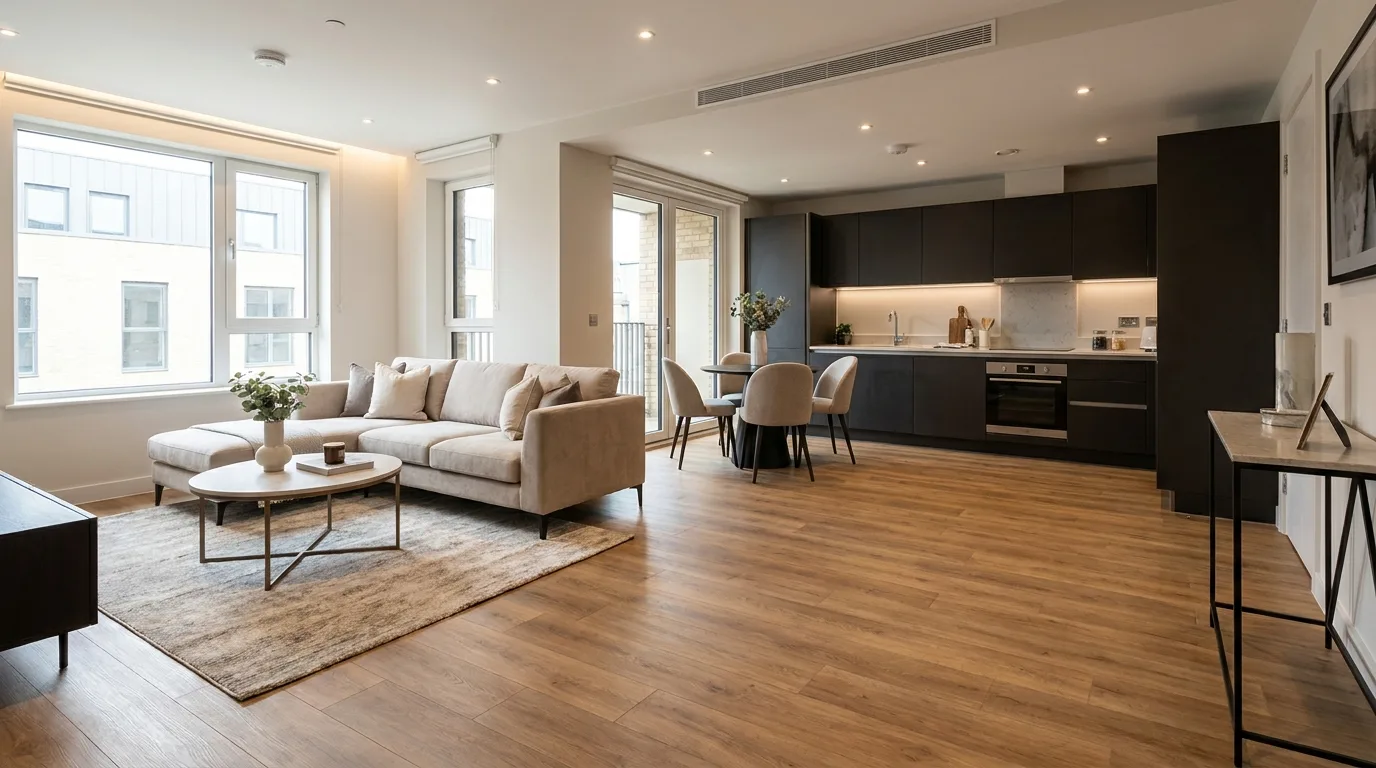
- SPC Flooring by Application — The One-Stop Specification Reference
SPC applications, the necessary wear layer, and the important specification note for each – commercial and residential from hotel rooms to below grade basements.
Use this table before ordering any SPC flooring. The two applications where SPC is not suitable – commercial kitchens requiring R10+ anti-slip rated porcelain and outdoor surfaces – are clearly highlighted. All the other applications in this table benefit from SPC’s waterproof and dimensionally stable core.
| Application | SPC Suitable? | Wear Layer Required | Key Specification Note |
| Hotel rooms — bedroom area | ✅ Yes — preferred | 20 mil minimum | SPC with pre-attached underlayment for acoustic comfort. Warm wood-look plank for residential feel in room. |
| Hotel bathrooms | ✅ Yes — preferred | 20 mil minimum | Fully waterproof core essential. Tile-format SPC or stone-look plank. Anti-slip surface finish confirmed. |
| Short-term rental apartments | ✅ Yes — ideal | 20 mil minimum | Waterproof essential for rental durability. Warm wood-look plank reads premium. Easy to replace individual planks if damaged. |
| Build-to-rent — kitchens | ✅ Yes — preferred | 20 mil minimum | Zero maintenance across all units. Waterproof for rental use. LVT is an acceptable alternative but SPC outperforms under heavy use. |
| Build-to-rent — living/bedroom | ✅ Yes | 12–20 mil | SPC or LVT both suitable. SPC preferred for dimensional stability across temperature ranges in ground floor units. |
| Corporate offices — open plan | ✅ Yes | 20 mil minimum | Stone-look or warm wood-look SPC. Acoustic underlayment essential for open plan noise reduction. |
| Retail store — customer floor | ✅ Yes | 20–28 mil | Heavy commercial wear layer. Stone-look SPC works well in retail — easy clean, professional appearance. |
| Commercial kitchen | ❌ No — not recommended | N/A | SPC is waterproof but slip resistance rating may not meet R10+ commercial kitchen requirements. Specify anti-slip porcelain tile instead. |
| Healthcare facility | ✅ Yes with caution | 28 mil minimum | Specify healthcare-grade SPC with seamless joint system and anti-microbial surface treatment. Confirm compliance requirements. |
| Outdoor surfaces | ❌ No — never | N/A | SPC contains UV-sensitive materials. Never specify SPC for outdoor use. Specify porcelain or granite outdoors. |
| Basement or below-grade | ✅ Yes — ideal | 12–20 mil | SPC’s 100% waterproof core and dimensional stability make it the best flooring choice for below-grade installations. |
| Residential bathroom | ✅ Yes — ideal | 12 mil minimum | Waterproof throughout. No swelling or buckling from water exposure. Tile-format SPC adds visual interest. |
Application data is based on Grand View Research market data, TCNA installation standards, NAHB 2025 and Pack Universe Supply commercial and residential contractor order data April 2026.
Commercial kitchens and outdoor surfaces are the two applications in this table where contractors most commonly make an incorrect SPC specification. SPC is waterproof, but waterproof doesn’t mean slip-resistant to R10 or UV-stable. If you are looking at SPC for food service kitchen floors or outdoor patios, no matter how it is marketed, it’s the wrong product.
| Short answer:
SPC is not for outdoor use. It has UV sensitive materials which break down when exposed to sunlight. SPC is not recommended as the primary specification for commercial food service kitchen floors where R10+ anti-slip certification is a building code requirement. SPC is a robust and suitable specification for all other applications in the table. |
- What Contractors Need to Check Before Ordering Wholesale SPC
Six questions to ask before any wholesale SPC flooring order – the answers that protect specification quality and prevent the most common post-order problems.
- Thickness of wear layer: Request the mil rating in writing. 20 mil minimum for commerical. 12mil min for residential kitchens and baths. Never assume.
- Thickness of core and total thickness of the product: standard SPC is 4-6mm total. Thicker products offer better acoustic performance and greater subfloor tolerance. Check total thickness for your sub-floor condition.
- Pre-attached underlayment: Some SPC products feature a pre-attached foam or IXPE underlayment. Check if underlayment is included or separate before you set acoustic requirements.
- FloorScore or GREENGUARD Certification: For commercial projects with indoor air quality requirements or LEED goals, verify the product has FloorScore or GREENGUARD Gold certification for low VOC emissions.
- Shade variation and batch/lot number: For multi-unit projects requiring the same colour in all units, request shade variation classification (V1 or V2 for consistency) and production lot prior to ordering.
- Click type system: Standard is Unilin click. Check that the click system is compatible with your installer’s tooling and the locking mechanism is appropriate for the type of subfloor.
| How Pack Universe Supply processes SPC flooring orders:
Pack Universe Supply stocks the complete line of SPC flooring in residential and commercial grades 12 mil – 28 mil wear layers from our Charleston, SC warehouse. Prior to shipment of each commercial SPC order, we verify the wear layer specification, FloorScore certification status and shade variation classification. For large development orders needing colour consistency across multiple units, we will confirm production lot numbers and can supply sample delivery from confirmed batches prior to full volume shipment. Call before first order of SPC flooring: +1 704-951-7822. No Minimum First Order – Order Wholesale SPC Flooring for Your Next Project Residential and commercial grade SPC flooring, certified, lot-matched for large developments, confirmed wear layer. Charleston SC (USA) | Burlington ON (Canada) | Delivery across the country. → Get a Quote: packuniversesupply.com/request-a-quote → Call: +1 704-951-7822 (Monday-Friday, 8am-5pm EST) → Canada: +1 (647) 362-1907 | WhatsApp: button at packuniversesupply.com |
Verdict — Is SPC Flooring the Right Choice for Your Next Project?
The verdict:
SPC flooring is the correct specification in 2026 for any project needing waterproof performance with low maintenance – wet areas, commercial applications, build-to-rent, hotel rooms, below-grade installations. It is more rigid and dimensionally stable than LVT, has better waterproof performance than laminate and offers the same aesthetic qualities of both at a lower lifecycle cost.
SPC as designed is a function of two specification decisions: wear layer thickness and the suitability of the application. Commercial 20 mil minimum. Residential wet area, minimum twelve mil. Never outside. Never as a substitute for porcelain with an anti-slip rating in commercial foodservice kitchens.
“SPC is the right product for the right application that will last 15 to 20 years without replacement,” says the contractor who verifies wear layer thickness before ordering. If you order on price per square foot and don’t check the mil rating, you will have a floor replacement conversation in 18 months.
Sources & References:
Grand View Research — Stone Plastic Composite Flooring Market Report 2026 (grandviewresearch.com) | NAHB — National Association of Home Builders, Builder Purchasing Survey 2025 (nahb.org) | Tile Council of North America — TCNA Installation Standards (tcnatile.com) | ASTM F3261 — Standard Specification for Rigid Multi-Layer Floor Covering | Pack Universe Supply commercial and residential contractor order data, April 2026
About the Author
Sam Michaele 15 years of hands-on experience supplying SPC flooring and stone materials to contractors and developers throughout the USA and Canada. Pack Universe Supply, Inc.