Marble vs Quartz for Bathroom Vanity Tops — Which Should Contractors Specify? [2026 Guide]
Marble vs Quartz for Bathroom Vanity Tops — Which Should Contractors Specify? [2026 Guide]
Marble vs Quartz for Bathroom Vanity Tops – Complete 2026 Contractor Guide – Acid Etching Risk, Sealing Needs, 10-Year Maintenance Cost Comparison, Scratch & Stain Resistance, Full 11-Factor Comparison Table & 12-Application Specification Reference. Data from NSI, NKBA, MIA+BSI throughout. For U.S. and Canadian contractors, developers and commercial specifiers.
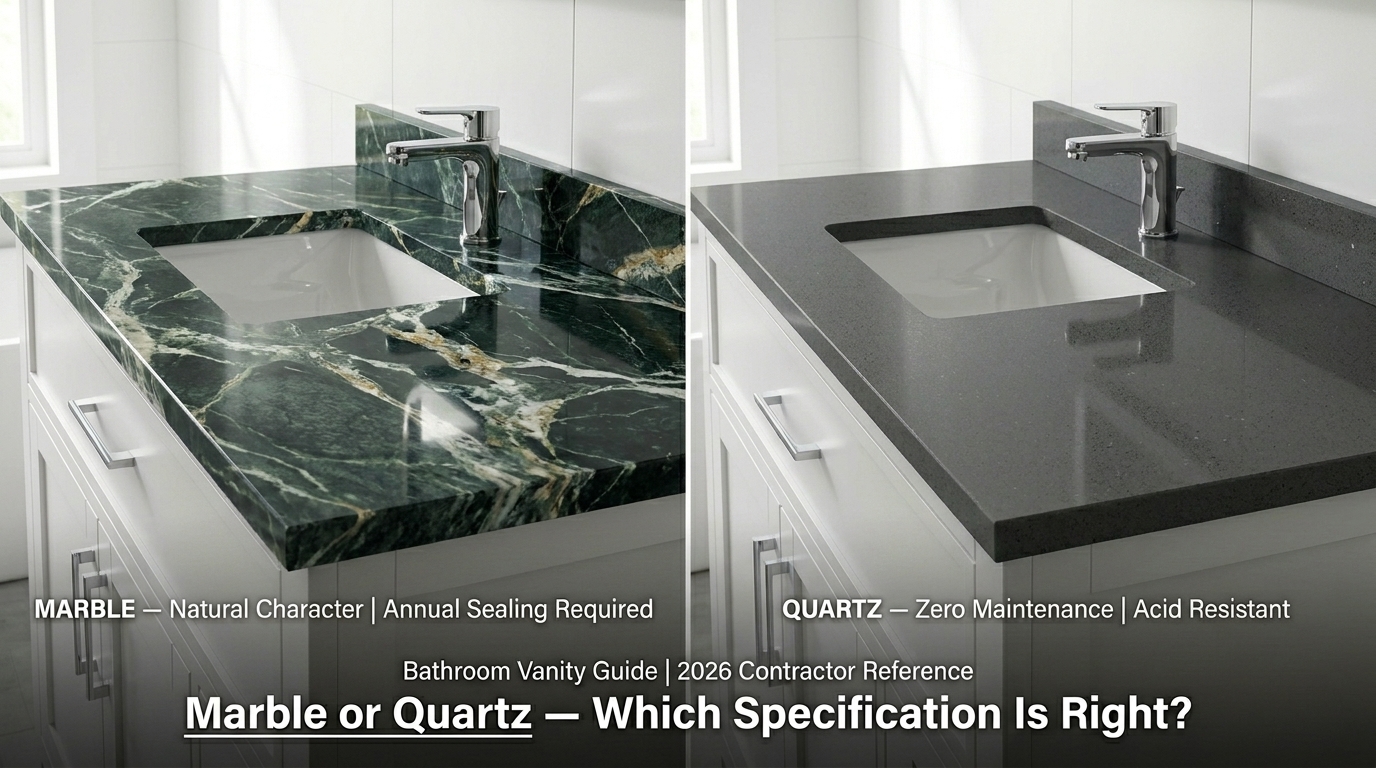
| The short answer by project type is:
Quartz. Hotel bathrooms – any tier: No sealant program. The same color in each room. Resistant to commercial house-keeping chemicals. Build to rent and serviced apartments: Quartz. No maintenance for tenants and building management. Standardized in all units. Premium residential bathroom – contemporary brief: Quartz or marble to design intent. Quartz for consistency. Marble to give a natural stone look. Luxury residential bathroom – marble specific brief: Marble: polished or honed. The client must be aware of the risk of acid etching and the need for an annual sealant. Spa and wellness residential: Marble Honed. The defining aesthetic is the matte natural character. Maintenance briefing required. Pack Universe Supply carries all grades of marble and quartz bathroom vanity tops. Contractor wholesale rates. No minimum 1st order. Request a Quote Call +1 704-951-7822 | packuniversesupply.com |
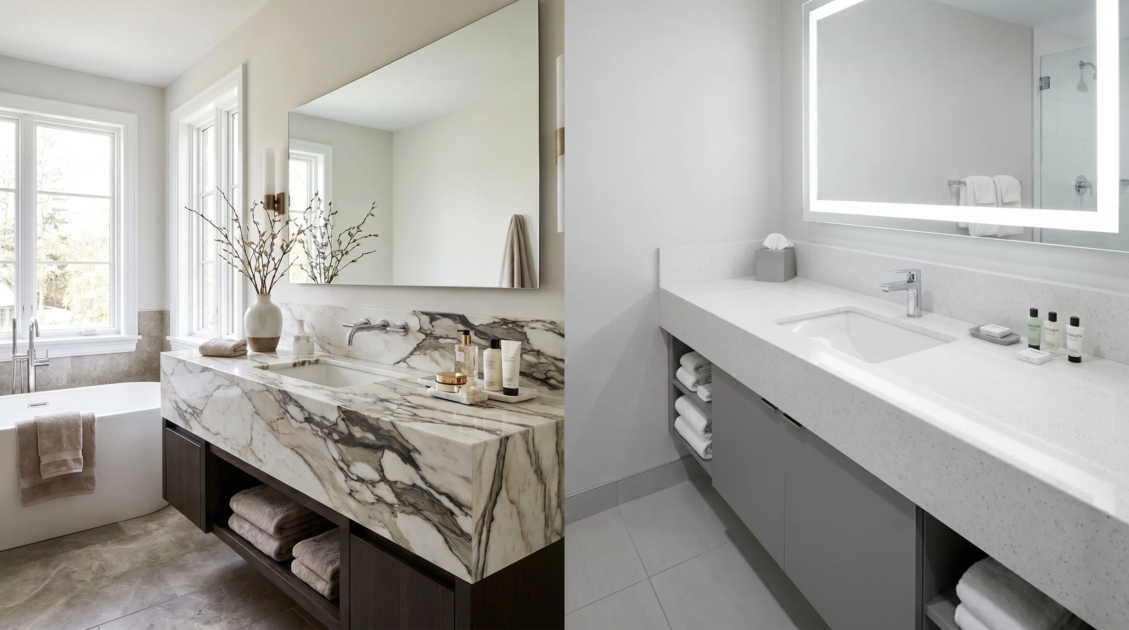
Marble bathroom vanity tops are specified for their beauty and against their maintenance. Quartz vanity tops are specified for their function and specified against for their uniformity. It is not about quality, it is about fitting the material to the client, the type of project, and the maintenance reality.
Both materials are regularly available at wholesale prices, regularly specified by contractors across residential and commercial bathroom projects, and regularly misspecified — marble in applications that will etch and stain within months, quartz in applications where the client wanted natural stone character, and accepted a compromise they didn’t fully understand. This guide clears up that ambiguity. It takes into account all performance factors, all applications and all maintenance implications – so the right specification is done the first time.
Data throughout from NSI commercial maintenance guidelines, NKBA 2025 specification research and MIA+BSI fabrication standards.
- The Core Difference — Why Bathroom Vanity Tops Are a Tough Specification
Bathrooms are the most chemically aggressive surface environment in any building, and the performance difference between marble and quartz is most visible in that very environment.
Bathroom vanity tops are exposed daily to acidic personal care products such as toothpaste, mouthwash, facial cleansers, toners and exfoliants. Once a week, they are also exposed to acidic cleaning products such as limescale removers, bathroom sprays and disinfectants. Marble is a mineral made of calcium carbonate, and it reacts chemically with acid. Acid etching is a chemical reaction that occurs when any acidic product comes into contact with an unsealed or poorly sealed marble surface, damaging the polished finish of the stone and leaving permanently dull marks that cannot be cleaned away. They need to be professionally re-polished to remove them.
Quartz is an engineered surface made up of about 93 percent ground quartz mineral and 7 percent polymer resin. It is non-porous, acid resistant and does not react chemically to any standard bathroom product. A quartz vanity top cleaned daily with commercial bathroom spray, descaling products and disinfectant will look the same at year ten as it did at year one – if it is not exposed to extreme heat or impact. This is the basic performance difference which drives specification decisions in bathroom applications.
| Quick answer:
Marble is a calcium carbonate stone that chemically reacts with acid and leaves permanent dull marks called acid etching on the polished surface. Acidic: Most bathroom cleaners, limescale removers, facial cleansers, mouthwash and toothpaste. Quartz is non porous and acid resistant, so no bathroom product will chemically etch or otherwise damage the surface. |
| Industry Data:
NKBA 2025: Quartz accounted for 61% of all bathroom vanity top specs in new residential construction in the US, up from 48% in 2020. The main reason given by contractors was zero maintenance and acid resistance in bathroom areas. NSI commercial maintenance guidelines: Marble bathroom vanity tops in residential applications must be professionally sealed annually. In commercial hotel environments, 6 monthly sealing is recommended. Acid etching from personal care products is the most common maintenance problem reported for marble bathroom surfaces. MIA+BSI 2025: Acid etching on marble bathroom vanity tops is the most common surface damage complaint in residential stone installations and accounts for 44 percent of all marble residential maintenance calls in the USA. Sources: NKBA 2025 (nkba.org) | NSI (naturalstoneinstitute.org) | MIA+BSI (marble-institute.com) |
| The one thing to bear in mind:
The bathroom is the most chemically aggressive surface environment in any building. Quartz’s zero-maintenance profile and acid resistance make it the practical specification for most bathroom countertops. Marble is only correct where the character of the natural stone is specifically required and the client is well informed about the risk of acid etching and annual sealing. |
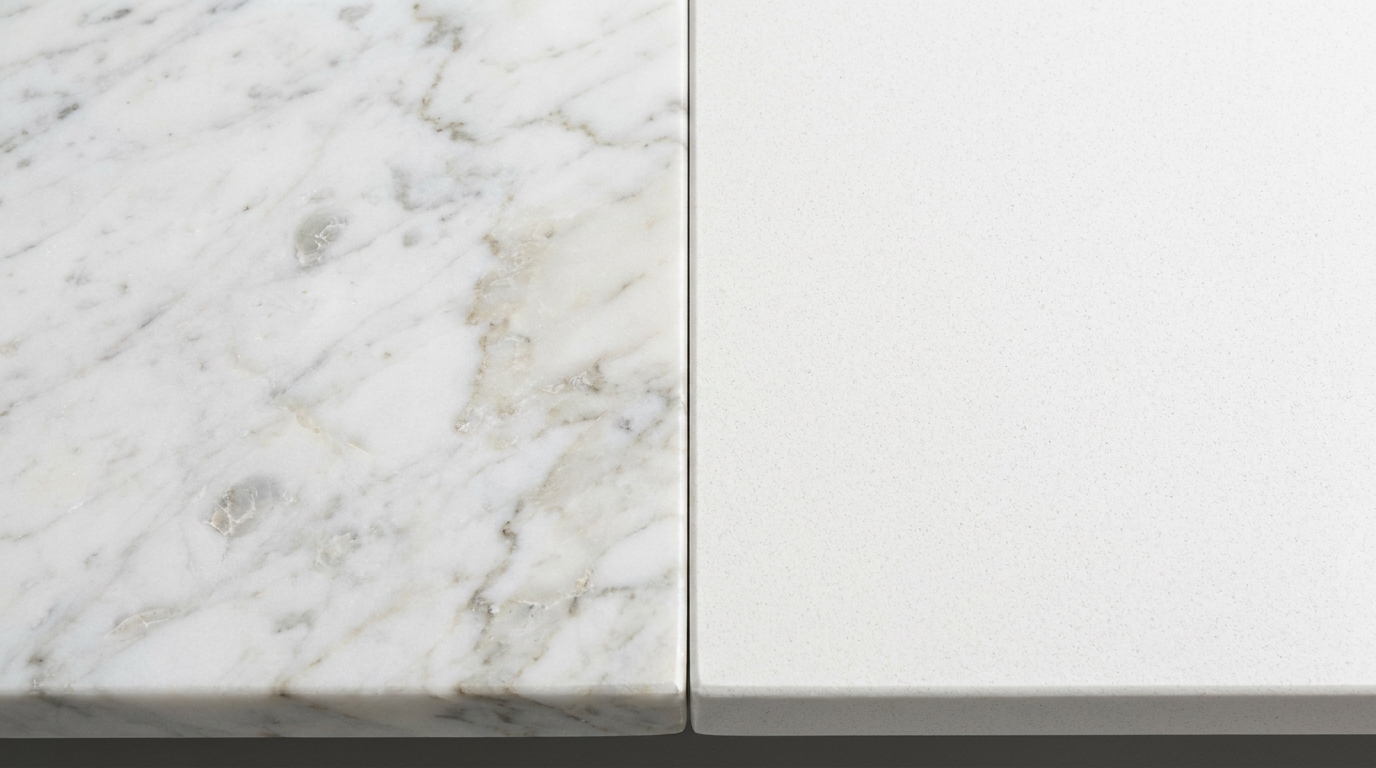
- Marble vs Quartz – 11 Factor Detailed Comparison
Each performance and specification comparison – acid etching, sealing frequency, 10 year maintenance cost, and the applications each material is best suited for.
The 10-year maintenance cost row is the most critical for commercial and multi-unit residential specs. Professional sealing of marble vanity tops annually adds $1,000 to $2,000 per vanity top over ten years in addition to installation cost. Quartz is not useful. In a 120-room hotel that difference is great enough to determine material selection by itself.
| Factor | Marble Vanity Top | Quartz Vanity Top |
| Porosity and waterproofing | Porous natural stone — absorbs liquids if sealer is not current. High moisture bathroom environment accelerates sealer wear. | Non-porous engineered surface — waterproof throughout. No sealer required. Bathroom moisture has no effect on surface integrity. |
| Acid etching risk | High — marble reacts chemically with acidic bathroom products: toothpaste, mouthwash, facial cleansers, perfumes, and most commercial bathroom cleaners. Etching shows as dull marks where the surface finish is chemically damaged. | None — quartz is acid-resistant. Commercial bathroom cleaners, toothpaste, and personal care products cause no surface reaction or etching. |
| Sealing requirement | Annual sealing minimum for residential bathrooms. Every 6 months for hotel or commercial bathrooms. Professional stone sealer required. Non-negotiable. | No sealing required. Ever. Zero sealing programme across the surface’s full residential or commercial lifecycle. |
| Stain resistance | Moderate when sealed. Vulnerable when sealer lapses. Cosmetics, dyes, and organic stains can penetrate unsealed marble permanently. | Excellent. Non-porous surface resists all common bathroom staining agents including cosmetics, dyes, and personal care products. |
| Scratch resistance | Moderate — marble rates 3–4 on the Mohs hardness scale. Susceptible to surface scratches from hard objects, razor blades, and abrasive cleaners. | Good — quartz rates 7 on the Mohs scale. Significantly harder than marble. Resistant to surface scratching under normal bathroom use. |
| Visual character | Unique — every marble slab is different. Natural veining, colour variation, and mineral character cannot be replicated. Each vanity top is one of a kind. | Consistent — engineered uniformity means every vanity top in a multi-unit project looks identical. Ideal for brand-standard hotel and BTR specifications. |
| Colour consistency (multi-unit) | Challenging — natural variation between slabs requires lot confirmation and careful slab selection for colour-matched multi-room projects. | Excellent — engineered colour consistency across all slabs in a production run. Lot confirmation still recommended for large multi-unit projects. |
| Thermal shock resistance | Good but not immune — sudden extreme temperature changes can cause thermal stress in marble, particularly at thin edges. | Very good — quartz handles standard bathroom temperature variation without thermal stress under normal residential and commercial use. |
| 10-year maintenance cost | Annual sealing: approximately $100–$200 per vanity professionally applied. 10-year cost: $1,000–$2,000 per vanity top above installation. | Zero maintenance cost beyond routine cleaning. 10-year additional cost: $0. |
| Fabrication cost | Moderate to high — marble requires careful cutting and finishing. Honed finish adds cost. Polished marble: standard fabrication cost. | Standard — engineered quartz fabricates similarly to granite. Consistent cutting properties across grades. Predictable fabrication cost. |
| Best for | Luxury residential where natural stone character is the brief. Spa and wellness. Boutique hospitality. Projects with informed clients and maintenance programmes. | Hotels, build-to-rent, serviced apartments, mid-range residential, any application where zero maintenance is a specification requirement. |
Comparison data based on NSI commercial maintenance guidelines, NKBA 2025, MIA+BSI fabrication standards 2025 and Pack Universe Supply contractor specification data April 2026.
| Short answer:
Ten-year maintenance cost comparison: Professional sealing of marble bathroom vanity top costs $1,000 to $2,000 more per surface than other vanity tops. Zero adds Quartz. For a 120-room hotel renovation with one vanity per bathroom, the 10-year maintenance premium of marble over quartz is $120,000 to $240,000 in sealing costs alone—before any etching repair or re-polishing events. |
The client who chooses marble for their master ensuite bathroom, only to discover what acid etching looks like at month three, is not mad at the stone. They are mad about the conversation that did not happen before the order was placed. It is professional standard to show the risk of acid etching and the annual requirement for sealing before a decision is made. That is not a deterrent.
- Acid Etching: The Marble Bathroom Risk Every Contractor Should Explain
Acid etching is not a manufacturing defect, and it is not a cleaning issue. It is a chemical reaction between the calcium carbonate found in marble and the acidic products that are in the daily use of every bathroom.
When an acidic product touches marble, even for a moment, even when it is wiped away, a chemical reaction dissolves the top layer of the stone’s crystalline structure. It looks like a flat spot on a shiny marble surface where the high-gloss coating has been chemically lifted. That dull spot can’t be cleaned out. When it appears it cannot be shut away.” The surface needs a professional re-polishing to bring it back to life. This is a mechanical abrasion of the affected area and re-sealing. This usually costs $200 to $500 per event depending on the severity.
In a typical bathroom, the acidic products that etch are toothpaste (pH 6-8, borderline but etch polished marble), mouthwash (pH 4-6, etch readily), facial cleansers and toners (pH 3-6, etch readily), perfume and cologne (acidic alcohol content, etch), most commercial limescale removers (highly acidic, etch aggressively) and many multi-surface bathroom cleaning sprays. A marble surface that is unprotected will be etched in the first month of normal use by a bathroom user who is unaware of the risk of acid etching.
What Contractors Should Tell Clients Before Specifying Marble Bathrooms
In simple terms, acid etching is: ‘If you leave toothpaste, mouthwash and most bathroom cleaners on marble, they will dull the finish. Always wipe up at once. Never use acidic cleaning products.’
Confirm the sealing regime: Marble should be professionally sealed on an annual basis at a minimum. We suggest that the hand-over pack should include a 3-year sealing programme.’
Provide the maintenance guide in writing: A written care guide at handover is the professional standard and the contractor’s documentation that the client was informed.
Show a sample of etched marble: If available, showing a client what acid etching looks like on a sample piece is more effective than any written description.
Confirm client acceptance: If the client proceeds after this briefing, then their specification decision is fully informed. If they switch to quartz after the briefing, the talk saved a post-installation argument.
| ⚠ Real Risk – Real Consequences:
The risk: specifying marble for a bathroom vanity top in a hotel, BTR development, serviced apartment or any application where there is no end user maintenance briefing. The result: acid etching appears within months of normal bathroom use. The building owner informs the contractor that surface deterioration exists. The contractor explains acid etching to a client who has never heard of it. This conversation is so much harder after the installation than it was before. |
| Short answer:Acid etching on marble can’t be cleaned or sealed, and must be repolished by a professional, which costs between $200 and $500 per occurrence. The only prevention is: keep sealing on schedule, wipe acidic products immediately and don’t use acidic cleaning products on marble.” All three of these requirements must be written to the client prior to installation. |
- When to Use Marble as a Specification — and How to Protect It
Where the natural stone character it offers cannot be replicated by any engineered alternative, and where the client is both aware and committed to the maintenance it requires, marble is the correct specification.
The visual case for marble in a bathroom is compelling. Natural marble veining, especially in premium grades such as Calacatta, Statuario or Arabescato, produces a surface that no quartz product can duplicate. It’s the flow of the veining, the depth of the crystal structure, the tactile warmth of natural stone that makes marble the aspirational specification for luxury residential bathrooms and high-end boutique hospitality. For clients who want them and can maintain them, marble gives a bathroom vanity top that only gets more beautiful with age with proper care.
NKBA 2025 demonstrated that marble bathroom vanity specifications in the US for luxury residential projects with a sale value over USD 800,000 remained steady at 38 percent of specifications despite the growth of quartz. This is because the natural stone character is a buyer expectation in the luxury residential tier that quartz has not been able to displace. The issue is not whether marble is suitable, but whether the specific client and project environment can support the maintenance it requires.
How to Protect Your Marble Bathroom Vanity Top
Specify polished finish for better acid resistance: Polished marble has a slightly more closed surface than honed, thus resisting acid penetration slightly better between sealing cycles.
Use a penetrating sealer that is rated for wet area stone: Not all sealers are made equal for bathroom conditions. Use a good penetrating impregnator that is rated for continuous moisture exposure.
Seal before installation and re-seal annually. Sealers should be applied before the vanity top is installed, including the underside and all cut edges, and should be re-sealed on a confirmed annual schedule.
List of acidic products at handover: The best maintenance tool that is available is a simple list of bathroom products that should not be used on marble, as part of the handover pack.
Specify honed finish where etching is more important to hide than prevent: Honed marble shows acid etching less obviously than polished marble because the matte surface disperses the difference in light between etched and unetched areas. The etching is still going on, just less immediately visible.
The marble bathroom, when kept in good condition – sealed every year, wiped immediately after contact with acid, cleaned with pH neutral products – is still beautiful at year twenty. By year two the marble bathroom that is unbriefed, unsealed, and cleaned with whatever is under the kitchen sink looks like it has been chemically attacked. The only difference is in the pre-installation conversation.
| Short answer:
Marble is perfect for luxury residential bathrooms where the natural stone quality is specifically required and the client will take proper care of it. Not suitable for hotel bathrooms, BTR developments, serviced apartments or for any application where consistent end user maintenance cannot be guaranteed. Quartz gives the same visual quality at zero maintenance cost for these applications. |
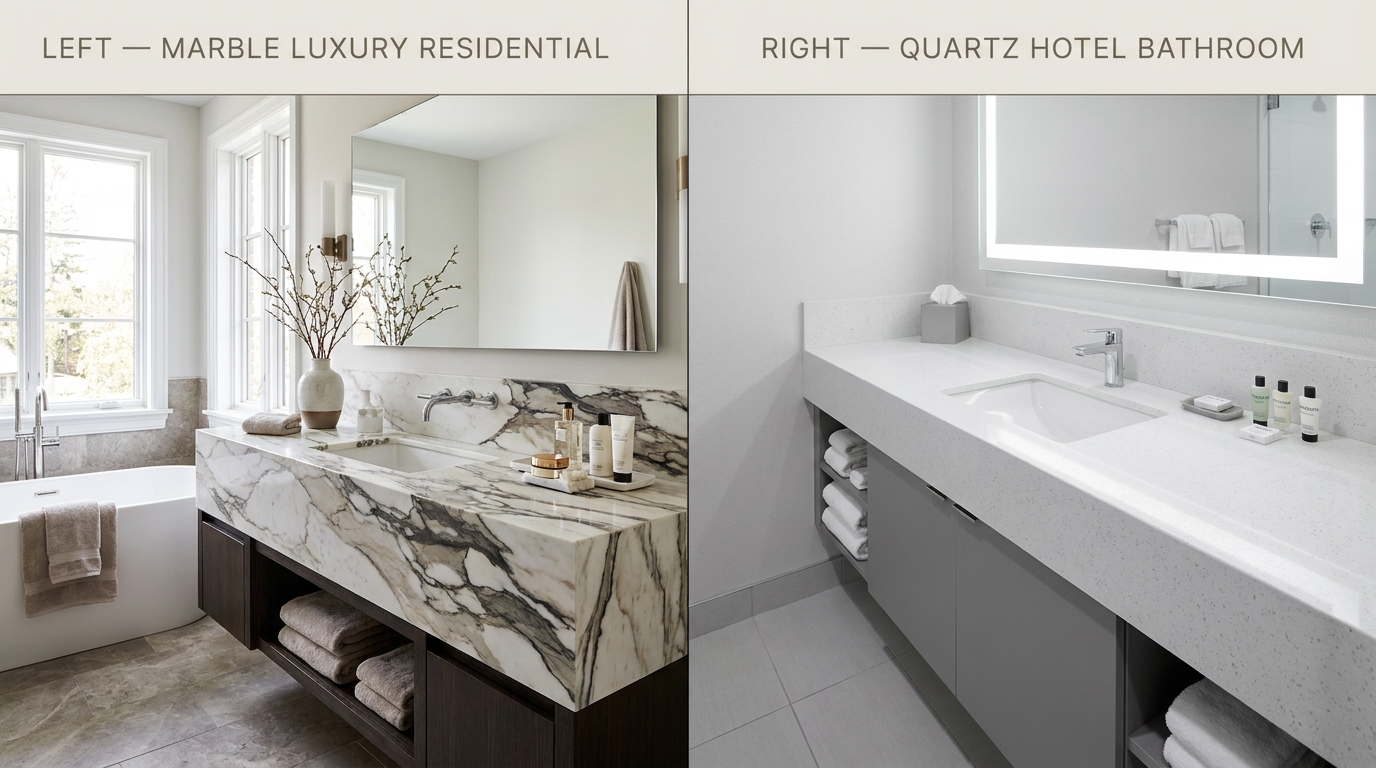
- Marble vs Quartz by Application – The Complete Specification Reference
The right material, and why, for all the key bathroom vanity top applications – commercial, hospitality, residential and specialist.
The two applications where the only requirement for quartz is that it is the right product – gym changing rooms and healthcare bathrooms – are clearly highlighted. Marble is damaged by cleaning chemicals that would be used in both environments within months of normal operational use.
| Application | Specify | Reason |
| Hotel bathroom — budget and mid-range | Quartz | Zero maintenance. No sealing programme. Housekeeping-chemical resistant. Consistent colour across all rooms. |
| Hotel bathroom — luxury and boutique | Quartz or polished marble | Quartz for zero maintenance at scale. Polished marble where natural stone character is a brand signal and facilities management is confirmed. |
| Build-to-rent bathroom — all tiers | Quartz | Zero tenant maintenance. Consistent colour across all units. Resists all bathroom products tenants use without instruction. |
| Serviced apartment bathroom | Quartz | Long-stay guests use bathroom surfaces intensively. Zero-maintenance quartz outperforms marble under extended residential-style use. |
| Premium residential bathroom — contemporary | Quartz or marble | Quartz for visual uniformity and zero maintenance. Marble where the natural stone character is specifically required by the design brief. |
| Luxury residential bathroom — feature vanity | Honed or polished marble | The specification for clients who want genuine natural stone. Requires annual sealing briefing and written maintenance guide at handover. |
| Spa and wellness residential bathroom | Honed marble | Matte organic character defines the spa aesthetic. Zero-maintenance performance is less critical in a private spa context with an engaged owner. |
| Master ensuite — high-value residential | Either — brief dependent | If client asks ‘what lasts longer?’ — specify quartz. If client asks ‘what looks most luxurious?’ — show marble samples and discuss maintenance honestly. |
| Guest bathroom — residential | Quartz | Lower-use bathroom. But guest bathrooms accumulate cleaning neglect. Quartz is more forgiving of inconsistent sealing than marble. |
| Cloakroom — residential | Quartz or marble | Either suitable in low-use cloakroom. Marble’s visual character is dramatic in a small space. Quartz requires no maintenance instruction at handover. |
| Gym changing room — commercial | Quartz only | Aggressive commercial cleaning chemicals mandatory. Marble will etch and stain under gym cleaning protocols within months. |
| Healthcare bathroom | Quartz only | Hospital-grade cleaning chemicals essential. Non-porous quartz is the only appropriate vanity specification in healthcare environments. |
The master ensuite row in this table is the most honest one to read: if the client asks what lasts longer, specify quartz. If the client asks what looks most luxurious, show marble samples and have the maintenance conversation. Both are correct answers. Neither is the wrong answer. The wrong answer is specifying marble to avoid the maintenance conversation and hoping for the best.
| Quick answer:
Gym changing rooms and healthcare bathrooms require quartz only. Aggressive commercial cleaning chemicals mandatory in both environments will etch and stain marble within months of operational use. No aesthetic preference overrides this requirement. Quartz is the only correct specification for both applications. |
- Quartz That Looks Like Marble — The 2026 Option
For projects where the marble aesthetic is desired but the maintenance requirement is not acceptable, marble-look quartz has become a credible specification alternative in 2026 — and the best products are difficult to distinguish from genuine marble in photographs and in many site visits.
Marble-look quartz products use high-definition photographic printing layered under a clear quartz surface to replicate the veining patterns of popular marble types — Calacatta, Statuario, Arabescato, and Carrara patterns are all available in engineered quartz format. The best products in 2026 achieve a visual similarity that satisfies clients who want the marble aesthetic without the maintenance commitment.
The honest specification position: marble-look quartz is not marble. An experienced stone specifier or designer will identify it on close inspection. The veining is printed rather than natural — it repeats across slabs in a way that natural marble does not, and the surface lacks the crystalline depth of genuine stone. For clients at the luxury residential tier who specifically requested natural marble, marble-look quartz is not a substitute. For clients at mid-range residential, BTR, or hotel tiers who want a white veined surface with zero maintenance, marble-look quartz is a strong and appropriate specification.
Marble-look quartz is the specification that gives clients the Instagram bathroom without the maintenance call at month three. It is not a compromise in most residential and commercial contexts. It is a compromise only for the client who specifically wanted natural stone — and who should have been shown genuine marble samples alongside the maintenance briefing before the decision was made.
| Quick answer:
Marble-look quartz in 2026 closely replicates popular marble patterns — Calacatta, Statuario, Carrara — with zero maintenance and full acid resistance. It is the correct specification for BTR, hotel, and mid-range residential projects where the marble aesthetic is desired but maintenance cannot be guaranteed. It is not a substitute for genuine marble in luxury residential projects where natural stone character is the brief. |
| How Pack Universe Supply supports bathroom vanity top specification:
Pack Universe Supply stocks marble and quartz bathroom vanity tops in all grades from our Charleston, SC wholesale warehouse — including marble-look quartz in Calacatta and Carrara patterns. For multi-unit hotel and BTR projects: we confirm production lot numbers for colour consistency across all bathrooms, provide samples from confirmed lots before full-volume orders ship, and manage phased delivery against renovation programmes. For luxury residential marble specifications: we can advise on grade selection, finish options (polished vs honed), and sealing product recommendations before the order ships. Call to discuss your bathroom vanity specification: +1 704-951-7822. Order Wholesale Marble and Quartz Bathroom Vanity Tops — No Minimum First Order: Marble and quartz in all grades — confirmed lots, all finishes, nationwide delivery. Charleston SC (USA) | Burlington ON (Canada) | Nationwide delivery. → Request a Quote: packuniversesupply.com/request-a-quote → Call: +1 704-951-7822 (Mon–Fri, 8am–5pm EST) → Canada: +1 (647) 362-1907 | WhatsApp: button at packuniversesupply.com |
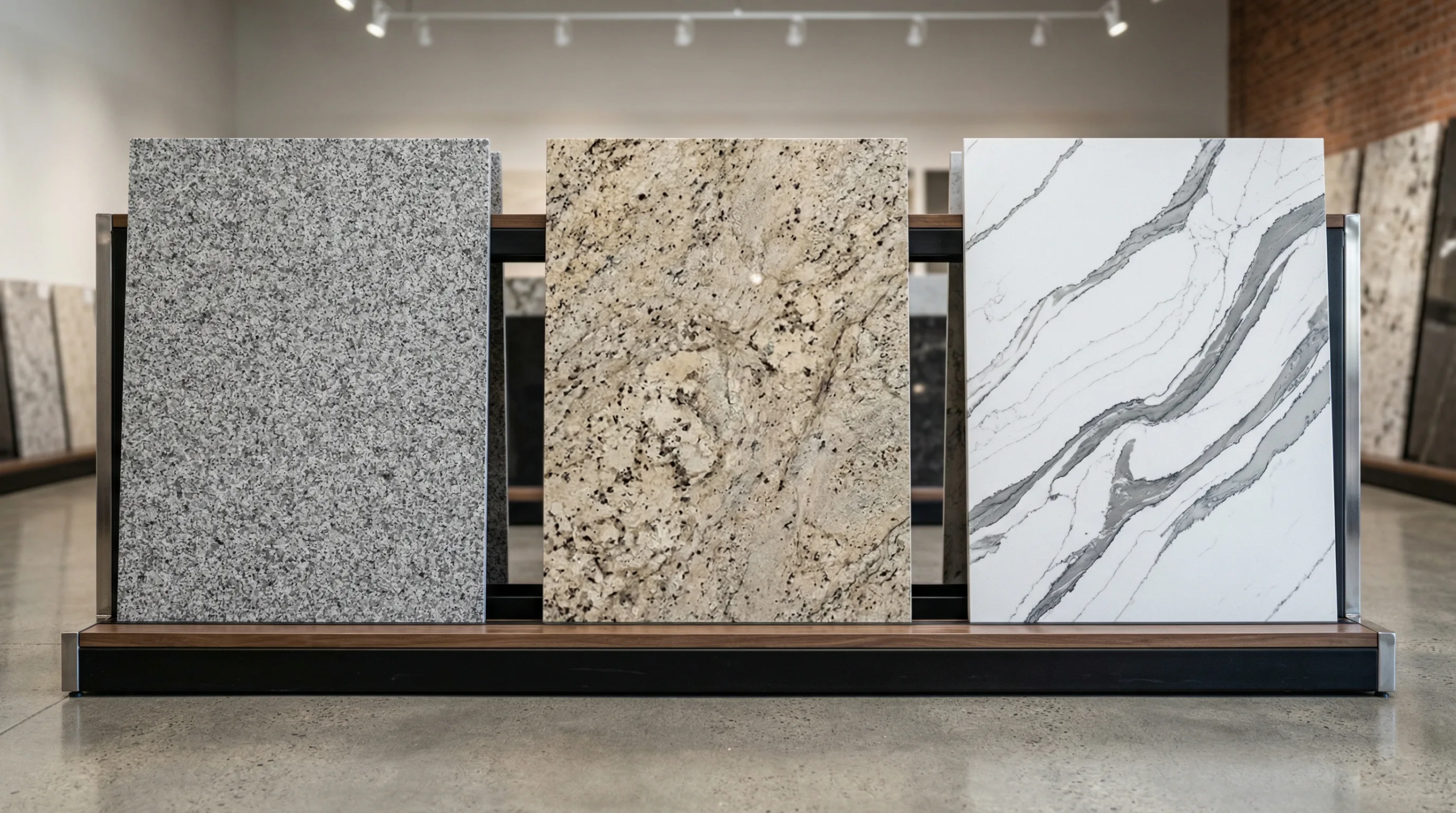
Verdict — Marble or Quartz for Bathroom Vanity Tops?
Verdict:
Quartz is the correct specification for the majority of bathroom vanity top applications in 2026 — hotels, BTR, serviced apartments, mid-range residential, gym changing rooms, and healthcare. It is acid-resistant, zero-maintenance, consistent across multi-unit projects, and performs correctly under every bathroom cleaning protocol without any instruction to the end user.
Marble is correct for luxury residential bathrooms where the natural stone character is specifically required and cannot be substituted — and where the client has been fully informed about acid etching risk, annual sealing requirements, and the written maintenance programme they need to commit to before installation begins.
Marble-look quartz is the appropriate specification for projects that want the marble aesthetic without the maintenance requirement — and it is honest to present it as such. It is not genuine marble. It delivers the visual register of marble with zero maintenance at BTR, hotel, and mid-range residential scale.
The specification rule: if maintenance cannot be guaranteed — by the building operator, the facilities team, or the homeowner — specify quartz. The bathroom environment will expose every marble specification that was not properly briefed and properly maintained.
Sources & References
NKBA — National Kitchen & Bath Association, Specification Survey 2025 (nkba.org) | NSI — Natural Stone Institute, Commercial Maintenance Guidelines (naturalstoneinstitute.org) | MIA+BSI — Marble Institute of America + Building Stone Institute, Residential Maintenance Data 2025 (marble-institute.com) | Pack Universe Supply contractor specification data, April 2026
Related Guides:
→ Honed vs polished granite — which finish should contractors specify?
LINK: /blog/honed-vs-polished-granite-finish-specify-contractors
→ Which is better for commercial countertops — granite or quartz?
LINK: /blog/which-is-better-commercial-countertops-granite-or-quartz
About the Author
Sam Michele 15 years of direct experience supplying marble and quartz bathroom vanity tops to contractors and developers across the USA and Canada. Pack Universe Supply operates wholesale warehouses in Charleston, SC (USA) and Burlington, ON (Canada).