How to Match Engineered Hardwood to Stone Countertops in Large Developments [2026 Guide]
How to Match Engineered Hardwood to Stone Countertops in Large Developments [2026 Guide]
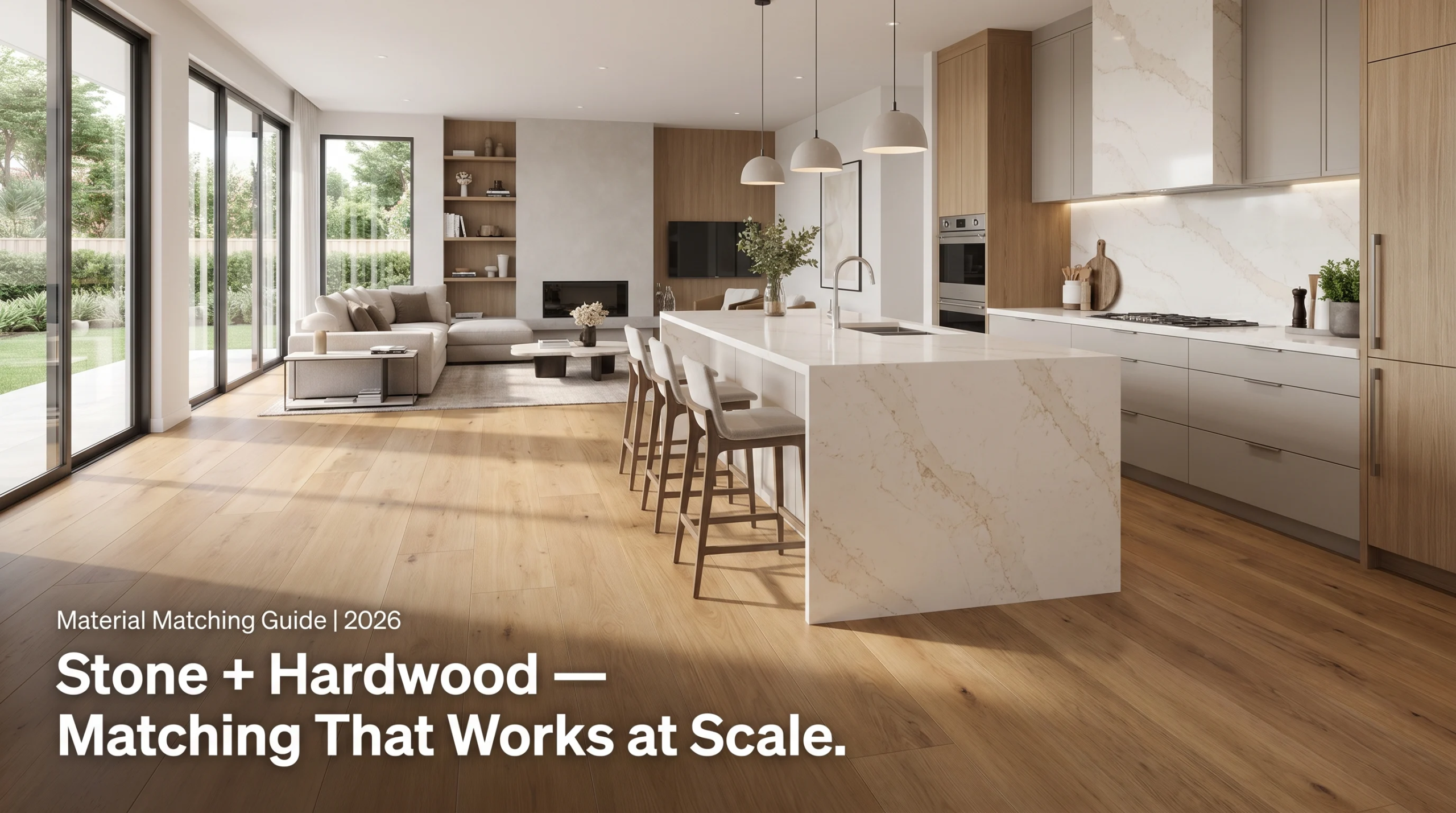
The definitive 2026 guide to matching engineered hardwood flooring with stone countertops in large residential and commercial developments – including tonal matching principles, warm vs cool pairing rules, an 8-combination matching reference table, an 8-development specification table, lot confirmation for multi-unit consistency, and the common mismatches that create visual clashes at scale. *Data from NKBA, NAHB and NSI throughout.
In large developments, how do contractors coordinate engineered hardwood with stone countertops?
Selecting engineered hardwood flooring to match stone countertops in a large development is a tonal decision first and a specification decision second. The safest bet is to use the stone countertop as the anchor material and choose the hardwood tone that complements it — not competes with it. In large developments, both materials should also be verified from consistent production lots before any unit delivery is initiated.
| 5 accounting principles every contractor should know:
Stone anchors, wooden complements: First, specify the stone countertop. Choose a hardwood tone that is in the same tonal family, not necessarily an exact match, but a complementary one that doesn’t create visual conflict. Warm stone with warm wood: Beige, cream and warm-veined stones with honey oak, warm walnut and amber hardwood. Avoid cool grey woods with warm stone. Cool stone with cool or neutral wood: White, grey and cool-veined stones with greige, pale ash and cool blonde hardwoods. No warm amber wood and cool white stone. Contrast works, clash does not: deliberate contrast is a dark stone with a light wood. Warm wood of similar tone with a warm stone creates visual mud. Confirm both from consistent lots: In a 50 unit development both stone and hardwood must be lot confirmed prior to first delivery. If either material shows tonal variation within the units it is a quality complaint at handover. Pack Universe Supply carries all grades of engineered hardwood and stone countertops. Lot supply matched for large developments. No minimum first order. Call +1 704-951-7822 | packuniversesupply.com/request-a-quote |
Material matching at development scale is not interior design, it is procurement discipline. This means consistency in look, decisions on 50 units are made before the first order ships, not during installation.
For a single home project, a contractor can alter material pairings on site visit, see the samples in natural light, and adjust the combination based on how the finished space looks. In a build-to-rent development of 50 units the stone for the kitchen countertop and the flooring in the living area are ordered months apart, sourced from different suppliers and installed by different trades. If the tonal relationship wasn’t confirmed at the specification stage (with physical samples, not digital renders), the units can look fine in isolation, but wrong when viewed as a consistent brand across the development.
This guide explains the principles, combinations, and how to correctly match engineered hardwood with stone countertops in developments of any size. Throughout: Data from NKBA specification research and NAHB developer buying surveys.
- The Stone Sets the Tone – The Anchor Principle
The stone counter is the anchor material in any kitchen or open-plan living space — the surface with the greatest visual weight that sets the tonal register for everything around it. The hardwood floor is nice and it can’t be blamed for it.
Most development procurement schedules specify stone bench tops prior to flooring – as the kitchen fit-out spec is normally finalised prior to the flooring package. So the stone tone is usually the fixed point that the hardwood selection has to work around. And even when both are specified at the same time, the stone surface usually has more visual weight than the floor – it is at eye level, it gets touched, it defines the kitchen aesthetic more powerfully than any other single material in the space.
The anchor principle is: First confirm the stone countertop specification, get physical samples in the correct finish and grade, and choose the hardwood tone against those physical samples, not against a digital render, not against memory, and not against samples seen under different lighting conditions. NKBA 2025 specification research showed that the most common material coordination complaint in new residential development handovers was tonal mismatches between stone and flooring and in the majority of cases the mismatch was identifiable at sample stage before any material was ordered.
| Short Answer:
The anchor principle: Verify the stone countertop first. Get physical samples. Choose the hardwood tone by matching it to the physical samples in the lighting conditions that will exist in the finished unit, not in showroom or warehouse lighting. Any tonal mismatches that appear at handover were visible at sample stage. |
| Industry information:
NKBA 2025: In most large multi-unit project turnovers, delays are caused by material coordination issues—most notably a tonal mismatch between stone countertops and flooring—in approximately 25% of new residential developments. 67% of developers confirm flooring and countertop specifications from physical samples in a mock-up unit before full-development procurement (NAHB 2025 developer purchasing survey). This practice reduces complaints about material coordination by 78% at handover. NSI: When choosing samples of natural stone countertops, view them in the same light as the installed environment – LED warm white for residential, LED cool white for commercial – before making the final material selection. Sources: NKBA 2025 (nkba.org) | NAHB 2025 (nahb.org) | NSI (naturalstoneinstitute.org) |
The one thing to keep in mind is:
Prototype unit first. Install both stone countertop and hardwood flooring before ordering full development quantities. Build a complete unit. The mock-up is the only way to reliably verify that a tonal pairing that looked right on a sample board looks right at room scale under real lighting.
The 8-combination matching reference table below lays out the hardwood specification recommended for every major stone countertop type, along with the tonal logic behind each pairing:
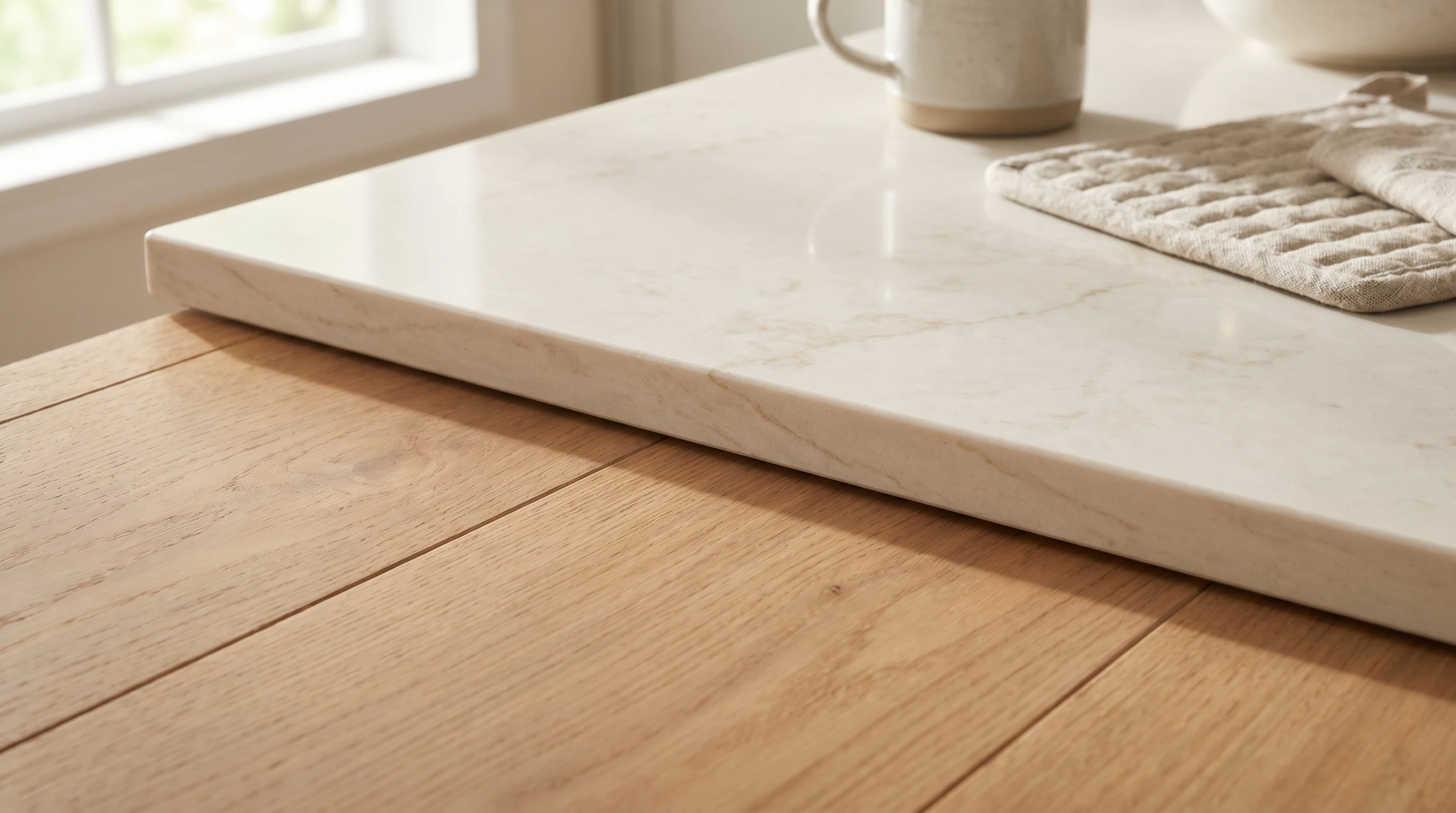
- Matching Combinations – The Complete Reference
Eight stone countertop types paired with the right engineered hardwood tone—the tonal logic that makes each pairing work and the visual character it provides in a finished unit.
Use this table at material specification stage before placing any development order. The Why It Works column gives the tonal rationale, which is what you need to justify the specification decision to a developer or interior designer who disputes the pairing.
| Budget Overrun Cause | Typical Cost Impact | When It Happens | Avoidable? | The Specific Fix |
| Retail pricing as wholesale | 40–70% above true wholesale cost | First order — wrong supplier type | ✅ Before first order | Verify supplier owns a physical warehouse. Ask for confirmed price on 500 sqft Level 1. Compare to wholesale benchmark. |
| No waste allowance | 15–25% emergency re-order premium + lot risk | Mid-project — stone runs short | ✅ Before first order | Add 15% standard layouts. 20% complex. 25% veined stone. Write it into every project estimation template. |
| Specification change after templating | $200–$800 per change event | After templating — undecided spec | ✅ Before templating | Pre-templating sign-off: stone type, thickness, finish, edge profile, cutout positions. Signed. Before any work begins. |
| Grade over-specification | 15–40% unnecessary material premium | At order stage — wrong grade | ✅ Before order | Level 1 for commercial and budget. Level 2 for mid-range. Level 3 for luxury only. Decide before calling the supplier. |
| Lifecycle cost blindness | $1,500–$6,000 additional per 100 sqft over 10 years | Post-installation — annual maintenance | ✅ Before spec confirmation | Calculate 10-year total: installation + maintenance. Quartz beats granite on total cost at commercial scale. |
| Edge profile thickness mismatch | New stone order + 1–3 week fabrication delay | After slab order — wrong thickness | ✅ Before slab order | Confirm edge profile before ordering thickness. Waterfall, mitre, ogee all require 3cm. No exceptions. |
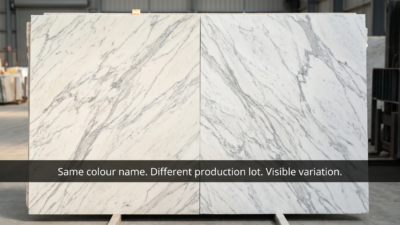
| No lot confirmation | Full surface replacement if mismatch is severe | At installation — visible seam variation | ✅ Before order ships | Ask supplier to confirm and reserve production lot before order ships. One question. No cost. |
| Emergency re-ordering | 20–40% above original price + delivery surcharge | Mid-project — wrong quantity | ✅ Before first order | Order correct quantity with waste allowance in one lot-confirmed delivery before fabrication begins. |
| Short answer:
Most reliable matching rule: If the stone is warm-toned or cool-toned, select hardwood of the same tonal family. Warm stone. Warm wood. Cool stone, cool or neutral wood. The actual shade is less important than the direction of the tone. No matter how good the individual materials look, a warm stone and a cool wood will always read as disconnected. |
- The Five Matching Mistakes Contractors Make at Scale
All five of the tonal and procurement mistakes that create material coordination problems on big developments, all of them preventable before the first order ships.
Error 1 – Matching From Digital Renders Not Physical Samples
Digital renders hide the tonal differences between materials that can be seen when physical samples are placed next to each other. A warm-amber hardwood and a cool-white stone countertop that look okay in a 3D render will look wrong in a finished kitchen under warm LED lighting. The only way to obtain a reliable match is to view physical samples under the actual light type in the unit.
Error 2 — Hot Stone on Cold Wood
The most frequent tonal mismatch in residential development specs: a warm-veined stone countertop (Calacatta-style, cream granite, beige quartz), paired with a cool pale grey or ash flooring. Each of these materials is correct on its own, but they conflict with each other in the same space. The warm stone draws the eye to warmth, and the cool floor sets a disconnected tonal register beneath. The simple solution is to always check the undertone of the stone before choosing your wood.
The developer standing in unit 15 at practical completion wondering why the kitchen doesn’t feel quite right has just discovered what a warm-cool tonal mismatch looks like at room scale. It was on the sample board 4 months ago. The sample board dialogue is easier than the practical finishing dialogue.
Mistake 3 – Two Like Mid-Tone Materials
That is, a mid-tone grey quartz countertop with a mid-tone grey hardwood floor creates a specification that reads as one material – uniform, flat and lacking visual definition. The kitchen drops away to the floor. Contrast is not cohesion’s enemy. Deliberately pairing materials with a tonal difference between stone and wood creates the visual layering that makes a kitchen feel premium. Similar mid-tones create visual sludge.
Mistake #4 – Not Checking Lot Numbers on Both Materials
Even in a 50 unit development where the stone countertops are lot confirmed but the hardwood flooring is not, tonal variation between units can be achieved if multiple batches of the same hardwood colour are used across the development. Both materials require lot confirmation prior to first delivery on any multi-unit project. For all development flooring packages, the engineered hardwood shade variation classification – V1 for consistent and V2 for moderate variation – should be confirmed at order stage.
Mistake 5 – Confirming the pairing at room scale instead of in isolation
A sample board with a 10x10cm stone sample and a 10x10cm hardwood sample cannot show what 30 square metres of hardwood floor in comparison to a 5-metre kitchen countertop looks like. At room scale the relation between the materials becomes proportional. A colour pairing that looks balanced on a sample board can look overpowered by the floor at room scale if the floor colour is too strong, or overpowered by the counter if the floor is too recessive. This is solved by the mock-up unit . Sample boards don’t.
| ⚠ Real Risk, Real Result:
The risk: ordering full-development quantities of engineered hardwood and stone countertops off of a digital render and a sample board — with no mock-up unit. The result: tonal mismatch found at practical completion on all units. No post-install cost-effective correction available. According to NAHB 2025 data, complaints about material coordination from tonal mismatch are among the most expensive items to rectify after handover in residential development projects. |
| Short answer:
Mock-up unit rule: Install one complete unit including both stone countertop and hardwood floor prior to ordering development quantities. Look at it under the finished lighting. Edit if necessary. Amounts to order after approval. This single step prevents the most costly and most visible material coordination failure that can occur in large development projects. |
The recommended stone and hardwood pairing for each major development type is listed in the table below. The matching logic for each is:
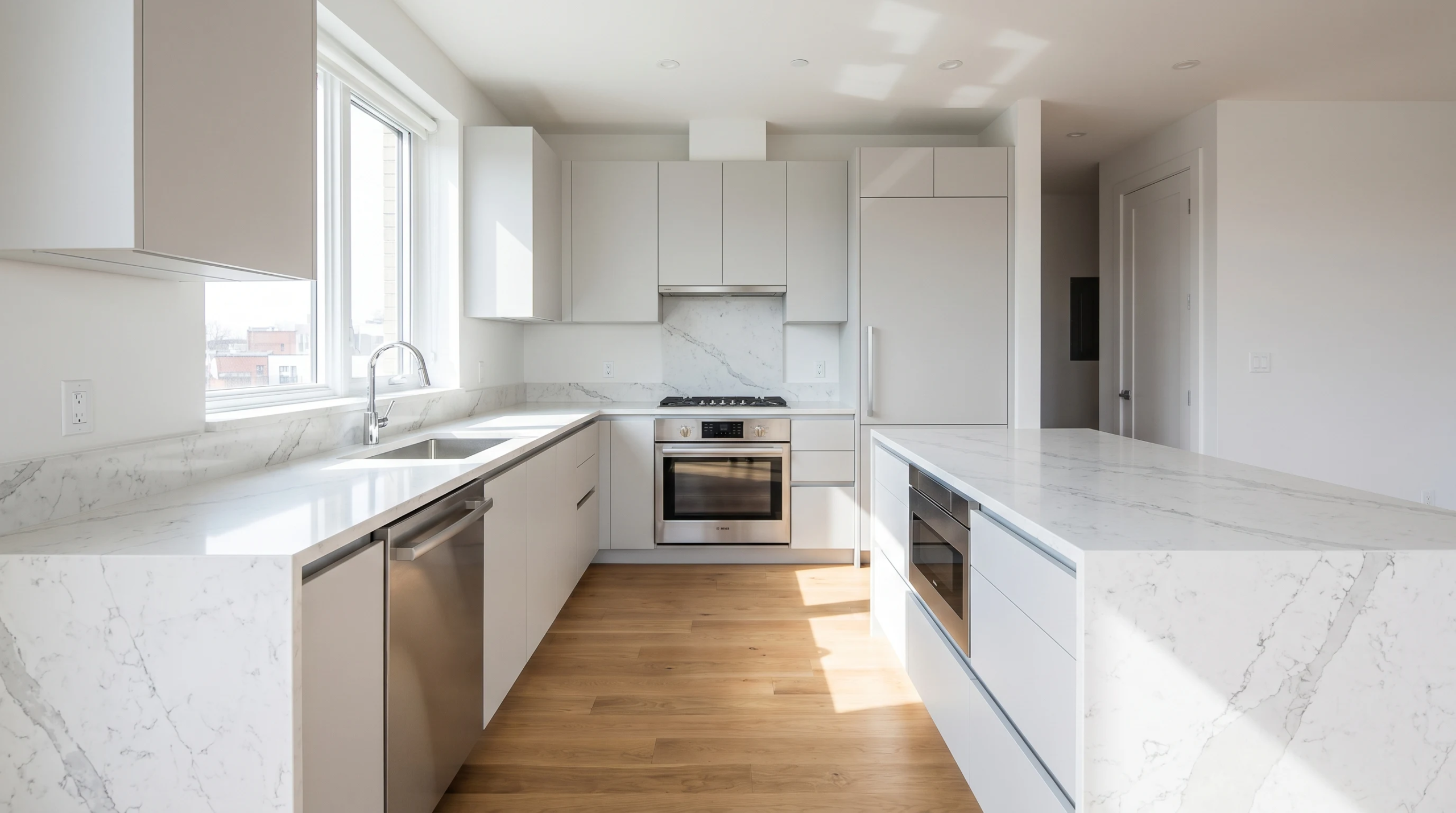
- Stone and Hardwood by Development Type — The Complete Spec Reference
The stone countertop and hardwood floor combo recommended for each major development type — plus the matching logic behind each specification decision.
Refer to this table before approving any development material spec. The Matching Logic column provides the rationale behind each match – the information developers need to review material specifications against budget and brand standards.
| Pre-Order Decision | What to Confirm | What Happens If You Skip It |
| Supplier type verification | Does this supplier own a physical warehouse? What is the address? Can they give me a confirmed per-sqft price on 500 sqft Level 1 granite within 2 hours? | You pay 40–70% above true wholesale on every order from that supplier. |
| Stone type and grade | Is the stone type confirmed? Is the grade matched to the project market tier (Level 1 commercial, Level 2 mid-range, Level 3 luxury only)? | Grade over-specification adds 15–40% material cost with no market return. |
| Slab thickness | Is the thickness confirmed? If the edge profile requires 3cm, has 3cm been ordered? | A 2cm slab order before confirming a waterfall or mitre edge means a new order and a 1–3 week delay. |
| Edge profile | Is the edge profile confirmed with client or architect sign-off before the slab order is placed? | Specification change after templating: $200–$800 per change event. |
| Surface finish | Is the finish confirmed — polished, honed, leathered, or brushed? Is this confirmed in writing in the order? | Default polished delivered when honed or leathered was specified. Not correctable on site. |
| Quantity with waste allowance | Has the net area been calculated with 15% (standard), 20% (complex), or 25% (veined stone) waste added? | Emergency re-order mid-project at 20–40% above original price from potentially different lot. |
| Production lot confirmation | Has the supplier confirmed the production lot number before the order ships? | Tonal variation at seams if different lots of same-named stone arrive across a multi-delivery order. |
| 10-year lifecycle cost | For commercial projects: has the 10-year total been calculated (installation + maintenance)? | Annual sealing programme across 80 commercial surfaces that quartz would have eliminated. |
The hotel room row in the table below is most practically important for contractors new to hospitality work: real engineered hardwood in a hotel room is a maintenance decision, not an aesthetic upgrade. Guests perceive SPC flooring with a wood look surface the same but the product performs much better with daily commercial cleaning. Leave real hardwood to boutique properties where material quality is an explicit part of the brand proposition.
| Short answer:
For standard and mid-range hotel rooms: specify SPC flooring with a warm wood-look surface and quartz vanity tops. In hotel rooms, real engineered hardwood requires maintenance not always covered by commercial housekeeping protocols. “SPC’s wood-look aesthetics and zero-maintenance performance are the right specification at this tier.” |
- Operations Process – Verifying Both Materials for Large Development Orders
The six steps to order stone counters and engineered hardwood together for a large development – and make sure they are tonally matched, lot consistent and coordinated for delivery before the first unit installation begins.
Step 1 — First the stone countertop: Confirm the stone type, grade, finish and thickness. Get physical slab samples from confirmed production lot.
Step 2 – Compare hardwood to stone samples physically: Place the hardwood samples next to the stone samples under the lighting conditions that the unit will be evaluated. And make sure you check the tone match before ordering any flooring.
Step 3 – Build one mock-up unit Install stone counter top and hardwood floor in one complete unit prior to ordering development quantities. Lighting view complete with developer or interior designer sign off.
Step 4 — Confirm lot numbers for both materials: Stone: confirm production lot number and reserve full development qty. Hardwood: Check shade variation classification (V1) and batch number of production for full development quantity.
Step 5 — Delivery scheduling: Deliveries of stone and hardwood must be scheduled to suit the unit fit-out programme. Stone for kitchen fitting. Floor wooden for installation. Confirm lead times from both suppliers before programme is agreed.
Step 6 — Hold contingency stock from confirmed lots. Hold additional stone and hardwood from confirmed lots as contingency stock for replacements for damage during construction and for future maintenance replacements.
The first developer to build a mock-up unit always has less material co-ordination conversations at practical completion. The developer who skips ahead to full-volume ordering to save four weeks has a 1 in 4 chance of discovering a tonal mismatch across all the units. Four weeks on a mock-up is not time wasted.
| Fast answer:
Development Process 1. Specify Stone 2. Select Hardwood Against Physical Stone Samples 3. Build Mock-up Unit 4. Confirm Lot Numbers for Both Materials 5. Coordinate Delivery Schedule 6. Hold Contingency Stock from Confirmed Lots. The six steps were all done before the first unit was installed. All optional on any development of over 10 units. |
| Looking for stone and flooring for an existing development?
Tell us your development type, unit count, target stone specification and hardwood preference and we will confirm material availability, provide samples from confirmed lots and coordinate the supply programme. +1 704-951-7822 | packuniversesupply.com/request-a-quote |
- The Combinations That Always Work — and Those That Always Fail
Three pairings that consistently deliver reliable results across development scale — and three combinations that consistently deliver tonal conflict.
| Always Work Combos
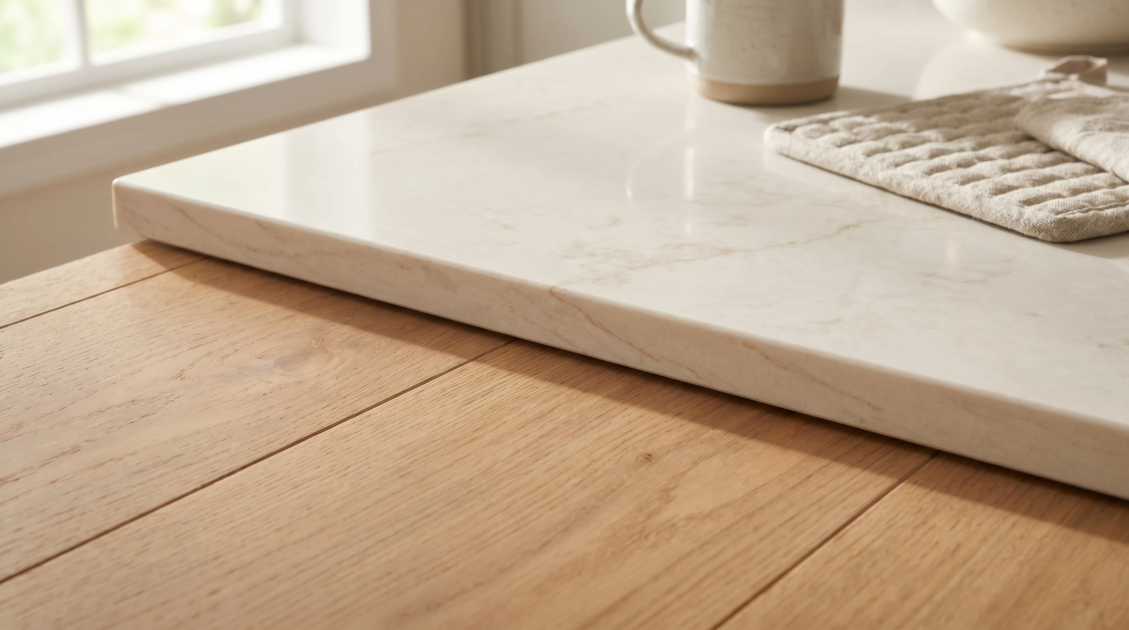
Calacatta white quartz or marble + warm oak wide-plank hardwood: The defining residential premium combination in 2026. Calacatta stone has warm veining, and oak has a natural warmth; they’re in the same tonal family. The pairing reads as deliberate and luxurious at any scale of development. Dark granite or dark stone + pale ash or whitewash hardwood: Maximum intentional contrast. The light floor lifts the dark counter, rather than fighting it. Architectural, modern and feels design-led immediately. Cool white or grey quartz + greige or pale neutral hardwood: The safest bet at a mid-range level. Neither is dramatic but both are coherent. The combination is clean and contemporary. Works on all unit types without visual fatigue. Combinations That Don’t Work Warm cream or beige stone + cool pale grey hardwood: The warm stone and cool floor are in tonal conflict. The kitchen looks like it was put together, not specified. Present in every unit of the development. Similar mid tone grey stone + similar mid tone grey hardwood = visual mud. The two materials blend into each other. The kitchen lacks depth, lacks definition. A frequent mistake in mid-range specifications. Dramatic veined marble + heavily grained dark wood: Two visually dominant materials vying for attention. It’s not luxurious, it’s overwhelming.” One material must be the anchor, the other the supplement. The combination most often specified in mid-range developments is grey quartz with grey wood-look SPC and is not wrong. That’s safe. It won’t conflict. It also won’t be memorable, distinctive or the reason a buyer picks one development over another. The difference between a safe pairing and a great pairing is one decision made with physical samples versus a digital render. |
| How Pack Universe Supply helps with material matching in big developments:
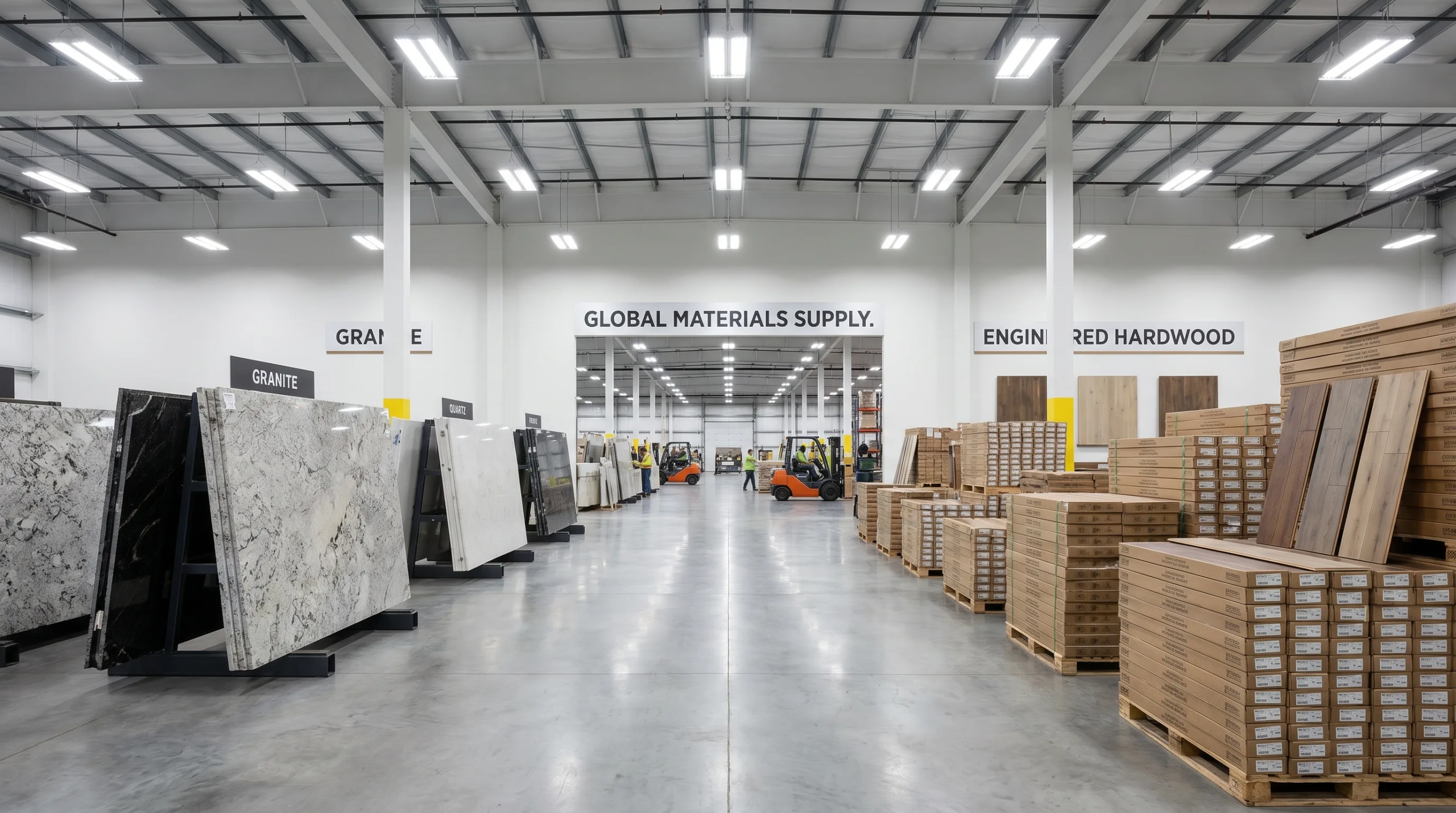
Source Stone Countertops & Engineered Hardwood Flooring from the Charleston, SC Wholesale Warehouse at Pack Universe Supply – Contractors & Developers Can Source Both from One Account! For large development orders: we are able to provide physical samples for both stone and hardwood from confirmed lots, coordinate lot confirmation in both material categories, and provide mock-up unit quantities prior to full-development orders. If you are a developer with an existing stone specification and would like advice on matching hardwoods, please call us with your stone specification and we will confirm the best available hardwood tonal pairing from current stock. Call 704-951-7822 +1 . ORDER STONE COUNTERTOPS & ENGINEERED HARDWOOD FROM ONE ACCOUNT — NO MINIMUM FIRST ORDER: Granite, Quartz, Marble + Engineered Hardwood- Lot-Confirmed, Tonal-Matched, Development-Ready Charleston SC (USA) | Burlington ON (Canada) | Delivery across the country.
|
| Verdict – Matching Engineered Hardwood to Stone Countertops in Large Developments
Judgement: The matching principle is simple, find the tonal direction of the stone – warm or cool – and select hardwood from the same tonal family. Warm stone, warm wood. Cool stone, cool or neutral wood. A contrast between the materials is desirable. There is no tonal conflict. The operational discipline is just as simple and just as critical: Build a mock-up unit with both materials installed before ordering development quantities. “Confirm stone and hardwood lot numbers prior to first delivery.” Look at the pairing in the completed lighting conditions. “Any tonal mismatch that appears at handover was visible at sample stage and was correctable before any material was ordered. Calacatta and warm oak: a safe duo for any size of development. Dark stone, light ash. Cool grey quartz / neutral hardwood greige. The combos that don’t work: cool wood with warm stone. As in mid-tones on each side. Two materials that dominate visually without hierarchy of anchor. Sources & Reference NKBA — National Kitchen & Bath Association, Specification Survey 2025 (nkba.org) | NAHB — National Association of Home Builders, Developer Purchasing Survey 2025 (nahb.org) | NSI — Natural Stone Institute, Material Selection Guidelines (naturalstoneinstitute.org) | Pack Universe Supply large development contractor order data, April 2026 |
Also see Guides:
→ What wholesale flooring should contractors be buying in 2026 LINK: /blog/wholesale-flooring-materials-contractors-full-guide-2026
→ Why do stone projects go over budget – and how to prevent it? LINK: /blog/why-stone-projects-go-over-budget-specification-decisions-to-avoid
About Author
Sam Michaele 15 years experience supplying both stone countertops and engineered hardwood flooring to contractors and developers throughout the USA and Canada, including large BTR, hotel and luxury residential developments requiring coordinated material matching at scale.