Bullnose, Eased, Mitre: Which Countertop Edge Profile Should Contractors Specify? [2026 Guide]
Bullnose, Eased, Mitre: Which Countertop Edge Profile Should Contractors Specify? [2026 Guide]
The complete 2026 guide to countertop edge profiles for contractors and developers — covering all ten major profiles, the slab thickness each one requires, fabrication cost implications, chip resistance by profile type, and a 12-application specification reference table. Includes the waterfall and mitre thickness trap that costs contractors money every year. Data from MIA+BSI, NSI, and NKBA throughout.
| Which countertop edge profile should contractors specify — and does it actually matter?
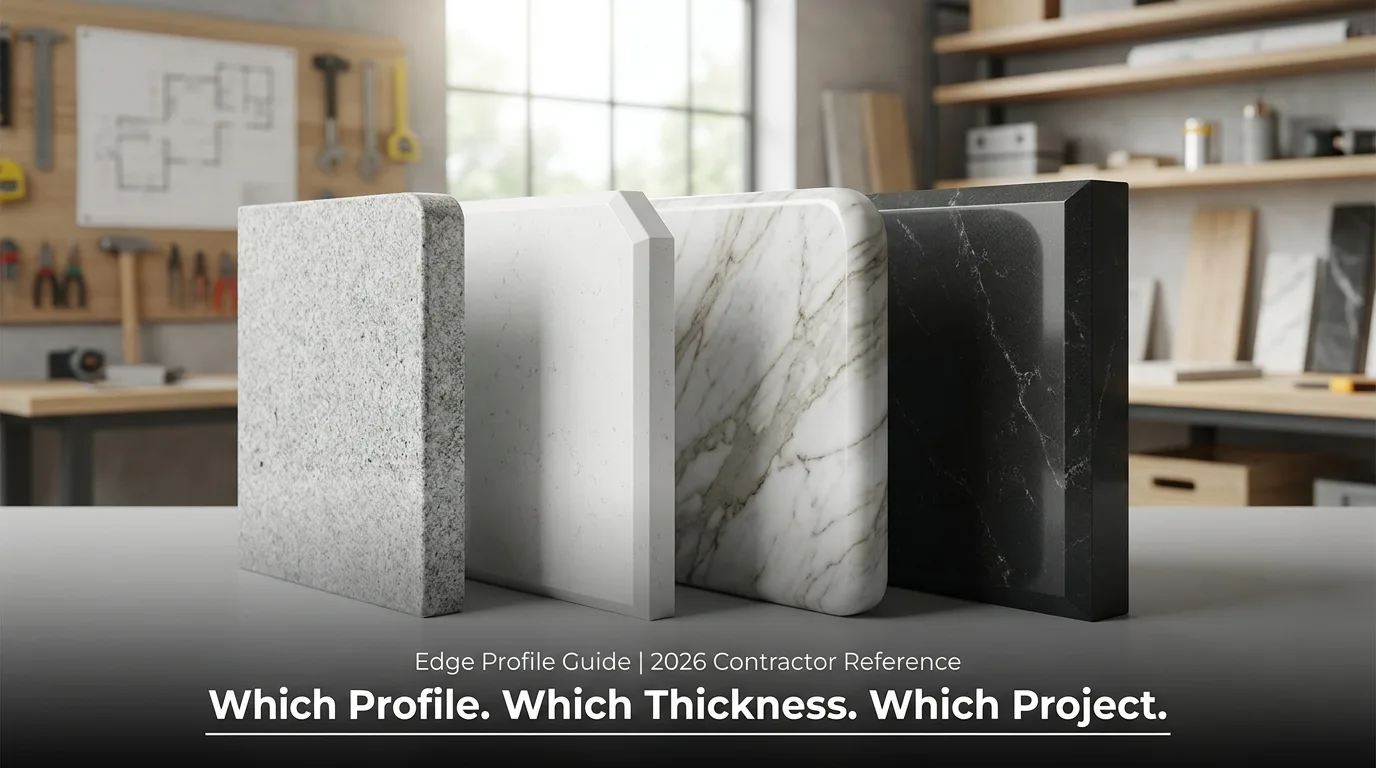
Edge profile is one of the most visible specification decisions on any countertop project — it defines the visual character of the surface and directly affects fabrication cost, slab thickness requirements, and the risk of chip damage in service. The right profile depends on three things: the project market tier, the slab thickness ordered, and the use environment the countertop will operate in. The short answer by project type: • Commercial standard — kitchens, bathrooms, offices: Straight or eased edge. Clean, functional, durable. Requires 2cm or 3cm. No chip risk under commercial use. • Mid-range residential kitchen: Bevelled or eased edge. Adds visual detail without premium fabrication cost. 2cm or 3cm. • Luxury residential kitchen island: Waterfall or mitre edge. The defining premium residential specification in 2026. Requires 3cm — no exceptions. • Luxury residential bathroom vanity: Bullnose or bevelled. Soft profile suits bathroom aesthetics. 2cm or 3cm depending on design. • High-traffic commercial — bars, reception desks: Eased edge only. Chip-resistant profile for surfaces that receive regular impact from glasses, trays, and briefcases. Wholesale stone slabs in 2cm and 3cm stocked at Pack Universe Supply — confirmed thickness before every order ships. Call +1 704-951-7822 | packuniversesupply.com/request-a-quote |
The edge profile is the last decision most contractors make on a countertop specification — and one of the most consequential ones they make without full information.
Most specification conversations about countertops focus on stone type, grade, and colour. The edge profile is treated as a finishing detail — something to confirm with the client or fabricator after the slab order is placed. That sequencing creates a specific and recurring problem: the wrong slab thickness is ordered for the edge profile that is eventually specified, generating either a new stone order or a compromised edge that the contractor has to defend at handover.
This guide covers every major edge profile available to contractors in 2026 — what it looks like, what thickness it requires, what it costs to fabricate, how it performs under commercial and residential use, and which applications it suits best. Data from MIA+BSI fabrication standards, NSI installation guidelines, and NKBA specification research throughout.
1. Why the Edge Profile Decision Matters More Than Most Contractors Realise
The edge profile affects four things simultaneously: the visual character of the countertop, the slab thickness required, the fabrication cost, and the chip resistance in service. Getting it wrong on any one of these has a cost.
Visual character is obvious — a waterfall edge on a kitchen island reads as a completely different specification from a straight edge on the same stone. But the thickness constraint is less intuitive and more costly when it goes wrong. A waterfall edge requires 3cm slab. A mitre edge requires 3cm slab cut at 45 degrees and joined precisely. An ogee or dupont requires 3cm for structural integrity during routing. If 2cm slabs have been ordered before the edge profile was confirmed, none of these profiles are available without a new stone order.
According to MIA+BSI 2025 fabrication standards, slab thickness incompatibility with the specified edge profile is one of the leading causes of post-order specification changes on residential countertop projects — each of which adds $200 to $800 in change event cost to the project budget. The fix is straightforward: confirm the edge profile before the slab order is placed, not after.
The client who approved a waterfall island edge on the mood board six weeks before installation and is now being told the slabs that arrived are 2cm does not want a technical explanation about thickness requirements. They want their waterfall island. Confirming the edge profile before ordering is the only way to guarantee they get it.
| Quick answer:
Edge profile must be confirmed before the wholesale slab order is placed — not at the fabrication stage. Waterfall, mitre, ogee, and dupont profiles all require 3cm slab. If 2cm slabs are ordered first, none of these profiles are achievable without a new stone order. |
| Industry Data:
MIA+BSI 2025 fabrication standards: slab thickness incompatibility with the specified edge profile is among the leading causes of post-order specification changes on residential countertop projects — adding $200 to $800 per change event to the project budget. NKBA 2025 specification data: waterfall edge profiles accounted for 31 percent of all luxury residential kitchen island specifications in the Southeast USA — up from 14 percent in 2020. The profile is now the dominant luxury residential kitchen specification. NSI installation guidelines: eased edge profiles have the lowest chip incidence rate of any profile type in commercial high-traffic environments — making them the standard commercial specification for bars, reception desks, and food service counters. Sources: MIA+BSI Fabrication Standards 2025 (marble-institute.com) | NKBA 2025 (nkba.org) | NSI (naturalstoneinstitute.org) |
| The one thing to remember:
Confirm edge profile before placing the slab order. Every order. The thickness requirement of the profile determines which slab must be ordered — not the other way around. |
The full edge profile reference table below covers all ten major profiles — visual character, thickness requirement, fabrication cost, and best application for each:
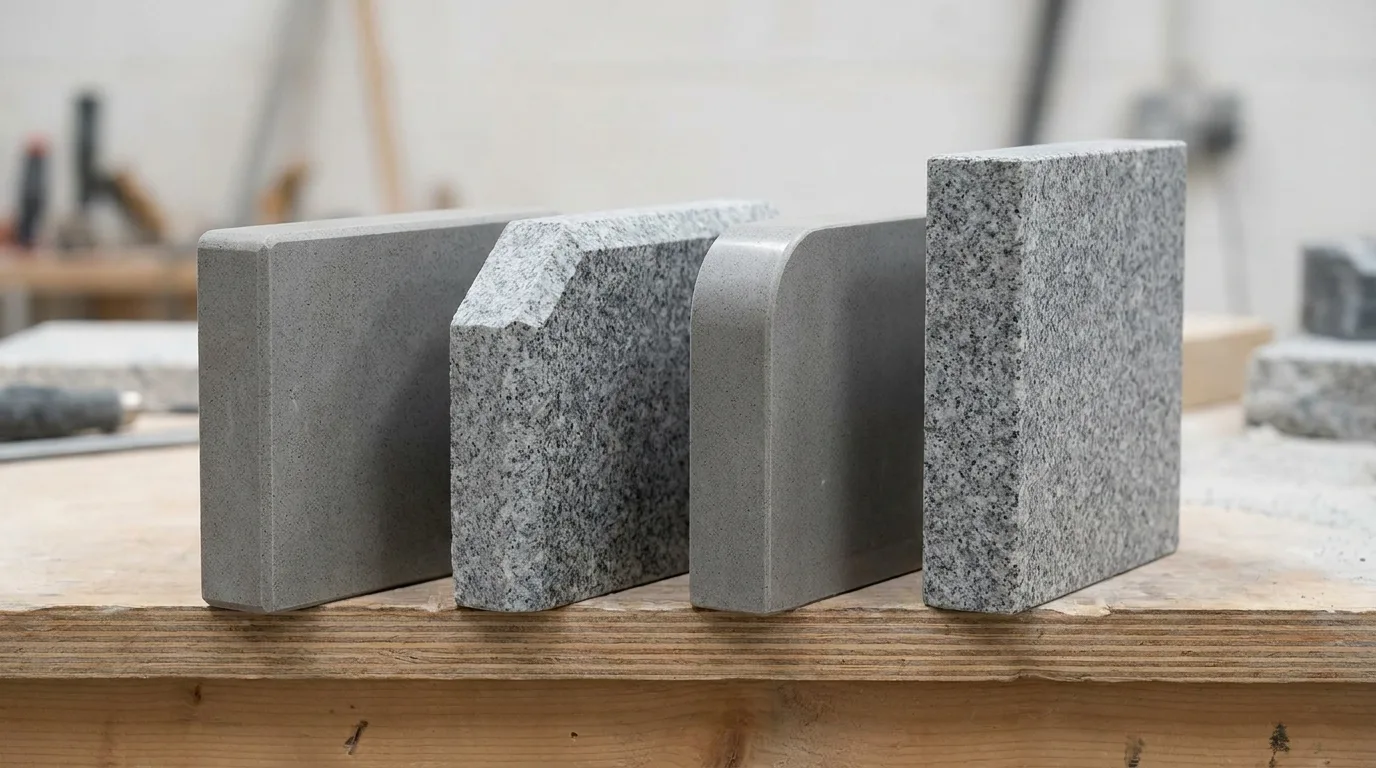
2. All Ten Edge Profiles — Complete Reference
Every major countertop edge profile available to contractors in 2026 — compared on visual character, thickness requirement, fabrication cost, and best application.
Use this table before confirming any countertop order. The Thickness Required column is the most critical — it determines which slab must be ordered from the wholesale supplier. The Fabrication Cost column gives the relative cost signal — not a dollar figure, but a comparison that helps set client expectations before the fabricator quotes.
| Edge Profile | Visual Character | Thickness Required | Fabrication Cost | Best Specified For |
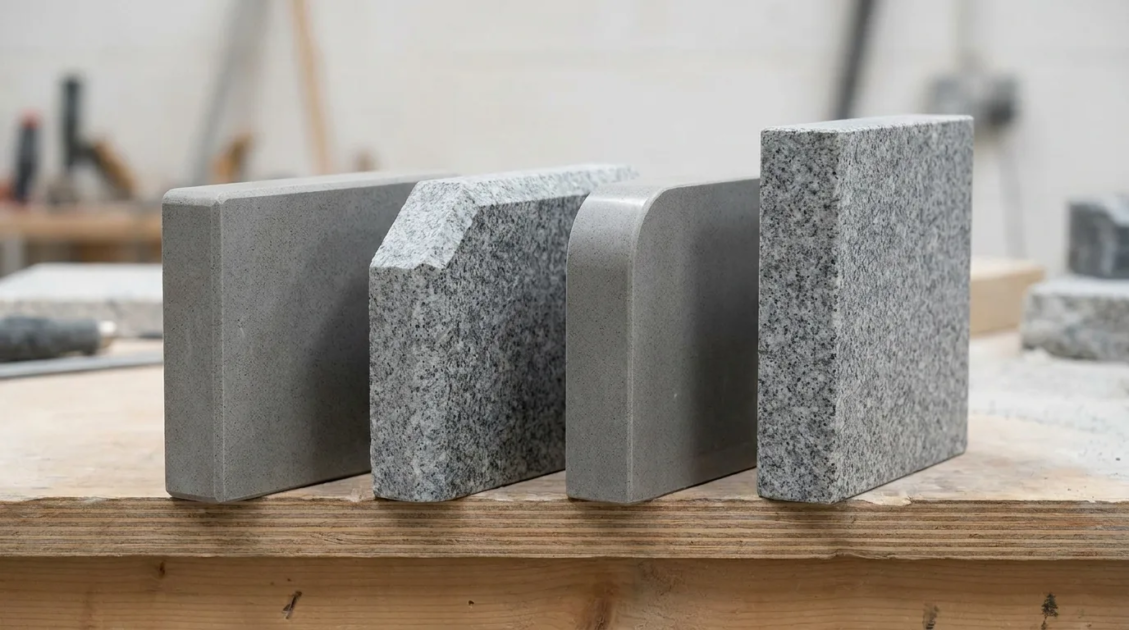
| Straight / Square | Clean 90° edge — no rounding or chamfer | 2cm or 3cm | Lowest — simple cut | Commercial standard surfaces, modern minimal residential, any project where clean and functional is the brief |
| Eased | Very slight rounding on top corner only — almost straight but safer | 2cm or 3cm | Very low — minimal extra work | Commercial countertops, bars, reception desks — reduces chip risk versus square edge while maintaining clean appearance |
| Bevelled | Angled chamfer on top edge — typically 45° — visible but subtle | 2cm or 3cm | Low to moderate | Mid-range residential kitchens and bathrooms — adds detail without premium cost |
| Bullnose — full | Fully rounded edge — smooth semicircle profile | 3cm recommended | Moderate | Residential bathrooms and family kitchens — softens appearance, reduces injury risk on exposed corners |
| Bullnose — half | Rounded on top half only, square on underside | 2cm or 3cm | Low to moderate | Residential vanity tops, island sides — softer than eased without full profile cost |
| Ogee | Decorative S-curve — traditional, ornate appearance | 3cm recommended | High — complex routing | Traditional residential and heritage hospitality — not suited to modern commercial or contemporary residential |
| Dupont / Cove | Curved undercut at bottom edge — decorative recessed detail | 3cm required | High | Premium residential only — adds visual depth but fragile under commercial impact |
| Waterfall | Slab continues vertically down island side — no visible edge | 3cm required — structural | Very high — specialist | Luxury residential kitchen islands — the defining premium edge specification in 2026. Both sides: double waterfall. |
| Mitre | Two pieces joined at 45° angle — creates ultra-thin appearance | 3cm required (two pieces) | Very high — precision cut | Luxury residential and architectural — makes 3cm appear as thin floating slab. Maximum visual impact, maximum cost. |
| Laminated / Double | Two layers of stone laminated together at edge — increases apparent thickness | 2cm base + 2cm laminate | High — two pieces | Where 4cm thickness appearance is desired without ordering 4cm slab. Feature edges on islands and peninsulas. |
Profile data based on MIA+BSI Fabrication Standards 2025, NSI installation guidelines, and Pack Universe Supply fabricator and contractor order data April 2026. Fabrication costs are relative comparisons — actual quotes vary by fabricator, stone type, and regional market.
| Quick answer:
The two profiles that generate the most specification problems are waterfall and mitre — both require 3cm slab and specialist fabrication. If either is specified after 2cm slabs have shipped, the project has a new stone order and a delay. Confirm these profiles first, before any other specification element is locked. |
| Specifying edge profiles for a current project?
Tell us the edge profile, stone type, and thickness required — we will confirm slab availability and give you a confirmed wholesale quote within 2 business hours. +1 704-951-7822 | packuniversesupply.com/request-a-quote |
3. The Thickness Trap — Why 2cm vs 3cm Is an Edge Profile Decision
The single most common and most avoidable edge profile error is ordering 2cm slabs before the edge profile has been confirmed — then discovering the specified profile requires 3cm.
The 2cm vs 3cm slab decision is almost always framed as a budget and structural question. Two centimetre slabs are lighter and slightly cheaper. Three centimetre slabs are self-supporting and structurally preferred for most commercial and residential countertop applications. What is less commonly understood is that the edge profile specification restricts which thickness is viable.
Profiles That Require 3cm — No Exceptions
- Waterfall edge: The slab must continue vertically down the island side. The 3cm thickness provides the structural mass required for this profile — 2cm waterfall edges are fragile and not fabricator-recommended.
- Mitre edge: Two pieces of 3cm slab are cut at 45 degrees and joined to create an ultra-thin appearance. There is no 2cm equivalent.
- Full ogee: The S-curve routing requires material depth that 2cm cannot provide without chip risk at the thinnest points of the profile.
- Dupont / cove: The undercut detail requires sufficient material depth for the router to create the recessed profile without breaking through the underside.
- Full bullnose: A complete semicircle profile requires sufficient stone thickness to achieve the full radius — strongly recommended in 3cm for a smooth, structurally sound result.
- Laminated edge: Two layers of stone joined at the edge to create a thicker appearance — requires 3cm base layer for structural integrity.
Profiles That Work in 2cm
- Straight / square edge: Works in 2cm or 3cm — but 2cm straight edge is only viable with a full plywood substrate.
- Eased edge: Works in 2cm or 3cm — eased profile adds minimal material thickness requirement.
- Bevelled edge: Works in 2cm or 3cm — the chamfer angle removes material rather than requiring additional depth.
- Half bullnose: Works in 2cm or 3cm — only the top half is rounded, which does not require the full stone depth of a complete bullnose.
The fastest way to avoid the thickness trap permanently is to add edge profile confirmation to the pre-order checklist — before thickness is discussed, before the slab is quoted. Edge profile first. Thickness follows from it.
| Quick answer:
Waterfall, mitre, full ogee, dupont, and full bullnose all require 3cm slab. Straight, eased, bevelled, and half bullnose work in 2cm. Confirm the edge profile before the thickness is specified on any order — the profile determines the thickness, not the other way around. |
| ⚠ Real Risk — Real Consequence:
The risk: ordering 2cm slabs before confirming the edge profile — then discovering the client or architect has specified a waterfall or mitre edge. The consequence: a new stone order at full cost, a fabrication delay of 1 to 3 weeks, and a change event cost of $200 to $800 on top of the new material cost. All of it avoidable with one conversation before the original order was placed. |
The 12-application specification table below gives the recommended edge profile, required thickness, and the key reason for every major contractor application:
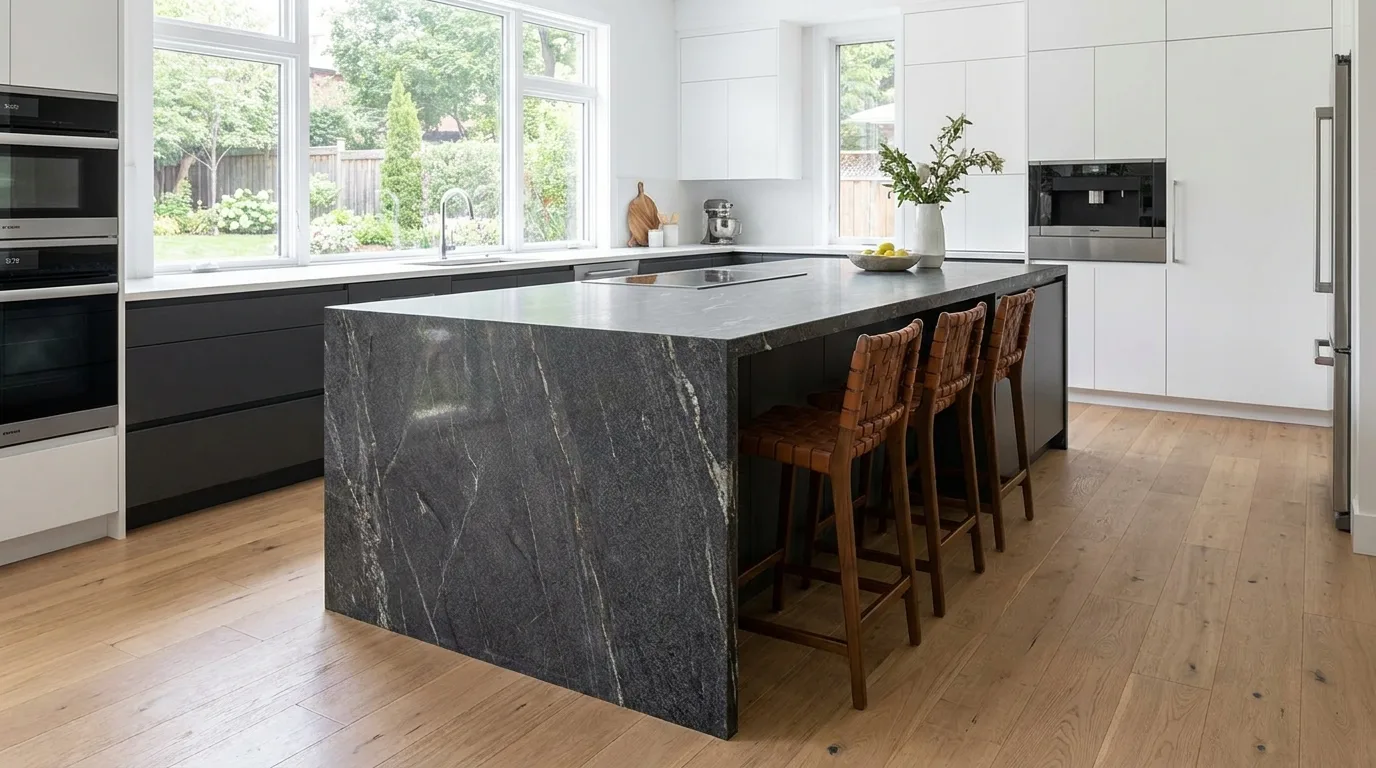
4. Edge Profile by Application — The Complete Specification Reference
The recommended edge profile, required slab thickness, and specification reason for every major contractor application — commercial and residential, standard and luxury.
Use this table at the specification stage for any countertop project. The Reason column gives the practical logic behind each recommendation — which is what you need to explain the decision to a client, architect, or building owner who asks why.
| Application | Recommended Profile | Thickness Required | Reason |
| Commercial kitchen countertop | Eased | 2cm or 3cm | Chip-resistant profile under commercial impact. Clean appearance meets food service aesthetic standard. |
| Hotel bathroom vanity — standard | Eased or straight | 2cm or 3cm | Consistent across all rooms. No complex fabrication. Neutral profile suits widest range of bathroom styles. |
| Hotel bathroom vanity — luxury suite | Bevelled or half bullnose | 3cm | Adds visual detail appropriate to the tier. Still practical under housekeeping cleaning cycles. |
| Corporate office kitchenette | Straight or eased | 2cm or 3cm | Professional neutral. Consistent across all floors. No fabrication premium. |
| Restaurant bar counter — guest-facing | Eased | 3cm | Guest-facing bar edges receive constant impact from glasses, bottles, and arms. Eased profile is most chip-resistant. |
| Retail service counter | Straight or eased | 2cm or 3cm | Functional, consistent across all locations in a chain rollout. No design premium required. |
| Mid-range residential kitchen | Bevelled | 2cm or 3cm | Adds visual interest without luxury fabrication cost. Suits mid-range buyer expectation. |
| Premium residential kitchen island | Waterfall | 3cm ONLY | The specification that defines premium residential kitchen quality in 2026. Requires 3cm — cannot be done in 2cm. |
| Luxury residential kitchen island | Waterfall or mitre | 3cm ONLY | Both profiles require 3cm. Mitre creates the ultra-thin appearance; waterfall creates the dramatic vertical continuation. |
| Residential bathroom vanity — standard | Half bullnose or bevelled | 2cm or 3cm | Soft profile suits bathroom character. Practical under daily residential use. |
| Luxury residential bathroom vanity | Bullnose or mitre | 3cm | Full bullnose or mitre at luxury tier. Confirms material investment to the buyer. |
| Outdoor kitchen countertop | Eased — granite only | 3cm | Granite only outdoors. Eased profile on outdoor surfaces — no decorative profiles on exterior applications. |
Application specifications based on MIA+BSI 2025, NSI installation guidelines, NKBA 2025 residential specification data, and Pack Universe Supply contractor order data April 2026.
The application table shows the same pattern in every commercial row: eased or straight edge. Not because the other profiles are unavailable — they are available. Because eased and straight edges are the profiles that survive commercial use without chipping, without looking dated, and without a fabrication premium that the commercial budget does not call for.
| Quick answer:
In every commercial application — food service, hospitality, corporate — the standard profile is eased or straight. Not because contractors lack imagination. Because these profiles perform reliably under daily commercial use, cost the least to fabricate, and hold up for the full commercial surface lifecycle without chip events. |
5. Edge Profile and Chip Resistance — What High-Traffic Environments Require
The edge profile is the most vulnerable point of any countertop surface in commercial use — and the profile choice directly determines how chip-resistant that point is under daily impact.
In a residential kitchen, a countertop edge encounters occasional impact from pots, cutting boards, and occasional dropped objects. In a hotel bar, a restaurant counter, or a corporate reception desk, the edge encounters constant impact from glasses, bottles, briefcases, handbags, and regular cleaning equipment. The profile geometry at the edge determines whether that impact creates a clean deflection or a chip.
The eased edge — a very slight rounding of the top corner — is the profile with the highest chip resistance in commercial environments. The rounding distributes impact energy across a small radius rather than concentrating it at a sharp 90-degree corner. The straight edge, while clean and modern in appearance, concentrates impact at a precise right angle — which is the geometry most likely to chip under repeated commercial impact. According to NSI installation guidelines, eased edges have the lowest chip incidence rate of any profile type in commercial high-traffic environments.
Chip Risk by Profile in Commercial Environments
- Lowest chip risk: Eased edge — slight radius distributes impact. Standard commercial specification.
- Low chip risk: Bevelled edge — chamfer deflects glancing impacts. Acceptable in mid-range commercial.
- Moderate chip risk: Straight/square edge — sharp right angle concentrates impact. Avoid on bar edges and heavily used corners.
- Higher chip risk: Full bullnose — smooth but large radius can catch lateral impacts. Better in residential than commercial.
- High chip risk: Ogee and dupont profiles — complex geometry with thin sections at the routing points. Not suitable for commercial.
- Specialist handling required: Waterfall and mitre — the exposed vertical edge on a waterfall and the join line on a mitre require careful installation and periodic inspection in high-traffic environments.
The bar counter chip conversation happens at year two, not at specification. The contractor who specified an eased edge on the bar never has it. The one who specified a sharp square edge for the clean modern look has to explain why the corner of the stone looks like it has been in a fight.
| Quick answer:
For any countertop edge that receives regular commercial impact — bar top, reception desk, service counter, restaurant counter — specify eased edge. The slight radius is invisible in normal use and eliminates the chip risk that a square edge carries in commercial environments. |
| How Pack Universe Supply supports edge profile specification:
Pack Universe Supply supplies 2cm and 3cm slabs in confirmed thicknesses for all edge profile requirements — from commercial eased specifications through luxury 3cm waterfall and mitre projects. For any project where the edge profile is a design feature — waterfall islands, mitre edges, feature counters — we confirm slab thickness at order stage before the fabricator is briefed, preventing the most common post-order thickness mismatch. Call before placing any order where the edge profile has not yet been confirmed: +1 704-951-7822. |
| Order Wholesale Stone Slabs in the Right Thickness for Your Edge Profile — No Minimum First Order:
2cm and 3cm granite, quartz, and marble — confirmed thickness before every order ships. Charleston SC (USA) | Burlington ON (Canada) | Nationwide delivery.
→ Request a Quote: packuniversesupply.com/request-a-quote → Call: +1 704-951-7822 (Mon–Fri, 8am–5pm EST) → Canada: +1 (647) 362-1907 | WhatsApp: button at packuniversesupply.com |

Verdict — Which Edge Profile Should Contractors Specify?
| Verdict:
For commercial applications — food service, hospitality, corporate, high-traffic bars and reception desks — specify eased edge. It is the most chip-resistant profile in service, the lowest fabrication cost, and the neutral visual standard that suits every commercial context. It works in 2cm or 3cm. For luxury residential kitchen islands — specify waterfall or mitre. These are the profiles that define premium residential kitchen specification in 2026. Both require 3cm slab without exception. Confirm the profile before the slab order is placed. For everything in between — mid-range residential, premium hotel bathrooms, corporate feature surfaces — bevelled or bullnose profiles add visual character without premium fabrication cost. Both work in 2cm or 3cm. The rule that prevents every edge profile problem: confirm the profile before ordering the slab. The profile determines the thickness. The thickness determines which slab ships. Reversing that sequence is what generates change events. |
Sources & References
MIA+BSI — Marble Institute of America + Building Stone Institute, Fabrication Standards 2025 (marble-institute.com) | NSI — Natural Stone Institute, Installation and Commercial Guidelines (naturalstoneinstitute.org) | NKBA — National Kitchen & Bath Association, Specification Survey 2025 (nkba.org) | Pack Universe Supply fabricator and contractor order data, April 2026
| Related Guides:
→ What is the difference between 2cm and 3cm quartz slab thickness? LINK: /blog/2cm-vs-3cm-quartz-slab-thickness-wholesale → What mistakes do contractors make when buying countertops? LINK: /blog/7-mistakes-contractors-make-buying-countertops
|
About the Author
Sam Michele 15 years of direct experience supplying wholesale stone slabs to fabricators and contractors across the USA and Canada — including projects specifying waterfall, mitre, and complex edge profiles at commercial and luxury residential scale. Pack Universe Supply operates wholesale warehouses in Charleston, SC (USA) and Burlington, ON (Canada).