Choosing the Right Stone for Open-Concept Commercial Spaces [2026 Contractor Guide]
Choosing the Right Stone for Open-Concept Commercial Spaces [2026 Contractor Guide]
| Stone Selection Strategy for Open-Concept Commercial Spaces [2026 Guide] A useful 2026 strategy guide for contractors who want to use stone in open-concept commercial spaces like hotel lobbies, co-working lounges, restaurants, corporate atriums, and retail flagships. Includes the anchor-stone principle, rules for keeping tones consistent, matching zone performance, confirming lots across multiple surface orders, a 12-zone strategy table, and six proven stone pairings. Data from NKBA, NSI, and CBRE commercial design research all the way through. |
How do you pick out stone for commercial spaces with an open floor plan where you can see more than one surface at a time?
In open-concept commercial spaces like hotel lobbies, co-working lounges, restaurant dining floors, and corporate atriums, the same stone is used on many different types of surfaces at once. You can see the bar counter, floor, feature wall, and reception desk all at once. The selection strategy is not the same as specifying each room: every stone choice affects every other surface that can be seen.
The five rules for choosing stones in open-concept commercial spaces are:
Choose one stone to be the main visual anchor for the whole space. It doesn’t respond to anything else; everything else does.
Use tonal consistency instead of material uniformity: When the same material is on every surface, it looks flat. Different materials that are in the same tonal family look like they were meant to go together.
Keep drama to one surface: The visual statement is on one feature surface, like an exotic granite reception counter or a dramatic marble feature wall. It is supported by every other surface.
| Confirm lot across all stone surfaces at once: In an open-concept space, slabs from different lots on adjacent surfaces make tonal changes that can be seen throughout the room at once.
Make sure the stone works well in the right zone: The feature wall above the kitchen prep counter has different cleaning and maintenance needs than the counter itself. Make sure to spec each zone correctly. Pack Universe Supply has all kinds and grades of stone in stock. They offer wholesale contractor prices, bulk orders that match lots, and no minimum first order. Call +1 704-951-7822 or go to packuniversesupply.com/request-a-quote. |
Open-concept commercial spaces break the most common rule about stone specification, which says that you can choose each surface separately. They can’t.
If you can see the reception desk, the floor, the feature wall, and the staircase balustrade all at once in a hotel lobby, then a stone decision made for any one of those surfaces is a stone decision made for all of them. The contractor who specifies each surface separately and works through the project zone by zone without a single palette makes the inside look like it was put together rather than designed. The building owner and their guests notice, even if they can’t say why.
This guide is all about choosing the right stone for open-concept commercial spaces. It includes the principles, the order in which to make decisions, the zone-by-zone strategy for twelve of the most common open-concept commercial spaces, and six stone combinations that have been shown to work well at scale. Data from NKBA’s research on commercial specifications, NSI’s installation guidelines, and CBRE’s surveys of commercial design.
- Why Open-Concept Commercial Spaces Need a Different Stone Plan
In a room-by-room specification, each surface is looked at on its own. In an open-concept commercial interior, every person who walks in looks at every surface at the same time.
Sightline density is the main problem with open-concept commercial stone specification. A guest in the hotel lobby, a member of a co-working space, or a diner in a restaurant can see four to six stone surfaces at once, such as the floor, counter, wall, column, staircase, or feature panel. The tonal difference between the countertop and the floor can only be seen when standing in the kitchen in a closed room. You can see the tonal mismatch between the reception counter and the floor from 30 meters away in a 200-square-meter open lobby.
This has a direct and specific effect on how stone orders are made. You can order the countertop stone and the floor stone from different suppliers at different times in a room-by-room project without causing a problem with the integrated specification. Everyone who uses an open-concept commercial space can see the countertop stone and the floor stone at the same time. They have to be ordered together from confirmed lots, reviewed together from physical samples, and specified together before any order ships.
The open-concept lobby specification that looked coordinated on the mood board sometimes looks put together in real life. This is because the samples were looked at on a white sheet of paper under showroom lighting, not next to each other in the actual installation space under the building’s LED fit-out. Most open-concept stone mismatches happen in that space.
| The short answer is:
Every choice about a stone surface in an open-concept commercial space is a color choice. You can’t say what a surface is without also saying what it is not. The first material confirmed anchors every decision after that, even if the person placing the first order doesn’t understand this. Data for the industry: According to CBRE’s 2025 research on commercial interior design, open-concept hospitality and office interiors that used a unified stone palette on all visible surfaces got 28% higher tenant and guest satisfaction scores on interior quality assessments than those with mixed or independently specified stone surfaces. NKBA 2025: Contractors who used a unified palette review process—looking at all the surface materials together from physical samples before ordering—got 74% fewer complaints about surface material compatibility on commercial projects. NSI specification guidelines say that for commercial projects, all stone surfaces that can be seen from the same sightline should come from the same production lot if they are made of the same material. If they are made of different materials, they should be reviewed together to make sure they match in tone. |
The one thing you should remember is:
The order in which things are chosen is just as important as the things that are chosen. First, put in the anchor stone. The anchor affects the supporting surfaces. Never let surfaces that were specified separately be looked at together for the first time during installation.
The table below shows the zone strategy for twelve open-concept commercial spaces, including the main stone role, performance priority, and specification strategy for each.

- The Anchor Stone Principle: How to Make a Palette for an Open-Concept Space
The first step in making a successful open-concept commercial stone specification is to choose the surface that will be the visual anchor for the whole space.
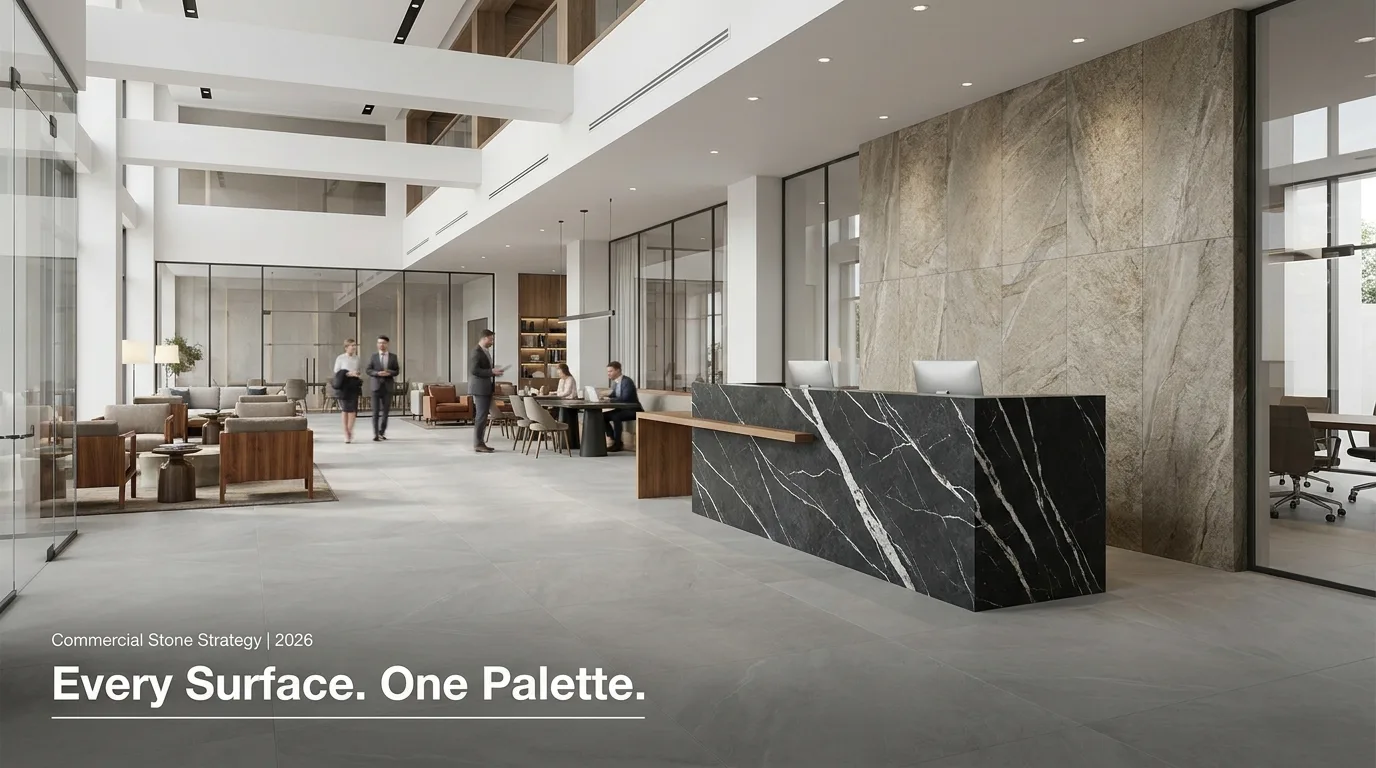
Guests, tenants, or customers first notice the anchor surface, remember it the longest, and use it as a reference point for how good the whole space is. The reception desk or the wall behind it is almost always the main feature in a hotel lobby. The bar counter or the feature wall at the back of the dining room is the best place to sit in a restaurant. The reception desk is the first thing you see when you walk into a corporate atrium. The feature wall or display counter is the main focus of the floor plan in a retail flagship.
Choosing the anchor stone first, before any other surface, turns the specification process from a series of separate choices into a clear design plan. Every surface choice after that either helps the anchor or fights with it. Adding depth, warmth, and scale to supporting surfaces. When surfaces compete with each other, they make visual noise that looks like inconsistency instead of richness.
What Makes a Good Anchor Stone
Three things make a strong anchor stone for an open-concept business space. For starters, it has enough visual interest to keep people’s attention from anywhere in the room. For example, in a 200-square-meter lobby, a Level 1 granite that looks interesting from 30 cm may look flat and undifferentiated from 20 meters. Second, it has a neutral tone that lets different supporting surfaces exist together without clashing. For example, a very warm amber stone makes it hard to find floor and wall options that go well with it. Third, there is enough confirmed lot volume available to cover the entire anchor surface without any visible differences. For example, if a dramatic exotic granite runs out of lot stock halfway through the installation of the reception counter, it is a crisis, not just an inconvenience.
The question that changes the conversation about anchor stones with a designer or building owner is not “Which stone do you like?”But “which stone do you want every person who comes through this door to remember?”Those are different questions, and they usually get different answers.
| Answer quickly:
The anchor stone must have enough visual interest to keep people’s attention from the farthest point in the room, enough tonal neutrality to let the supporting surfaces coexist, and enough confirmed lot availability to cover the anchor surface without any changes. Before the first order ships, all three must be confirmed. |
How to Build Around the Anchor with Supporting Surfaces
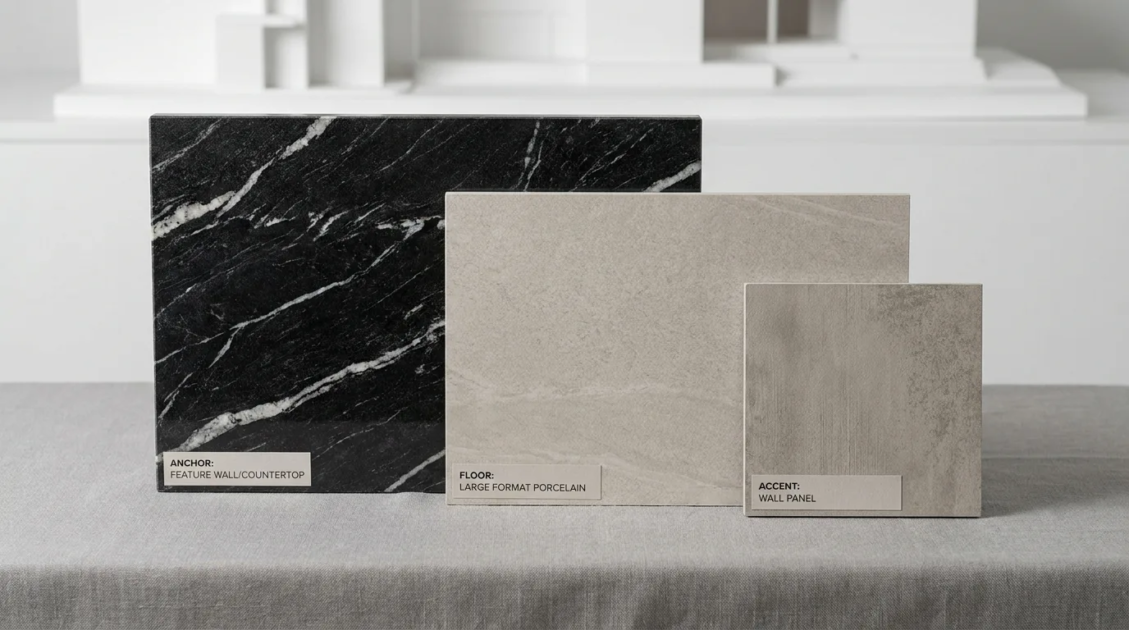
Once the anchor stone is set, all the other surfaces in the open-concept space are measured based on it. Floors, secondary walls, and column cladding should all be in the same color family as the anchor, but they should have a noticeable difference in texture, finish, or material character. A polished dark granite anchor looks best against a large-format honed porcelain floor that is a lighter color. The difference in both lightness and finish adds depth without making the floor look too busy.
Using the same stone throughout an open-concept space will make the space look flat and institutional. The hotel lobby is made entirely of grey stone, which looks like a parking lot. The lobby, which has a dramatic Nero Marquina feature reception counter, has warm greige stone floors and brushed concrete wall panels. It looks like a high-end place. The materials work together because they are related, not because they are the same.
One thing to keep in mind:
The anchor should be lighter or rougher than the supporting surfaces, but the two should still be in the same tonal range of warm or cool. The anchor is dark and the floor is light. Polished anchor and honed surface for support. Natural stone anchor and engineered support material. Depth comes from contrast. Uniformity makes things flat.
- Zone-by-Zone Stone Strategy: Twelve Open-Concept Business Uses
The right stone role, performance priority, and specification strategy for twelve of the most common open-concept commercial zones, including hospitality, corporate, retail, and food service.
This table should be used during the specification stage, before any stone orders are placed. The Dominant Stone Role column shows if each zone has a feature surface, a working surface, or a supporting surface. This tells you if the stone choice for that area is mostly about looks, mostly about function, or mostly about tone.
| Open-Concept Zone | Dominant Stone Role | Performance Priority | Specification Strategy |
| Hotel lobby — reception counter | Feature surface — anchor stone | Durability, visual impact | Level 3 exotic granite or bold quartz. This is the surface guests photograph. Make it count. |
| Hotel lobby — floor | Supporting surface | Durability, slip resistance, scale | Large-format neutral stone or porcelain. Tonal complement to the counter, not competition. |
| Co-working lounge — bar/café counter | Working surface | Hygiene, zero maintenance, durability | Quartz Level 2. Non-porous for food and beverage service. Clean and professional. |
| Co-working lounge — floor | Supporting surface | Durability, acoustic comfort, tone | Large-format porcelain or LVT. Warm grey or greige. Consistent across all zones. |
| Restaurant dining floor | Supporting surface | Slip resistance, durability, tone | Anti-slip porcelain R10+. Neutral tone that does not compete with the table surface spec. |
| Restaurant bar counter — front | Feature surface | Visual impact, durability | Quartz Level 2–3 or natural stone. Visible to every dining table. Worth the specification investment. |
| Restaurant bar counter — back (prep) | Working surface | Hygiene compliance, zero maintenance | Quartz Level 1. Non-porous for food prep. White for contamination visibility. |
| Corporate atrium — reception | Feature surface | Visual impact, brand quality signal | Granite Level 3 or Calacatta quartz. The quality of this surface communicates brand value to every visitor. |
| Corporate atrium — floor | Supporting surface | Durability, scale, professional tone | Large-format porcelain or polished natural stone. Neutral — the architecture carries the drama. |
| Retail flagship — feature wall | Accent surface — maximum drama | Visual impact | Level 3 exotic stone or dramatic quartz. One wall. One statement. Everything else neutral. |
| Retail flagship — service counter | Working surface | Durability, hygiene | Quartz Level 2. Professional, clean, consistent across all locations in a chain rollout. |
| Hospitality pool / spa lobby | Feature and working surfaces | Wet area performance, luxury aesthetic | Honed natural stone or large-format porcelain. Anti-slip rated for wet area. Stone adds warmth. |
Natural stone that has been honed or large-format porcelain. Rated for wet areas to prevent slipping. Stone makes things feel warmer.
Zone strategies based on the NSI installation guidelines, the NKBA commercial specification research 2025, the CBRE commercial design data 2025, and the Pack Universe Supply open-concept commercial order data from March 2026.
The most helpful thing about this table is that it shows the difference between feature surfaces and working surfaces in the same open-concept space. The front counter of the restaurant bar is a feature surface because every diner takes a picture of it, remembers it, and uses it as a quality signal. The bar back prep surface is a work surface that needs to be clean, easy to care for, and useful. You can see both of them at the same time. They have different specifications that make them good for different tasks.
| Short answer:
In an open-concept business space, the same counter can have a feature face (which guests can see and which has a lot of visual impact) and a working back (for food prep or service, which is very important for hygiene). Don’t make all the surfaces the same for either looks or hygiene; instead, make each one for its real purpose. Choosing stone for a commercial space with an open floor plan? Let us know what kind of open-concept space you have, what kind of anchor surface you want, and how many square feet it is. We will suggest a full stone palette and give you a confirmed wholesale quote for all surfaces within 2 business hours. +1 704-951-7822 | packuniversesupply.com/request-a-quote |
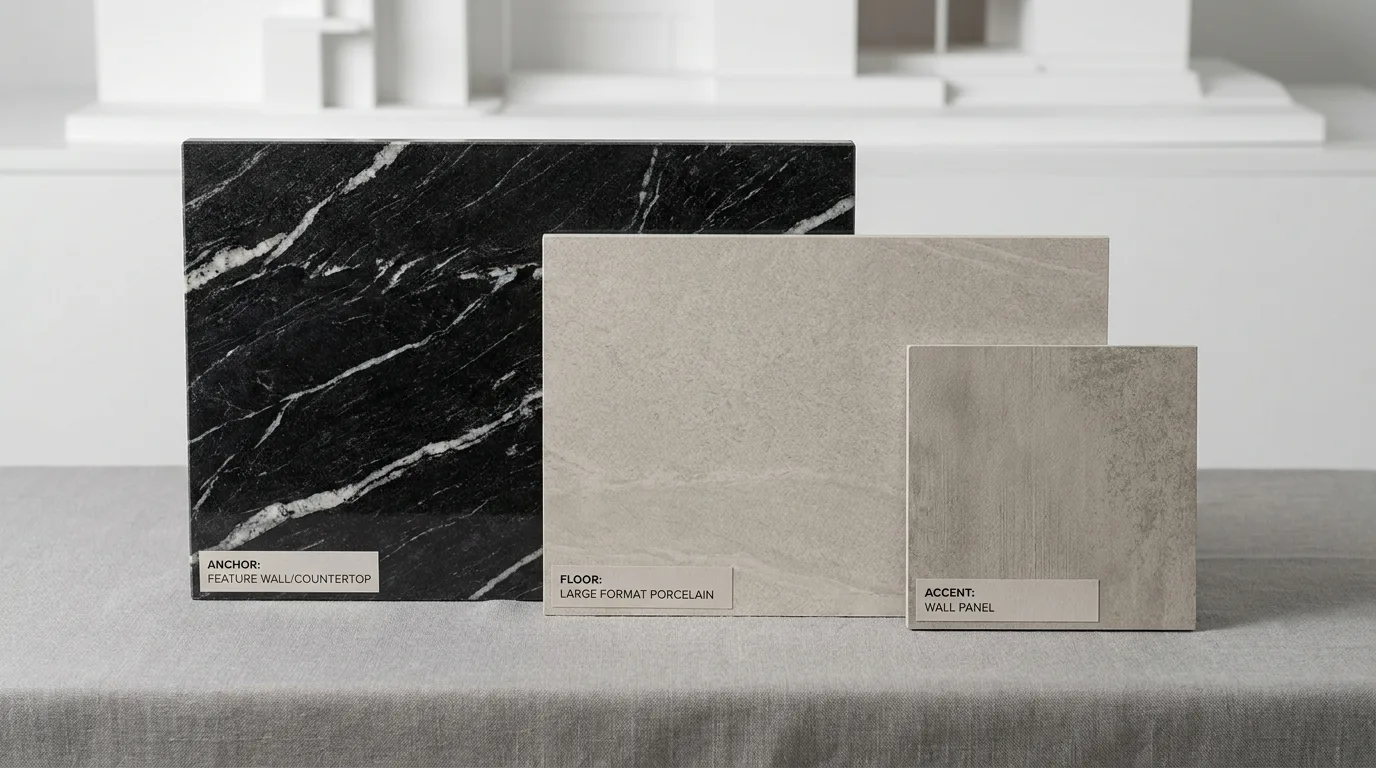
The stone combination table below shows six tested anchor-to-floor-to-accent pairings for open-concept commercial spaces, along with an explanation of why each one works:
- Six Stone Combinations That Work for Open-Concept Business Spaces
Six combinations of anchor, floor, and accent stones that will work in businesses in 2026, along with the reasons why each one works.
These combinations have been tried out in real life on commercial projects like hotel lobbies, restaurant interiors, corporate atriums, and co-working spaces. Each one follows the anchor principle, which means that a strong feature stone is supported by materials that are tonally compatible but differ in lightness or texture without fighting for visual dominance.
| Anchor Stone (Feature Surface) | Floor Stone / Material | Accent / Support Stone | Why This Combination Works |
| Calacatta white quartz — bold vein | Warm greige large-format porcelain | Brushed concrete-look porcelain wall panel | The bold white counter is supported by warmth below. No visual competition — one story, well told. |
| Cosmic Black granite — dramatic dark | Light grey honed marble-look porcelain | Crisp white quartz working surface | Maximum contrast reads luxury. Dark anchor, light surround. Classic commercial high-end specification. |
| Nero Marquina — black with white vein | White oak or warm grey engineered floor | White quartz bar prep surface | Natural warmth in the floor softens the drama of the black stone. The white working surface completes the palette. |
| Statuario quartz — soft white vein | Cool light grey large-format porcelain | Stainless steel or honed grey quartz accent | Clean, architectural, modern. All cool tones, layered textures. High-end hospitality standard 2026. |
| Jerusalem Gold natural stone | Warm sand porcelain or travertine-look tile | Quartz Level 2 warm white | Natural warmth throughout. The gold stone anchors a palette that reads Mediterranean-luxury residential quality. |
| Absolute Black granite honed | Light cream or warm white large-format porcelain | White or Calacatta quartz working counter | High contrast, high clarity. The black honed stone reads as genuinely premium against a clean light floor. |
A lot of contrast and clarity. The black honed stone looks really high-end against a clean light floor.
Based on research from the NKBA 2025 specification, the CBRE commercial design survey, and the Pack Universe Supply open-concept commercial contractor order data from March 2026, here are some pairing suggestions.
The first pairing, Calacatta quartz with warm greige porcelain, is the one that surprises contractors the most. It looks like quartz and tile on paper. In a finished lobby, the warm floor under a bold white-veined counter looks like it really is high-end. The white counter looks intentional instead of clinical because the floor is warm.
| Answer quickly:
When you anchor with a bold stone and then pick a floor that competes with it for visual attention, that’s the most common mistake people make in open-concept commercial spaces. The anchor should always be the most interesting part of the room. The floor should not be used with the anchor; it should only make it look better. |
- Confirming lots on more than one stone surface—The Open-Concept Ordering Discipline
Open-concept commercial projects have a lot confirmation requirement that single-surface orders don’t have: all stone surfaces that can be seen in the same sightline must be lot-confirmed at the same time, before any delivery ships.
In a typical room-by-room project, you never see the stone on the kitchen counter and the stone on the hallway floor at the same time. It is not a problem that the tone of different lots of the same stone on those two surfaces is not the same. In an open-concept lobby where the reception counter stone and the feature wall stone are made from the same material but different production lots, every guest can see that the two stones are not the same color.
This sets a specific order for open-concept commercial projects: before any delivery to the site can begin, the production lot of every stone surface that can be seen in a single sightline must be confirmed and reserved from the same production batch, or from batches that have been reviewed and confirmed as tonally compatible. It is not enough to confirm a lot for one surface while leaving other surfaces in the same sightline unconfirmed.
For surfaces made of the same material that are in the same sightline, confirm one production lot for all of them. Request that the supplier set aside enough space for all surfaces at once.
For surfaces made of different materials that are in the same sightline: Before placing an order, ask for sample pieces from confirmed lots of both materials and look at them together in the same lighting as the installation.
Natural stone has the most batch variation of any type of material when used on more than one surface. Never say that natural stone will be used on adjacent open-concept surfaces without first looking at confirmed lot samples together.
For the anchor stone: Before placing an order for any supporting surface, make sure the lot and reserve volume for the entire anchor surface. Before building the palette around the anchor surface, it must be safe.
| ⚠ Real Risk, Real Consequence:
The risk is that you confirm the anchor stone lot and place the feature surface order before the supporting surface lots are confirmed. Then, when both materials are on site, you find out that the floor stone from a different supplier doesn’t match the tone. The result is that the whole open-concept space has a clear tonal mismatch that can only be fixed by replacing one or both of the surface materials after they have been installed, which will cost a lot more than the original estimate. |
| How Pack Universe Supply helps with open-concept commercial specifications:
Pack Universe Supply handles lot confirmation for open-concept commercial projects from our warehouse in Charleston, SC, across a variety of stone surfaces. For lobby, restaurant, and atrium projects where three or more stone surfaces can be seen from the same point of view, we send sample pieces from confirmed production lots for all surfaces at once. This lets you see them in installation lighting before the order ships. For anchor stone reservation, we keep confirmed lot stock for the entire anchor surface until orders for the supporting surface are placed. This makes sure that the palette is built on a solid foundation. Before you place your first order for open-concept commercial stone, call +1 704-951-7822. Order wholesale stone for your open-concept business project. There is no minimum first order: All kinds of stones. All levels. Matched lots on a number of surfaces. Delivery anywhere in the USA. Charleston, South Carolina (USA) and Burlington, Ontario (Canada) → Get a Quote: packuniversesupply.com/request-a-quote → Call: +1 704-951-7822 (Monday through Friday, 8 a.m. to 5 p.m. EST) → Canada: +1 (647) 362-1907 | WhatsApp: button at packuniversesupply.com |
| Related Guides:
→ How do you match countertops with flooring in large developments? LINK: /blog/how-to-match-countertops-flooring-large-developments → Which is better for commercial countertops — granite or quartz? LINK: /blog/which-is-better-commercial-countertops-granite-or-quartz → Is quartz better than granite for commercial construction? LINK: /blog/is-quartz-better-than-granite-commercial-construction → What is the difference between engineered stone and natural stone? LINK: /blog/engineered-stone-vs-natural-stone-contractor-buying-guide-2026
|
Stone Strategy for Open-Concept Commercial Spaces: The Verdict
| The decision:
Choosing beautiful materials isn’t the stone strategy for an open-concept commercial space. It means picking materials that work well together across the whole space and making sure they do by putting together physical samples in real-world conditions before any order is shipped. First, anchor. Second, support. The surfaces to work on were chosen for their function, not their looks. All lots confirmed at the same time on all surfaces. Supporting materials that are in the same tonal family as the anchor, but with a clear difference in lightness or texture to add depth without making the other materials look bad. The commercial spaces that guests remember, tenants renew in, and building owners are proud to show are the ones where every stone decision was made in relation to every other stone decision that could be seen in the same room. That coordination starts when you place a wholesale order, not when you install. |