Granite vs. Quartz: How They Work Inside and Outside—The Contractor’s Specification Guide
Granite vs. Quartz: How They Work Inside and Outside—The Contractor’s Specification Guide
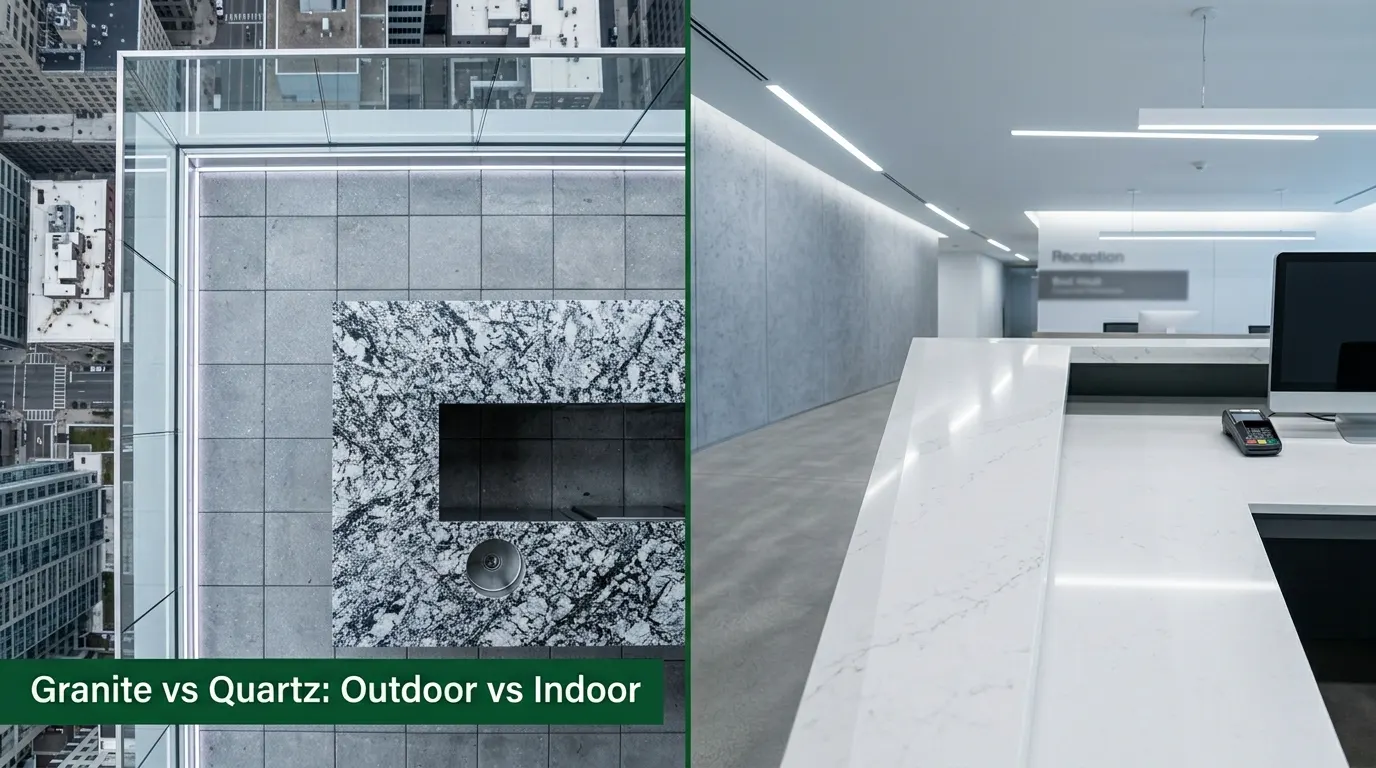
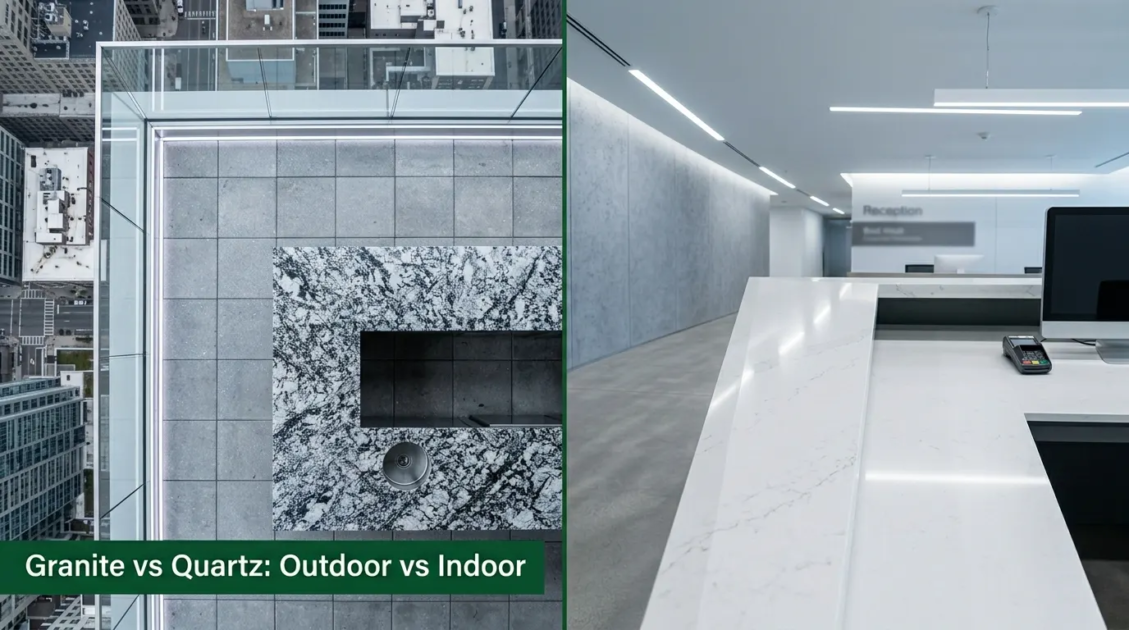
What material works best outside, what works best inside, and how to specify correctly when your project covers both areas.
Is granite or quartz better for outdoor projects?
Granite is the best choice for outdoor use because it can handle UV exposure, freeze-thaw cycles, and moisture without the structural damage that engineered quartz can. Quartz is the better choice for commercial work inside buildings where cleanliness, consistency, and low maintenance are important.
| Here are the five most important rules for specifying correctly at a glance:
Granite only—quartz resin binders break down when exposed to UV light and freeze-thaw cycles for a long time. Indoor business—Quartz is best because it is non-porous, consistent, and low-maintenance in places with a lot of traffic. Thermal zones: Granite can handle big changes in temperature, but quartz can’t handle them as well. Granite (sealed) and coastal and marine—both materials need to be checked; granite is easier to work with when it’s not sealed. Never use the same material for both indoor and outdoor runs; instead, list each one separately. Pack Universe Supply | Charleston SC & Burlington ON | +1 704-951-7822 |
One of the most costly mistakes a contractor can make is to use the same material for both outdoor terraces and indoor lobbies on a project.
People often talk about granite and quartz as if they are the same thing. In a commercial setting indoors, the gap between them is very small. Both are good options, and the choice often comes down to looks, batch consistency, and budget. But as soon as you add exposure to the outdoors, the gap becomes clear. Quartz is a man-made material that has resin binders that break down when exposed to UV light and freeze-thaw cycles. Granite is a natural stone that has been used outside for hundreds of years when it is properly sealed.
This guide is for builders, contractors, and developers who need to be very clear about what they want in different parts of the same project or who are comparing two materials for use in the same environment. All of the advice in this guide is based on material science, installation standards, and actual supply data.
- Why Outdoor Environments Are a Different Specification Problem
When you install something outside, you have to deal with three stressors that aren’t present in a controlled indoor environment: constant UV radiation, freeze-thaw cycles, and uncontrolled moisture.
Most specifications for countertop and surface materials are based on how well they work indoors in homes and businesses. The TCNA Handbook for Ceramic, Glass, and Stone Tile Installation is the closest thing we have to a hard surface specification bible. It clearly separates the requirements for interior and exterior applications, and for good reason. The conditions are completely different.
| INDUSTRY DATA: NSI (Natural Stone Institute)
The NSI Installation Guidelines say that freeze-thaw cycling and moisture penetration are the two main reasons why outdoor stone installations fail too soon. When water freezes, it expands by about 9%, which is enough force to crack or delaminate engineered composite surfaces over time. This happens when water gets into unsealed joints or micro-fractures. Source: naturalstoneinstitute.org — Guidelines for Installing Stone |
What UV rays do to quartz outside
About 90 to 93 percent of the material in quartz slabs is crushed quartz aggregate that is held together with polymer resins and pigments. The resins and pigments in engineered quartz don’t hold up well to UV light. When exposed to direct sunlight for a long time, they turn yellow, fade, and sometimes even get brittle. This isn’t a flaw in the product; it’s just how the material works. Almost all major quartz manufacturers void their warranty for outdoor use for this reason.
| Short answer: Quartz that is used outside usually starts to fade or change color within 12 to 24 months of being installed in direct sunlight, which usually voids the manufacturer’s warranty. |
Granite is an igneous rock that has been around for a long time and has been exposed to UV radiation. The mineral makeup of feldspars, quartz crystals, and micas gives it its color stability under UV light, not a coating or binding agent. This makes it much better for any installation where you can’t control UV exposure.
If you’ve put quartz on an outdoor counter that faces south and watched it come back in less than 18 months, you already know where this conversation is going.
The freeze-thaw issue that only affects engineered materials
The second most important outdoor stressor is freeze-thaw failure. Quartz has a low inherent porosity (about 0.02%), but it is more vulnerable to damage when used outside. The resin matrix that holds the aggregate together can break down at the micro-level when it goes through thermal cycling over and over again. When water gets into edge joints, the cycle of expansion and contraction weakens the bond between the aggregate and the binder. The mineral structure in granite can handle thermal cycling. The risk is in unsealed joints, which is a sealing specification that can be managed, not a limitation of the material.
| WARNING: Quartz edges can break in cold climatesIn USDA Hardiness Zones 5 and below, where temperatures can drop to -15°C / 5°F, engineered quartz that is installed outside, even in covered or partially protected areas, is at a high risk of edge delamination and resin fracture within 3 to 5 years. In these climates, replacing a quartz outdoor installation before its expected lifespan is a real cost risk that should be figured out before making a choice. Granite is the right type of stone for these areas. |
| Quick answer: If you live in a freeze-thaw climate (USDA Zones 1–5), use granite for all outdoor stone surfaces. None of the big quartz manufacturers say it can be used outside in freezing weather.
The table below compares all the performance factors that matter when choosing between outdoor and indoor specifications, such as cost, maintenance, and warranty. Choosing stone for a project that will be inside and outside? We sell granite and quartz in bulk to contractors all over the US and Canada. We’ll help you choose the right material for each part of your project before you place your order, not after. Call packuniversesupply.com at +1 704-951-7822 |
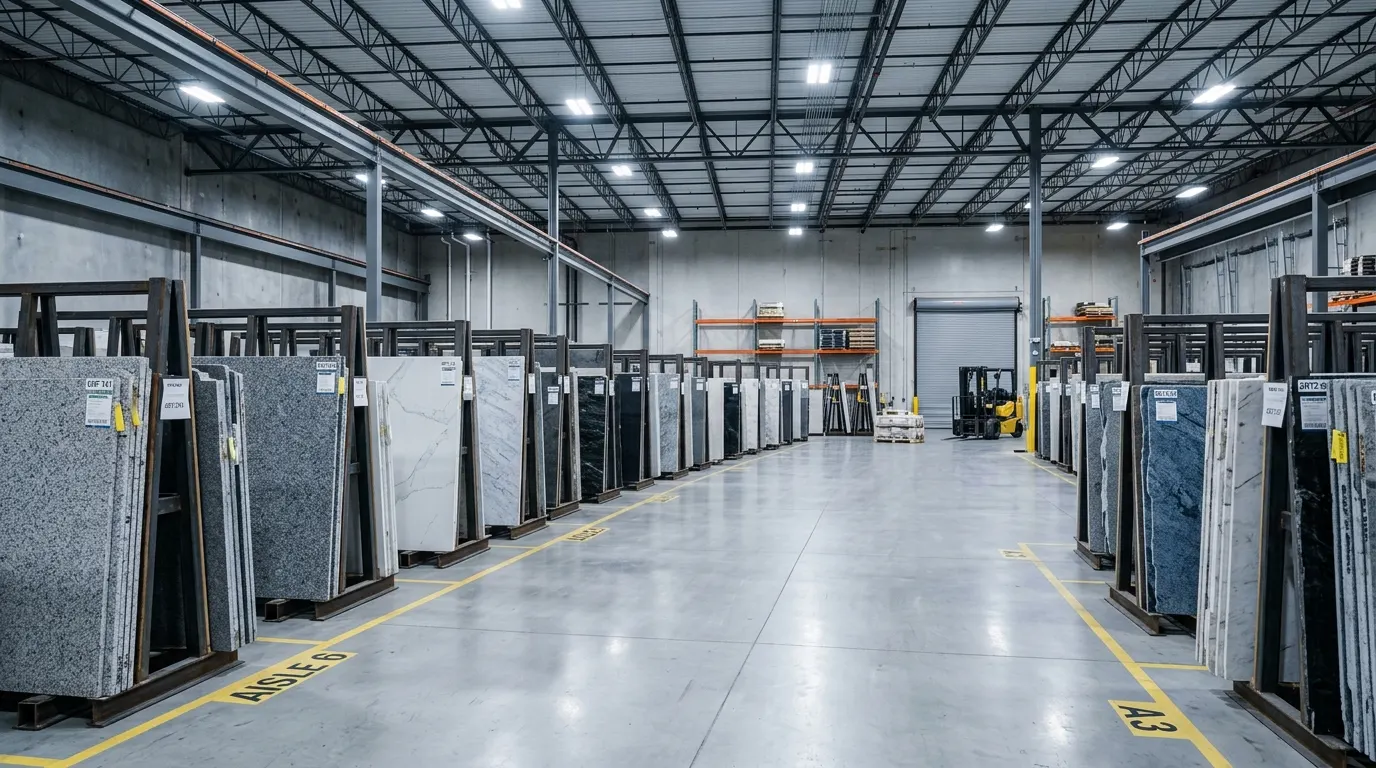
![: granite slab outdoor installation B2B commercial setting cool LED lighting]](https://packuniversesupply.com/wp-content/uploads/2026/04/Photorealistic_wide-angle_photograph_202604151627.webp)
- Full Performance Comparison: Granite vs. Quartz—Both Inside and Outside
Granite beats quartz in all outdoor performance metrics, based on fourteen factors. The gap gets a lot smaller indoors, and quartz is clearly better for hygiene and batch consistency.
The table below shows how both materials compare on every factor that is important to your decision about which one to use.
| Performance Factor | Granite (Outdoor) | Quartz (Outdoor) | Quartz (Indoor) |
| UV Resistance | Excellent — stable colour & structure | Poor — resin yellows over time | Excellent — no UV exposure |
| Freeze-Thaw Cycling | Good (sealed) / Moderate (unsealed) | Poor — resin/filler cracks | N/A — interior application |
| Moisture Absorption | 0.1–0.4% (sealed) — manageable | Near 0% but joint failure risk | ~0.02% — best class |
| Thermal Shock | Handles 40°C+ swings well | Limit 75°C — risk of delamination | Limit 150°C — adequate indoor |
| Surface Hardness (Mohs) | 6–7 — resists abrasion well | 7 (engineered) — surface consistent | 7 — consistent under load |
| Slip Resistance (wet) | Rough finish achievable (R11+) | Polished — R9 or below wet | R9-R10 — adequate indoor |
| Maintenance (annual) | Seal every 1–3 years outdoors | Joint re-seal; UV degradation check | Wipe down; no sealing needed |
| Stain Resistance | Sealed: good / Unsealed: moderate | Fails with outdoor chemicals | Excellent — non-porous |
| Colour Consistency (batch) | Natural variation — plan layout | Moderate outdoor variation | High — best for commercial runs |
| 10-Year Cost (per sq ft) | USD $85–$130 installed + sealing | USD $95–$150 + premature replacement | USD $70–$110 — lowest lifecycle |
| Typical Applications | Cladding, pavers, outdoor counters | Not recommended outdoors | Countertops, vanities, reception |
| Warranty (typical) | 10–25 years natural stone | Voids in outdoor use (most brands) | 10–15 years interior use |
| Ideal Climate Zone | All — with correct sealing | Controlled indoor only | Controlled indoor only |
| Important rule: Use granite for outdoor areas and quartz for indoor commercial uses that need to be clean or have consistent batches. You should never use the same specification for both zones. |
The warranty position is one aspect that specification guides don’t often cover. For outdoor quartz, the warranty that comes with it from any major manufacturer is either clearly voided or so heavily conditioned that it is effectively void. This is an important conversation that needs to happen at the spec stage, not after installation, when a developer or client expects warranty coverage.
| Quick answer: Most big quartz companies, like Silestone, Caesarstone, and Cambria, say that their warranties don’t cover outdoor use. Contractors who specify quartz for outdoor use are fully responsible for any problems that arise. |
- Choosing Stones for Outdoor Projects
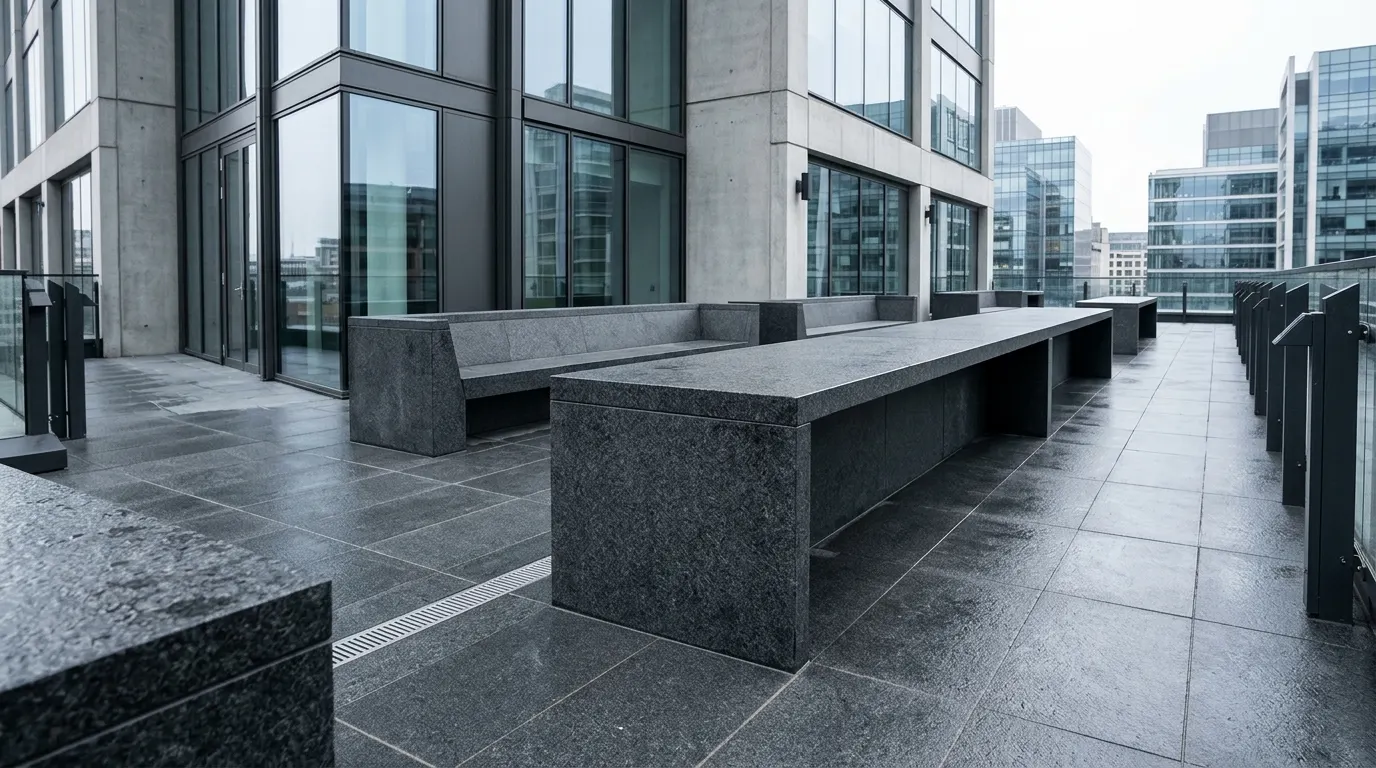
Not all outdoor uses have the same level of risk. A rooftop plaza is different from a covered outdoor kitchen, and a coastal installation is different from an inland terrace. To be precise in specifications, the material must match the exact exposure conditions.
The most common mistakes in outdoor stone specifications come from treating all outdoor uses as the same. No, they aren’t. An outdoor kitchen that is fully covered and in a moderate climate (no direct UV, little freeze-thaw) is very different from an exposed rooftop terrace in Chicago or a pool surround in a coastal South Carolina property. The key to long-lasting outdoor stone work is making sure that the material specification matches the actual conditions of exposure.
| INDUSTRY DATA — NFSI (National Floor Safety Institute)
The NFSI says that about 55% of all slip-and-fall accidents in businesses happen on wet floors. For outdoor stone specifications, the finish on the surface is a very important safety factor. Polished granite (R9) should not be used outside when it is wet. Outdoor walkways, pool surrounds, and terrace surfaces should have flamed, brushed, or honed finishes that get R11+ ratings. There is no worse phone call to make than the one where you tell a site manager that the stone either broke or is making the site unsafe, and both problems could have been avoided at the spec stage. The outdoor project decision table below shows the right material specifications and important notes for each type of project. |
For outdoor pool decks and wet terraces, always ask for a flamed or brushed granite finish with a wet slip resistance rating of R11 or higher. In these situations, polished finishes are a liability specification.
| Project Type | Recommended Material | Key Specification Note |
| Exterior cladding (commercial) | Granite — honed or flamed finish | Specify R11+ slip rating for walkways |
| Rooftop terrace counters | Granite (Level 2+, sealed) | Seal before install; re-seal every 18 months |
| Hotel pool surrounds | Granite (flamed/brushed) | Never polished — slip hazard wet |
| Outdoor kitchen countertops | Granite (Level 2–3, sealed) | Quartz void in most outdoor warranties |
| Commercial plaza pavers | Granite only | Freeze-thaw cycling eliminates quartz |
| Coastal/marine environments | Granite (salt-resistant sealant) | Test salt spray resistance before order |
| Covered outdoor areas (partial UV) | Granite preferred; quartz if fully covered | Assess UV penetration before quartz spec |
| Interior lobbies | Quartz or granite — both suitable | Quartz offers better batch consistency |
| Commercial kitchens (indoor) | Quartz — hygiene advantage | NSF certification check for food prep zones |
| High-traffic retail counters | Quartz (engineered, consistent) | Match colour across multiple batches |
- Where Quartz Has a Real Advantage: Indoor Uses
Quartz has three real advantages over granite for commercial countertops, reception areas, and vanities: it doesn’t absorb water, the color stays the same from batch to batch, and it costs less to maintain over time.
The indoor environment takes away the two things that make quartz weak: exposure to UV light and freeze-thaw cycles. What is left is a material that is almost completely non-porous (about 0.02%), has a very hard surface, and is as consistent as an engineered product. If a contractor is providing 40 matching countertops for a hotel renovation, the ability to guarantee color consistency across batches is a real operational advantage that natural stone can’t match with the same level of reliability.
| INDUSTRY DATA — NKBA (National Kitchen & Bath Association)
According to the NKBA 2025 Professional Survey, 61% of commercial kitchen and hospitality designers choose engineered quartz for interior countertops. The top three reasons for this choice are hygiene certifications, batch consistency, and ease of maintenance. Source: nkba.org — 2025 Survey of Professional Designers |
Standards for hygiene and food service
Quartz has a specific benefit for commercial kitchens and food prep areas: its non-porous surface doesn’t trap bacteria like unsealed or poorly sealed natural stone can. NSF International certifies some quartz products for use in commercial kitchens, which is important for any installation that will be checked for health. Contractors who choose surfaces for restaurant kitchens, hotel catering prep areas, or institutional food-service areas should make sure they are NSF-certified before they install them, not after.
| Short answer: When ordering commercial food prep surfaces, make sure they are NSF-certified quartz and double-check the certification. To stay clean, granite used in places where food is prepared must be sealed and re-sealed on a regular basis that is recorded. |
For big commercial runs, batch consistency
By definition, natural stone is different. The veining, mineral distribution, and color tone of each slab taken from the same quarry block will be different. This natural variation makes it necessary to carefully choose and plan the layout of the slabs for a stylish hotel lobby where visual continuity across 30 linear meters of countertop is a design requirement. As an engineered product, quartz has much better batch consistency. For example, the same color code ordered six months apart will match much better than the same natural stone specification.
It’s much easier to talk about material consistency before the order goes in than after the site manager sees that the counter at position 14 doesn’t match position 1.
| Operational Note for Pack Universe Supply
Pack Universe Supply checks the available batch stock for quartz specifications at the time of order for large indoor commercial runs that need batch consistency. Before placing a big order for granite, we suggest looking at physical slab samples for indoor feature applications. Get in touch with our Charleston or Burlington team to set up a time to look over the samples. packuniversesupply.com | +1 704-951-7822 |
- Cost of Living: Outdoor Granite vs. Indoor Quartz
If the initial specification is correct, both properly specified outdoor granite and indoor quartz have an acceptable total cost of ownership over a 10-year project lifecycle. A misspecified material in the wrong place takes away any cost benefit.
When doing a lifecycle cost analysis for stone surfaces, you need to think about four things: the cost of the materials, the cost of installation, the cost of maintenance, and the chance of needing to replace them early. The last variable is the one that is most often left out of the first specification and the one that is most likely to make the total cost go up when a material is misspecified.
| INDUSTRY DATA — NAHB (National Association of Home Builders)
NAHB’s research on the costs of commercial surface materials found that early replacement, which is caused by material failure in conditions that the material wasn’t rated for, is the biggest cost driver in commercial surface projects. Contractors surveyed in northern US markets have reported early replacement rates of 30–40% within the first five years for outdoor quartz installations in freeze climates. Source: nahb.org — Research on the Cost of Commercial Construction |
The cost of outdoor granite over its lifetime is: the cost of the slab, the cost of installation, the cost of sealing at installation, and the cost of resealing every 1 to 3 years. For a well-planned granite installation in a temperate climate, this means that the total cost over ten years is about $85–130 per square foot installed. If outdoor quartz breaks before its time, the same calculation includes the original cost of installation and the cost of replacing it, which can easily add up to $180 to $250 per square foot over the same 10-year period.
A properly planned outdoor granite installation costs about $85 to $130 per square foot over 10 years, including maintenance for sealing. An outdoor quartz installation that needs to be replaced early in a cold climate can cost $180–250 per square foot over the same time period.
Most of these cost overruns happen after a problem, not before one. The conversation about the specifications is free. The new part is not.
Rule of thumb: The material that is rated correctly for the actual exposure conditions is always the cheapest long-term specification, not the one that costs the least to buy at first.
| Pack Universe Supply sells granite and quartz in bulk to contractors and developers in the US and Canada.
Are you ready to buy granite or quartz in bulk? Pack Universe Supply ships directly to builders, contractors, and developers all over the US and Canada. No markup at the store. Grade that stays the same. Prices for bulk orders are available. USA: +1 704-951-7822 | Canada: +1 (647) 362-1907 | packuniversesupply.com |
Decision
Granite is the only option for outdoor commercial projects. Quartz resin binders don’t work well in UV light, freeze-thaw cycles, and uncontrolled moisture, and these problems can’t be fixed and aren’t covered by the manufacturer’s warranty.
Quartz is better for high-turnover countertops and vanities in indoor commercial settings because it is more hygienic, consistent from batch to batch, and requires less maintenance.
If a project covers both environments, make sure to list each one separately and don’t use the same material to cover both. The performance needs are very different.
Getting this specification right at the planning stage helps contractors avoid the biggest cost increase in commercial stone projects, which is having to replace materials early because they don’t fit with the environment.
| Guides
→ Is granite or quartz better for commercial countertops? LINK: /blog/granite-vs-quartz-commercial-countertops → What are the differences between Level 1, Level 2, and Level 3 granite? LINK: /blog/granite-grades-level-1-2-3
|
Sam Michele has 15 year been supplying wholesale building materials to commercial contractors and developers in the US and Canada for more than [X] years. Pack Universe Supply is based in Charleston, SC, and Burlington, ON, and sells granite, quartz, and engineered stone in large quantities to builders, fabricators, and project developers.