Why Lot Matching Matters on Multi-Unit Stone Projects — and How to Get It Right [2026]
Why Lot Matching Matters on Multi-Unit Stone Projects — and How to Get It Right [2026]
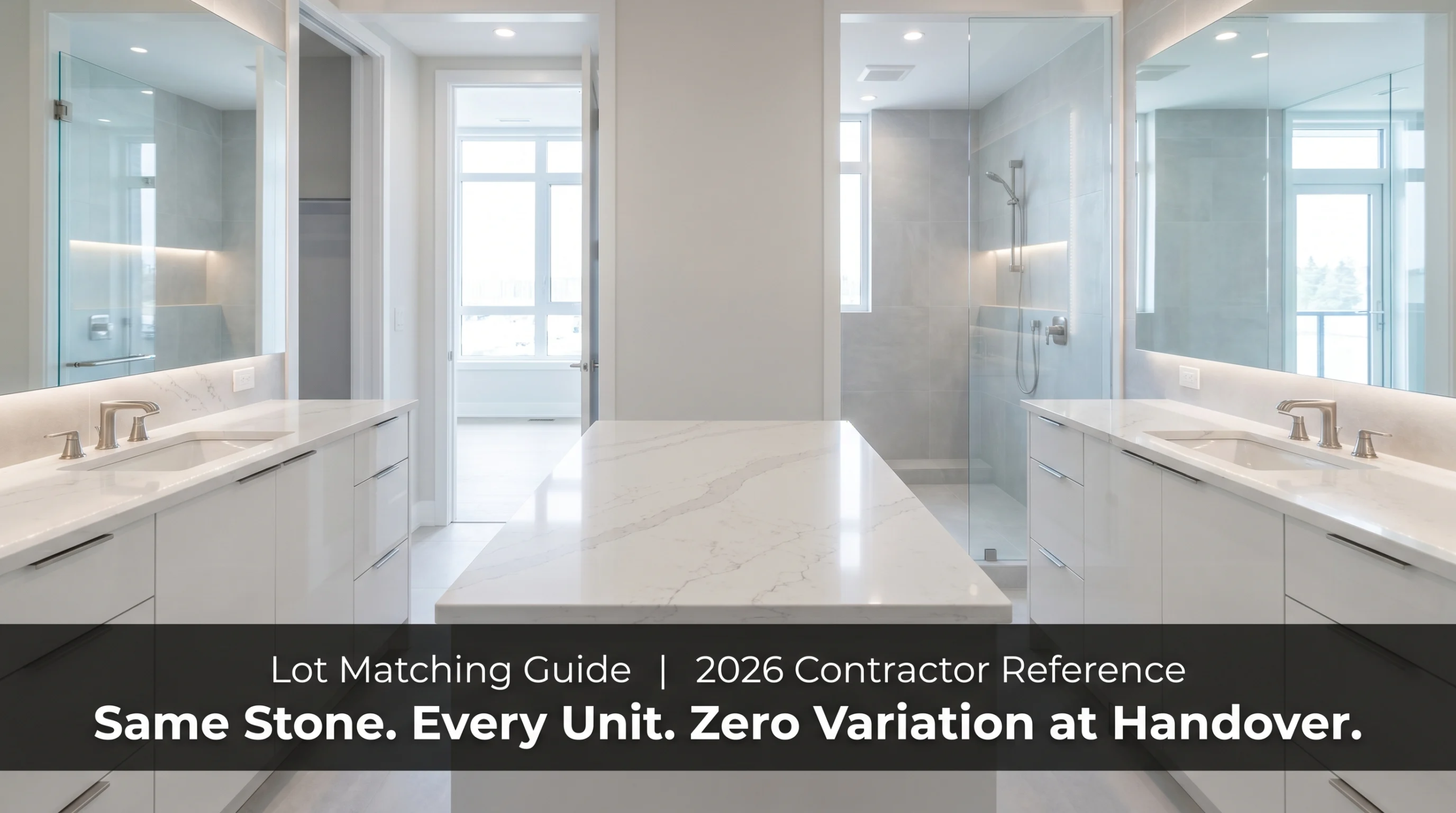
The complete 2026 guide to book-matched stone panels for contractors — what book-matching is, how it is produced, which stone types produce the best results, a 7-stone-type quality reference table, a 12-application specification guide, the ordering requirements specific to book-matched projects, and the installation considerations that separate a successful book-match from a failed one. Data from MIA+BSI, NSI, and NKBA throughout.
Why does lot matching matter on multi-unit stone projects — and what happens when it is skipped?
Book-matched stone panels are created by cutting a stone slab in half and opening the two halves like a book — so the natural veining pattern mirrors perfectly across the join line, creating a symmetrical butterfly pattern. The result is a wall panel, feature surface, or cladding element that looks architecturally composed rather than naturally random. Book-matching is specified for hotel lobbies, luxury residential feature walls, high-end commercial reception areas, and any surface where the stone is intended to be a deliberate visual statement rather than a background material.
| When book-matching is the right specification:
Hotel lobby feature wall: Book-matched stone panels create a symmetrical grand statement that signals the hotel’s quality tier to every arriving guest. Luxury residential fireplace surround: The mirrored veining pattern of book-matched marble turns a fireplace surround into a piece of architecture. Corporate headquarters reception: A book-matched stone reception wall communicates permanence, quality, and considered design at a level no other material achieves. High-end bathroom feature wall: Book-matched marble panels behind a freestanding bath create the defining luxury bathroom visual in 2026. Retail flagship store — feature surface: Book-matched stone differentiates a flagship store from its competitors and communicates brand values through material quality. Book-matched stone panels available to order at Pack Universe Supply — wholesale contractor pricing, confirmed pair sourcing, nationwide delivery. Call +1 704-951-7822 | packuniversesupply.com/request-a-quote |
Book-matched stone panels are the specification that separates a luxury interior from a premium one — and they are more accessible to contractors than most assume, provided the ordering process is correct.
Most contractors encounter book-matched stone as a design specification from an architect or interior designer who wants a feature wall that looks like it was composed rather than installed. The brief usually arrives as a reference image — a hotel lobby or luxury bathroom photograph showing a floor-to-ceiling marble wall where the veining mirrors perfectly across a join line, creating a symmetrical butterfly pattern. The brief is clear. The specification process is less so.
Book-matching requires specific ordering — matched pairs from consecutive slabs cut from the same block — and specific installation discipline to ensure the mirrored pattern aligns correctly across the join. This guide covers both: the specification questions that must be answered before the order is placed, and the installation requirements that ensure the book-match delivers what the design brief promised. Data from MIA+BSI fabrication standards and NSI throughout.
- What Book-Matching Is — and How It Is Produced
Book-matching is produced by cutting a stone slab in half through its depth and opening the two halves like the pages of a book — so the natural veining pattern on one half mirrors the veining pattern on the other, creating a symmetrical reflection across the join line.
When a stone slab is cut from a block, the cut face exposes the mineral structure and veining pattern within the stone at that exact point in the block. If a second cut is made immediately adjacent to the first — running parallel through the same block — the two cut faces are mirror images of each other. Placed side by side with their cut faces showing, the veining on each slab reflects the veining on the other, creating the symmetrical butterfly pattern that defines book-matched stone.
The quality of the book-match effect depends entirely on the stone type and the drama of its veining. A stone with bold, flowing veining — Calacatta marble with its dramatic gold and grey veins, Statuario marble with its fine grey movement — creates a book-match of extraordinary visual impact. A stone with minimal veining — a uniform grey granite, a consistent engineered quartz — creates no visible book-match effect because there is no veining pattern to mirror.
| Quick answer:
Book-matched stone definition: two consecutive slabs cut from the same block, opened like a book so the natural veining mirrors symmetrically across the join line. The effect requires dramatic natural veining to be visible. Marble — particularly Calacatta and Statuario — produces the most visually striking book-match of any stone type. |
Four-Match and Eight-Match Extensions
A standard book-match uses two slabs and creates one mirrored join. A four-match extends this by using four consecutive slabs to create a four-way symmetrical pattern around a central point — also called a ‘butterfly’ or ‘radial’ match. An eight-match extends further to create an octagonal symmetrical pattern typically used for floor medallions, ceiling panels, and large decorative feature installations. Each level of matching requires more slabs from the same consecutive block cut and increases the material cost and fabrication complexity proportionally.
| Industry Data:
MIA+BSI fabrication standards 2025: book-matching requires consecutive slabs from the same quarry block cut — slabs from different blocks of the same named stone will not produce a true mirrored pattern because the veining position within the block differs. NSI specification guidelines: book-matched stone panels are a growing specification in luxury commercial and residential projects — specified in 28 percent of luxury hospitality feature wall projects in the USA in 2025, up from 14 percent in 2020. NKBA 2025: book-matched marble bathroom feature walls are cited as the defining luxury bathroom specification in 2026 — specified behind freestanding baths, as shower feature walls, and as vanity wall panels in the luxury residential tier. Sources: MIA+BSI (marble-institute.com) | NSI (naturalstoneinstitute.org) | NKBA 2025 (nkba.org) |
The one thing to remember:
Book-matching requires consecutive slabs from the same quarry block cut — this cannot be substituted with slabs from different blocks of the same named stone. The wholesale supplier must be able to confirm that matched pairs are available from a confirmed consecutive block cut before any book-match order is placed.
The stone type quality reference table below shows which stone types produce the strongest book-match effect — with visual character and best application for each:
- Stone Types for Book-Matching — Which Produce the Best Results
Seven stone types evaluated for book-matching — from Calacatta marble with exceptional mirrored veining to budget porcelain with printed patterns that reveal their engineered origin on close inspection.
Use this table before specifying a stone type for any book-matched project. The Book-Match Quality column reflects both the visual drama of the mirrored pattern and the reliability of producing a consistent mirror across a pair of consecutive slabs — which depends on the stone’s veining character and the quarry’s ability to supply confirmed consecutive pairs.
| Stone Type | Book-Match Quality | Visual Character | Best Application |
| Calacatta marble | Exceptional — bold dramatic veining creates the most striking butterfly pattern of any marble type | White background with bold gold or grey veining that mirrors dramatically across the book-match join | Hotel lobbies, luxury residential feature walls, fireplace surrounds, bathroom feature walls |
| Statuario marble | Exceptional — fine grey veining creates an elegant symmetrical pattern | White background with fine to medium grey veining — more refined than Calacatta, less dramatic | Corporate headquarters reception, luxury residential, premium boutique hotel bathroom |
| Arabescato marble | Excellent — complex grey and white veining creates an intricate mirrored pattern | Off-white with complex grey and green-grey veining — rich and detailed when book-matched | Boutique hotel bathrooms, high-end residential, specialist architectural wall panels |
| Onyx | Outstanding — translucent mineral structure creates extraordinary mirrored patterns, especially when backlit | Translucent with dramatic colour banding — green, honey, red, or white. Backlit book-matched onyx is unique | Reception desk fronts, bar feature panels, backlit wall features in luxury hospitality |
| Quartzite — veined | Very good — natural veining creates a strong pattern, though less predictable than marble | White or grey with dramatic iron-oxide veining — more linear and architectural than marble | Contemporary luxury residential, corporate office feature walls, modern hotel lobby |
| Granite — high veining | Good — dense mineral structure creates geometric patterns rather than flowing veining | Dramatic mineral crystalline patterns — bold but less fluid than marble veining | Bold commercial feature walls, executive suite reception, strong architectural statements |
| Porcelain — marble look | Limited — printed pattern can be book-matched but the repetition of the print is visible on close inspection | Consistent printed pattern — less dramatic than natural stone but achievable at lower cost | Mid-range commercial feature walls where budget does not support natural stone book-matching |
| Quick answer:
Calacatta and Statuario marble produce the strongest book-match effect of any stone type available to contractors. Both have dramatic natural veining that creates an unmistakable symmetrical pattern when mirrored. Onyx produces an extraordinary backlit effect. For projects where natural stone book-matching is beyond budget, large-format porcelain with a printed marble-look pattern can approximate the visual at significantly lower cost — but the printed repetition is visible on close inspection. |
The architect who specified a Calacatta marble book-match and receives a Carrara marble book-match has a legitimate complaint — not because Carrara is inferior stone but because Carrara’s finer, more subtle veining creates a significantly less dramatic mirrored effect. Stone type confirmation in book-match projects is not interchangeable.
- When to Specify Book-Matched Stone Panels — Application Reference
Book-matched stone panels are appropriate for specific high-impact applications — and inappropriate for others where the cost and installation complexity are not matched by the application’s visual register.
The 12-application reference table below shows where book-matching is appropriate, where it is not, and the specification notes for each:
| Application | Specify? | Specification Notes |
| Hotel lobby feature wall | ✅ Yes — ideal | The defining book-match application. Full-height book-matched marble panels create the visual anchor of the lobby. Calacatta or Statuario marble. 3cm panels. Professional installation essential. |
| Luxury residential fireplace surround | ✅ Yes — ideal | Book-matched marble surround panels turn a fireplace into the room’s centrepiece. Calacatta or Arabescato. Polished or honed finish. 2cm or 3cm depending on fixing method. |
| Corporate HQ reception wall | ✅ Yes | Book-matched stone reception wall communicates permanence and quality. Statuario or premium granite. Polished. Floor-to-ceiling panels for maximum impact. |
| Luxury bathroom — behind freestanding bath | ✅ Yes — defining specification | The 2026 luxury bathroom feature specification. Book-matched marble panels behind a freestanding bath. Honed Calacatta or Statuario. 3cm for structural wall panels. |
| Hotel bathroom — luxury suite | ✅ Yes — boutique tier | Book-matching appropriate for luxury suite bathrooms. Smaller panel area than lobby. Arabescato or Statuario. Adds significant room quality signal. |
| Retail flagship — brand feature wall | ✅ Yes | Brand differentiation through material quality. Book-matched stone feature wall in flagship retail communicates the brand at a level no manufactured material achieves. |
| Restaurant — bar back feature | ✅ Yes | Onyx book-matched panels backlit behind the bar. The defining premium bar specification in hospitality. Extraordinary visual impact. Specialist fixing and lighting required. |
| Standard hotel bathroom | ❌ No — not appropriate | Book-matching is inappropriate for standard hotel bathrooms — the panel cost and installation complexity do not match the room tier. Specify standard polished stone or quartz. |
| Residential kitchen splashback | ⚠ Consider carefully | Book-matched stone splashback panels are possible but fragile near cooking surfaces. Thermal shock risk on marble from cooking steam. Specify porcelain or granite if book-match is required near hob. |
| Commercial office partitions | ❌ No — rarely appropriate | Book-matched stone panels on office partitions are not structurally practical without specialist framing. Specify standard cladding panels instead. |
| Exterior building facade | ⚠ Specialist only | Book-matching on exterior facades requires specialist weatherproof fixing systems, thermal movement allowance, and stone types rated for exterior exposure. Not a standard contractor specification. |
| Budget residential feature wall | ❌ No | Natural stone book-matching is not cost-effective at budget residential scale. Consider large-format porcelain book-match print as an alternative. |
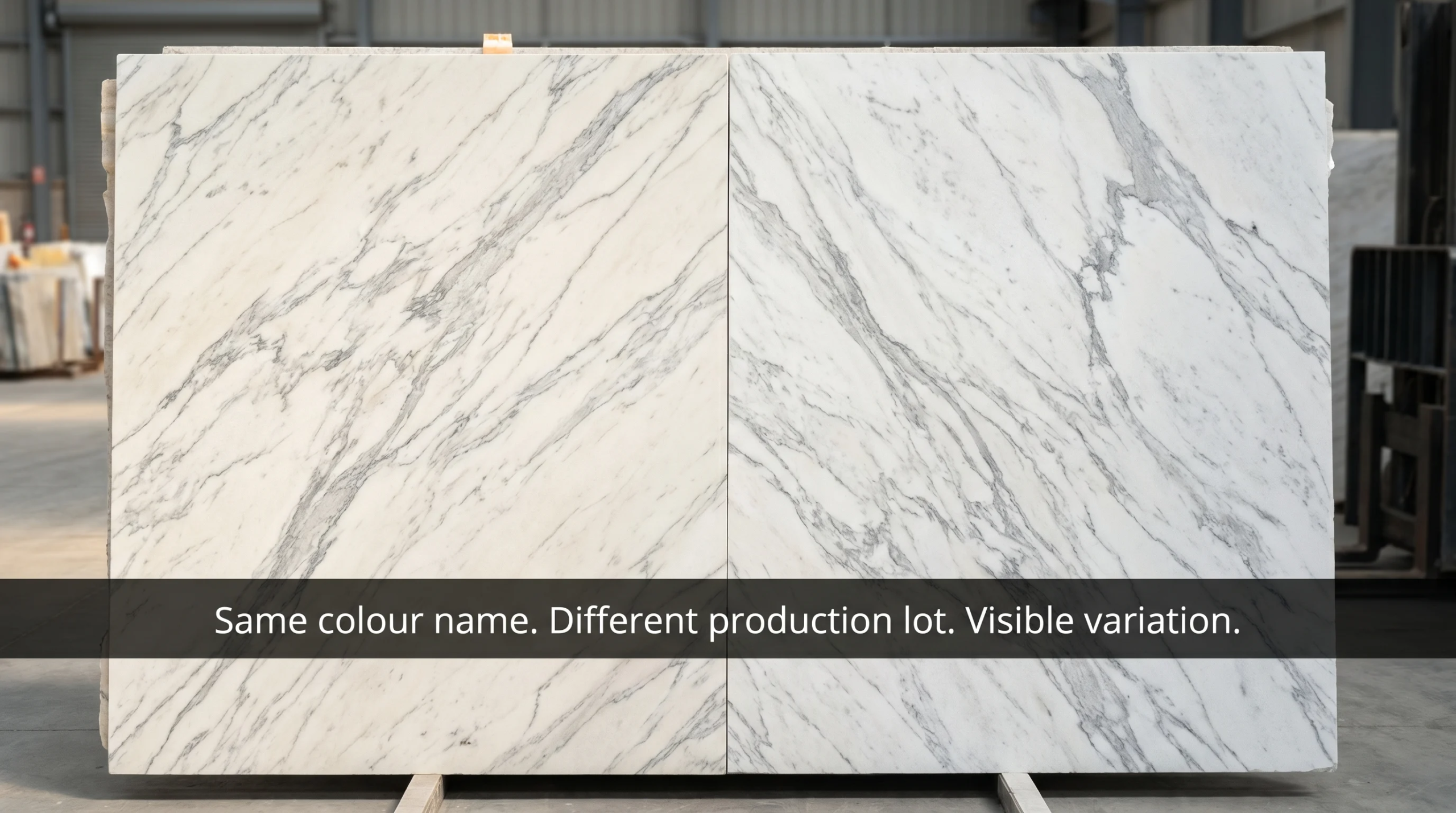
The book-match effect that was specified and paid for is not delivered.
4.Phased Renovations — The Highest-Risk Lot Matching Scenario
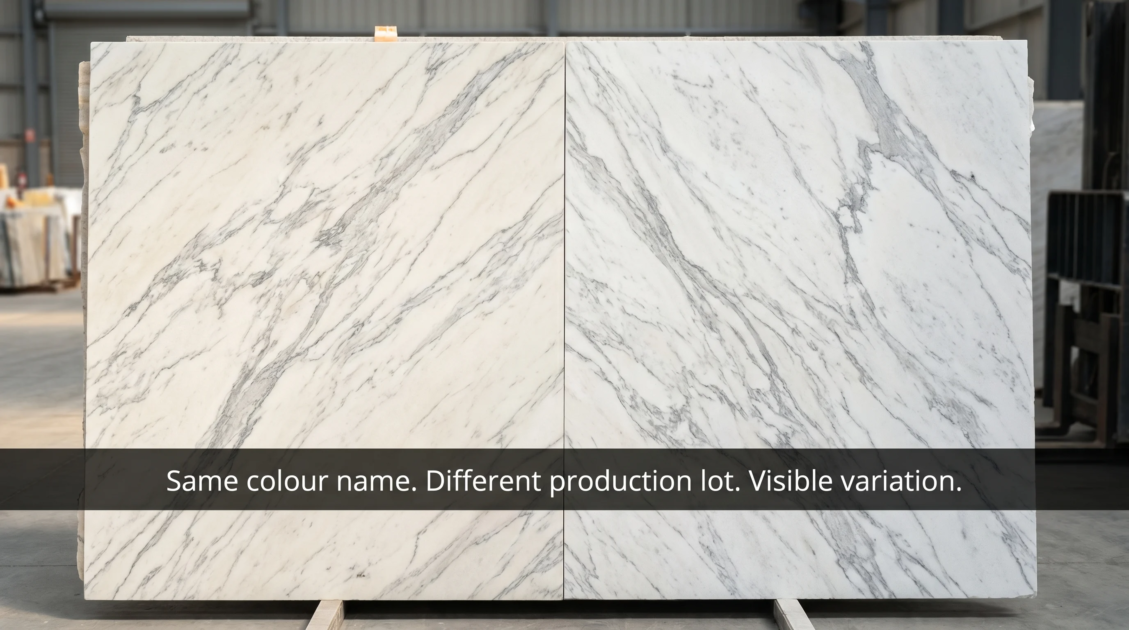
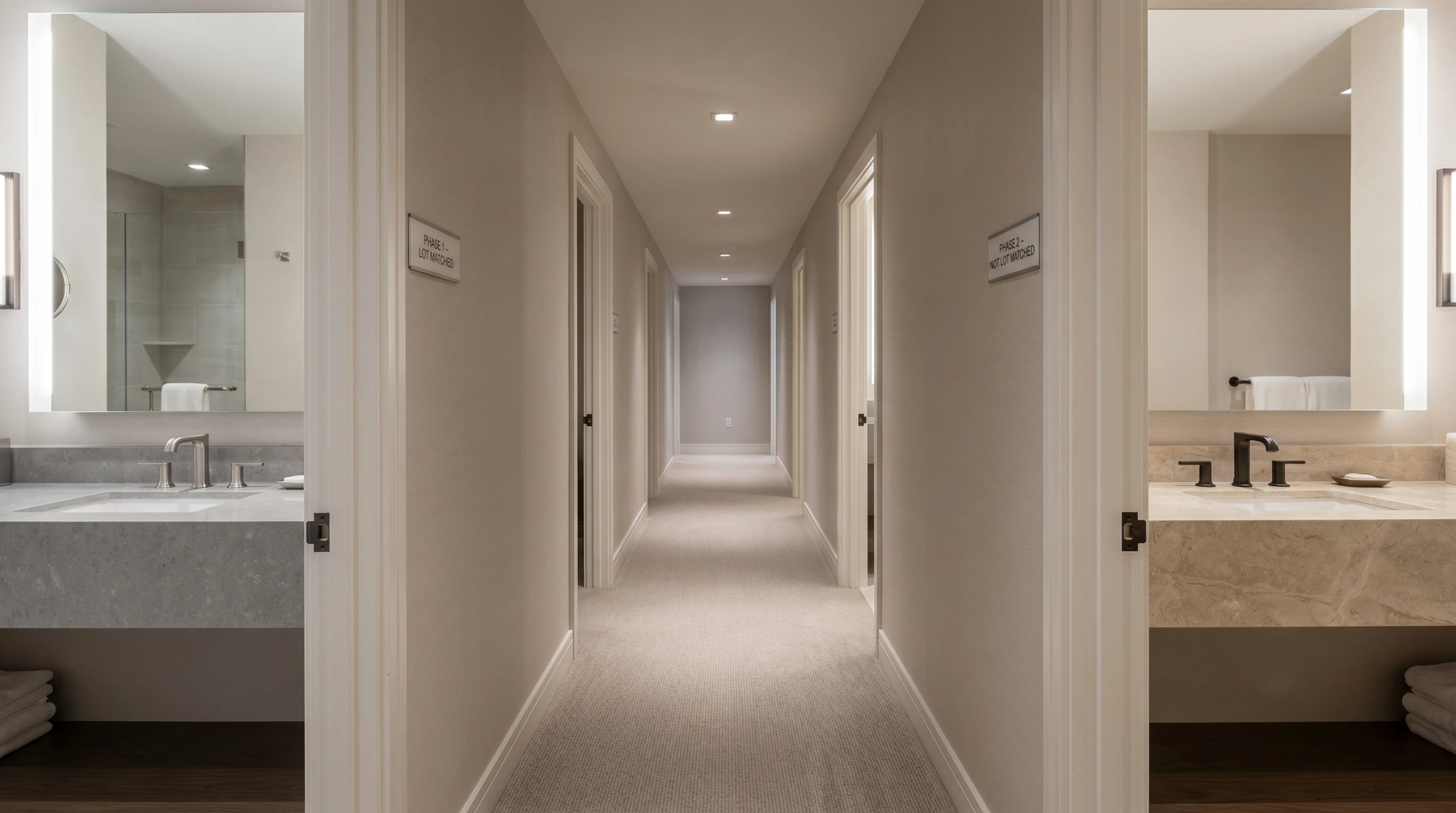
Phased hotel and residential renovations are the highest-risk lot matching scenario — because the gap between Phase 1 and Phase 2 ordering is long enough for the original production lot to sell out, and the result is visible across the entire property.
A hotel renovation completed in phases — typically floor by floor or wing by wing while the property remains operational — places Phase 1 stone orders months or years before Phase 2. The renovation contractor confirms the stone specification in Phase 1, installs correctly, and moves on. Phase 2 is ordered when the next floor becomes available. If the original production lot was not reserved in full before Phase 1 shipped, Phase 2 stone arrives from whatever is available at that time — which may be a different lot of the same named stone.
The tonal difference between Phase 1 and Phase 2 stone is not visible in isolation. It becomes visible when a guest walks from a corridor renovated in Phase 1 past rooms renovated in Phase 2. The bathroom vanity in room 201 looks warmer than the bathroom vanity in room 301. The stone is the same name, the same supplier, the same grade. It is a different lot. And there is no correction available that does not involve replacing one phase of stone entirely.
How to Protect a Phased Renovation From Lot Variation
- Calculate the full renovation quantity before Phase 1 ships: Include all phases, all rooms, all stone applications across the full property scope. Add 20% waste allowance plus one slab per 10 units as contingency.
- Reserve the full quantity from a confirmed lot before Phase 1 ships: Ask the supplier to hold all slabs against the confirmed lot number. Get the reservation confirmed in writing.
- Agree a delivery schedule with the supplier: Phase 1 delivery on the confirmed date. Phase 2 delivery drawn from the same reserved lot on the Phase 2 start date. Each delivery verified against the lot reference.
- Hold contingency stock in a secure site store: One slab per 10 rooms held on-site or at the warehouse after Phase 1 installation — for damage replacements during construction and for future maintenance events.
The hotel renovation contractor who tells the general manager at Phase 2 completion that the stone variation between floors is a ‘natural characteristic of the material’ is not wrong about the characteristic. They are wrong about when that conversation should have happened. It should have happened before Phase 1 was ordered — not as an explanation of a visible quality failure at handover.
| Quick answer:
Phased renovation lot matching rule: calculate and reserve the full renovation quantity from a single confirmed lot before Phase 1 ships. Every phase of the renovation draws from the same reserved lot. Every delivery is verified against the lot reference before slabs are accepted. No exceptions on any phased renovation project. |
-
Installation — What Makes a Book-Match Succeed or Fail on Site
Three installation decisions determine whether the mirrored pattern reads correctly in the finished space.
Join Line Alignment
Any vertical or horizontal offset at the join line breaks the symmetry and undermines the entire visual effect. This requires that the two slabs are cut to identical dimensions at the fabrication stage and that the installation team is experienced with book-match installation — setting one panel first, confirming the join line position precisely, and then setting the second panel against it.
Grouting and Joint Treatment
The join between book-matched panels should be as tight as practically achievable — typically a hairline joint filled with colour-matched epoxy grout. A wide grout joint at the book-match seam interrupts the mirrored veining pattern and reduces the visual impact of the installation. For polished marble book-match panels, the grout colour should match the stone’s background colour — not the veining colour. For honed panels, a slightly recessed hairline joint with matching colour fill is the standard specification.
Panel Orientation and Direction
The book-match can be oriented in two ways: with the mirrored veining running vertically (the most common orientation for wall panels, creating bilateral symmetry) or horizontally (creating a landscape symmetry more commonly used for floor medallions and ceiling panels). The orientation must be confirmed against the architectural drawings before installation begins — reversing the orientation after panels are fixed requires complete removal and refixing.
The book-match that is installed with a 5mm grout joint because the installer did not have the right epoxy grout on site is not a book-match. It is an expensive wall tile installation. The joint treatment specification belongs in the pre-installation briefing, not in a site conversation on the day the panels are being fixed.
| Quick answer:
Three installation requirements for a successful book-match: precise join line alignment with no offset, hairline joint with colour-matched epoxy grout, and confirmed panel orientation before installation begins. All three must be confirmed in the installation briefing before any panel is fixed — not corrected after. The architect who visits the completed hotel lobby and sees the book-matched marble wall for the first time is either experiencing the most satisfying material specification result in the project — or discovering that someone made a decision on site that broke the symmetry. The difference between the two outcomes is entirely in the pre-installation briefing. |
| How Pack Universe Supply supports book-matched stone panel orders:
Pack Universe Supply can source book-matched stone pairs — confirmed consecutive cuts from the same quarry block — for luxury residential and commercial hospitality projects. For book-match orders: we confirm consecutive block cut availability before any order is placed, provide pre-delivery layout photographs of matched pairs in mirrored orientation for client and designer approval, and confirm panel thickness against the specified fixing system. For projects requiring stone types not currently in stock: we can source confirmed matched pairs from our supplier network with confirmed consecutive cut documentation. Call before placing any book-match order: +1 704-951-7822. |
| Order Book-Matched Stone Panels — Confirmed Consecutive Pairs, Pre-Delivery Sign-Off:
Calacatta, Statuario, Arabescato marble — confirmed consecutive block cuts, pre-delivery layout photographs. Charleston SC (USA) | Burlington ON (Canada) | Nationwide delivery. → Request a Quote: packuniversesupply.com/request-a-quote → Call: +1 704-951-7822 (Mon–Fri, 8am–5pm EST) → Canada: +1 (647) 362-1907 |
| Verdict — Book-Matched Stone Panels: What They Are and When to Specify Them
Verdict: Book-matched stone panels are the specification for feature walls, fireplace surrounds, luxury bathroom panels, hotel lobby walls, and high-end commercial reception surfaces where natural stone is intended to be a visual statement rather than a background material. They are not appropriate for standard hotel bathrooms, budget residential, or commercial partition walls. The stone types that produce the most striking book-match are Calacatta and Statuario marble — both have the dramatic bold veining that creates an unmistakable symmetrical pattern when mirrored. Onyx produces an extraordinary effect when backlit. Porcelain printed book-match approximates the visual at lower cost but reveals its engineered origin on close inspection. The ordering requirement that cannot be substituted: confirmed consecutive slabs from the same quarry block cut. Any supplier who cannot confirm this cannot guarantee a true book-match. Request a pre-delivery layout photograph of the matched pair in mirrored orientation before the slabs leave the warehouse. The installation requirement that determines success or failure: join line precision and hairline joint treatment. Both must be in the pre-installation briefing. Neither can be corrected cost-effectively after panels are fixed. |