What Wear Layer Should Contractors Specify for Commercial SPC Flooring? [2026 Guide]
What Wear Layer Should Contractors Specify for Commercial SPC Flooring? [2026 Guide]
The 2026 complete guide to SPC flooring wear layer specification for contractors – what the wear layer is, why it determines commercial service life, the complete AC1-AC6 thickness reference table, a 12-application commercial specification guide, how to verify wear layer on supplier datasheets, and the ordering mistake that puts an 8 mil residential product into a 20 mil commercial application. ASTM & NSF data throughout.
What wear layer should contractors insist on for commercial SPC flooring?
The wear layer is the clear, protective layer that sits on top of the SPC flooring’s photographic print – and the one specification variable that determines how long the floor looks acceptable in commercial use. For commercial uses, 20 mil (0.5mm) is the minimum. Heavy commercial 28 mil (0.7mm) 40 mil (1.0mm) for health care, education & heavy commercial traffic. The biggest ordering mistake in commercial SPC flooring is ordering a residential wear layer—6 or 8 mil—in a commercial application where it will show wear within months.
Wear layer specification by application:
Call 704-951-7822 | packuniversesupply.com/request-a-quote |
The only thing that makes an SPC floor look good for a long time is the wear layer. And the most common mistake in the SPC specification for a commercial project is a wrong one.
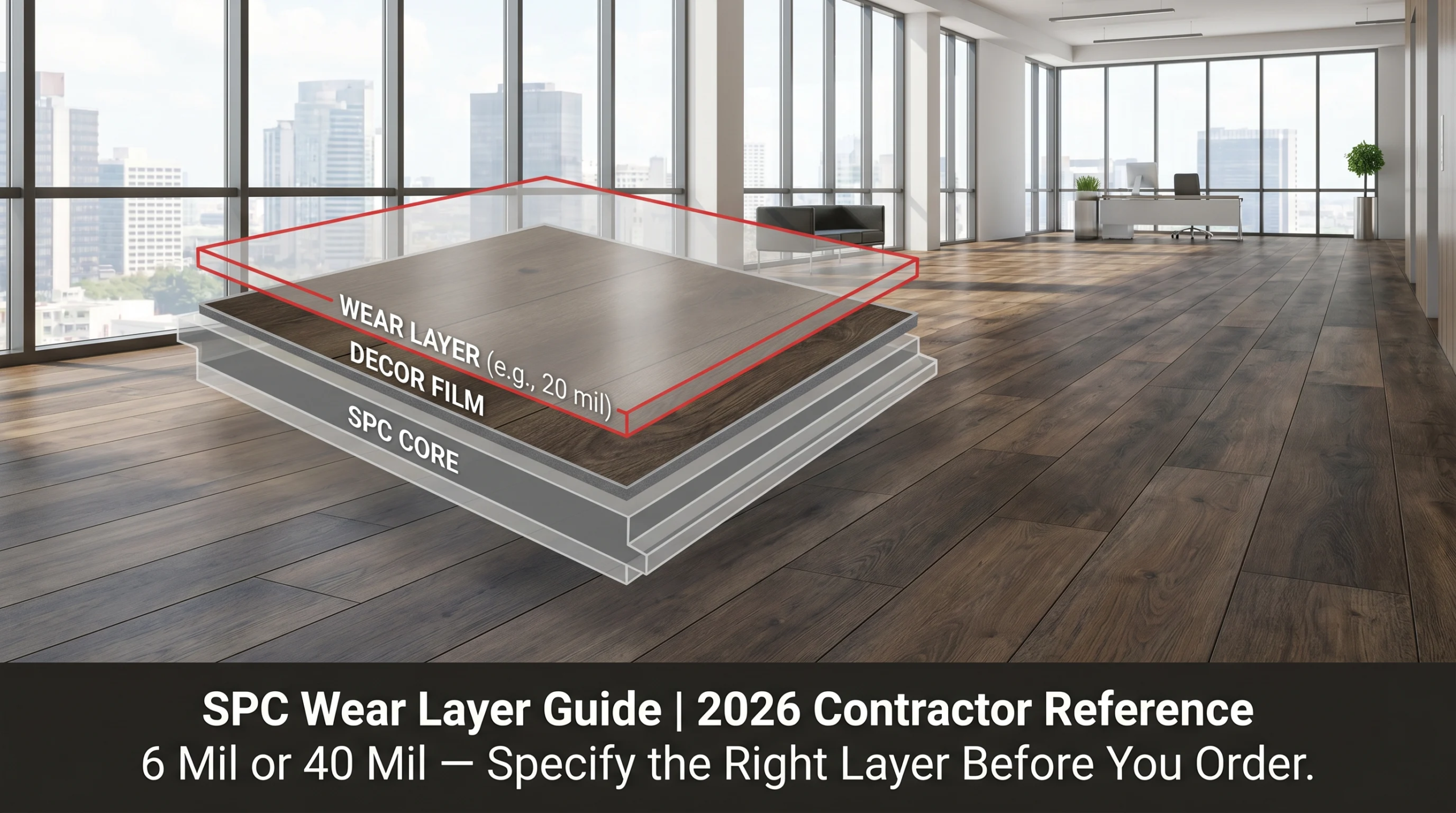
SPC flooring consists of four layers: the backing layer, the rigid stone-plastic composite core, the photographic print layer, and the wear layer on top. The backing, core and print are invisible in use. The wear layer is the only layer that comes in contact with traffic, cleaning chemicals, furniture legs, rolling loads and everything else the floor comes in contact with daily. When the wear layer wears out – or scratches out if it’s an under-specified layer in a commercial environment – the photographic print underneath is exposed. This print is not meant to be a floor. So visually the floor fails first before structurally failing.
This guide addresses all wear layer thicknesses from 6 mil to 40 mil, the AC classification system that standardizes commercial performance claims, the 12-application reference table that gives contractors the right specification for any project, and how to verify that the product on a supplier datasheet actually performs to the claimed wear layer. Throughout data from ASTM flooring standards.
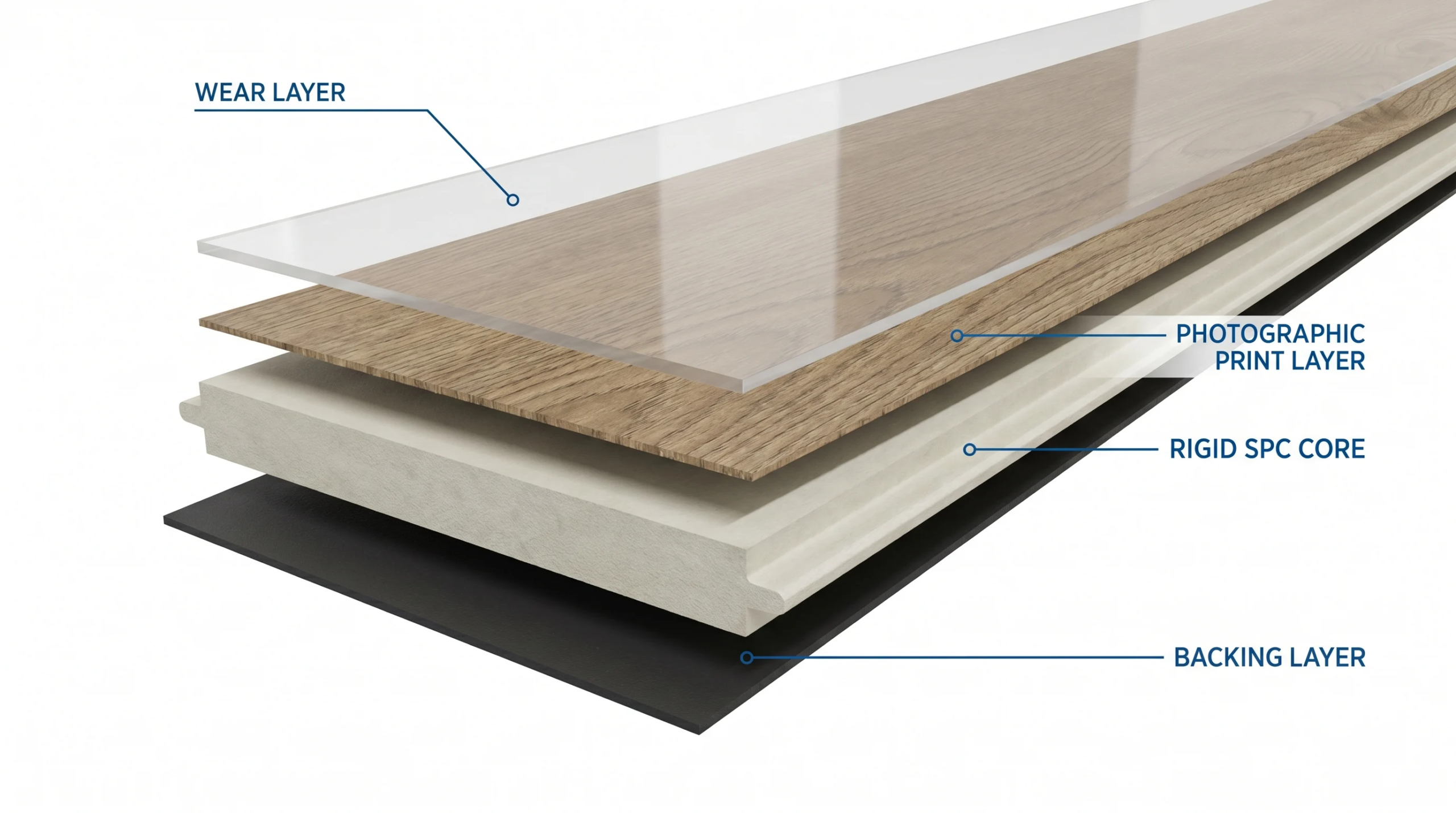
- The Wear Layer: What It Is and Why It’s the Only Specification That Matters in Commercial Life
The wear layer is a clear polyurethane or aluminum oxide reinforced coating that is bonded to the top of the photographic print of the SPC floor – the only barrier between the print and everything the floor comes into contact with in use.
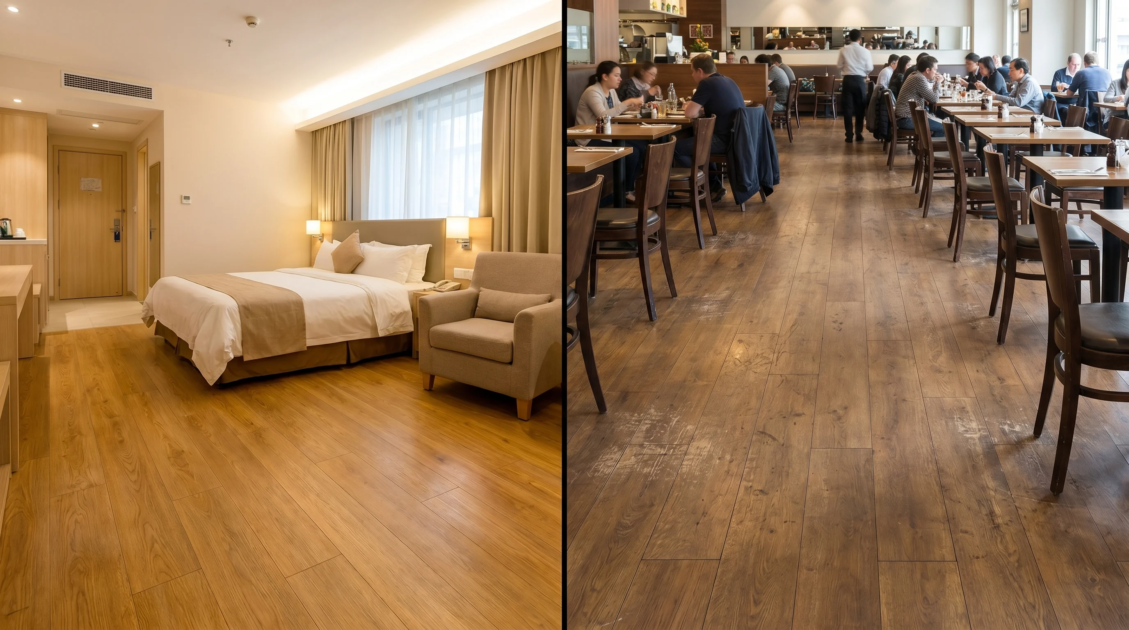
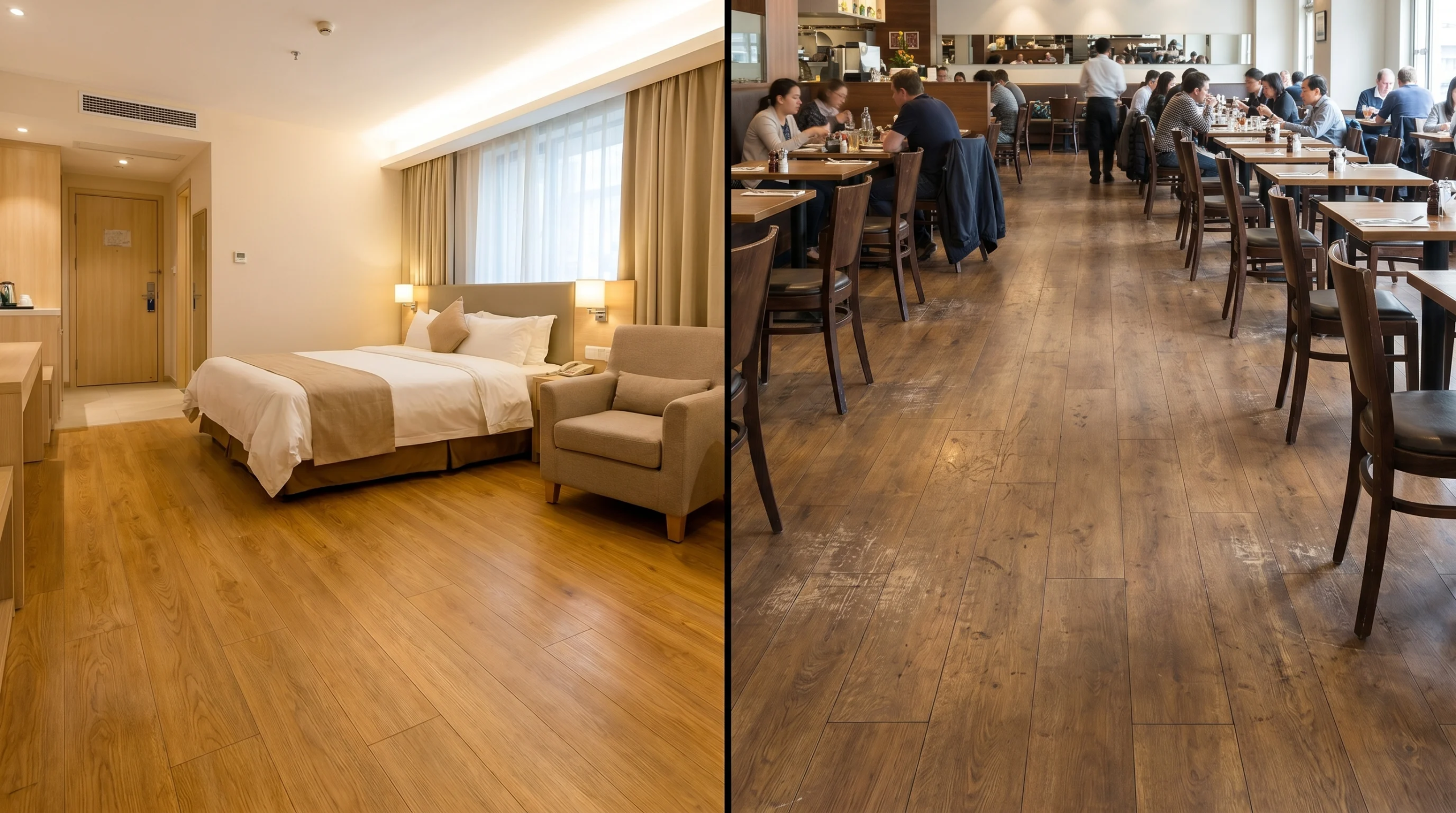
Wear layer thickness is measured in mils. One mil is one thousandth of an inch (0.0254mm). The jump from 6 mils to 40 mils is a 6.7x increase in wear layer material — and that translates directly to expected service life in commercial use. A 6 mil wear layer on a light duty residential bedroom floor will last 15 to 20 years. The same 6 mil wear layer on a hotel room floor with commercial housekeeping, rolling luggage and daily foot traffic will show visible wear in 12 to 18 months.
The wear layer also determines chemical resistance. Thicker wear layers offer greater resistance to the commercial cleaning chemicals, disinfectants and degreasing agents commonly found in commercial environments. 6 mil residential wear layer simply does not have the formulation or thickness to withstand the pH and chemical concentrations in commercial cleaning protocols without gradual degradation of the surface.
| Short answer:
Wear layer thickness is measured in mils (1 mil = 0.0254 mm). Commercial minimum is 20 mil (.5mm) . 6 mil and 8 mil products are for residential only. The most common failure with SPC flooring is the specification of a residential wear layer in a commercial application. Rather than years, the floor exhibits visible wear within months. |
| Industry Statistics:
ASTM F3261 (astm.org) – the standard for classifying rigid core SPC flooring by wear layer performance. The AC ratings (AC1–AC6) are based on ASTM tests for abrasion, impact and stain resistance. The minimum rating for commercial use is AC4 (20 mil). AC5 (28 mil) for heavy commercial use. AC6 (40 mil) for extreme commercial & healthcare. NAHB 2025 (nahb.org) — The most frequent SPC flooring warranty claim in commercial applications is for premature wear layer failure, happening almost exclusively when a residential-grade (6-12 mil) product was installed in a commercial traffic environment. |
| The only thing to remember is:
The fastest way to determine commercial suitability is the AC rating on the product datasheet. AC4 = 20 mil commercial min. AC5 = 28 mil heavy commercial. AC6 = 40 mil extreme commercial. Any product that does not have an AC rating or has an AC1-AC3 is a residential product and not suitable for commercial specification. |
The full wear layer reference table below includes all thicknesses from 6 mil to 40 mil – the AC classification, the correct commercial application and the applications each thickness must never be used in:
- The Full Wear Layer Reference – 6 Mil to 40 Mil
Six wear layer thicknesses from residential 6 mil to extreme commercial 40 mil — with AC classification; proper application; and why 6 mil and 8 mil products should NEVER be used in commercial settings.
| Wear Layer | Thickness | Traffic Class | Certification | Correct Commercial Application |
| 6 mil | 0.15mm | Residential light | AC1 | Standard residential bedrooms and low-use dry rooms only. Never specify for commercial. |
| 8 mil | 0.20mm | Residential medium | AC2 | Residential kitchens and bathrooms. Not for any commercial application. |
| 12 mil | 0.30mm | Residential heavy / light commercial | AC3 | High-use residential — kitchens, hallways, open-plan. Light commercial only where confirmed low-traffic. |
| 20 mil | 0.50mm | Commercial standard | AC4 | The commercial minimum. Hotel rooms, BTR kitchens and bathrooms, standard offices, small retail, co-working. |
| 28 mil | 0.70mm | Heavy commercial | AC5 | High-traffic retail, restaurants, hotel lobbies and corridors, gyms, open-plan corporate, busy co-working. |
| 40 mil | 1.00mm | Extreme commercial | AC6 | Healthcare, education, large-format retail, transport hubs, and any application with aggressive commercial cleaning and heavy equipment loads. |
| Short answer:
The two layers that are highlighted in red in this table – 6 mil and 8 mil – are residential products. They are often standard on commercial spec orders because commercial flooring suppliers can supply them more cheaply. They are not commercial items. 6 mil SPC flooring in a hotel room shows visible wear tracks after 12 to 18 months of commercial housekeeping use. |
Why Some Suppliers Pass on 12 Mil as Commercial
Some flooring vendors market 12 mil SPC as “suitable for light commercial use” and under very specific circumstances (small private offices, meeting rooms with low foot traffic and no commercial cleaning protocols) this may be technically defensible. 12 mil is not a commercial specification for any application that has standard commercial foot traffic, standard commercial cleaning chemicals or rolling loads. 12 mil products are classified as ASTM AC3 based on residential heavy-use performance, not commercial performance. Contractors who accept 12 mil as a commercial specification will have warranty and performance issues in 2 to 3 years in normal commercial environments.
The facilities manager who calls the installation contractor eighteen months after a hotel room fit-out to say that the flooring is showing wear tracks in the traffic path has a product failure that was entirely predictable from the spec. The £2 per square metre saving with the 8 mil product will be more than offset by the cost of early replacement. The order. The wear layer conversation takes 30 seconds. The warranty talk goes on a lot longer.
| Short answer:
General rule for any commercial SPC order: If the product datasheet does not indicate an AC4 classification or higher, the product is not a commercial specification regardless of the marketing. Request written ASTM test result & AC classification prior to accepting any SPC product for a commercial application. |
- Wear Layer by Application — Full Commercial Reference
The wear layer specification for every major commercial application, from standard hotel rooms at 20 mil to healthcare at 40 mil, along with the reason why each application needs its specified thickness.
| Commercial Application | Wear Layer | Reason |
| Hotel room — standard and mid-range | 20 mil | Rolling luggage, commercial housekeeping cleaning chemicals, standard foot traffic. 20 mil handles these conditions across a normal hotel room service life of 7–10 years. |
| Hotel room — boutique and luxury | 20–28 mil | Premium product expected at boutique tier. 28 mil provides longer service life to match the property’s refurbishment cycle and higher guest expectations. |
| Hotel lobby and corridor | 28 mil | High continuous foot traffic. Rolling luggage and trolley loads. Frequent commercial cleaning. 28 mil minimum for any hotel public area. |
| BTR apartment — kitchen and bathroom | 20 mil | Commercial-grade moisture and cleaning in residential-style use. 20 mil handles BTR tenant use across a standard 5–7 year tenancy cycle. |
| BTR apartment — bedroom and living | 12–20 mil | Lower traffic than kitchen and bathroom. 12 mil acceptable in dry living areas. 20 mil for consistency across the full unit specification. |
| Corporate open-plan office | 20–28 mil | Rolling chair loads, daily commercial cleaning, sustained foot traffic. 28 mil preferred for open-plan environments with high desk density. |
| Restaurant dining floor | 28 mil | Heavy foot traffic, dropped items, chair movement, and commercial cleaning. 20 mil will show wear within 2–3 years in a busy restaurant environment. |
| Retail store — high street | 28 mil | Sustained high-density foot traffic, shopping trolley loads, and aggressive commercial cleaning. 20 mil will show wear at entrance zones within 18 months. |
| Gym and fitness facility | 28–40 mil | Heavy equipment loads, moisture from sweat and cleaning, and abrasive cleaning products. 28 mil minimum. 40 mil where heavy weights or machines are present. |
| Healthcare — clinical areas | 40 mil | Hospital-grade disinfectants, heavy medical equipment loads, and seamless hygiene requirements. 40 mil with FloorScore or GREENGUARD Gold certification. |
| Education — classrooms | 20–28 mil | Sustained foot traffic and daily cleaning. 20 mil for primary classrooms. 28 mil for corridors, common areas, and secondary school high-traffic zones. |
| Co-working space | 20 mil | Variable commercial loading. 20 mil handles diverse user activity and daily cleaning across standard co-working environments. |
| Short answer:
Both restaurant and the high street retail rows in this table specify 28 mil, not 20 mil. Both environments share three conditions that accelerate wear layer degradation: sustained high-density foot traffic, abrasive commercial cleaning chemicals and physical impact from equipment and furniture. 20 mil will show visible wear in entrance zones and high-traffic paths in these environments in 18 to 24 months. 28 mil. Same conditions, extends commercial service life to 5 to 7 years. |
| The retail client who specified 20 mil SPC for their flagship high street store to save £1.50 per square metre will be renewing the entrance zone flooring within two years. The 28 mil product is £1.50 per square metre more at time of order. Two years and a full floor replacement, not to mention installation disruption. The question that the 8 percent specification decision poses is whether the floor lasts for one fit-out or for two.
Ordering SPC flooring for a commercial job? Tell us about your commercial application and traffic level – we will confirm the correct wear layer specification and provide you with a verified wholesale quote within 2 business hours. +1 704-951-7822 | packuniversesupply.com/request-a-quote |
- How to Check Wear Layer on a Datasheet from a Supplier
Three things to look at on any SPC product datasheet before accepting it as a commercial spec – and the two claims to look at beyond the marketing description.
Check 1 – AC Classification Verify.
The AC (Abrasion Class) rating is a standardized measure of wear layer performance based on ASTM abrasion and impact testing. It appears as AC1-AC6 on product datasheets. Commercial minimum is AC3. If the datasheet does not list an AC rating, then contact the supplier and ask for the ASTM test result. If a product has no AC rating, it has not been independently tested to the standard. This means the manufacturer’s wear layer claim is self-certified and unverified.
Check 2 — Verify the wear layer thickness in mm
Some supplier datasheets use mils (imperial thousandths of an inch) for wear layer thickness, some use millimetres. 20 mil = 0.50mm Verify both. 28 mil = .70 mm. 40 mil = 1.00 mm. A product described as having a 0.3mm wear layer is a 12 mil product — a residential heavy spec, not a commercial one. The conversion is easy but the error is common when contractors are comparing datasheets from different suppliers in different units.
Check 3 – Verify the Wear Layer Material
Not all layers are equal for the same thickness. For most commercial uses, standard polyurethane wear layers are sufficient at 20 mil. Wear layers reinforced with aluminium oxide (AlOx) are the same thickness, but offer a much higher level of scratch resistance – vital in retail and hospitality environments where furniture is moved and abrasive footwear is commonplace. For healthcare and education applications, choose a wear layer with FloorScore or GREENGUARD Gold certification for low VOC emissions, a requirement in most healthcare facility specifications.
| ⚠ True Risk – True Consequences:The pay-off: trusting a supplier to tell you the product is “commercial grade” by word of mouth and not checking the datasheet to see if the AC classification is listed.
The result: an AC2 or AC3 residential product in a commercial application. The floor has early wear in 12 to 18 months. The supplier’s claim of ‘commercial grade’ does not protect against premature wear as the product was not specified for the actual traffic conditions of the application. |
| Short answer:
Before accepting any SPC product for commercial use: Check datasheet for minimum AC4 classification. Check thickness (mils and millimetres). Check wear layer material – AlOx for heavy commercial use. Check FloorScore or GREENGUARD Gold for healthcare. 4 confirmations in writing before order shipping. |
| How Pack Universe Supply recommends to specify SPC wear layer:
From our Charleston, SC warehouse, Pack Universe Supply stocks SPC flooring in 20 mil, 28 mil and 40 mil commercial wear layers – all with verified AC classifications and FloorScore certification where applicable. Each commercial SPC order includes: product datasheet with AC classification, wear layer thickness in mils and millimeters, certification documents prior to dispatch. For large development orders: we issue confirmation of production batch codes, wear layer verification per batch and manage phased delivery per the project programme. Please call before placing any commercial SPC order. +1 704-951-7822 |
Wholesale Commercial SPC Flooring – Verified Wear Layer, No Minimum First Order:
SPC 20 mil, 28 mil, 40 mil commercial grade. AC4/AC5/AC6 certified, batch verified, nationwide delivery.
Charleston SC (USA) | Burlington ON (Canada) | We Ship Nationwide.
→ Request a Quote: packuniversupply.com/request-a-quote
→ Phone: +1 704-951-7822 (Mon-Fri, 8am-5pm EST)
→ America|+1 704-951-7822 WhatsApp: button on packuniversesupply.com
Verdict – What Wear Layer Should Contractors Specify on Commercial SPC?
The verdict:
20 mil (AC4) is the commercial minimum for any SPC flooring application – hotel rooms, BTR apartments, standard offices and co-working. Residential product under 20 mil. There’s no middle ground.
28 mil (AC5) for high traffic commercial – restaurant floors, high street retail, hotel lobbies and corridors, gyms and open plan offices with high desk density. The extended service life before the first replacement event pays back the extra cost over 20 mil.
40 mil (AC6) for healthcare, education and any applications with aggressive chemical cleaning and heavy equipment loads. Must have for clinical environments.
What is verified before any commercial SPC order: AC classification on the datasheet, thickness confirmed in mils and millimeters, wear layer material confirmed, certification confirmed. All four, in writing. The wear layer talk is 30 seconds before the order. The argument for replacing it early takes quite a bit longer.
Sources & References
ASTM F3261 — Rigid Core Flooring Standard: astm.org | NAHB — Builder Purchasing Survey 2025: nahb.org | Pack Universe Supply commercial order data, April 2026.
About the Author
Sam Michaele 15 years of direct experience providing commercial SPC flooring in all wear layer grades to contractors across the USA and Canada. Pack Universe Supply Functioning